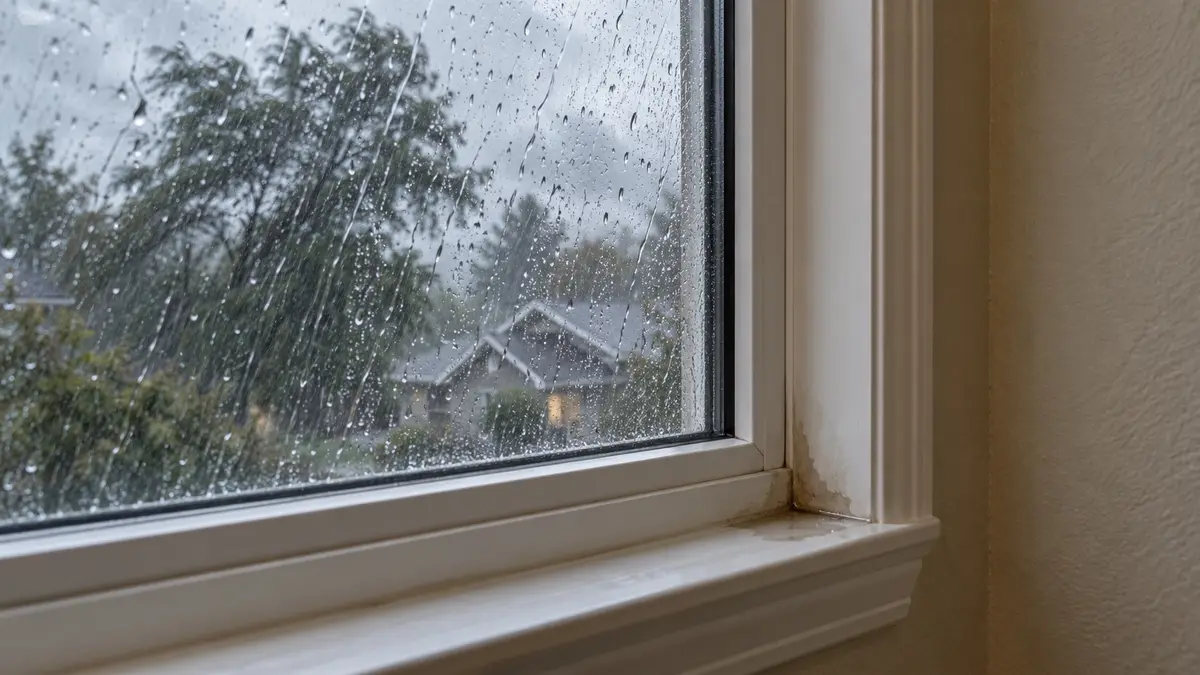
The window stays dry in an ordinary shower, then drips onto the sill when the wind swings around. That pattern is useful: wind adds pressure and changes where rain reaches the opening. It still does not tell you whether the window, its installation, or the wall above it is at fault.
There is no verified authoritative national price for finding or repairing this leak. Testing, story height, siding removal, flashing correction, and wet materials behind the wall determine the scope. Start by recording the location of the first water; it may save paying for a new window that leaves the leak path untouched.
Where does the rain first appear at the window?
Watch from inside during the next storm and photograph the first wet spot. If a wet spot approaches an outlet or light fixture, stop observing from that area. A qualified electrician should assess the electrical exposure before a window contractor traces the leak. The pattern narrows the possibilities but does not prove one cause.
| First wet spot | Likely path to investigate | Right professional |
|---|---|---|
| Top trim or window head | Flashing or wall above | Siding contractor or roofer |
| Lower frame corner | Frame joint or sill pan | Window or envelope contractor |
| Between sash and frame | Fit, lock, or weatherstrip | Window repair contractor |
| Seam between joined units | Mulled joint | Window repair contractor |
| Dry sill, wet wall below | Concealed wall or flashing path | Building-envelope contractor |
DOE’s Building America guidance lists missing or poorly lapped head, side, and sill flashing as installation errors. A drip below the opening can begin higher on the wall: water travels along framing and sheathing before it appears. A stain is a starting point for testing, not a map of the entire path.
Why does the window leak only when the wind blows from one direction?
Calm rain mostly runs downward. Building Science Corporation’s August 2011 technical digest explains that wind pressure and momentum can push rain sideways and even upward; capillary action can carry it across tight joints. The windward wall also receives more rain. An unprotected upper window may be soaked while a sheltered one on the same house remains dry.
Wind pressure can slow drainage out of a track. A sash that was not fully closed or latched may also admit water; check the lock from inside before treating the assembly as defective. FEMA’s 2023 Hurricane Ian advisory describes both latching and drainage as part of rain resistance. A directional leak means a detail needs investigation, even if it takes a severe storm to expose it.
Is track water a leak, condensation, or normal drainage?
Many windows and most sliding doors use a contain-and-drain design. Some rain crosses the outer seal, enters a sill channel, and exits outdoors through weep holes. Andersen’s care document says water may pool during heavy rain and may not drain immediately. Check your own manufacturer’s care guide; drainage layouts differ. Water overflowing onto interior flooring or entering the wall is a leak, regardless of the track design.
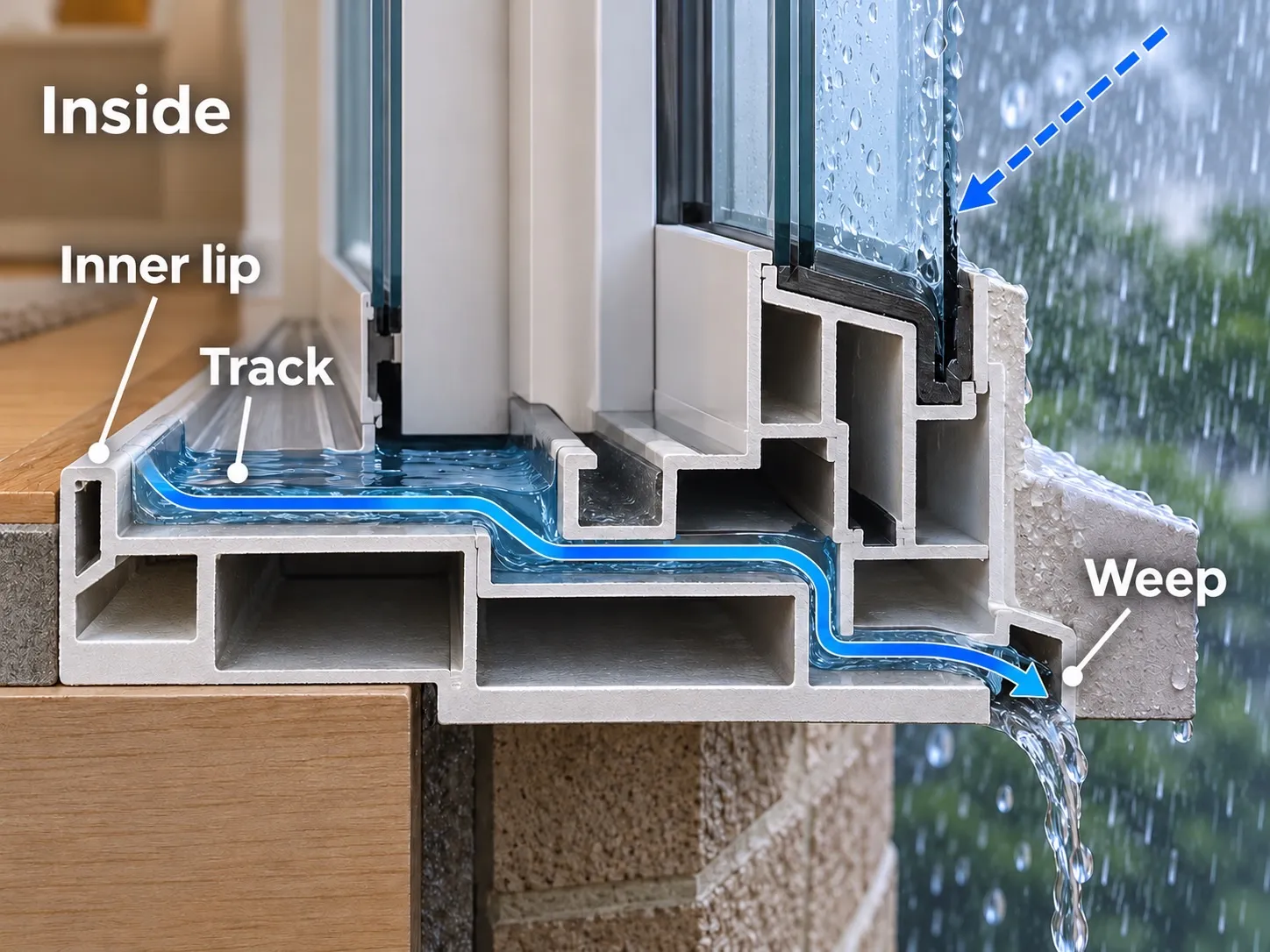
The solid arrow shows designed drainage outdoors; the dashed arrow shows incoming rain. Water crossing the interior lip needs investigation.
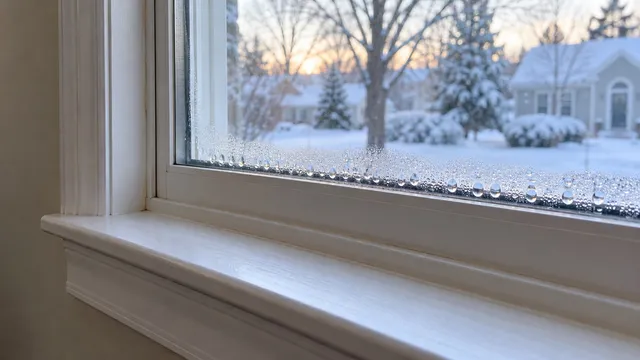
If the glass beads on a cold, rain-free morning, sort condensation from rainwater first. Fog inside the sealed glass is a separate glass-unit issue. Water far from the opening can also come from plumbing, roofing, or an HVAC drain; the storm timing and first wet location still matter.
For a reachable, ground-level window, look for debris in visible weeps and clear it gently. Do not drill new holes or caulk existing ones. Persistent pooling or water crossing the interior sill calls for a window repair contractor to check whether the channel, riser, and outlet work as the maker intended.
Is the frame or sash allowing rain inside?
Water at a meeting rail, sash edge, or frame corner can indicate a fit, weatherstrip, or frame-joint problem. Check from inside whether the sash is seated and locked. If the lock will not engage or the sash sits crooked, ask a window repair contractor to fix alignment and hardware before replacing glass or adding thicker seals. Joined windows have a mull joint between units; water along that seam deserves its own test.
FEMA observes, generally, that fixed windows and compression-seal casements or awnings resist water better than sliding or double-hung designs. That is not a rating for your specific unit. A sound window may need a gasket, sash, frame-joint, or drainage repair. A warped or damaged frame may require a broader scope. Ask the repairer to identify the entry point rather than calling all rain at a window a failed pane.
Could flashing or the wall above the window be the source?
Window flashing is the water-shedding material around an opening. It works with the wall’s drainage layer, often called the water-resistive barrier or house wrap. Each upper layer should overlap the lower layer like shingles, directing water outward. Missing corner details, reverse laps, or a sill pan that does not drain outward can send water into framing. DOE’s installation guide notes that cladding may hide damage for years.
A head-trim drip can come from flashing at the window, but also from siding, soffit, a gutter, or roof above it. Brick veneer needs special attention. The Brick Industry Association’s 2017 Technical Note 7 says heavy wind-driven rain is expected to penetrate a single outer brick layer regardless of workmanship, mainly through minute gaps between brick and mortar. Flashing at lintels and openings must collect that water and direct it out through weeps. Have a mason or building-envelope contractor assess those details; surface caulk on brick is not a substitute.
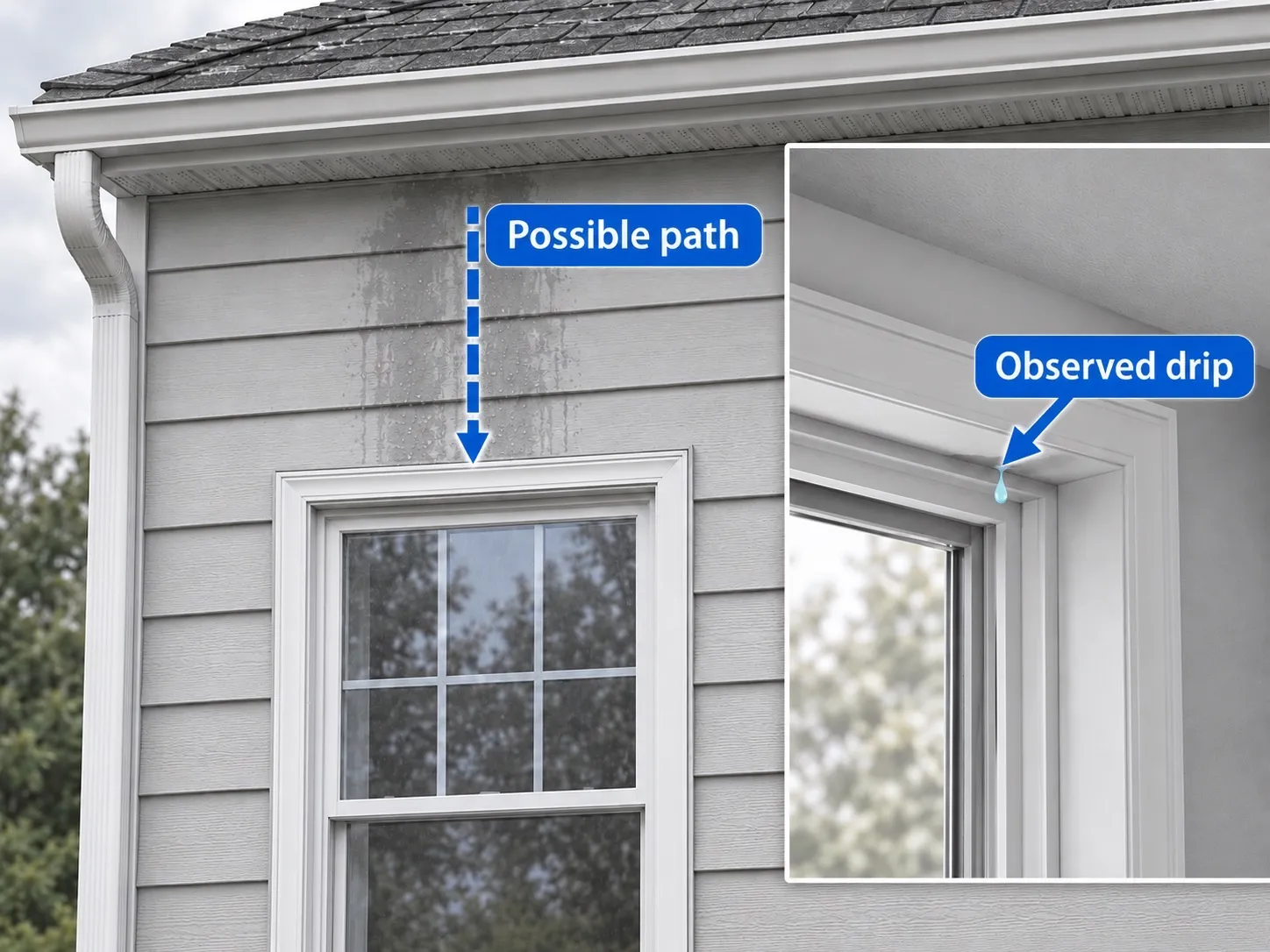
The dashed path is a possibility for a contractor to test. The visible interior drip alone does not establish where water entered.
The model IRC has called for sill pan flashing since its 2012 edition where the manufacturer supplies no alternate method, according to Fine Homebuilding’s code-change report. Adoption and amendments vary. Minnesota’s 2020 provision, for example, has exceptions for some existing-window work. Ask the local building department about the proposed repair or replacement; do not assume an older opening has a pan or that every replacement triggers the same rule.
Can a drainage failure make wind-driven rain back up?
Yes. Wind may hold water in the lower channel, while blocked weeps, a compromised sill riser, or failed pan drainage leave no reliable exit. FEMA’s advisory describes some sill risers as part of the system; removing one can change performance. A small amount of track water that drains outside after the storm fits the design. Water that remains, rises above the inner lip, or reaches the wall does not.
This is why the quote must identify the intended drain route. Ask the window contractor which openings and layers move water outward and whether the proposed repair preserves them. Caulking the entire bottom edge can trap rain behind the frame.
What can you safely check before the next storm?
Keep a log for several storms: date, wind direction, approximate rain intensity, affected window, first wet spot, and photos before wiping. Add whether the window was latched and whether the track emptied after the storm. Those notes can distinguish a one-sided exposure from a leak at every window.
From the ground, look for visibly cracked sealant, loose trim, missing-looking head metal, gutter overflow, or stains above the opening. Do not climb a ladder in a storm or remove siding. Do not hose-test an already leaking window: a rinse cannot reproduce wind pressure or establish the entry point, and more water may deepen the damage. A window or building-envelope contractor can do controlled testing when needed.
Will recaulk around the window stop it?
Recaulking a visibly failed fixed joint can be sensible maintenance after the leak path is confirmed. It will not correct a reverse flashing lap, wet wall cavity, misfit sash, or blocked drain. Building Science Corporation warns that systems relying on a perfect face seal have a high chance of failure. FEMA calls for compatible sealant and continued drainage when deteriorated joints are replaced.
Ask which joint is being sealed, what the sealant bonds to, and where water will exit if it gets behind that joint. A repeated “caulk and see” repair after several storms is a reason to seek a component-level water test. Do not seal weep holes or the sill’s designed drain path.
Do product ratings guarantee a dry window in a storm?
No. A product’s Performance Grade, or PG, includes water resistance testing under a named standard; DP is design pressure and alone does not establish the water-test pressure. FEMA’s advisory gives a 15%-of-PG water pressure under AAMA/WDMA/CSA 101/I.S.2/A440. Other test schemes differ: TAS 202 uses 15% of DP, and the Florida International University’s 2024 review for the Florida Building Commission notes 20% for the AW class under NAFS-22.
The FIU review focused on sliding glass doors and reported FEMA observations of tested products leaking in hurricanes; installation may have contributed. Lab static pressure does not recreate every gust or installed flashing detail. A rating is useful when comparing products for an exposed location, but it does not settle whether today’s leak is product failure or installation failure.
What should professional leak testing and a repair quote cover?
For a new unit, first call the installer or manufacturer service network and preserve warranty paperwork. A siding or envelope contractor handles wall integration; a mason handles brick lintel and veneer drainage; a roofer handles water entering above. For a disputed leak, seek a consultant who specializes in building-envelope diagnosis.
Ask the tester to isolate the sash, frame corners, track, head, and window-to-wall joint one at a time. FGIA guidance summarized by Door and Window Market distinguishes AAMA 502 testing of new installations from AAMA 511 forensic work on known leaks. Excess pressure can create a leak that would not occur in service. The contractor should explain what test pressure and sequence fit this window, not blast everything at once. If the frame is sound but the opening needs broader work, compare inserts and full-frame replacement before selecting a unit.
No reliable authoritative cost range exists for this combination of diagnosis and repair. An estimate should separate testing, access equipment, trim or siding removal and matching, flashing materials and method, sealant, rot allowances, interior restoration, disposal, and any permit required locally. Ask whether the proposed window replacement leaves existing flashing in place. If nobody can say where water entered, a second diagnostic opinion is more valuable than a second guess at caulk.
How fast should you act on hidden damage?
Dry accessible wet material promptly. EPA guidance says drying within 24–48 hours prevents mold in most cases, and advises professional help for extensive water damage or mold above about 10 square feet. That figure is cleanup guidance, not a legal cutoff. Avoid opening a saturated wall yourself; have a water-damage professional assess it and a window or envelope contractor stop the entry.
Soft trim, peeling paint, swelling, and a musty wall suggest the leak has been active longer than one storm. FEMA says repeated water intrusion can cause rot and fastener corrosion. It does not mean one wet sill has structurally failed. Have a qualified contractor inspect concealed materials before they are covered again.
Will insurance pay for a wind-driven rain leak?
Maybe; the policy wording and event matter. California’s Department of Insurance says homeowners policies can cover wind-driven rain damage in a storm. A 2005 Texas regulator notice described a TWIA form that excluded rain unless wind or hail first made an opening in roof or wall. That dated example is not a description of your current policy.
Photograph the exterior and interior condition, keep storm dates and repair invoices, and read your complete form before asking the insurer how it applies. Coverage for a water leak depends on cause and timeline. Arrange drying and diagnosis without assuming either coverage or exclusion.
Frequently asked questions
Is it normal for water to sit in my window track after a storm?
Yes, briefly, in many contain-and-drain windows. Check your manufacturer’s care guide and whether the water exits outdoors. Overflow into the room or persistent pooling calls for a window repair contractor.
Why does my window leak only when wind blows from one direction?
That wall receives more driven rain, and pressure can force water across small gaps or slow track drainage. Record the wind direction and first wet location so a contractor can test the relevant side of the opening.
My new windows leak in heavy wind. Is that a product or installation defect?
Either is possible. Ask the installer or manufacturer service team to test the sash, unit joints, and wall flashing separately, and review the installation and warranty documents before agreeing to replacement.
Can I just caulk around the outside of the window?
Only a confirmed, failed fixed joint is a candidate for sealant maintenance. Caulk cannot repair hidden flashing, and sealing weeps traps water. Repeated leaks call for a building-envelope contractor to trace the path.
How can I tell a window leak from condensation?
Water on room-side glass after a cold night points toward condensation; wet trim or wall after rain points toward a leak. Keep a weather and humidity log, then use the inside-window water guide for the overlap cases.
Will homeowners insurance cover water that came through during a storm?
It depends on your policy’s covered causes and exclusions. Document the storm and ask your insurer about the specific form; a rain leak without a wind-created opening may be treated differently under some policies.
Sources
- FEMA — Reducing Water Intrusion Through Windows and Doors
- Florida International University — Reviewing Standards for Wind-Driven Rain Intrusion
- DOE Building America — Windows and Doors are Fully Flashed
- Building Science Corporation — BSD-013: Rain Control in Buildings
- Brick Industry Association — Technical Note 7
- Minnesota Residential Code — Pan Flashing of Windows and Doors
- Fine Homebuilding — 2012 IRC Codifies Window and Door Pan Flashings
- Door and Window Market — FGIA Explains AAMA Resources
- Andersen — Important Product, Care, and Maintenance Information
- U.S. EPA — A Brief Guide to Mold, Moisture and Your Home
- Texas Department of Insurance — TWIA Adopted Rule Notice
- California Department of Insurance — Winter Storm Coverage Alert