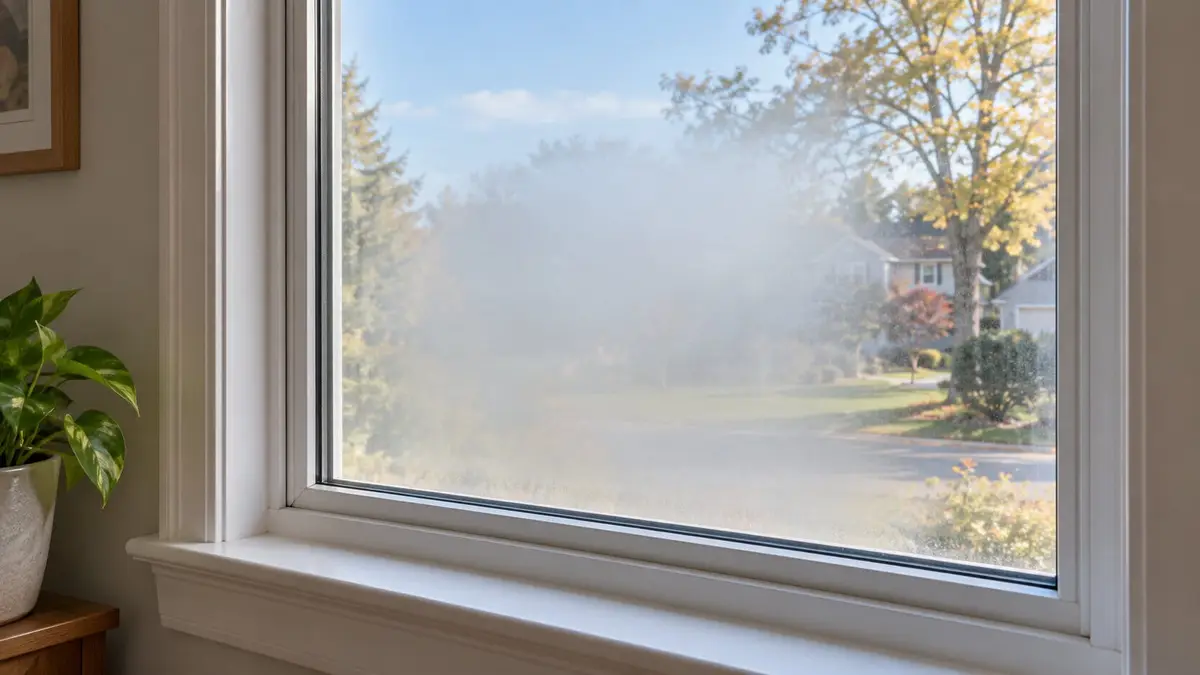
One window has a cloudy band that appears on cold mornings and sometimes disappears by lunch. Another has a milky film all day. Before paying for a new window, find out where the moisture sits and whether the frame still works.
No reliable independent national range for replacing an insulated glass unit is available. Compare two or three itemized local bids for glass, a sash (the frame holding the glass), and full-window work, including any warranty-supplied parts.
Is the fog really between the window panes?
First, look for cracked or bowing glass. Leave either condition alone, stay clear, and call a residential glazier. For apparently intact, reachable glass, use the Cardinal IG bulletin’s simplest distinction: clean the indoor and outdoor surfaces before treating haze as trapped moisture. Wipe the indoor face first. Wipe the outdoor face only from stable ground or a safe interior position; do not climb a ladder or lean out. If the mark moves with a wipe, it was on that surface. If both reachable faces are clear and the mark remains, ask the glazier to confirm it is in the sealed airspace. Leave a window you cannot safely reach to the glazier.
| What you see | Likely reading | Glass replacement? |
|---|---|---|
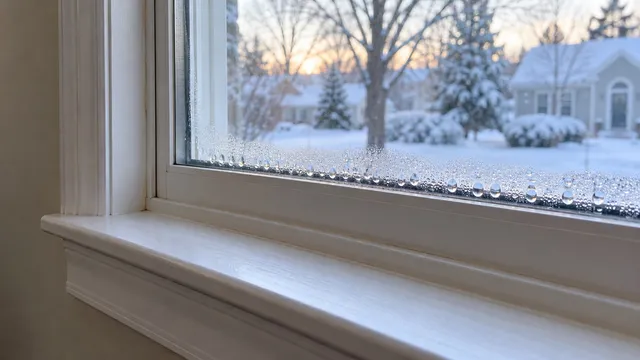
| Room-side droplets, often at the bottom in winter | Indoor humidity meeting cold glass | No, not for this symptom |
| Outside dew or frost on a clear, still morning | Outdoor condensation on insulating glass | No, not for this symptom |
| Haze that comes and goes between clean faces | Moisture in the sealed airspace | Document and ask a glazier |
| Persistent white film or streaks between faces | Deposits after repeated airspace condensation | Ask about a new sealed unit or sash |
| Ring near the center of the unit | Panes may be touching | Ask the maker or glazier to assess |
Cardinal says room-side sweating and ordinary outdoor dew are not reasons to replace the glass. It recommends replacing glass units when condensation is evident in the airspace; after a glazier confirms that finding, choose an IGU or factory sash based on the assembly’s condition. A dry-looking film trapped in the unit cannot be cleaned from your side. A small pane crack can admit moisture too; do not press on the glass to investigate it.
Why does sealed glass fog, sometimes years after a seal problem begins?
An insulated glass unit, or IGU, is a factory-sealed package of two or three panes. A spacer separates them, its desiccant absorbs moisture, and perimeter seals enclose an airspace that may contain argon or krypton gas. Moisture entering that space may remain invisible until the desiccant is overwhelmed and cold glass lets it condense. The familiar fog is therefore often a late visible sign, not the moment the problem began.
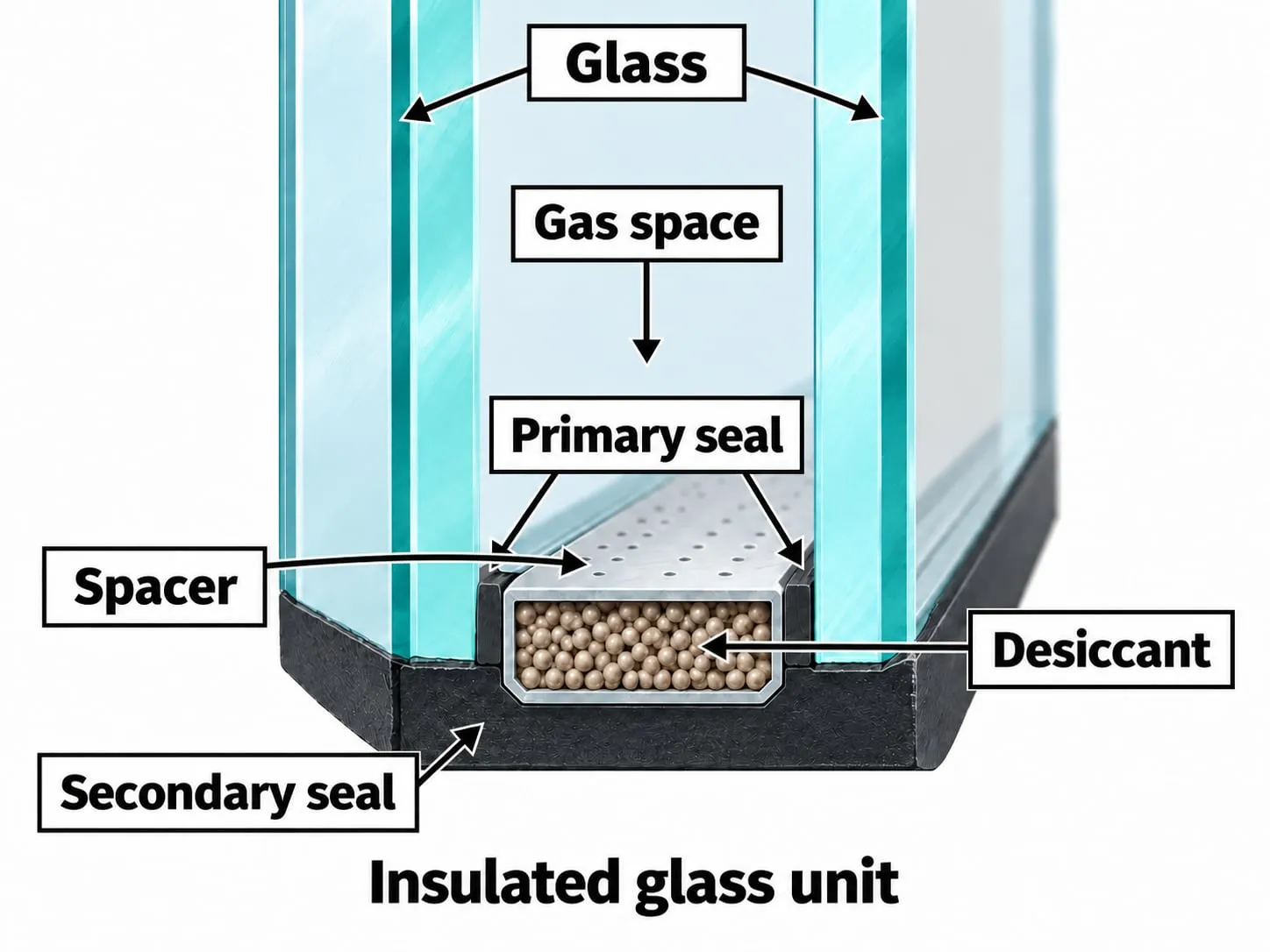
Building-envelope engineer Michael Louis explains that fogging from a seal breach is permanent and irreversible, while slow moisture diffusion can cause intermittent episodes. He cites the industry definition of failure as a permanent material obstruction of vision. Home inspector Reuben Saltzman describes progression from invisible failure to occasional condensation and then permanent mineral haze. A clean home-inspection report cannot establish that every seal was intact; early failure may be invisible.
Manufacturing defects, a small glass crack, and pressure differences at altitude are documented possibilities. There is no reliable rule that all IGU seals fail after a fixed number of years. A 2023 NREL-authored literature review reports Lingnell’s 1980–2005 field study of more than 2,400 IGUs and its 9.2% cumulative failure rate at 25 years. That study has a particular sample and period; it is not a forecast for your window.
Is fogged window glass urgent, and will it raise energy bills?
Fog usually matters first because it blocks the view. A failed seal can also reduce the insulating value of that unit. The NREL-authored review reports Asphaug and colleagues’ research in which gas loss raised an IGU’s U-factor, a measure of heat flow, by up to 32%. That is a unit-level result, not a 32% increase in a home’s energy bill. Asphaug and colleagues also modeled up to 1.3 MWh of extra heating demand for a single-family home over 20 years under their assumptions.
Normal gas loss is a different process and scale. The National Fenestration Rating Council consumer guide says efficient windows lose about 0.5% of their gas fill annually and retain roughly 90% of original performance after 20 years. Saltzman’s inspection perspective is that fogged glass will not cause enormous household bills. It is sensible to fix a failed unit when visibility, comfort, or warranty value warrants it, without accepting an unsupported dollar-savings promise.
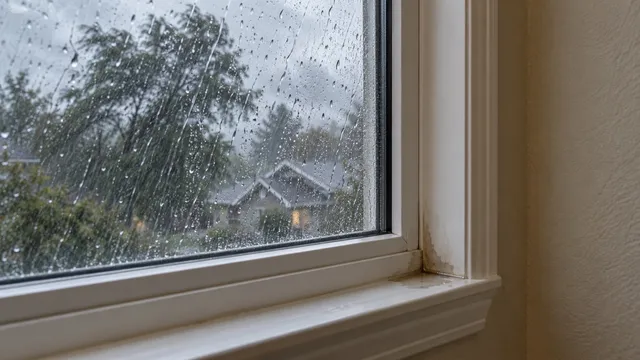
Fog trapped between panes does not itself wet the wall or prove mold is growing in the house. If water is on the sill or wall, have a window contractor investigate a separate leak or room-side condensation issue. A cracked or bowing pane, particularly near a door, tub, or stairs, deserves prompt glazier assessment. Otherwise, documenting the fog and comparing several units in one order can be a reasonable planning choice.
Check the glass warranty before paying for a repair
Photograph the fog on the days it appears, record the date, and capture any code you can see without removing trim or glass. Marvin’s product-identification guide says its post-November-2003 products have a glass-corner etch with serial and NFRC numbers; older units may show its name and a two-digit year on the spacer. Other brands vary. Keep the purchase, builder, and installer papers if available.
Read your own glass clause, not a generic “20-year window warranty” claim. For example, the Andersen 200/400 Series warranty revised May 7, 2019 covers a material obstruction of vision from premature seal failure for 20 years and is transferable. Andersen chooses among replacement parts without installation labor, factory-authorized repair at no cost to you, or a refund; the labor exclusion applies to the replacement-parts remedy, not every remedy. That 20-year glass provision excludes impact-resistant glass, art glass, between-glass blinds, and glass not factory installed by Andersen; separate terms may apply to some specialty products. An unclear claim may carry an inspection fee that is waived if covered. The 2017 Pella vinyl warranty gives transferable 20-year nonlaminated glass-seal coverage, with labor for two years. It gives laminated glass ten years and sealed blinds five years, and lists glass breakage, high indoor humidity, and unapproved modifications among exclusions.
Those are examples of specific product documents. Coverage can change with product line, purchase year, installation, and glass type. Ask the maker or dealer what remedy it offers, what part it supplies, who pays for the visit and installation, and whether an earlier film or defogging modification affects the claim. Intermittent fog may not yet meet a permanent-obstruction definition, but dated photos preserve the record if it worsens.
Can you replace the glass without replacing the whole window?
Yes, often, once a glazier confirms that the sealed unit is the failed part and the sash and outer frame are sound. There are three distinct quotes to consider:
| Option | Scope | Problems left unresolved |
|---|---|---|
| New IGU | Replaces factory-sealed glass package and edge seals; keeps sash and outer frame | Drafts, rot, hardware, frame leaks |
| Factory sash | Replaces glass and sash together; keeps outer frame | Frame rot, frame leaks, surrounding damage |
| Whole window | Replaces window assembly; keeps opening and surrounding structure if sound | Hidden wall damage unless included |
A residential glazier can measure and order a new IGU for a sash that can be reglazed. This Old House recommends professional IGU work and describes a factory sash with glass as another route. Andersen sells complete replacement sashes by unit size and glass package. Availability is model-specific. Ask whether the existing sash can be reglazed and whether a factory sash can be sourced before concluding the entire window must go.
New glass also needs a specification. Ask whether its low-E coating (a thin coating that reduces heat transfer), gas fill, spacer, grille pattern, tint, and thickness will match nearby units. A custom unit takes measuring and manufacturing time; the quote should state the lead time. Handling a large sealed unit involves sharp, heavy glass and precise setting, so leave removal and installation to a glazier.
When is glass-only replacement the wrong choice?
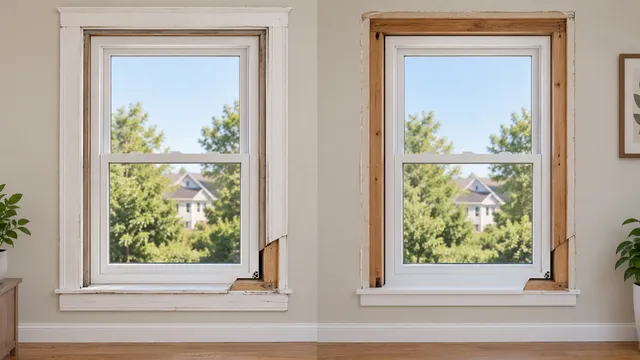
Inspect from a safe position for peeling or water-stained frame material, gaps, a sash that no longer closes squarely, or a soft wood sill. Those signs call for a qualified window contractor to check the frame and surrounding wall. Fog alone is not evidence that every window in the house must be replaced; frame failure or a broader performance or style change can make a full-window quote worthwhile.
A new IGU does not cure a draft through weatherstripping, a failed sash balance, a lock that will not engage, or rainwater entering around the frame. Some sash constructions may also be impractical to reglaze in the field. Ask the glazier why and whether a factory sash is an option. Specialty glass, unusual shapes, and integrated blinds may narrow choices or alter warranty coverage. If wall stains or rot are present, have the window and surrounding wall assessed by a qualified contractor before ordering glass.
What does a window “defogging” service actually fix?
This Old House describes defogging as drilling the glass, cleaning and drying the airspace, then sealing the holes. The process may improve appearance, but it does not rebuild the original perimeter seal or restore the gas fill. Moisture may return. A homeowner with an out-of-warranty unit might still choose it for appearance, while accepting those limits.
Check coverage first: Pella’s cited warranty excludes unapproved alterations and modifications, so drilling may affect a remaining claim. Ask any provider to explain the expected visual result, exclusions, and written warranty without relying on a promised universal durability period.
Does the replacement need safety glass?
It may. The model International Residential Code identifies hazardous glazing locations such as doors, glass close to doors, large low panes near walking surfaces, and glass by tubs, showers, stairs, and landings. Washington-area building departments’ 2024 tip sheet explains the 2021 IRC requirements with Washington amendments, including permanent labeling. Local jurisdictions adopt and change model rules; ask your glazier and building department what applies to this opening and replacement.
Look for a permanent corner etch on the old glass. If it indicates tempered safety glass, tell the glazier and request a compliant replacement specification. An absent mark on an older window is not proof ordinary glass is allowed now. Tempered or laminated safety glass can change the price and lead time, especially in a specialty unit. Do not order ordinary glass for a door sidelight or tub window on the strength of a generic quote.
What should a fogged-window repair quote include?
There is no verified independent national IGU-replacement price to rely on. One Andersen parts listing showed a 400 Series replacement sash at $366.89 in September 2026, parts only; that single catalog example will change and says nothing about installed cost. Request two or three itemized glass quotes and, when frame condition warrants, a comparable full-window quote.
Ask each bidder to identify the unit size, double or triple pane, glass thickness, low-E type, gas fill, spacer, grilles, safety or impact specification, and expected match with adjacent windows. The scope should separate IGU or factory-sash parts from labor; measure and trip charges; removal and disposal; upper-floor access equipment; trim or paint touch-up; taxes where applicable; lead time; and warranty on both parts and labor. Verify whether the manufacturer supplies a warranted part while you pay labor.
A price that omits the glass package is hard to compare. So is a full-window quote that includes wall work beside a glass quote that excludes it. Ask the glazier what condition would switch the recommendation from IGU to sash or whole window, then compare installed totals on equal terms.
Do climate and location change the glass order?
Yes, sometimes. Winter makes both trapped airspace condensation and ordinary room-side sweating easier to notice, so repeat the safe wipe check before ordering. For a high-elevation home, Cardinal’s capillary-tube bulletin explains that a unit made at low altitude and installed high can bow under the pressure difference. Its tubing guidance is for dry, high-altitude settings; tell the glazier the installation elevation so the replacement is specified appropriately.
In hurricane-prone or coastal areas, impact-resistant or laminated glass may have different warranty terms, and local product-approval rules may affect what can be installed. Ask the glazier and local building department about the actual opening; do not assume glass-only replacement is accepted for a particular impact-rated assembly. The useful next step is a measured glass specification that fits your climate, location, and warranty—not a generic “same glass” line on an estimate.
Frequently asked questions
If only one pane in a triple-pane window is fogged, does the whole glass unit have to be replaced?
Usually the sealed IGU is replaced as one package. The panes, spacer, and seals form a factory assembly, so a glazier should assess whether that unit or a complete factory sash is available. Ask for the new triple-pane specification, not a quote for one loose pane.
Will replacing the fogged glass fix my drafty window too?
No. An IGU replacement addresses the sealed glass package. Ask a window contractor to check sash fit, weatherstripping, and frame condition separately; a glass-only quote should not promise to cure an air leak it has not diagnosed.
My home inspection didn’t mention fogged windows. Can seals still be failing?
Yes. As Saltzman explains, an early failure may have no visible fog, and inspection standards do not require every failed seal to be reported. Photograph any fog that appears now and ask a glazier to assess it.
Does fog between the panes mean mold is growing inside the window?
No such conclusion follows from fog alone. Moisture and deposits inside the sealed airspace are not proof of mold or of a health problem in the room. Water on the sill or wall is a separate symptom that a window contractor should investigate.
Can new glass units be made to match the tint and look of my other windows?
Often a glazier can specify a close match, but an exact match is not guaranteed across older coatings or discontinued glass packages. Ask for the proposed low-E, tint, grille, and spacer details and view a sample if the side-by-side appearance matters.
Is a failed window seal covered by homeowners insurance?
Coverage depends on your policy and the cause of loss. Ask your insurer whether gradual seal deterioration is excluded as wear and whether a covered event caused the damage. A manufacturer glass warranty is the more direct document to check first.
Sources
- Cardinal IG — Insulating Glass Condensation
- Simpson Gumpertz & Heger — When Is Insulating Glass Fogging Not Considered Failure?
- Structure Tech — Failed Window Seals vs. Fogged Glass
- NREL authors — Degradation of Insulating Glass Units
- National Fenestration Rating Council — Gas Fills
- Marvin — How to Identify a Marvin Window or Door
- Andersen — 400 and 200 Series Limited Warranty
- Pella — Vinyl Window and Patio Door Limited Warranty
- This Old House — How To Repair Fogged Windows in Your Home
- Andersen — 400 Series Tilt-Wash Double-Hung Window Sash
- MyBuildingPermit.com — Safety Glazing
- Cardinal IG — Capillary Tubes and Breather Tubes