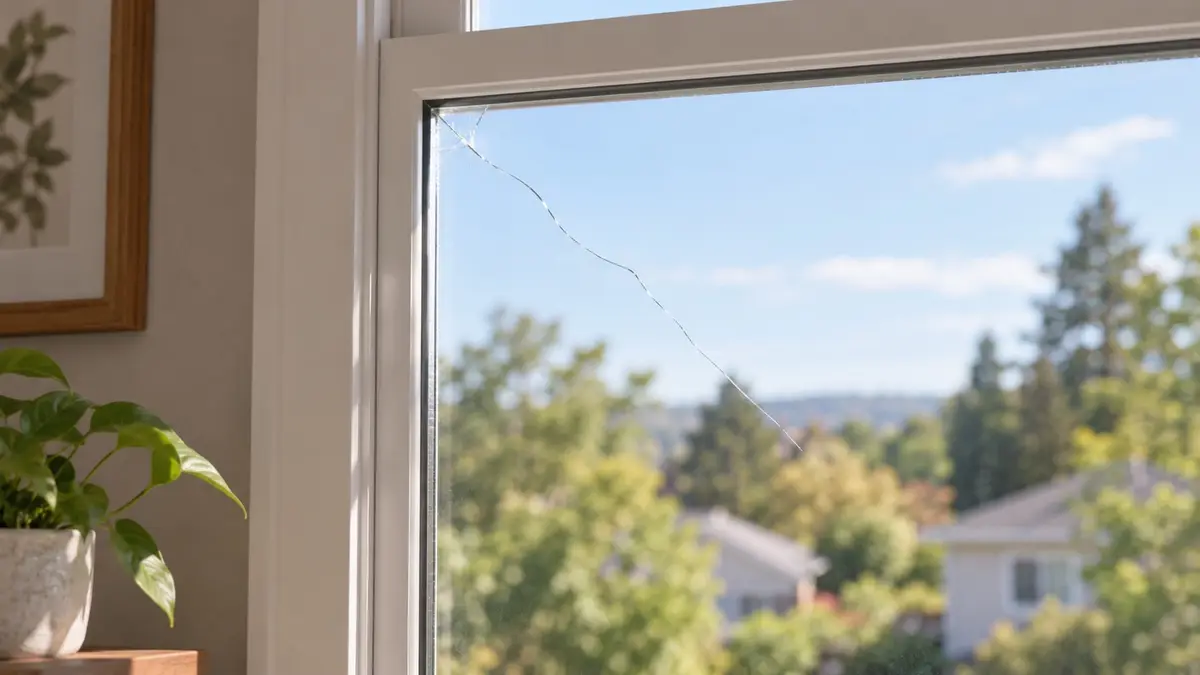
You find a thin crack at the edge of a bedroom window. There is no ball, stone, or impact mark in sight. Before deciding that the weather or the manufacturer is responsible, preserve what the glass can still tell you.
Size, pane count, glass type, access, and local labor shape the repair price. There is no authoritative national price for your opening; an August 2025 Fixr estimate puts window-glass replacement around $300–$880, but it is an aggregator range and may omit work your job needs. Ask for a local itemized quote.
Is a cracked window pane safe to leave for now?
A narrow crack in one pane of an otherwise intact sealed window usually calls for a scheduled glass repair. It is not permission to keep using that sash: Quaker Windows’ January 14, 2016 Q&A says cracks can worsen over time and glass should be replaced. No reliable source gives a timetable for growth.
Call a residential glazier promptly if pieces are loose or sharp, the pane has shifted, or the whole pane has crazed into small fragments while still in the frame. A door, sidelight, or opening within a child’s reach also raises the urgency. If weather or entry can pass through, have the glazier arrange a safe temporary board-up. Do not remove remaining glass yourself, press tape onto a crack, or work from a ladder at an upper-floor window.
While you wait, keep people and pets away and leave the sash still. Photograph the condition from a safe distance before anyone clears it.
What does the crack pattern suggest?
Start with a whole-window photo, then a closer photo of the point where the line appears to begin. Trim may cover the true glass edge. The pattern is a clue for a glazier, not a diagnosis you can make from a photo alone. Cardinal’s December 2020 insulating-glass bulletin separates impact, thermal, bending, pressure, and tempered-glass breakage.
| Visible pattern | What it can point toward | What else to record |
|---|---|---|
| Starts near edge, short straight section, then turns | Thermal stress | Shade line, glass type, recent sun and cold |
| Tiny pit with lines radiating outward | Small impact | Outdoor work, mowing, storm debris |
| Curved or roughly hourglass lines in sealed unit | Pressure difference | High elevation, reflected bowing |
| Break after forcing a partly locked sash | Bending or racking | Which lock was engaged, where sash bound |
| Whole pane in small fragments | Tempered-glass breakage | Etched glass mark, nearby debris; leave cause to glazier |
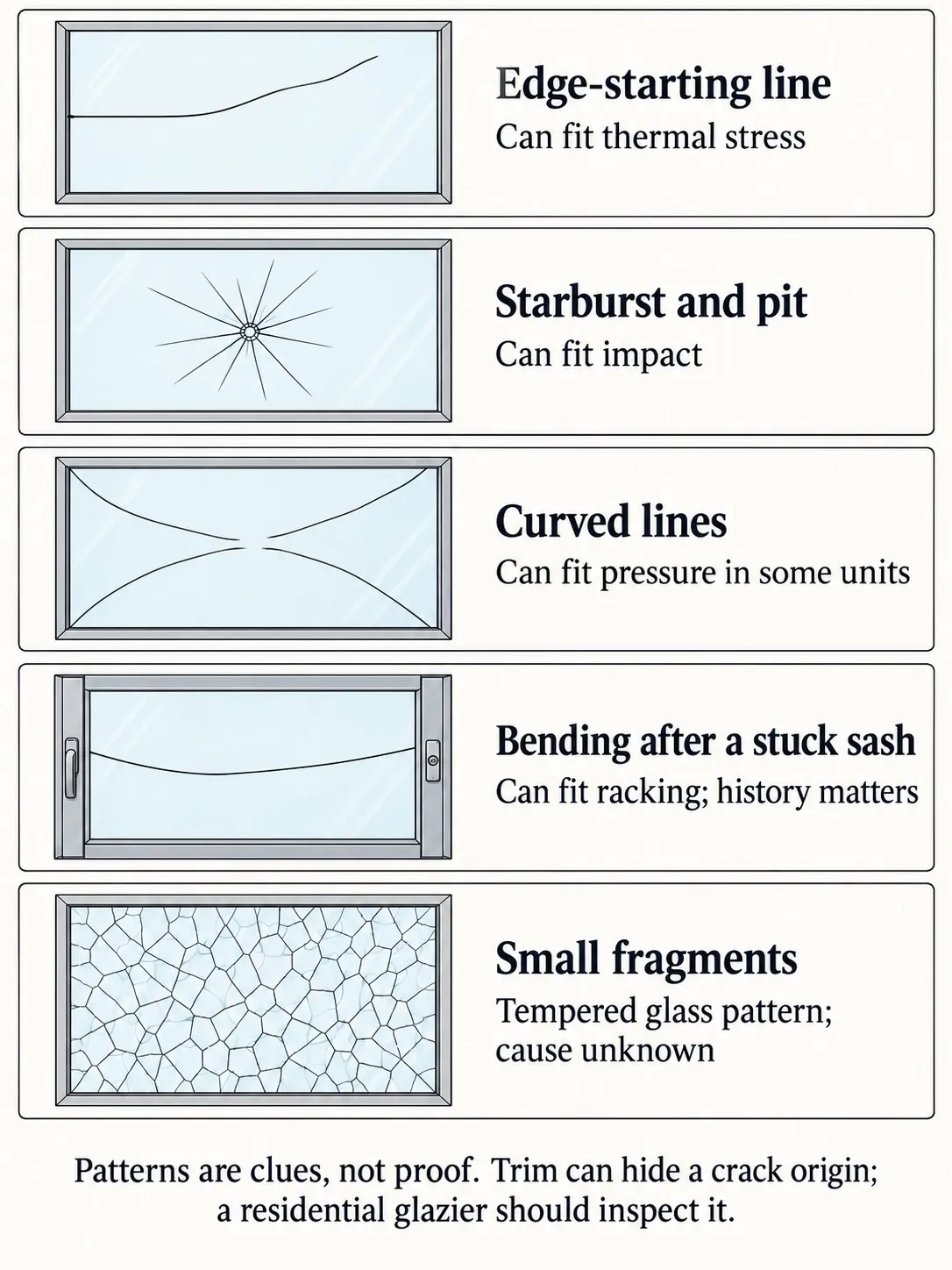
Patterns and the history of the break help a residential glazier investigate; a pattern alone does not prove the cause.
Viridian’s technical guide describes a thermal break starting square to the glass edge with a short straight run before bending or branching. Pella’s April 2017 explanation describes a starburst around an impact point and an hourglass-like pressure pattern in some dual-pane units. These forms overlap in real glass, and the origin may be hidden under the stop. Ask a glazier to examine the edge before it is discarded.
Which pane cracked: outdoor, indoor, or middle?
Look from safely reachable sides without touching the glass. In a double-pane window, try to tell whether the cracked sheet faces outdoors or the room. An outdoor crack invites a check for a tiny impact pit from mowing, trimming, storm debris, or nearby work. On the indoor pane, note blinds close against sunny glass, a heating register, or room-side film. These are clues, not exclusive causes.
A triple-pane unit has a middle sheet you cannot reach. Cardinal’s August 2022 thermal modeling shows that the center pane can face elevated thermal stress with certain coating placements. A residential glazier can confirm which sheet failed and specify a matching replacement. In double- or triple-pane windows, the sheets form one factory-sealed insulated glass unit, or IGU. Replacing the cracked sheet usually means replacing that sealed unit, while keeping a sound sash and outer frame. See how sealed-glass replacement differs from a full new window.
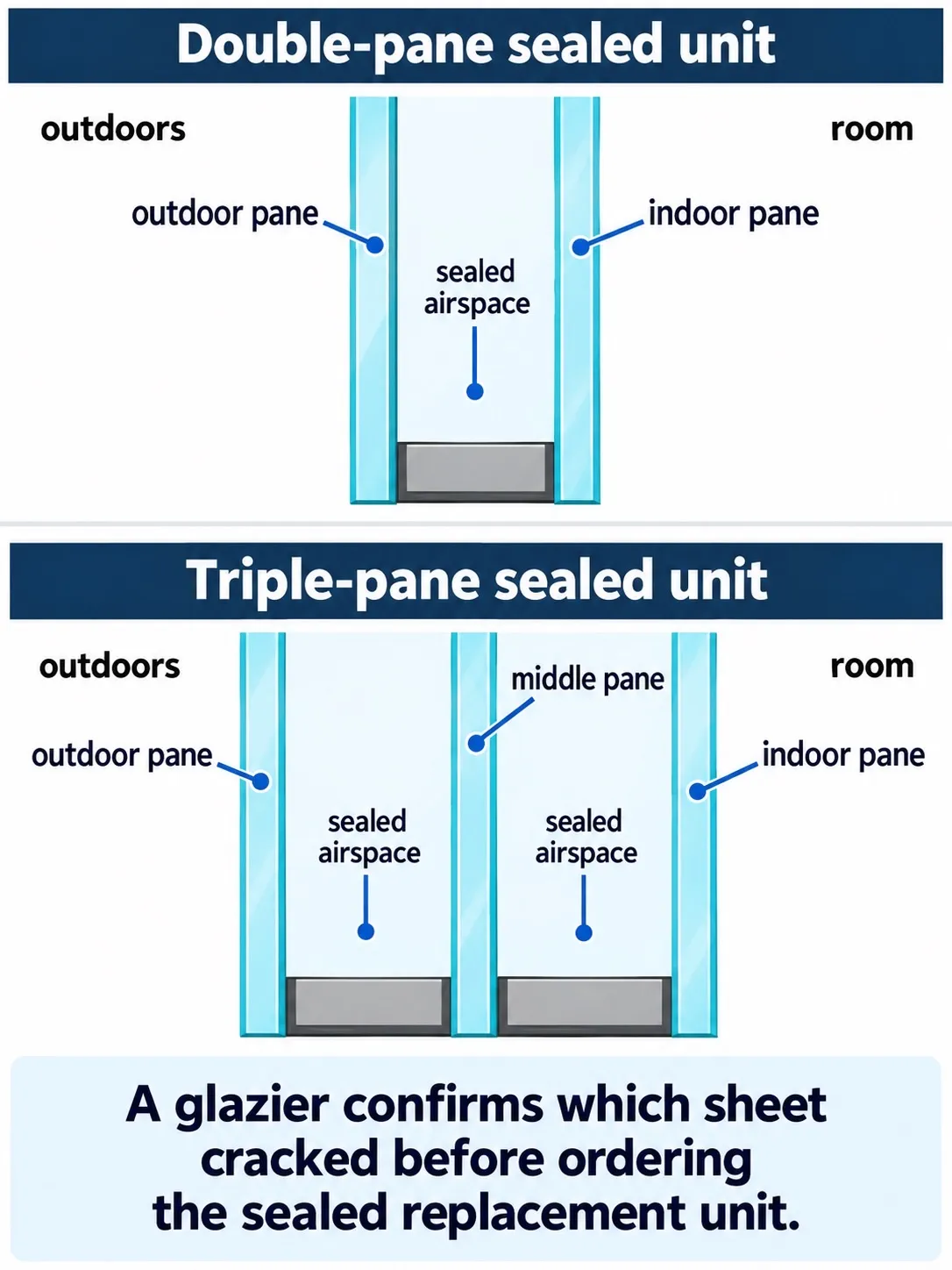
The pane position is part of identifying the replacement sealed unit.
Note whether nearby panes have fog between them as well as the crack. That might change the order or warranty discussion, but it does not prove the crack’s cause.
How does thermal stress crack a window?
Sun can heat the exposed center of a pane while the edge remains cooler inside the frame. The center expands, pulling at the edge until a weak point breaks. Vitro’s glass guidance explains that mechanism and names partial shading, tightly placed coverings, heating registers, and absorbing glass as contributors. Cardinal describes a severe condition as a shaded frame on a sunny cold day.
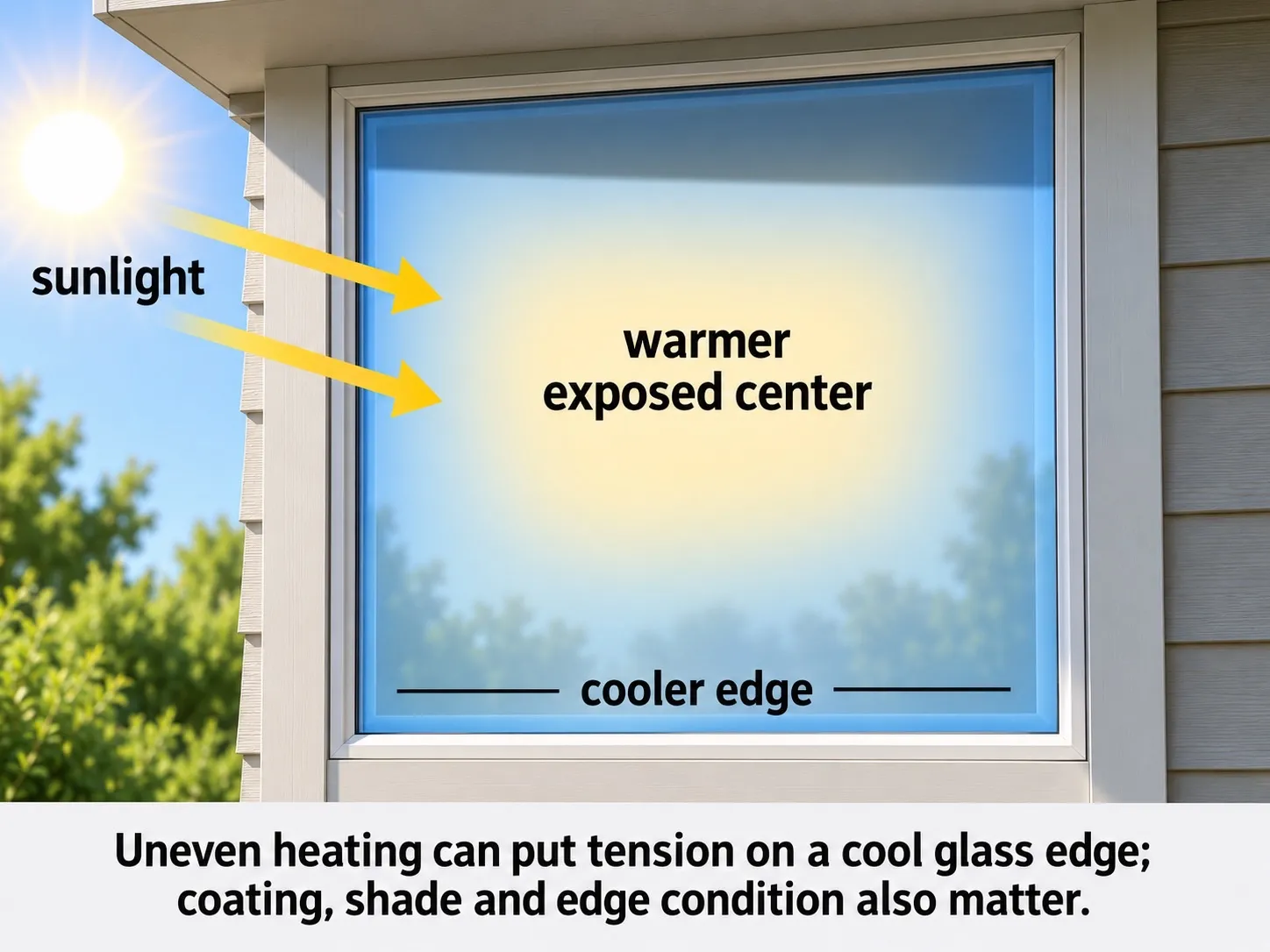
This illustrates uneven heating, not a prediction that the pictured window will crack.
Walk around the unchanged window and note where shadow falls at different times: an eave, porch, awning, tree, or another building may shade only part of the pane. Morning sun after a cold night can matter, particularly on east-facing glass in Viridian’s discussion. Pella says its stress-crack calls rise in spring and fall; that is its service experience, not a frequency estimate for all windows. Record a recent change such as a removed tree or new neighboring structure.
Risk rises with absorbing tint or some low-E coating arrangements, partial shading, and edge flaws. Glass makers do not agree that ordinary clear glass faces the same risk as absorbing glass. Viridian considers clear-glass thermal breaks unlikely without serious edge damage; Pella sees seasonal stress cracks in its residential service calls. That is why a single sunny day, by itself, is weak evidence. Ask the glazier about coating position and the edge condition.
If you recently added film, save the invoice and packaging. The International Window Film Association says film can affect thermal stress by increasing absorbed sunlight. Film makers publish compatibility guidance for installers. Ask the installer which film-to-glass check was used before accepting another film recommendation. Do not add tint as a blanket way to prevent cracking; absorbing tints can increase the risk. For the broader comfort choice, see film, shades, and new glass for an overheated room.
Could a hidden impact or binding sash be responsible?
Yes. Cardinal says mower-thrown stones, debris, and tools are usual explanations when tempered glass breaks, even when no one sees the moment of impact. Look for a tiny pit at the apparent origin from a safe distance. An exterior pane near a lawn or after a storm deserves particular attention. A clear storm event may also matter when you speak to your insurer. If hail was involved, see when a roof inspection is worthwhile even without a leak.
Cardinal also illustrates bending breakage when a casement is opened with one lock still engaged. Quaker lists slamming and house settling as possible contributors. Frame movement, edge damage, or glass touching a frame component are other possibilities a glazier can investigate; they are not things to identify by prying the glass out. If the sash also won’t close or lock properly, ask a window installer to diagnose the binding before the new glass goes in.
A repeat crack in the same opening deserves more than another glass order. Have the glazier inspect the edge and glazing supports, and have the installer check sash and frame operation. A finding such as a missing gasket must come from that inspection, not from the crack’s shape alone.
Does high altitude change the explanation?
Sometimes. A sealed unit manufactured at one air pressure and installed at much higher elevation can bow outward as outside pressure drops. Cardinal’s August 2020 capillary-tube bulletin says enough pressure difference can fracture glass or damage a seal. It calls pressure breakage uncommon in its breakage bulletin. A bowed reflection and a mountain-state installation are reasons to mention elevation to the glazier; a low-elevation home can usually put this lower on the list.
The supplier may specify a unit built for high elevation or a capillary tube to equalize pressure. Cardinal says capillary tubes are for high-altitude applications and allow argon to escape. Ask the supplier how the replacement is specified and what insulation trade-off follows. Do not open, plug, or alter any tube yourself.
What if tempered glass shattered without warning?
Tempered glass breaks into small pieces. Heat treatment greatly reduces thermal-break risk, according to Cardinal and Vitro, so a pane that suddenly crazes may have suffered an unnoticed impact, edge damage, or contact with the frame. Vitro calls nickel-sulfide inclusion an extremely rare, tempered-only cause. A homeowner cannot confirm it by looking at fragments.
Keep people clear and let a residential glazier remove the remaining pieces and secure the opening. Ask the shop to confirm glass type before ordering. Local code may require tempered or laminated safety glass in some window locations; your glass shop or building department can confirm. Do not assume the replacement can be ordinary glass because the old pane’s mark is hard to read.
Who should see the evidence before replacement?
Take a wide photo of the room and window, close photos of the apparent origin and both safe-to-view sides, and images of nearby shade, blinds, vent, or film. Record the date, recent weather, direction the window faces, any nearby mowing or work, and whether the sash binds. Find the invoice, label, or etched maker mark without removing stops. Then choose the first call:
- Recent film: Preserve the film invoice and ask the installer to explain its compatibility assessment.
- Possibly in-warranty window: Ask the maker or dealer to document the crack and review the written glass-breakage terms. Quaker’s January 14, 2016 Q&A described one-year stress-crack coverage; check current written terms for your product.
- Clear storm, hail, vandalism, or accident: Read your insurance policy and ask the insurer how it treats the event. Compare the estimate with your deductible.
- No responsible party identified: Ask a residential glass shop for an inspection and itemized replacement quote.
Insurance is policy-specific. An October 2014 Oklahoma-filed CSAA policy form shows glass-breakage wording alongside exclusions for wear, latent defects, and settling. That example cannot predict how your insurer will treat a thermal crack. Ask for the applicable provision and keep the photos before removal.
Can the glass be replaced without a whole new window?
Often, if the sash and frame are sound. An older single-glazed sash may accept a new pane; a sealed double- or triple-pane window usually needs a new IGU. A manufacturer may instead supply a complete sash. Full window replacement earns consideration when the sash, outer frame, or operation is damaged too. See how frame condition changes insert versus full-frame replacement before approving that larger scope.
Ask the glazier to specify size, pane count, low-E or tint, gas fill, grilles, safety-glazing type if needed, labor, access equipment, temporary board-up, disposal, trim or stop refinishing, lead time, and glass and labor warranties. Upper-story access, custom glass, and high-altitude construction can change the price. An itemized bid lets you compare the actual repair instead of a generic per-pane number.
To reduce a repeat in the same opening, ask whether heat-strengthened or tempered replacement glass suits the location; makers say heat treatment greatly reduces thermal-break risk. Leave room-side coverings off the glass in strong sun, redirect a register blowing at it, and fix sash binding. Ask a film installer to document compatibility before adding film. A residential glazier should confirm which of those changes addresses this opening’s actual risk.
Frequently asked questions
Does a cracked outer pane reduce a double-pane window’s insulation?
Yes. Quaker says cracked glass causes energy loss, though it gives no bill estimate for your window. Ask a residential glazier to specify a matched sealed replacement unit.
Why did two windows on one side crack in the same season?
Shared sun and shade patterns, glass specifications, or installation details are possibilities. Similar timing alone does not prove a cause; ask the glazier to compare crack origins, coatings, and frame conditions in both openings.
Sources
- Cardinal IG — Insulating Glass Breakage
- Cardinal IG — Thermal Breakage Prediction
- Cardinal IG — Capillary Tubes & Breather Tubes
- Vitro — Managing Thermal Stress Breakage
- Vitro — Nickel Sulfide and Spontaneous Breakage
- Viridian — Thermal Stress & Glass Strength
- Pella — Why Did My New Window Crack?
- Quaker Windows & Doors — Stress Cracks Questions & Answers
- International Window Film Association — FAQ
- CSAA General Insurance — Oklahoma Homeowners Policy
- Fixr — Window Glass Replacement Cost