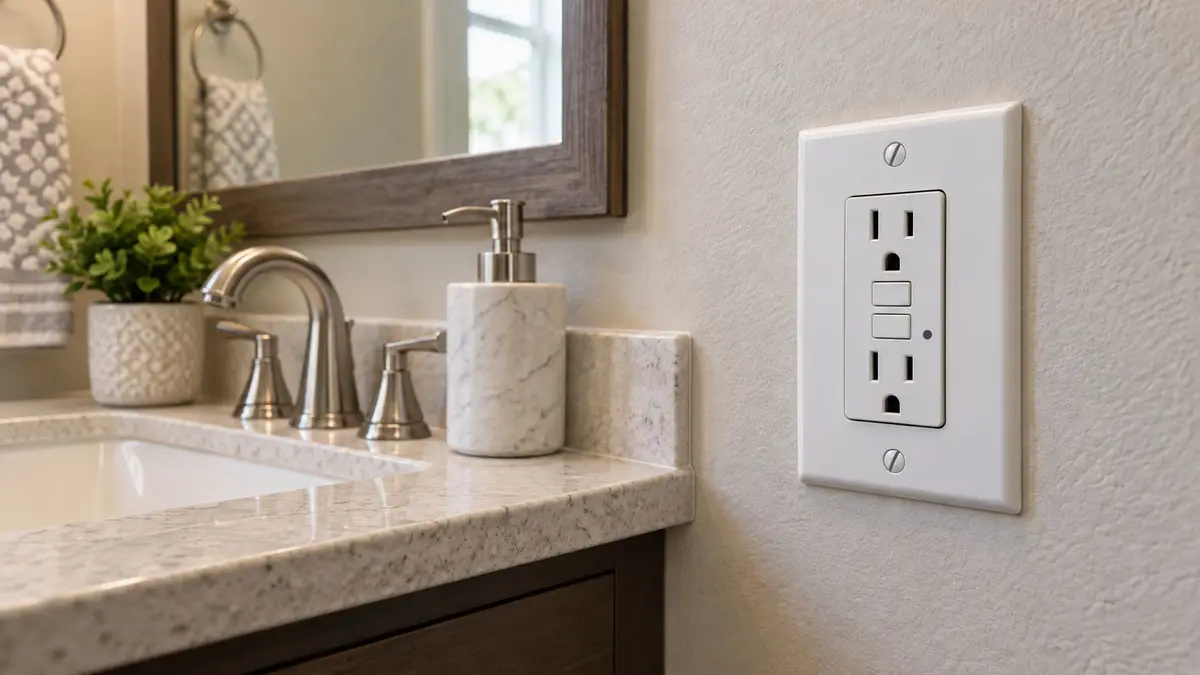
The RESET button presses in and springs back out—or nothing happens at all. That can be frustrating when the bathroom, kitchen, or garage outlet is dead. It can also be a GFCI doing its job: refusing to hand power back when it cannot confirm protection. The next step depends on what else is dead, what the button does, and whether there is any sign of heat or water.
No defensible national average was found for this visit. A device replacement, an upstream power problem, and a circuit fault require different work. Get the cause and scope before comparing prices.
What is a GFCI that won’t reset telling you?
A ground-fault circuit interrupter, or GFCI, compares current going out and returning. An imbalance of a few milliamperes can make it trip; OSHA describes a threshold around 5 milliamperes, while Fluke describes common devices around 6 milliamperes. That protects against some shock hazards. It does not protect against overloads, short circuits, or every possible shock path; a circuit breaker has a different job. For combined appliances that trip a breaker, use the overload-or-fault guide.
The CPSC’s engineering staff warned that a failed GFCI could continue to pass power without providing ground-fault protection. Manufacturers built reset lockout and self-monitoring to address that problem. Leviton’s installation sheet and Hubbell’s instructions both describe conditions in which a device cannot reset until power and wiring are correct, and say a device that cannot reset needs replacement. A dead outlet can therefore be a deliberate warning, not just a sticky button.
UL’s explanation of the 2015 standard says GFCI receptacles and GFCI circuit breakers manufactured after June 29, 2015 must monitor themselves. Earlier stock could still be sold until exhausted, so a remodel date does not establish manufacture date. Power denial is the general response to a failed self-test, but the standard allows audible or visual indication for two failure modes. A self-test model can lose protection while still supplying power. This product standard is not an NEC mandate that every homeowner own a self-test device; the monthly manual test still matters.
Which signs mean stop before testing?
A shock or tingle, burning smell, heat, buzzing, discoloration, scorch mark, or wet device means stop using the receptacle and call a licensed electrician now. If an outlet is wet or has been flooded, leave it untouched. Do not use another outlet to aim a hair dryer at it. A licensed electrician should assess the device, box, and circuit before it is energized. The hot-or-buzzing-outlet guide explains the heat and noise stop signs.
If the dead circuit powers a sump or well pump, arrange a same-day electrician and follow your water or flood contingency plan. For essential medical equipment, use the established backup plan and seek emergency help if a person’s care is immediately threatened. A dry, isolated outlet with no critical load may remain unused until an electrician can attend. Tell the electrician the critical load first; bypassing GFCI protection is not a fix.
Are you pressing the controlling GFCI?
A GFCI receptacle can protect other ordinary-looking outlets downstream. The one whose RESET button controls your dead outlet may be in another bathroom, garage, kitchen, basement, or outdoors. Look for TEST/RESET buttons you can see without removing covers. A GFCI breaker in the closed panel can also protect the circuit. If several rooms are dead and no GFCI appears tripped, the problem may be upstream. Do not open the panel cover or search inside a box.
Read the brand and model on the face. Indicator lights differ. Leviton’s guide describes green and amber states for its models; Hubbell’s sheet describes a green power indication and flashing red end-of-life indication for its model. The model instructions are the color chart to use. Leviton’s product FAQ says its self-test models blink red once after TEST then RESET, while its non-self-test models turn immediately green. That is Leviton-specific; use your own model’s document.
What does the RESET button do?
The following patterns help decide where to start reading. They are a practical starting heuristic. A locked-out device, a miswired device, and a device without incoming power can look the same on some models. Manufacturer sheets even describe different visible results for reversed line and load.
| RESET behavior | What you also notice | What it points you toward |
|---|---|---|
| Nothing happens | Other outlets may be dead | Check for upstream power loss; lockout remains possible |
| Pops straight back out | Recent replacement or electrical work may matter | Lockout or line/load reversal; button alone cannot distinguish |
| Holds briefly, then trips | Circuit may be energized | Active fault or connected load; location unknown |
| Holds until an appliance runs | Trip follows appliance use | Appliance, cord, or a shared circuit problem |
The table routes your attention; an electrician determines the cause and safety of the circuit. Hubbell’s instruction sheet says reversed line/load connections can leave power off at the face with RESET not staying in; Leviton describes a different indicator pattern for its model. Tell the electrician about recent work and exactly what the button did.
What safe checks can you make?
Before any reset, decide whether the device is safe to touch. Moisture, heat, abnormal sound, visible damage, or a reported shock ends homeowner checks; a licensed electrician takes over now. Otherwise, look for a tripped upstream GFCI or breaker with all covers closed. Unplug readily accessible devices on the affected circuit if their cords and receptacles are dry and undamaged. Then make one ordinary RESET attempt on the controlling GFCI. If it holds and a device trips it again in normal use, leave that device unplugged and call an electrician or appliance repair technician as appropriate. Do not keep recreating a trip or use a damaged appliance on another circuit.
If RESET still will not hold with loads removed, a licensed electrician must identify whether supply power is absent, the device has failed, line and load were reversed, or a wiring fault remains. This is where you stop. Do not remove the wallplate or loosen terminals; the face gives no assurance that conductors in the box are dead. Do not open the panel to inspect a breaker.
When it resets but trips again
A reset that holds briefly is different from one that never latches, but it still does not identify the fault. Fluke describes how some modern electronics leak small amounts of current by design. Several dry loads can add up across the same GFCI even when no single appliance has failed. That is one possible mechanism for an electrician to measure, not a diagnosis from the button. A wet cord or damaged appliance calls for discontinuing use. If trips follow rain, the electrician should inspect the outdoor equipment and enclosure.
A GFCI can also fail outright after surge or corrosion exposure; CPSC’s staff paper discusses those failure drivers. After a power disturbance, perform the device’s manual test once conditions are safe. Do not assume that a lit indicator proves protection.
Should the electrician replace the device or find a circuit fault?
A device that fails its own test or cannot reset after supply and wiring are verified needs replacement. A GFCI that trips because a downstream load or branch has a fault needs the fault found, even if a new GFCI temporarily behaves differently. Recent electrical work makes line/load wiring a specific question for the electrician. Ask what measurement or test established the diagnosis, and what happens if a replacement also will not hold.
The National Electrical Code provides ways to replace an ungrounded receptacle with GFCI protection, as described in EC&M’s NEC overview. A GFCI can function without an equipment grounding conductor. Under the NEC replacement provisions summarized by EC&M, the applicable replacement gets “No Equipment Ground” marking and, on protected downstream receptacles, “GFCI Protected” marking where specified. The adopted NEC edition and local amendments vary, so the electrician should confirm the permitted replacement and labeling at your address. This is especially relevant in a two-prong-outlet house.
That case needs the device’s own TEST button and an electrician’s evaluation. Klein’s RT210 instructions specify its use on a three-wire outlet and say it checks common wiring conditions but not ground quality or combined defects. A plug-in tester result alone does not establish that an ungrounded GFCI has failed. Use the device’s own TEST button with a working lamp for the meaningful homeowner check.
How do you test a GFCI so the result means something?
Once the receptacle is dry, undamaged, and operating, plug in a simple lamp or other visible load and switch it on. Press the GFCI’s own TEST button. On the conventional receptacle in CPSC’s archived fact sheet, RESET should pop out and the lamp should turn off. Press RESET and confirm the lamp comes back. If TEST does not cut power, or RESET does not restore it, stop using that outlet and call a licensed electrician. Follow the particular manufacturer’s instructions for a GFCI breaker or other model. CPSC’s archived GFCI fact sheet gives that outcome mapping for a conventional receptacle; follow the instructions for your particular modern device or GFCI breaker.
| Test | Result | Meaning and next step |
|---|---|---|
| Press TEST with nothing plugged in | RESET pops out | Load interruption unverified; repeat with lamp |
| Press TEST with lamp on | RESET pops out and lamp goes off | Expected result for CPSC’s conventional receptacle; RESET and verify return |
| Press TEST with lamp on | RESET pops out but lamp stays on | CPSC identifies a wiring error; stop use and call electrician |
| Press TEST with lamp on | RESET fails to pop | CPSC identifies a defective device; stop use and call electrician for replacement |
| Press RESET after test | Load stays off | Electrician verifies supply and wiring; replace a device that still fails |
A 2009 CPSC convenience survey of self-selected, safety-aware respondents found 77 percent thought testing with nothing plugged in confirmed protection, while 13 percent identified the correct result. It was not nationally representative; the agency said this group could understate misunderstanding in the general population. Self-test models still need the manual test the manufacturer specifies, generally monthly. A claimed lifespan is less useful than whether the device passes that test today: published service-life estimates differ widely and are poorly grounded.
What will the visit cost and cover?
No authoritative current national average was found for this repair. Diagnosis of a dead feed, replacing one accessible device, outdoor box and cover work, or tracing a downstream fault produce different bills. Ask the licensed electrician for diagnostic time and whether it is credited, device type, wiring work described by scope, enclosure parts, local permit and inspection fees, and parts and labor warranties. Local permit and licensing rules vary.
Tell the electrician what RESET does, what the light shows, which outlets are dead, what was plugged in, and whether there was recent work, rain, flooding, or a power disturbance. Mention a shock, burning smell, or scorch mark first. Ask which other outlets the device protects and whether they can be labeled. Ask when diagnostic work will pause for a new quote. A useful call line is: “Hazard or critical load: ___; RESET behavior: ___; light and brand: ___; dead outlets: ___; recent rain, work or power event: ___.” If the first quote jumps from one dead GFCI to a panel replacement without circuit findings, get a second electrical opinion. The electrician may isolate downstream loads and check neutral wiring as professional diagnostic work; the homeowner does not open the box.
Frequently asked questions
Can a GFCI stop supplying power because it failed internally?
Yes. Modern devices can deny power after a failed self-test or end-of-life condition, though some permitted failure responses use an indicator instead. A licensed electrician should verify supply and wiring before replacing it.
Does a green light mean my GFCI is safe?
No. A green light alone does not prove protection; on some models it indicates incoming power. Read that model’s manual, then use TEST with a working lamp only when the device is dry and undamaged. A device can remain energized after some failed self-tests.
Should I install a regular outlet so the power stays on?
No. That removes the shock protection the GFCI was providing and leaves the underlying problem unresolved. Have a licensed electrician identify why it will not hold.
Can I leave the circuit off until the electrician arrives?
Yes, for a dry isolated outlet with no critical load, leave it unused until the appointment. Arrange same-day help for a sump or well pump; use the established medical-equipment backup plan and emergency help if immediate care is at risk.
Sources
- OSHA — Ground-Fault Circuit Interrupters
- CPSC — Engineering Staff Position on GFCIs
- CPSC — GFCI Consumer Opinion Forum
- CPSC — GFCI Fact Sheet
- Leviton — Installing and Testing a GFCI Receptacle
- Leviton — Self-Test GFCI Indicators
- Leviton — GFCI Product FAQ
- Hubbell — Installing and Testing a GFCI Receptacle
- UL Solutions — Self-Testing GFCI Requirements
- Fluke — GFCI Trip Causes
- EC&M — NEC Requirements for Receptacles
- Klein Tools — RT210 Instructions