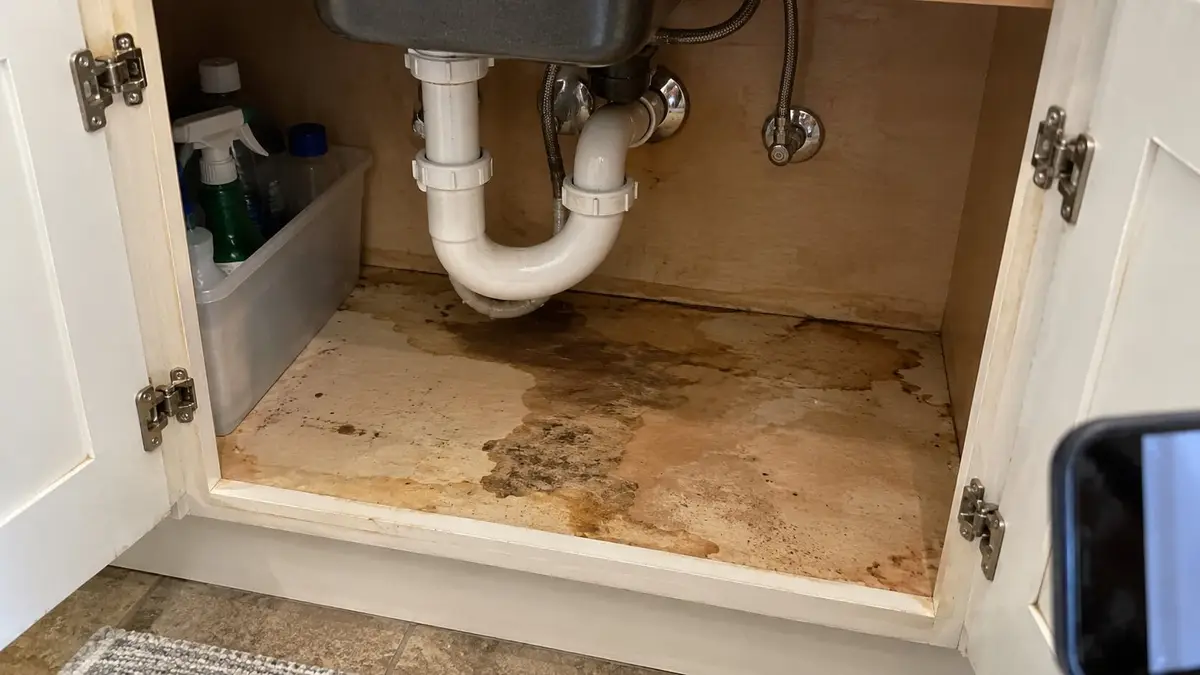
A soft cabinet floor brings two worries: how much damage is hidden, and who pays. A covered leak does not mean every repair is covered.
Your policy form and endorsements—the documents that change its coverage—decide your claim. “Water damage” alone does not describe what the insurer will pay.
Two questions decide most leak claims: what released the water, and for how long?
The Washington insurance commissioner describes sudden leaks as usually covered when reported quickly. Gradual leaks usually aren’t. This is no national guarantee.
Write down three separate facts: what failed, when you first noticed damage, and any earlier signs. If you don’t know when the leak began, say so. Discovery is a fact you can report; the start date may need investigation.
Where the water came from changes the coverage question
California’s claims guide explains storm-created openings; Triple-I addresses backup riders.
| Source | Common treatment or complication | Ask about |
|---|---|---|
| Supply line, water heater, dishwasher or washer hose, or toilet overflow | Accidental discharge commonly covered; duration can change the answer | Water-discharge wording and leakage exclusion |
| HVAC condensate line or drain pan | A long-running leak can face duration exclusions | Seepage wording and hidden-leak exception |
| Frozen pipe | ISO sample: reasonable care to heat or shut off/drain; fire sprinklers require reasonable care to keep water and heat | Freezing and vacancy conditions |
| Rain through a storm-created roof opening | Generally covered if the opening came from a covered cause | Roof cause and required protective repairs |
| Roof leaking through aging materials | Wear and deterioration wording is relevant | The actual exclusion being applied |
| Sewer or drain backup; sump discharge | Excluded in typical language; many insurers sell additional coverage | Water-backup endorsement and its limit |
| Groundwater through the foundation | Typically excluded | Groundwater provision |
| Surface flooding | Most homeowners policies don’t cover it | Separate flood policy |
| Another condo unit or common element | Multiple policies and governing documents matter | Unit policy, master policy, deductible responsibility |
Flood insurance has its own definition. FloodSmart describes excess water on normally dry land affecting at least two acres or two properties. Describe a plumbing discharge as a plumbing discharge when reporting it; “flood” has a specific insurance meaning.
What “sudden and accidental” means in your policy
Start with the declarations page, which lists your policy forms and endorsements. Read those documents together, especially “Perils Insured Against,” “Exclusions,” and “Duties After Loss.” Search for sudden, seepage, leakage, deterioration, neglect, and mold.
The Insurance Services Office (ISO) sample homeowners form hosted by Triple-I is a 2000-edition standard form; insurers may use later editions or their own. Its water-discharge provisions cover accidental discharge or overflow without requiring suddenness. The sample uses “sudden and accidental” elsewhere, including a separate belongings peril involving a water heater that cracks or bulges.
Some insurers require suddenness. Wear, corrosion, breakdown, and neglect may also matter. Ask your insurer to identify the provisions applying to your loss, rather than accepting “gradual” as the complete explanation.
Is a slow or hidden leak covered? Two clocks decide
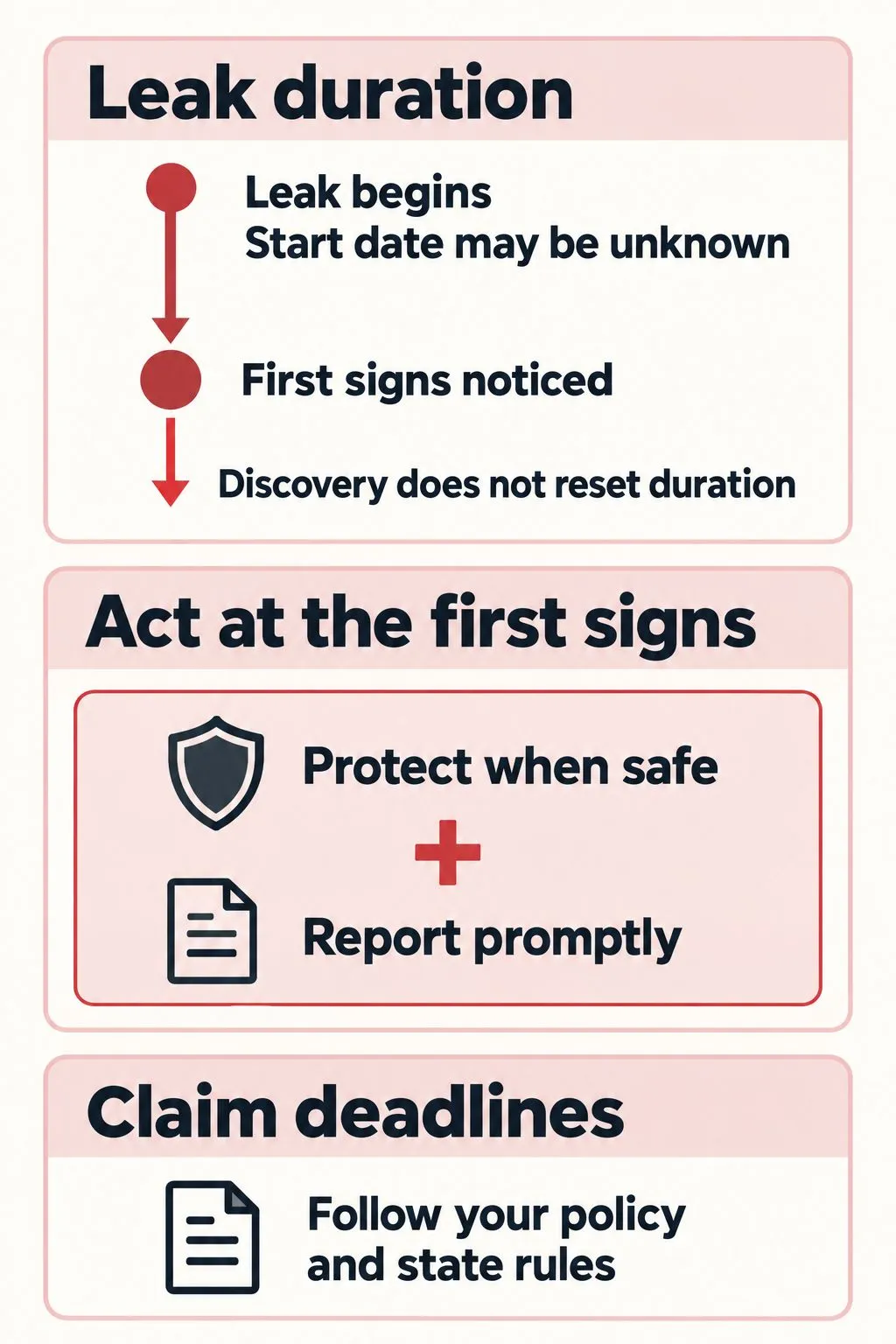
Unscaled timeline. Check your policy, endorsements and state rules.
The duration clock measures how long the leak ran
Rough Notes compared real carrier wording and found meaningful differences:
| Example wording or provision | What to check |
|---|---|
| “more than 14 days” | The precise day-count threshold |
| “weeks, months or years” | How the insurer applies that duration |
| Exception for hidden leakage and damage unknown to every insured | Whether both conditions must be met |
| Exception for damage following an unobservable leak source | Limits excluding rot and leaks below the slab or foundation floor |
| No separate seepage exclusion in the base form | Other exclusions and attached endorsements |
United Policyholders, a policyholder advocacy organization, describes insurers’ focus on when leakage began rather than when the homeowner learned about it. That explains why a hidden leak isn’t automatically protected. Its discussion of a delayed-discovery argument also describes a California court rejecting it; don’t assume that argument extends coverage.
The reporting clock starts when you first see signs of damage
The ISO sample requires prompt notice, protective work, and cooperation. Texas insurance regulators say hidden water damage usually must be reported within days after you first see it. Signs you saw and left alone, such as a stain or musty smell, can count against you. The sample excludes failure to use all reasonable means to save and preserve property at and after a loss. Report early signs honestly, even if the leak itself was hidden. If the water comes from a shower, the recurring shower-leak guide covers the separate repair assessment.
| Event | Which clock matters? |
|---|---|
| Water starts escaping | Duration under any seepage or leakage provision |
| You notice damage or warning signs | Notice and duties to prevent further damage |
| You report the loss | Claim instructions and document requests |
| The insurer requests proof of loss | The deadline in your form and applicable state rules |
Request all deadlines in writing. The sample form’s proof-of-loss deadline runs 60 days after the insurer requests it; its lawsuit limit is two years after loss. Deadlines vary, and negotiating may not pause them.
Buried lines and slab leaks need separate questions
For a yard line or under-slab leak, ask separately about replacing the line, resulting damage, and access. Don’t assume slab work is covered.
Some hidden-leak exceptions stop short of below-slab leaks. For exterior buried lines, ask whether you have utility or service-line coverage. Definitions, covered causes, and well or septic exclusions vary by carrier.
Water from outside your property isn’t one coverage bucket
In the ISO sample, the building has limited protection for accidental discharge from certain off-premises pipes, subject to other exclusions. The belongings water-discharge peril excludes on-premises damage from an off-premises discharge. Ask for separate answers about the structure and contents if a municipal main or neighbor’s pipe released the water.
For condos, Washington’s condo-claim guide points to the unit policy, association master policy, and governing documents. It also warns that an owner may owe the master-policy deductible. Notify the association or manager as well as your unit insurer.
Will insurance pay to fix the pipe itself?
Typical language excludes the system or appliance from which water escaped while allowing covered resulting damage. That means the plumber’s repair and the restoration contractor’s work can receive different answers.
| Part of one leak | Separate coverage question |
|---|---|
| Failed hose, pipe, or appliance | Is the failed item excluded or protected by another agreement? |
| Wet cabinet, drywall, floor, and belongings | Does the discharge and resulting damage qualify? |
| Wall opened to reach the pipe | Does the form pay necessary tear-out and replacement? |
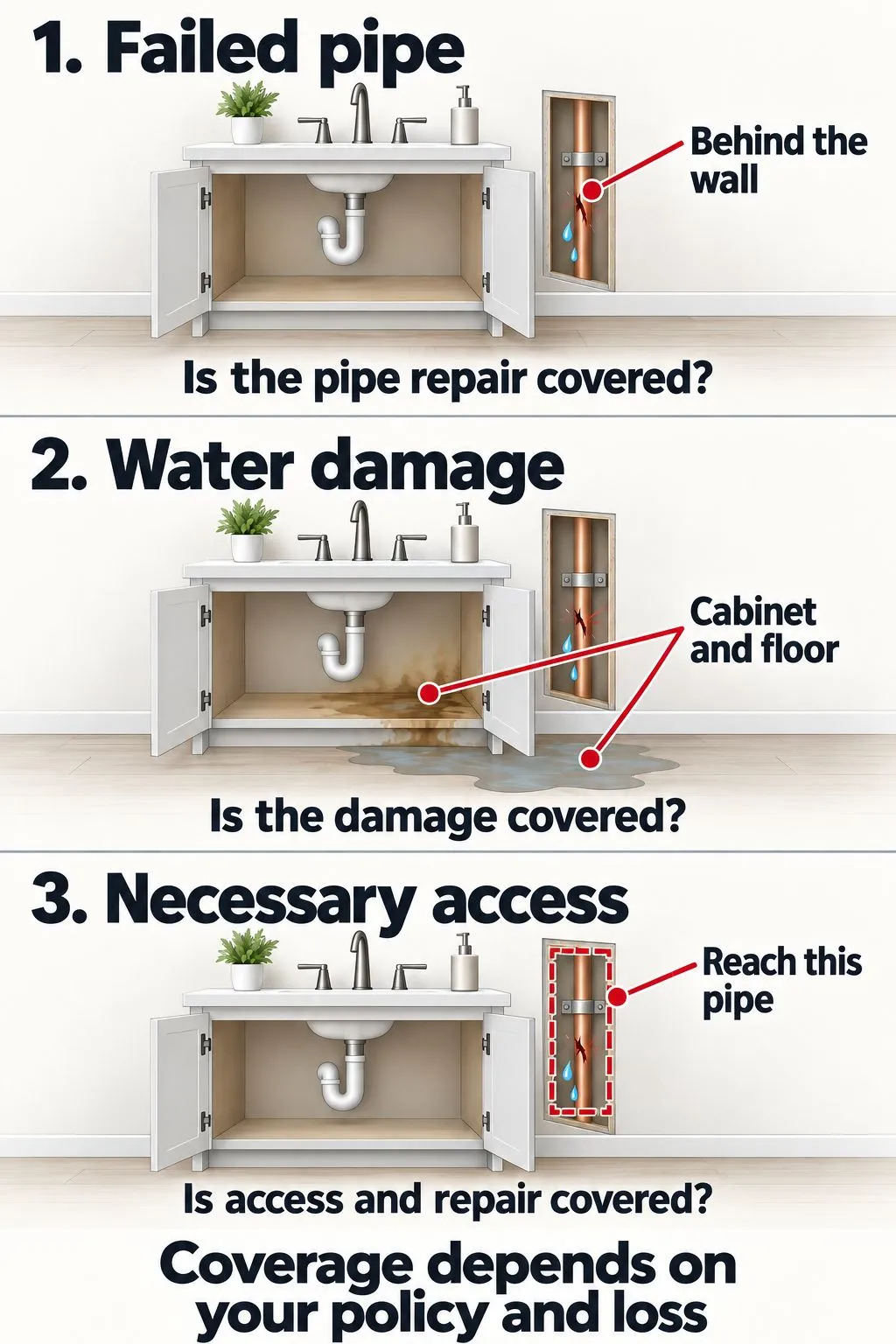
Conceptual illustration of three separate coverage questions.
The ISO sample includes necessary building tear-out to repair the system or appliance, subject to its terms. Coverage still depends on your form.
It also makes homeowners coverage secondary to payable amounts under a service agreement, including a home warranty. Read both contracts; don’t assume the warranty and policy cover identical work.
Structural claim checks may include your mortgage lender. California’s guide explains that lenders may hold funds and release them as repairs progress. Ask about that process before scheduling work around a payment you expect to receive directly.
Is mold from a leak covered?
Washington describes mold as usually excluded unless it results from covered water damage, with some insurers offering limited mold coverage. The ISO sample has an exception for hidden mold from qualifying accidental discharge. Your form may impose different restrictions or limits.
Texas distinguishes coverage for mold on a covered damaged item from later testing and cleanup, which many policies don’t include. Ask about both. Arrange drying promptly; cleanup delays can allow mold growth.
What investigators use to judge cause and duration
In CLM Magazine, engineer David Amori describes clues investigators examine. A rupture can fit freezing; a pinhole can point toward corrosion; fitting failures can suggest installation issues. These are clues, not automatic verdicts.
Investigators may also examine discolored framing, blistering or separating finishes, nearby fungal growth, and recent repairs. Request the duration evidence and investigator’s report.
Before removal, photograph damage from a safe position. Ask the plumber, HVAC technician, or roofer removing the failed part to save and label it. Keep:
- Date-stamped photos before tear-out and notes identifying who first saw damage.
- The plumber’s written failure description and the restorer’s moisture readings.
- Earlier stains, odors, repairs, water bills, and leak-detector alerts.
- Damaged-belongings inventory and protective-work receipts.
Bills and alerts are evidence, not proof the insurer must accept. An intentionally false timeline can defeat coverage under the sample form.
United Policyholders notes remediation can obscure duration evidence. For a large dispute, seek an independent plumber or engineer while evidence remains. Leave hazardous-material assessment to a licensed asbestos or lead specialist.
Asking about coverage and reporting a loss must work together
Washington’s filing guidance says you can explain that you’re asking about potential coverage without filing a claim. For a hypothetical or clearly small loss, ask how the deductible affects the decision and how the insurer will record the call.
Washington’s Comprehensive Loss Underwriting Exchange (CLUE) guidance describes LexisNexis advice against reporting simple coverage or deductible questions to that claims database. That is no guarantee for each call. CLUE generally holds up to seven years of history; you can request a free report and dispute errors.
Claims can affect pricing and eligibility, but there is no authoritative standard premium-increase figure. Texas’s premium guidance includes protections concerning unpaid claims and policy questions. Those are Texas rules; check your own state department.
Don’t let a deductible calculation delay notice of spreading damage. A coverage inquiry doesn’t replace your policy’s prompt-reporting duty or the need to mitigate an active loss.
Report the leak without losing evidence or delaying drying
- Stop water at the fixture valve or main only if safe to reach. Don’t enter standing water near electrical equipment.
- From a safe position, photograph or video the damage before repairs or removal. Report promptly, get a claim number, and ask whether inspection is needed before tear-out. Explain what you know about source and timing.
- Ask how protective work can proceed with documentation. The sample form pays reasonable costs for necessary measures protecting property damaged by a covered peril. Keep receipts and avoid costly temporary work pushed by contractors. Permanent repairs generally wait for inspection; necessary protection should not wait.
- Keep receipts, damaged items, and requested material samples until the adjuster gives instructions.
Hire a plumber for a plumbing source, an HVAC technician for condensate equipment, or a roofer for a roof source. A water-restoration contractor handles extraction, drying, and moisture documentation. Ask estimates to separate source repair, access, drying, removal, and reconstruction. An estimate does not establish coverage.
Before signing, read work authorizations, any assignment of benefits, and any direction to pay. The NAIC cautions that an assignment isn’t required to obtain repairs. Be wary of pressure to sign immediately or promises of coverage from someone who hasn’t read your policy.
If coverage is denied or the payment seems wrong
Request a written explanation identifying the exact policy provision and factual basis. California requires written denials with specified reasons and notice of Department review; other states have their own rules. Ask the adjuster, then a claims manager, to reconsider with documents addressing the stated reason.
| Disagreement | Useful next route |
|---|---|
| Cause or duration | Failure report, preserved evidence, and independent opinion |
| Excluded source | Check the provision and endorsements being applied |
| Amount needed to repair covered damage | Itemized estimates; ask whether appraisal applies |
| Delay or inadequate investigation | Contact your state insurance department |
Appraisal addresses the amount of loss, not whether the loss is covered. The sample form requires each side to pay its appraiser and share the umpire’s cost.
NAIC describes public adjusters as independent of the insurer and paid by the policyholder. Licensing and permitted roles vary by state. An attorney may help with a large contested loss or deadlines. A complaint doesn’t guarantee payment; keep checking deadlines while reconsideration proceeds.
Questions to settle before the next leak
Ask your agent for the actual provisions, not just a phone summary:
- What leakage time limit and hidden-leak exception apply? Does the exception stop at the slab?
- If there is no hidden-leak exception, does another form or endorsement offer one?
- What backup, service-line, mold, code-upgrade, and water-deductible terms apply?
- What vacancy or minimum-heat conditions apply? For a condo, who owes the master-policy deductible?
Triple-I recommends inspecting appliance hoses yearly, replacing them every five to seven years, and shutting off the washer supply when away. Know the main shutoff, keep a belongings inventory, and consider leak alerts or automatic shutoff devices.
Frequently asked questions
The adjuster says my leak ran for months, but I found it last week. Can they deny it?
They may, if your policy excludes leakage over that duration. Finding it recently does not reset the leak’s start date, but a hidden-and-unknown exception may change the answer. Ask for the exact provision and evidence supporting the duration estimate; preserve the failed part and seek an independent opinion for a significant dispute.
I was away for a month. Does that affect coverage?
Yes. An extended trip can raise a leakage-duration question. For freezing, the ISO sample calls for reasonable care to maintain heat or shut off the water supply and drain systems. But if automatic fire sprinklers protect the building, that sample requires reasonable care to continue the water supply and maintain heat. Check your policy’s vacancy and freezing terms; ask a plumber or sprinkler contractor how to winterize without disabling fire protection.
Is a slow roof leak treated like a slow plumbing leak?
Not necessarily: the water source and the applicable provisions differ. California’s guide links rain coverage to an opening caused by a covered event. For an aging roof or long-running leak, ask which wear, deterioration, or leakage exclusion applies rather than assuming the plumbing exception extends to roofing.
Correction (October 12, 2026): An earlier version omitted the fire-sprinkler condition in the cited sample policy.
Sources
- Washington OIC — Leaks, water damage and mold
- ISO / Triple-I — Homeowners 3 Special Form sample
- Rough Notes — Avoiding Policy Language Assumptions
- United Policyholders — Temporal Requirements for Water Damage Exclusions
- Texas Department of Insurance — When are water damage and mold covered?
- California Department of Insurance — Residential Property Claims Guide
- Triple-I — How to protect your home from water damage
- FloodSmart — The Cause of Flooding Matters for NFIP Coverage
- Washington OIC — Filing a condo unit insurance claim
- CLM Magazine — Figuring Out the Frozen Pipe Claim
- Washington OIC — Filing a homeowner insurance claim
- Washington OIC — CLUE
- Texas Department of Insurance — Will my premium go up if I file a claim?
- NAIC — Assignment of Benefits: Consumer Beware