An office that feels fine in the morning can become unusable when the sun reaches its west window. Closing a blind may help, yet the room can keep warming. The question is where to stop the sunlight: outside the glass, at the glass, or after it enters.
The price comparison starts with scope. There is no dependable national installed price range for film, solar screens, exterior shades, or awnings. Window size and count, product, upper-floor access, and mounting work change the quote. A full replacement is a much larger job, and the window may not be the whole problem.
Is it the window, or something else making the room hot?
Track when the room heats up for several clear and cloudy days. If the increase follows sun on that wall, peaks late afternoon, and eases after sunset, solar gain through the window is a likely contributor. Note the window’s direction, size, existing covering, and whether closing it before sun arrives changes the room’s feel. A hot sill or direct bright patch supports the same observation; it does not measure how much heat the window admits.
| Observation | Next question |
|---|---|
| Hot mainly on clear afternoons when sun hits this glass | Which shade can intercept the low sun? |
| Hot on cloudy days or at night too | Is airflow or nearby attic/garage heat involved? |
| Weak air from the room’s supply register | Can an HVAC contractor check distribution? |
| Whole upper floor runs hot | Is this a broader cooling or building-envelope problem? |
A closed door with no return-air path or a thermostat elsewhere can leave one room uncomfortable even when the equipment is running. An HVAC contractor can check airflow without you opening ducts or the air handler.
Why does afternoon sun get past an overhang?
The late-day sun sits low. A roof eave that shadows a window at noon can leave much of a west-facing pane exposed at 5 p.m. DOE’s shading guide says unshaded east and west glass can receive as much as twice the midsummer solar heat per square foot as unshaded south glass. That is a geometry comparison, not a temperature forecast for this room.
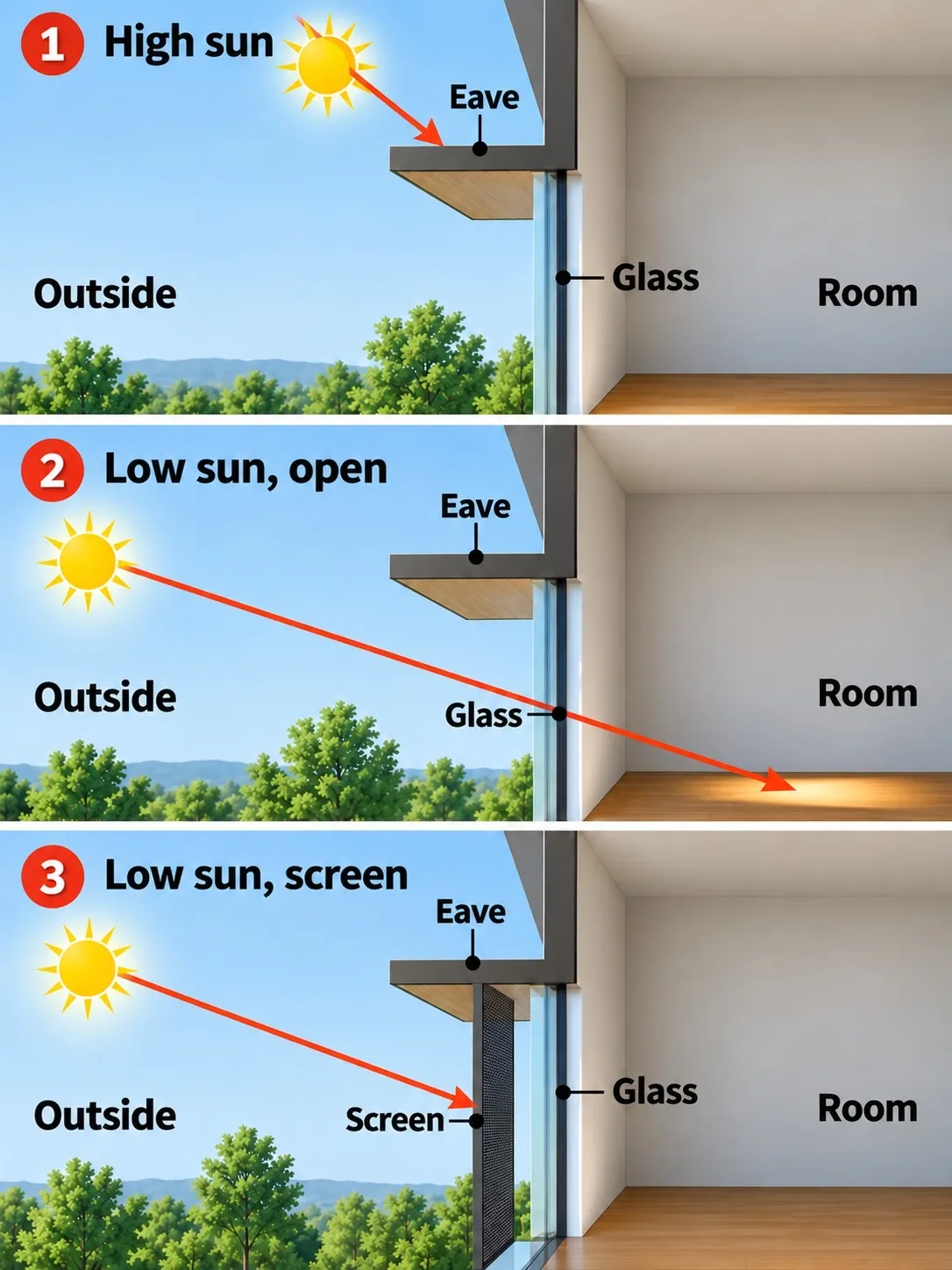
A horizontal eave and an exterior screen intercept sunlight at different angles.
Vertical shading in front of the glass—an exterior screen, roller shade, shutter, or carefully placed plant—intercepts this low-angle sun. A horizontal awning may help less on the west wall than it does above a south window. DOE’s attachment guidance explains why the exterior location matters: sunlight stopped before it passes through glass cannot warm interior surfaces. An interior shade still controls glare and some gain, but it works after the light enters.
What can you do with the shades you already own?
Lower the existing covering before the sun reaches the glass, then compare the room at the usual hot hour. A shade left open during that period has no solar-control effect. Lawrence Berkeley National Laboratory’s 2013 modeling found that how occupants operate attachments strongly affects energy results. Your short trial helps decide whether a more convenient shade is worth buying; it is not a laboratory efficiency test.
An interior roller or solar shade manages glare while preserving some view. A cellular shade adds an insulating layer that can be useful in the heating season. A timed or motorized version helps if no one is home to close it. Decide how much daylight and view you are willing to lose at the hot hour. Blackout fabric can darken the room but does not stop the sunlight before it reaches the glass.
The Attachments Energy Rating Council label separates Cool Climate and Warm Climate improvement ratings for rated shades, screens, and other attachments. Compare products within their category, since each category has its own maximum. A northern homeowner should read the Cool Climate measure even if one room is hot in summer; a southern homeowner should pay attention to Warm Climate performance.
If young children live in or visit the home, choose cordless coverings. The Consumer Product Safety Commission says cordless is the only way to eliminate the cord-strangulation hazard; securing an existing cord reduces risk but does not eliminate it.
Are exterior screens or shades better for a west window?
Often, because they block low sun before it crosses the glass. Solar screens and exterior roller shades fit this geometry better than a shallow fixed awning. DOE describes Rempel and colleagues’ 2022 modeling of a non-air-conditioned Portland home during the 2021 heatwave: exterior shades would have reduced dangerous heat-index hours by about 55%, versus 18% for interior roller shades and 23% for insulating interior shades. Those modeled results do not predict the improvement in your room.
Exterior choices also change the view from indoors and the look from the street. Ask how a screen will be removed or cleaned, how a shade handles wind, and who can safely access it. An upper-story installation belongs to an exterior-shade installer. Fixed awnings or mounted products may need local approval; HOA and historic-district rules also vary.
Climate changes the energy balance. The 2013 LBNL model found that attachments saved energy in cooling-dominated southern climates. In northern and much of central climates, fixed awnings and solar screens cut cooling demand but could create a larger winter heating penalty. Removable or retractable shading lets winter sun back in. A tree can eventually shade low sun, but its growth, siting, and winter shadow are long-term questions; keep planting and ladders away from power lines.
Will window film cool the room without replacing the window?
Solar-control film reflects and absorbs some sunlight. Its solar heat gain coefficient (SHGC) measures the fraction of solar heat admitted, from 0 to 1; lower means less gain. Visible transmittance (VT) measures how much visible light comes through. The NFRC consumer guide recommends using rated SHGC and VT for comparisons, rather than a seller’s generic “blocks heat” percentage.
Film makes more sense where cooling dominates. It also reduces useful winter sun, may darken the view or alter the exterior appearance, and adds little insulating benefit. An HOA may restrict reflective finishes. Ask to see a sample on a similar window at the time of day that bothers you. The room may feel better with less glare even if the glass remains a contributor to heat.
Film also changes the thermal behavior of glass. The NFRC guide warns about stress on panes and insulated-glass seals, particularly on sunny cold days. Existing low-e coatings, glass type, and film absorption affect compatibility. A qualified film installer should identify the glass and make a written compatibility recommendation. A crack with no obvious impact needs a glazier’s assessment before film goes on.
What happens to the window warranty when film goes on?
Read the glass maker’s terms first. For example, Guardian’s insulating-glass warranty excludes units with film applied to the interior or exterior. That is Guardian’s term for the specified product; check the terms for your window.
A film maker may provide a separate backstop. 3M’s March 1, 2026 warranty bulletin describes residential seal-failure coverage for up to 10 years when its film voids a still-valid original manufacturer warranty. Coverage ends sooner if that original warranty or the film warranty expires, or the purchaser no longer owns or occupies the home. The original glass manufacturer must also still be in business. The residential reimbursement cap is $1,500 per window including labor. Thermal-stress breakage coverage lasts up to five years, with the same residential cap. An authorized 3M dealer must complete the glass questionnaire before installation and register the warranty within 30 days afterward; missing that deadline voids coverage. The residential warranties do not transfer to a later owner. These are 3M’s terms for covered products, not a standard film warranty. Ask for both documents and the installer’s written compatibility finding before approving the job.
Does “new glass” mean a new pane, sash, or whole window?
It can mean three different scopes. A glazier may fit a new insulated glass unit (IGU) into a sound sash. A window restoration specialist may retrofit a sash to accept a new IGU. A window contractor may replace the whole unit when the frame, operation, or water management also needs work. DOE’s sash-retrofit guidance calls for climate-appropriate low-e glass, proper support, and drainage; an IGU alone does not repair frame leakage or heat loss.
In hot climates, seek a low-SHGC glass package. ENERGY STAR Version 7.0, effective October 23, 2023, uses an SHGC limit of 0.23 in the South-Central and Southern window zones, as Andersen’s criteria summary notes. Northern criteria include a minimum solar-gain value so that useful winter sun is considered. Ask for the actual product’s NFRC SHGC and VT, not just “low-e.” Permanent low-solar-gain glass also reduces winter gain.
If the window is fogged between panes, cracked, single-pane, or failing to operate, glass or window work may solve more than the hot-room complaint. A sound, modern window is a weaker case for full replacement solely to reduce afternoon heat. ENERGY STAR gives a broad installed replacement range of about $400 to $1,600 or more per window and warns that energy savings alone may not repay the investment. There is no dependable national IGU or sash-retrofit price; glass size and specification, sash condition, labor, and access change the quote. For an old sound frame, low-e storm windows offer another route; if replacement is warranted, compare insert and full-frame scope.
The IRS says the section 25C credit applied to qualifying windows placed in service through 2025. Do not count a 2026 federal 25C credit as part of the payback. Check current IRS guidance and any state or utility program before ordering.
Which fix fits your climate and house?
| Situation | Sensible first comparison | Trade-off to check |
|---|---|---|
| Cooling-dominated climate, strong west sun | Exterior shade or screen; rated film or low-SHGC glass | Daylight, view, glass compatibility |
| Mixed climate | Operable exterior shade or interior covering | Seasonal use and winter sun |
| Heating-dominated climate with one hot room | Timed or removable shade | Winter heating penalty from fixed shading or film |
| Rental, HOA limit, or historic facade | Interior cordless shade | Less heat stopped before glass |
A combination can work: a removable summer screen outside and a cellular shade inside for year-round comfort. Match the measure to the actual complaint. A cool room with harsh glare needs a different purchase from a room that overheats despite closed shades.
How do you compare film, shades, and glass quotes?
| Option | Where sun is stopped | What to request in writing |
|---|---|---|
| Interior shade | Inside the room | AERC rating if available; operating and cordless details |
| Exterior screen or shade | Before the glass | Rating, mounting, wind/removal plan, approval needs |
| Solar-control film | At the glass | NFRC SHGC/VT, glass compatibility, film and glass warranty terms |
| New IGU, sash, or window | At the new glass | Exact scope, NFRC SHGC/VT, trim and drainage work |
Ask a film installer whether it is authorized for the brand and whether the original glass warranty survives. Ask a window contractor to distinguish glass-only, sash, and full-unit work in the estimate. An exterior-shade installer should describe mounting and access. All quotes should separate product, labor, removal, upper-floor equipment, and warranty. Be skeptical of a promised dollar payback or a “heat blocked” percentage with no rated product or defined test.
Frequently asked questions
Will window film make the room too dark or change its street appearance?
It can. VT tells you how much visible light remains, but the tint or reflectivity also affects how the glass looks. View a sample in afternoon light and check any HOA restriction before installation.
Can I put window film on double-pane or low-e glass?
Sometimes, after an authorized film installer checks the particular glass and film combination. The glass maker’s seal warranty may exclude film, and film-maker coverage has conditions. Get the compatibility and both warranty documents in writing.
Are blackout curtains enough to keep a west-facing room cool?
They can reduce light and some heat when closed before the sun arrives. They work inside the glass, so an exterior screen or shade can stop more of the low sun before it enters. If shading during the sun hours does little, ask an HVAC contractor to assess airflow.
Is there still a federal tax credit for new energy-efficient windows?
The IRS says section 25C covered qualifying property placed in service through 2025. Do not assume a 2026 installation qualifies. Verify current IRS guidance and available state or utility programs.
Should I close the shades all day or only when the sun hits the window?
Close them before direct afternoon sun reaches that pane. In a heating season, opening them for useful sun can be valuable. Your room’s orientation and daily schedule matter more than a universal all-day rule.
Will planting a tree fix a hot west-facing room?
It may eventually shade low sun, but growth and placement make it a long-term choice. Use a covering you can operate now if the room needs relief this season. Keep planting work clear of power lines.
Sources
- DOE Building America Solution Center — Window Attachments for Solar Control and Energy Efficiency
- DOE Building America Solution Center — Shading and Solar Control for Windows and Skylights
- Lawrence Berkeley National Laboratory — Energy Savings from Window Attachments
- Attachments Energy Rating Council — Reading the Label
- Efficient Windows Collaborative — Window Film
- 3M — Window Films and 3M IPA for Flat Glass Applications Warranty Bulletin
- Guardian Glass — Insulating Glass Limited Warranty
- ENERGY STAR — High Performing Windows or Storm Windows
- Andersen — ENERGY STAR Version 7.0 Update
- DOE Building America Solution Center — Window Sash Retrofit
- U.S. Consumer Product Safety Commission — Go Cordless
- IRS — Energy Efficient Home Improvement Credit