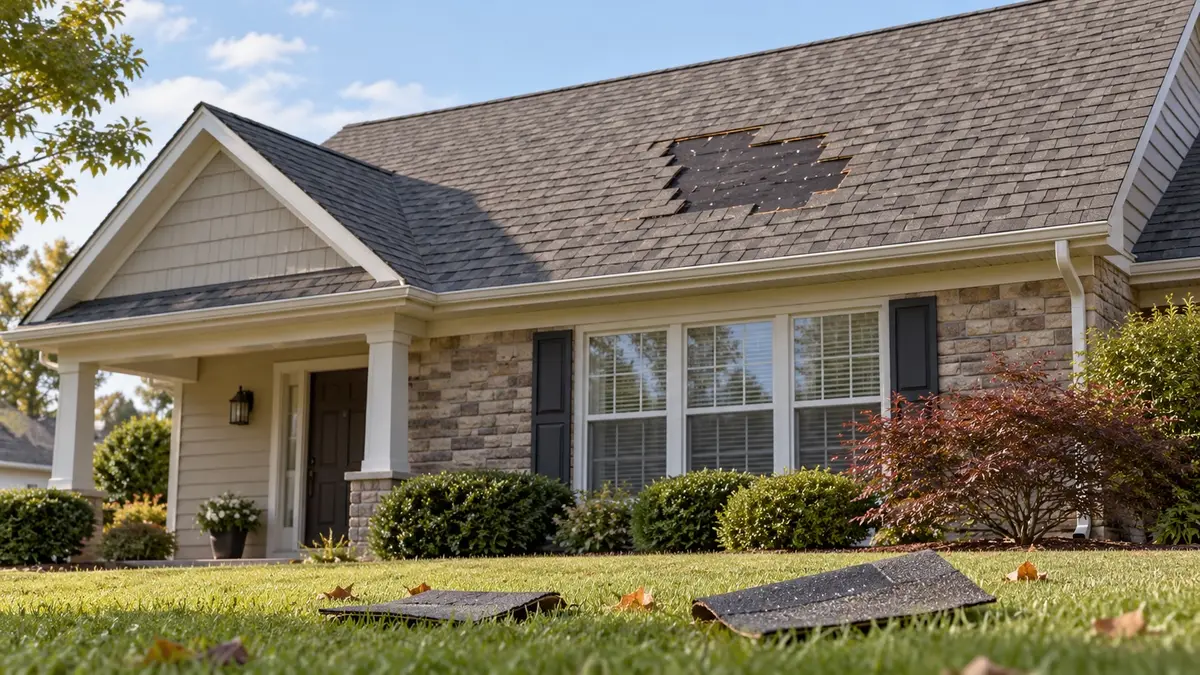
A shingle in the yard can mean a branch tore one spot, an edge detail failed, or a larger area has lost its hold. Rain reaches the layers beneath the missing piece first. What happens in the next wind depends on the shingles that are still there.
There is no reliable national price for either a storm repair or a roof replacement. Height, access, material matching, hidden deck damage and local labor all affect the quote. Get an itemized local assessment before treating a cheap patch or a costly replacement as the obvious choice.
What should you do when shingles are missing after a storm?
First, look for downed lines, hanging limbs and loose debris from a safe place. Do not approach a wire or climb the roof. If a tree touches electrical lines, call the utility. A roofing contractor should do roof access and temporary covering. The National Roofing Contractors Association’s wind bulletin warns that smearing mastic over a damaged spot can hide evidence a roofer needs.
| What you see from safety | What to do now | Who handles the roof |
|---|---|---|
| Shingles missing; underlayment lies intact | Photograph; arrange prompt assessment before rain | Roofing contractor |
| Torn underlayment or bare wood deck | Request urgent temporary covering | Roofing contractor |
| Water entering rooms | Protect belongings where safe; document and call | Roofing contractor; electrician for wet fixtures |
An intact-looking underlayment buys some protection, but it is not a promise of a dry house through the next storm. Keep clear of a wet or sagging ceiling. Keep away from water at a light, fan or outlet until a licensed electrician assesses it.
Before anyone covers or moves the damage, take wide photos of each roof face from the ground, then zoomed photos of gaps and loose tabs. Photograph shingles found in the yard, interior stains and other wind damage. Record the storm date and keep a few intact pieces without handling unknown older roofing material. Tell the insurer promptly if a claim may be involved, and keep receipts for professional temporary protection. The Texas Department of Insurance says a policy may pay for temporary repairs; your policy determines the terms.
What can you check from the ground and a safe attic hatch?
Use binoculars from the ground, as HUD’s 2000 inspection guide recommends for inaccessible roofs. Note whether shingles are missing at the eave (bottom edge), rake (sloping gable edge), ridge (peak), corners, or mid-slope. Wind damage often begins at edges; a torn patch beneath a fallen branch tells a different story. Note which compass-facing slopes lost material. Photograph slipped shingles, raised tabs, missing ridge caps, bent flashing and gutter or siding damage. Loose siding after wind deserves its own assessment.
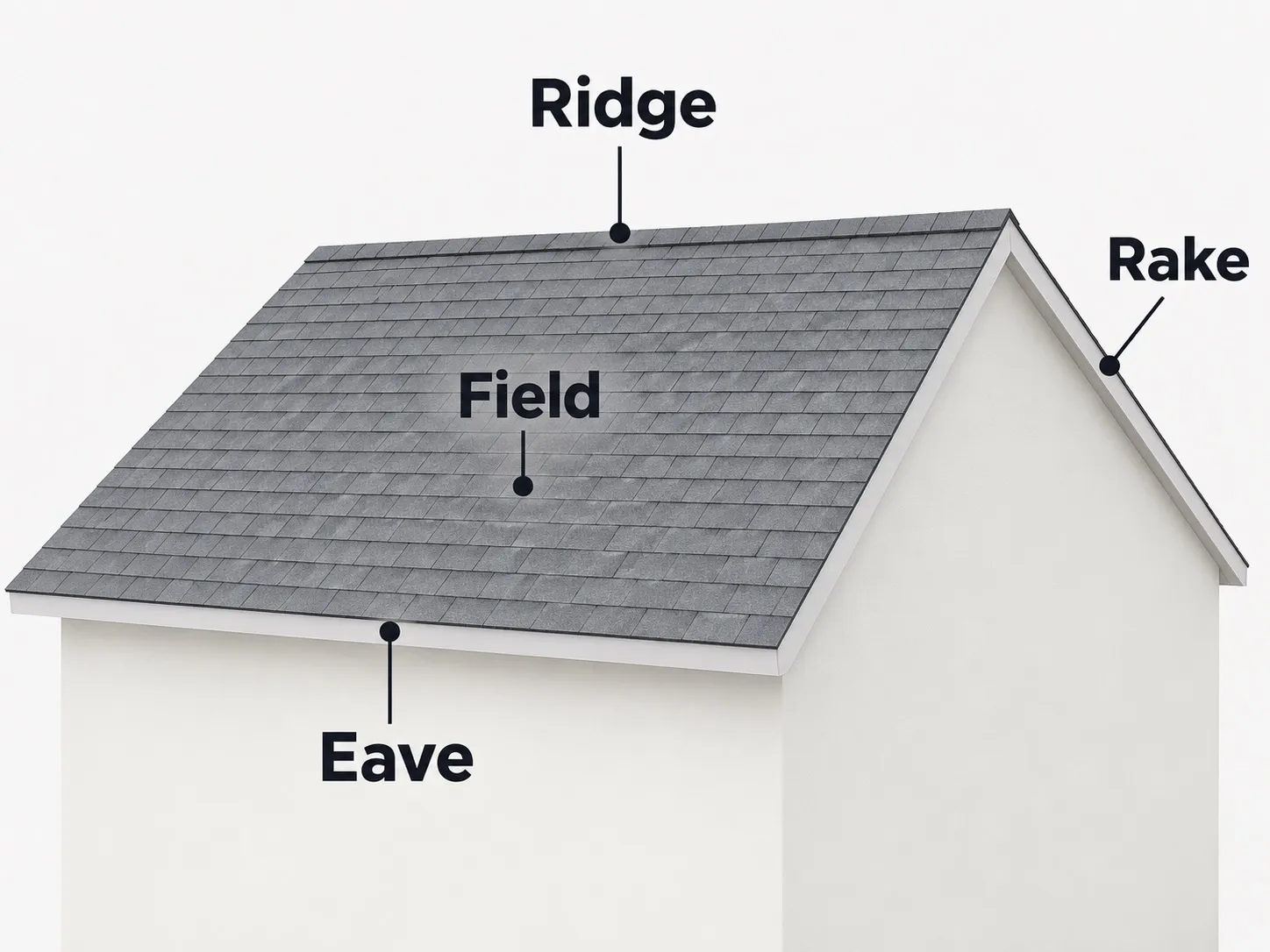
If the attic has safe access, good light and a floored path, look without disturbing insulation. Note daylight through the deck, new stains or drips beneath the damaged slope. Do not step on ceiling drywall. If the access is unsafe, leave the check to the contractor. Water that appears only in heavy rain may need the broader heavy-rain leak investigation.
Gather the installation invoice, warranty, product and color name, leftover bundles and prior repair records. Check the insurance declarations page for a separate wind or hail deductible. A sheltered neighbor’s undamaged roof is weak evidence about yours: IBHS’s Harvey assessment found exposure affected damage frequency.
Why did the shingles blow off—and are the others still sealed?
The hidden issue is the adhesive bond between courses. IBHS wind testing identifies seal strength as the most important factor in high-wind performance of self-sealing asphalt shingles. A temperature-activated strip bonds each exposed shingle to the course below. Nails matter, but a tab that has lost that bond gives wind an edge to lift.
| Pattern the roofer investigates | Possible cause | Question for the rest of the roof |
|---|---|---|
| Torn patch below a branch | Local impact | Are neighboring courses still sound? |
| Loss starting at eave, rake or ridge | Edge or cap detail; peeling wind load | Is the failure local or spreading upslope? |
| Newer roof, cold-season installation | Shingles may never have sealed | Were required hand-sealing steps used? |
| Loose tabs across several slopes | Seal bonds may have weakened with age | How much sound roof remains? |
In its 2026 ten-year wind study, IBHS calls unsealing the weakest link. Shingles can remain unsealed from installation or become unsealed with age; debris in the bond and backing-out nails contribute. Its research also found three-tab products more prone to unsealing than architectural shingles. Cold installation and steep slopes matter because manufacturers commonly call for hand-sealing in those conditions, yet IBHS found the practice was uncommon.
Age is evidence, not a cutoff. In IBHS’s study of 680 Cedar Rapids homes after the 2020 derecho, the chance of visible damage was about 5% for roofs aged three to six years and about 25% for roofs older than ten. Those are findings from that event, not odds for your roof. IBHS also observed different sun-exposure patterns: in southern latitudes south-facing slopes unsealed more, while north faces in northern climates risked never reaching the adhesive’s activation temperature. Ask the roofer to check all slopes, not just the one with a gap.
The wind rating printed for a new shingle does not certify its present seal. IBHS found wide variation in aged-shingle performance among products with the same new-product rating. A count of missing pieces cannot tell you which of the surviving ones are bonded.
When does a spot repair make sense?
A local repair is a strong candidate when impact or a specific edge detail explains a small area, surrounding courses remain sealed, the underlayment and deck are sound, and compatible shingles are available. The Asphalt Roofing Manufacturers Association says a qualified roofer can replace damaged shingles, correct backed-out fasteners and reseal disturbed courses. ARMA represents shingle makers; its statement establishes that repair is physically possible, while the surrounding roof’s condition determines whether it is worthwhile.
Ask whether adjacent shingles can be lifted for the repair without cracking, whether loose neighboring tabs will be addressed, and how the roofer will restore the overlaps. There is no published field test that turns shingle brittleness into a yes-or-no rule. A tarp or roofing cement over a puncture is temporary; ARMA does not consider cement a suitable long-term repair.
Saved shingles usually give the best color match. Otherwise, the installer, distributor or manufacturer can use the product name, color and installation year to find a close blend. Even a matching new shingle may stand out at first because the old roof has weathered, ARMA notes. ARMA says that difference will generally become less apparent over time. Appearance matters, but a mismatch alone does not establish replacement scope.
When is replacement more reasonable than patching?
Replacement becomes more persuasive when the roofer documents unsealed shingles over several slopes, repeated wind losses, curling and heavy granule loss, or a repair that breaks surrounding brittle shingles. Wet, softened or delaminating decking changes the scope further. Ask the roofer to show the condition in dated photos and separate storm damage from older wear.
| Repair favors | Needs a closer answer | Replacement gains weight |
|---|---|---|
| One impact or edge area | Several loose tabs nearby | Unsealing across slopes |
| Dry, sound deck | Concealed deck condition | Wet or damaged deck |
| Close shingle match | Product discontinued | No practical match on a visible slope |
| Limited work allowed locally | Permit or code scope unclear | Local rules require broader work |
No national percentage of damaged shingles requires replacement. Florida’s 2023 building code rule is a state example: more than 25% of a roof or defined roof section repaired, replaced or recovered within 12 months can trigger work on the entire section. Its exception covers a roof or section built, repaired or replaced under the 2007 Florida Building Code or later. A hip, ridge or valley alone does not define a separate roof section there. By contrast, DOE’s 2006 brief quotes the JLC Field Guide recommending a new roof when more than 10% needs repair. That dated, secondhand rule of thumb is not a code or a national threshold. Ask your local building department which rules apply to your proposed scope.
If a roof already has two coverings, or the existing covering is water-soaked, model code adopted in some jurisdictions bars another layer. See the overlay versus tear-off decision if replacement is proposed. A tear-off also lets the roofer inspect the deck, which a surface patch cannot do.
How can insurance change the repair-versus-replace decision?
Start with the deductible, including any separate wind or hail deductible. A percentage deductible is based on the home’s insured value, not the repair bill: a 5% deductible on $300,000 of insured value is $15,000, as the Insurance Information Institute explains. A small repair can fall entirely below that amount. Compare the roofer’s itemized estimate with your actual deductible before assuming a claim will pay.
Check whether the roof has replacement-cost or actual-cash-value coverage. Texas insurance guidance explains that some older roofs move to actual cash value, which accounts for depreciation. TDI says replacement-cost claims will be paid in two checks: the first subtracts age-related depreciation; the remainder follows started repairs. Actual-cash-value coverage does not later repay that depreciation. Your policy sets the payment terms. The 1999 ISO sample homeowners form lists wind as a peril and wear and tear as an exclusion; it is a sample, not your policy. An adjuster must distinguish storm damage from existing deterioration under your terms.
Matching rules vary. For replacement-cost homeowner claims, unless the policy provides otherwise, Florida law requires reasonable repair or replacement in adjoining areas when replacements differ in quality, color or size. The insurer may consider cost, achievable uniformity and undamaged material’s remaining life. For replacement-cost claims, Ohio’s rule requires replacement of enough material to produce a reasonably comparable appearance. Neither guarantees a full roof or applies nationwide. An HOA appearance rule is separate from what an insurer owes. Ask your state insurance department how its rule and your policy apply.
Florida’s roof-age rule uses the last complete build or replacement date, or the initial partial-replacement date when later work completes 100% of the surface. A patch alone does not reset that underwriting age; completed work must meet the applicable building code.
If the adjuster and roofer disagree, ask for a reinspection with the roofer present and compare their documented findings. If water entered the house, the cause and timeline affect the interior water claim. For a storm that also brought hail, use the hail inspection guide. Ask your agent about possible future effects of filing; they depend on insurer and state. Do not sign away claim rights merely to obtain a repair. The NAIC says an assignment of benefits is optional.
What should a post-storm inspection and estimate include?
Before the visit, give the roofing contractor the storm date, installation and permit history, and prior repair records. The assessment should check reported storm data for the location as well as the roof itself. A roofing contractor should inspect every slope, identifying damage by edge, corner, ridge and field, and test whether shingles near and away from the gap remain sealed. Ask for photographs of each slope, the underlayment and exposed deck, fasteners, starter course, caps, flashing and attic observations. RICOWI’s survey practices also distinguish patterns typical of wind from patterns suggesting another cause. The written report should explain why a repair will hold or why replacement is justified. A glance from the driveway cannot establish seal condition.
NRCA’s consumer guidance lists material, contractor, house size, location, labor and season as price factors and recommends several proposals. Ask each bidder to itemize temporary protection; affected slopes and quantities; matching product and color; neighboring-tab resealing; underlayment and deck work, including a unit price for hidden sheathing; flashing; disposal and permits where applicable; dates, payment schedule and separate manufacturer and workmanship warranties. For full reroof bids, use the roof-quote comparison guide.
Be wary of a door-knocker who declares the whole roof lost without slope photos, pressures you to sign an inspection form, asks you to pull the permit or offers to cover your deductible. The FTC advises checking credentials and written contracts. Deductible waivers are illegal in some states, including Texas and Minnesota, where residential contractors cannot promise to pay any part of an insurance deductible. Verify licensing with your state or local authority. Legitimate crews may travel after a storm; the problem is the behavior and paperwork, not their home state alone.
If you replace, ask about wind-rated shingles, a properly attached starter and drip edge, stronger deck attachment and a sealed roof deck. IBHS’s FORTIFIED Roof guidance describes these measures because wind often starts at the edge and exposed decking admits water. Ask how the installer handles cold weather or steep slopes, and how the new edge will be sealed. A new product rating cannot substitute for sound installation and long-term seal performance.
Frequently asked questions
Do a few missing shingles mean I need a new roof?
No. A few losses can be repaired when the failure is local and surrounding shingles, underlayment and deck are sound. Several loose slopes or repeated losses change that decision; ask the roofer for photos and a sealing explanation.
Can I leave exposed underlayment until a roofer has time?
Arrange professional protection before the next rain. There is no reliable number of safe exposed days because the condition of the underlayment and the next weather event matter more than a calendar. Keep records of the temporary work.
Will insurance replace the whole slope if a patch does not match?
It depends on the state rule and your policy. Florida requires reasonable adjoining repairs; Ohio’s replacement-cost rule requires a reasonably comparable appearance. Those different rules do not automatically buy a whole slope. Request the insurer’s written basis for its scope.
Why did a recently installed roof lose shingles?
A strong storm can damage a new roof, but check whether the affected shingles ever sealed. Cold-weather or steep-slope installation can call for hand-sealing under manufacturer guidance. Give the installer the photos and installation date, and ask a roofer to document the seal and fasteners.
Should I tarp the roof myself while contractors are booked?
No. Storm-damaged roofs, ladders and wet surfaces create a fall hazard, and a homemade patch can hide evidence. Ask a roofing contractor or emergency roofing service for temporary covering; protect the interior from a safe location and keep receipts.