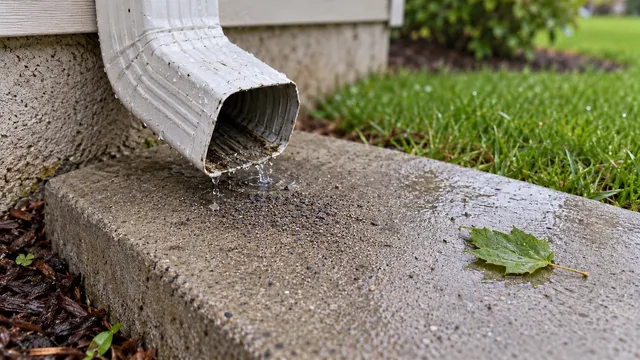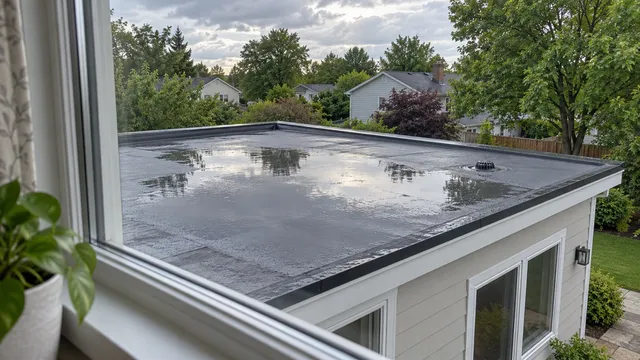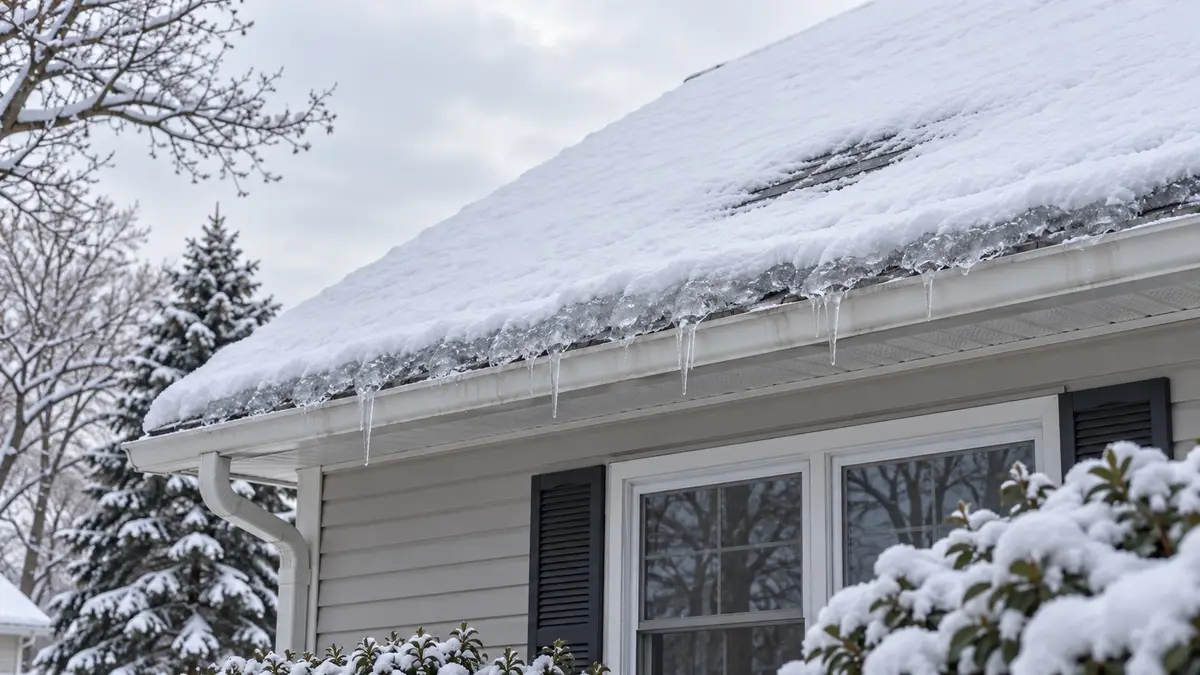
The same eave—the roof’s lower overhanging edge—grows a ridge of ice each winter, perhaps even after you paid for new shingles or more attic vents. A damp ceiling near the exterior wall can reappear weeks after the snow started. The ice comes back because the cause lies beyond the visible ridge.
The roof sheds water downhill. A dam holds meltwater at a cold edge until it can move beneath the covering. There is no authoritative national price for ice-dam removal, air sealing or insulation; attic access, roof geometry and damage make local itemized quotes essential.
What should you do if an ice dam is leaking now?
Keep people and pets away from the eave beneath large icicles. Do not climb the roof, lean a ladder against the ice, pry at it or apply chemicals or open heat. University of Minnesota Extension warns that winter roof work can injure people and damage the roof. OSHA’s winter-hazard guidance also notes slippery ice, hidden skylights, electrical hazards and the possibility of snow-loaded roof collapse.
Move belongings and catch a small drip where it is safe. Photograph the ice and the first indoor stain, then call a roofing contractor or qualified ice-dam removal service for temporary relief. A channel through the ice may let trapped water out for a short time, but Minnesota Extension says it becomes ineffective within days. Stay clear of a bulging ceiling and call a water-damage restoration contractor; water near a light or outlet needs a licensed electrician. If a claim may be involved, promptly report and document the loss. The interior water-claim guide explains how cause and timing are assessed.
Why do ice dams return to the same roof edge?
Three conditions persist: snow on the roof, an upper roof surface warm enough to melt its underside, and an eave cold enough to refreeze that runoff. Minnesota Extension’s explanation follows the water beneath the snow to the colder overhang. Ice builds a ridge there. Backed-up meltwater can work beneath shingles, through the deck and into insulation, exterior walls or ceilings.
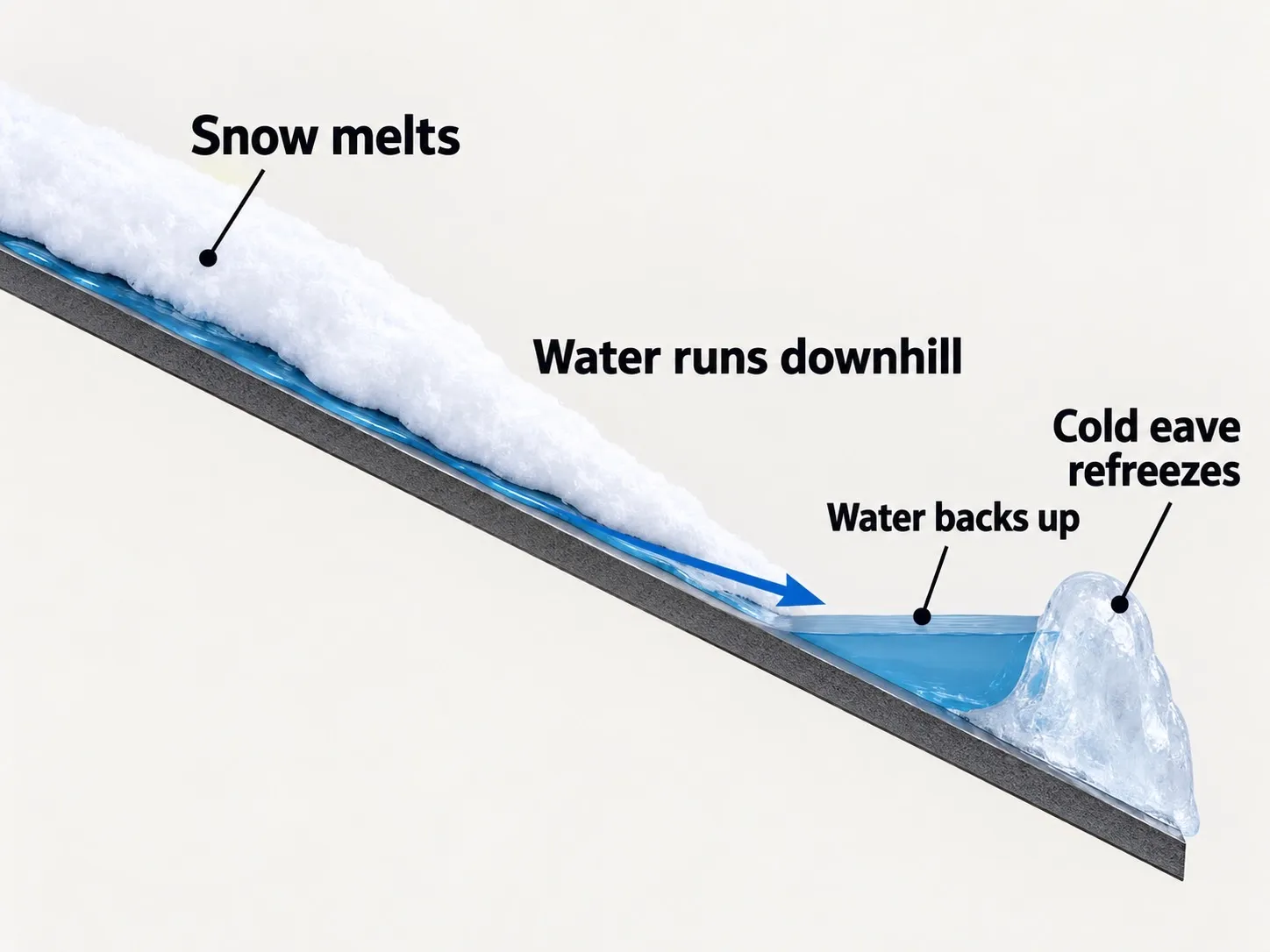
House heat is the usual source, most often through air leaks into the attic. Building Science Corporation identifies air leakage as the most common and damaging cause, while also naming inadequate insulation, heat sources such as attic ducts, and snow-depth or solar effects. A milder winter can hide a still-open heat path because the snow and temperature conditions never combine long enough.
Snow itself insulates the roof. Building Science Corporation’s companion explanation describes roughly R-1 per inch of snow (R-value measures resistance to heat flow); a deep pack can keep more heat at the roof surface. HUD’s 2000 inspection guide identifies prolonged freezing climates, especially those averaging 30°F or less daily in January. That is guidance, not a boundary excluding unusual winters elsewhere. More snow can increase risk, while extremely cold conditions may produce less melting than temperatures closer to freezing.
Why did the roof rake, heat cables or new roof fail to stop ice dams?
| Measure already tried | What it can do | Why ice can return |
|---|---|---|
| Ground-level roof rake | Remove some snow temporarily | Next snowfall meets the same warm deck |
| Professionally cut drainage channel | Release backed-up water briefly | Channel refreezes; heat path remains |
| Heat cables | Melt local water paths | Adds heat without correcting roof warming |
| New shingles and eave membrane | Reduce water entry behind ice | Membrane cannot stop ice formation |
| Extra or powered vents | Move attic air | Extra openings ease escape of warm house air before sealing |
| Insulation alone | Reduce some heat flow | Air still escapes through buried gaps |
| Gutter cleaning or guards | Keep drainage maintained | Roof-temperature difference remains |
The Minnesota Department of Commerce guide says heat cables shorten roof life and cost money to operate, and warns that chipping, chemicals and heat can damage shingles, gutters and other building components. Its advice is to seal attic leaks, not pile insulation on top of them. Building Science Corporation says eave membrane limits damage without preventing the dam. Extra vent openings give leaking house air an easier route outdoors and can worsen the problem. Once most leaks are sealed, ventilation may help.
Gutters deserve maintenance, but they do not create the roof’s warm-upper/cold-lower pattern. InterNACHI’s ice-dam guidance makes that distinction; IBHS’s winter checklist emphasizes that blocked drainage can leave water to freeze. Both can be true. A dam can form on a roof without gutters, while accumulated ice can damage a gutter. Repainting the ceiling each spring also treats a consequence; water stains bleeding through fresh paint are a separate finish problem after drying. Dry and repair it alongside the heat-loss fix, as Minnesota Extension advises.
What clues can you see without going on the roof?
Photograph the roof after snowfall and again when ice appears. Record which eaves have a ridge, where snow thins or vanishes above it, and which areas stay covered. Show those patterns to the energy assessor; they cannot identify an air leak by themselves.
| Where ice or snowmelt appears | What a professional should consider | Main trade |
|---|---|---|
| Eave above heated rooms | Ceiling air leaks and thin eave insulation | Weatherization contractor |
| Spot below fan, chimney or skylight | Local exhaust or heat source | HVAC contractor and roofer |
| Cathedral ceiling or finished attic | Tight cavity, knee wall or complex joints | Energy professional and roofer |
| Roof above attic ducts or equipment | Duct or air-handler heat | HVAC contractor |
| Sunny porch overhang | Sun and warm-wall air movement | Building-envelope professional |
A sunny dark wall can warm the air rising beneath a porch overhang. If that air is trapped there, it can melt snow even without heated rooms below, as Building Science Corporation describes. A building-envelope professional should assess that heat path.
Small sun-driven icicles alone need not mean backed-up water; Building Science Corporation distinguishes them from a dam with a water reservoir. Keep everyone away from large ice masses regardless of the diagnosis.
Look only from a safely reachable attic hatch in dry weather. Before entering, check for pebble-like gray-brown or silver-gold insulation: suspected vermiculite means do not enter or disturb it. EPA says to assume it may contain asbestos; an asbestos contractor handles work that would disturb it.
ENERGY STAR’s attic guide identifies darkened insulation as possible dust filtered from leaking house air, and frost as frozen moisture. Note deck stains, thin eave insulation, ducts and equipment from the hatch. Leave difficult access to the weatherization contractor. Wet, moldy or rotten material needs a water-damage restoration contractor; knob-and-tube wiring needs a licensed electrician. Exhausts ending in the attic need an HVAC contractor. Do not step on drywall or insulation or disturb these conditions.
Inside, date stains at the top of exterior walls and adjacent ceilings. Rain-only staining without snow calls for the heavy-rain leak investigation. Frost that wets the underside of the deck during a thaw may be attic condensation rather than an ice-dam leak. Give the pattern to the assessor rather than opening a ceiling yourself.
What should you fix before next winter, and in what order?
1. Document and dry. Save winter photos, dates, emergency invoices and the location of interior damage. Have a roofer or restoration professional assess wet deck and insulation. Minnesota Extension advises against repairing ceilings and walls before they dry and before heat loss is corrected. Visible growth on sheathing warrants a mold professional before the area is covered.
2. Measure the heat path. Hire a weatherization contractor or home energy professional. Minnesota Extension says the contractor should use a blower-door test to evaluate ceiling airtightness and may use infrared imaging to locate heat loss. Ask which leakage paths the test found.
3. Seal the ceiling plane. Common leakage points include the attic hatch, top plates (the horizontal framing atop walls), plumbing and wiring penetrations, recessed lights, chases, ducts and chimney surroundings. ENERGY STAR calls attic sealing generally challenging DIY work. The weatherization contractor must coordinate safe flue clearances with an HVAC contractor and recessed-light work with a licensed electrician. Non-IC lights are not rated for insulation contact. Do not bury a leak under new insulation.
4. Insulate after sealing. Ask the contractor to measure depth and condition, especially where insulation compresses at the eave or blocks soffit air. ENERGY STAR’s retrofit guidance, based on 2021 energy-code values, recommends R-60 for an uninsulated attic and R-49 where three to four inches already exist in zones 4A/4B and colder. These are energy-efficiency targets, not a legal rule for every existing house. Building Science Corporation’s ice-dam guidance gives lower building-science minimums—R-30 beneath a ventilated attic roof, R-35 for a ventilated cathedral ceiling, R-40 for an unvented cathedral ceiling—with more in very cold zones. Have the contractor match the target to your climate and assembly.
5. Correct other heat sources. An HVAC contractor should assess ducts or an air handler in the attic, exhausts that end there, and equipment that warms the roof. After a house is tightened, ENERGY STAR warns that gas appliances need a venting check because poorly venting equipment can allow carbon monoxide to build up. Have an HVAC technician perform that check.
6. Then review ventilation. Keep intended soffit airflow open, but ask the contractor to justify new vents after measuring and sealing leaks. IRC R806.3 in the Texas Windstorm Insurance Association’s 2024 residential code requires at least a one-inch space between insulation and sheathing at vents; Building Science Corporation recommends two inches in snowy regions. InterNACHI recommends three inches. Those are different authorities and purposes, not one combined requirement. Check local adoption. Minnesota Extension does not recommend mechanical attic ventilation as an ice-dam solution in Minnesota.
7. Coordinate roof-edge repair. A roofer should assess eave shingles, deck, flashing and gutters and discuss membrane when reroofing is already justified. Some very snowy or complex roofs can still ice after good air sealing; a roofer and building-envelope professional may need to consider a vented roof design. Air sealing should greatly reduce damaging dams, not promise an ice-free roof in every winter. Compare the same eave at the first real snowfall with your photos.
What should a roofer check at the eave?
Ask whether the deck at the exterior wall is stained or soft, whether flashing and gutters are secure, and whether a proper ice barrier exists. In the 2021 residential code as adopted in Colorado, jurisdictions designate where a history of ice-dam backup requires an eave barrier. That model-code text runs the barrier from the eave to at least 24 inches inside the exterior wall line and, on slopes rising at least eight inches per 12 horizontal inches (8:12), at least 36 inches along the slope. Detached accessory structures without conditioned floor area are excepted. Your local code edition and designation control.
An overlay over a water-soaked or deteriorated covering or two existing roof coverings is barred under that code’s reroofing provision. See when overlay or tear-off fits; ask the roofer to document deck condition before proposing either. A metal roof can shed snow more readily but does not cure a warm roof. Building Science Corporation describes ice-dam leakage under metal as well as shingles.
How should you handle next winter and compare quotes?
A roof rake used from the ground can remove snow temporarily, but Minnesota Extension says it may damage roofing material. Keep clear of overhead lines and falling ice; do not pull at the ice ridge. Heat cables are a stopgap, and any cable circuit belongs to a licensed electrician following its product instructions. Professional ice removal can relieve an active leak, but ask how the service protects shingles and gutters and what it found at the eave. It does not replace an energy assessment.
Compare written bids by attic access, blower-door and infrared testing, air-sealing locations, insulation type and target, eave depth, baffles (channels preserving airflow above insulation) and vent work, ducts or exhaust changes, wet-material removal, roof repair and membrane extent, permits where required, and post-work testing. ENERGY STAR notes local utility rebates and the Weatherization Assistance Program for eligible households.
Sealing can leave more snow on the roof because less escapes as heat. Minnesota Extension says a house built to current code should not have a structural problem; for an older home or missing plans, ask a structural engineer rather than estimating snow-load safety yourself.
Coverage for a repeat leak depends on policy, insurer, state and facts. The 1999 ISO sample homeowners form excludes wear and inadequate maintenance and requires reasonable protection and repair records. Washington’s insurance regulator says sudden leaks are usually covered but gradual leaks may not be. A history of repeat damage can affect how a claim is viewed. Report promptly, document and mitigate; read your own policy and ask your insurer for the claim basis in writing.
Frequently asked questions
Will cleaning the gutters stop ice dams?
No. Keep gutters draining, but the ice ridge can form on a roof without gutters. Find what warms the snow above the cold eave.
Can more attic vents solve a recurring ice dam?
Not by themselves. Added vents before air sealing can worsen the movement of warm house air through the attic. Seal leaks first; then have an energy professional calculate ventilation for the roof assembly and local code.
Why did a new roof with ice-and-water shield still get ice?
The barrier is backup waterproofing, not a heat-control layer. Ask a roofer whether it limits leakage and a weatherization contractor where heat still reaches the roof.
Should heat cables stay after sealing and insulating?
There is no blanket keep-or-remove answer. Have a licensed electrician assess the existing circuit under its product instructions and coordinate the decision with the roof and energy plan. Cables remain temporary ice management, not a repair to the heat path.
Is a roof rake a safe fix?
It can be used from the ground with care, but Minnesota Extension warns it may damage roofing. Stay clear of wires and falling ice. It removes snow temporarily; next snowfall can remake the dam.
Will a better-insulated roof hold too much snow?
It can retain more snow because less heat melts it. A current-code home should generally be designed for the local load, according to Minnesota Extension, but ask a structural engineer about an older home or uncertain design. Do not use the ice pattern as a structural safety test.