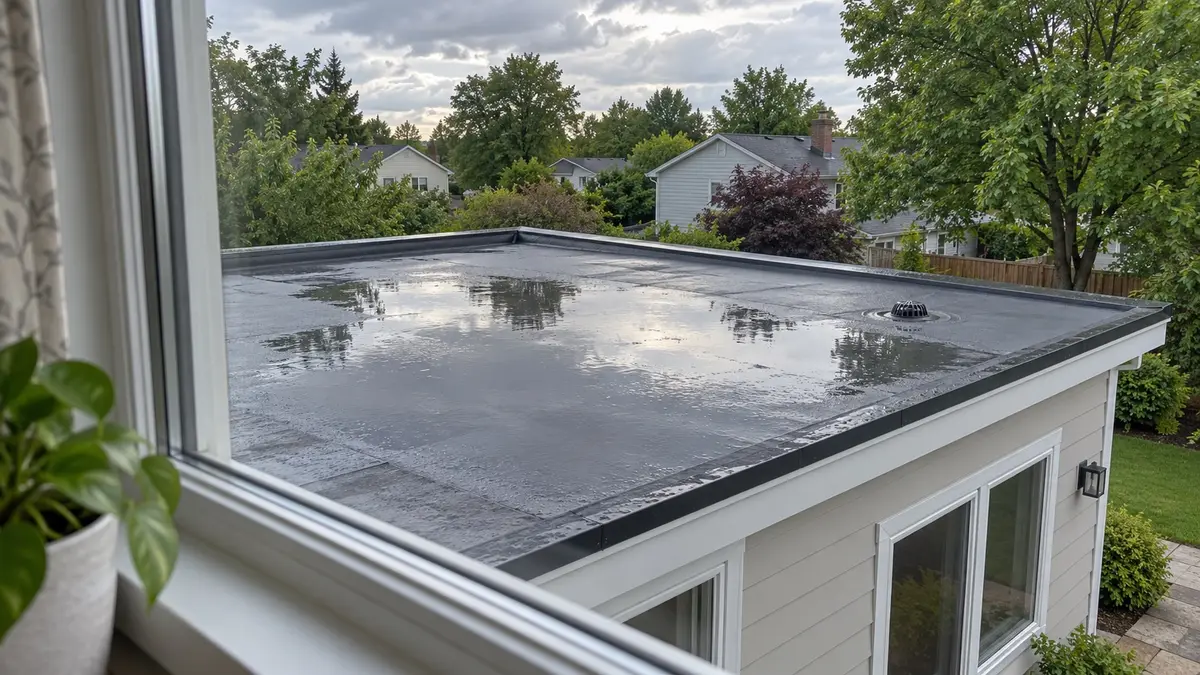
You can see a shallow pool on your porch or addition roof from an upstairs window. A low-slope roof drains more slowly than a steep one, but the important clues are how long the water remains, where it sits and whether that pattern has changed.
The covering also matters: a continuous waterproof membrane handles water differently from shingles that depend on runoff. A puddle on a near-flat shingle or roll-roofing section raises a material question as well as a drainage question. There is no reliable national repair price: clearing a drain, rebuilding slope and repairing a sagging deck are different scopes requiring local quotes.
When does standing water become ponding?
The working industry line is about 48 hours after rain stops, under drying conditions. SPRI, citing NRCA, uses that definition of ponding. The model residential code’s definition of positive drainage also uses 48 hours. Neither is a home inspection pass/fail test. SPRI says there is no universally accepted standard that sets an allowable pond’s depth or area.
Cold, humid or cloudy weather slows evaporation. A small area that clears by the next day after most storms is different from a pool that regularly remains through a dry second day. “Flat” roofs should still have designed slope: model residential code provisions call for at least ¼ inch per foot for most membrane systems, with a coal-tar built-up roofing exception of ⅛ inch per foot (⅛:12). The locally adopted code and the installed system determine what applies.
Which ponding signs need a call today?
Keep people out of the space below and call a roofing contractor today if a ceiling under the pond bulges, sags, cracks or drips; if the roof’s low spot grows deeper or wider between storms; or if water rises behind a parapet, a wall around the roof edge, with no visible overflow path. A growing pond or visibly deflecting deck or ceiling also needs a licensed structural engineer today. HUD’s 2000 inspection guide calls for structural correction of a sagging deck before it worsens.
The reason is a cycle: a sagging span holds more water; more water adds load and can deepen the sag. SPRI calls this ponding instability. A stable shallow wet area and a pond that grows after each storm do not have the same urgency. Heavy snow on a roof that already ponds, or frozen drains, requires a same-day call to a low-slope roofer; IBHS’s winter guidance describes the added load from trapped water and snow.
If water reaches a light fixture, fan or outlet, leave it untouched. Turn off the circuit only if the panel is dry and undamaged and you can reach and operate it safely without crossing water. A qualified electrician must evaluate water-damaged equipment before reuse, according to the Electrical Safety Foundation.
Book a low-slope roofer soon when a pond repeatedly survives 48 hours, even without a leak; when old dirt rings or plant growth show repeated wetting; or when seams, blisters or interior stains appear. Water that clears within a day or two, with no interior signs and free drainage, can be logged and raised at the next roof inspection.
What can you check without going onto the roof?
Photograph the same area from an upper window when rain ends, then roughly 24 and 48 hours later. Include a fixed feature such as a wall or drain so the change is visible. Record rain dates and whether the weather was sunny, cold or humid. Look at the rooms below for stains, cracks and changes in ceiling shape; an indoor stain may appear away from the pond because water can travel through roof layers.
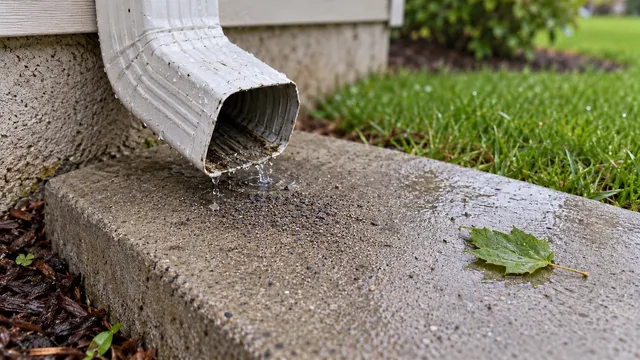
From a safe ground view, note whether an outlet downspout or scupper is discharging. A scupper is an opening through a roof-edge wall that lets water leave. Check only ground-level outlet ends for an obvious blockage or crushed section. Leaves in a rooftop strainer, ice at a high drain or work near a parapet are the roofer’s job.
Do not walk a wet membrane, push water with a broom, wet-vac it, puncture the covering or chip ice. Wet surfaces, skylights and unguarded edges make roof access hazardous. Johns Manville’s maintenance instructions also warn against puncturing or power-washing a membrane. A rushed coating or patch can cover the evidence a roofer needs to see.
Why is water collecting in that spot?
The location and timing narrow the likely cause; they do not diagnose a concealed leak. Give this pattern to the roofer instead of asking for a generic “flat-roof fix.”
| Pattern you can see | Likely line of inquiry | Professional to call |
|---|---|---|
| Sudden pool around a drain after leaf fall | Blocked strainer, scupper or leader | Low-slope roofer |
| Same pond since the roof was new | Drain placement or designed slope | Low-slope roofer or roof consultant |
| Growing pool in the middle of a span | Deck deflection or wet insulation | Roofer and structural engineer today |
| Water appears without rain near equipment | HVAC condensate or rooftop water line | HVAC technician or plumber, with roofer |
| Pond at a patched low spot | Built-up repair or local depression | Low-slope roofer |
A drain blockage is often simpler than a redesign. But water collecting when it has not rained is a strong clue to look for another source. Johns Manville calls out condensate lines and shows a split rooftop water line creating a persistent pool. An HVAC technician or plumber may need to correct the source; the roofer checks any damaged membrane.
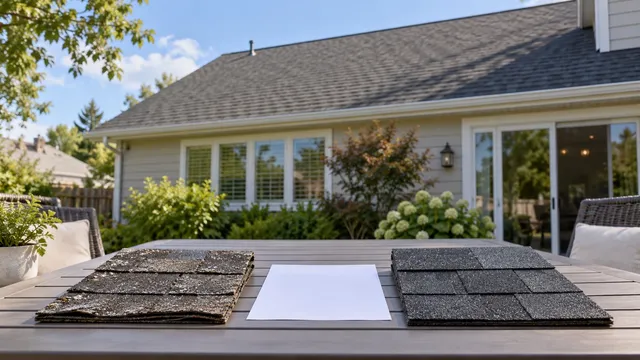
A porch roof with shingles below the model code’s 2:12 minimum, or roll roofing below its 1:12 minimum, may need a different system or more slope rather than sealant. Local adoption and the manufacturer’s instructions decide the proper assembly. A shallow roof may also receive runoff from a higher roof; the roofer should trace that path and the drain capacity. If water appears indoors only during a downpour, the heavy-rain leak pattern offers a separate clue.
What does ponding do before a leak appears?
Water over a tiny membrane defect can keep feeding it after the rain ends. A leak may show far from its entry point. Prolonged water can also leave sediment, algae or vegetation that marks recurring ponding. The EPDM Roofing Association, a rubber-roofing trade group, describes organic-felt decay in built-up roofs, algae on light-colored roofs, granule loss on modified bitumen, and premature curing and surface cracking in non-vulcanized thermoplastic membranes. These are interested-source comparisons, not a diagnosis of your roof.
Water adds load. USGS lists water density at about 62.4 pounds per cubic foot. One inch over one square foot is one-twelfth of a cubic foot, or about 5.2 pounds per square foot. That arithmetic is not a safe-depth rule: only a structural engineer can evaluate the roof’s capacity and a growing pond’s load.
Ponded water can freeze and compound snow and drain problems. Standing water on roofs can also support mosquitoes, according to the American Mosquito Control Association. For winter eave ice on a sloped roof, see why ice dams recur.
What will a roofer inspect and how can drainage be fixed?
A low-slope roofer should inspect the outlet path, drain strainers, roof slope and low points, seams and wall flashings, wet insulation signs, rooftop equipment, and the space below. A parapet-walled roof needs an overflow route where the adopted code requires one. If the deck appears to sag, a structural engineer evaluates that condition before a roofing-only fix is chosen.
The fix follows the cause: restore a blocked drain; reroute condensate; add or move an outlet to a true low point; build a small cricket behind a curb to guide runoff; fill a local depression or add tapered insulation to create slope; or replace wet insulation and damaged membrane. SPRI describes drain placement and filling depressions as ways to improve positive drainage. A roofer may use moisture testing or drainage mapping on a larger roof.
Some roof coatings are made for ponding conditions, but a coating cannot change roof slope or unblock a drain. Ask whether the exact product tolerates ponding and whether the warranty issuer permits the proposed work. Sealing over the lowest spot without correcting the water path leaves the problem in place.
Repair the drainage or replace the flat roof?
A targeted repair makes sense when the main roof remains sound and the problem is an outlet, condensate line or local depression with dry insulation. Reroofing becomes a more serious option when ponding is widespread, the membrane is broadly damaged, wet insulation extends beyond a local area, or the covering is wrong for the slope. The contractor should state what evidence led to that choice.
The model residential code grants reroofing exceptions for minimum slope and added overflow drainage only to roofs that already provide positive drainage. It does not permit a recover over a water-soaked roof or covering. The local building official decides how that applies to your house. Ask a bidder proposing a recover how wet areas will be identified and removed, and how the finished roof will drain. The overlay-versus-tear-off guide explains the covering decision; roof replacement quote comparison helps with the written scope.
Do warranties or insurance cover ponding water?
Read both the manufacturer’s document and the installer’s workmanship warranty before anyone coats or patches the roof. The EPDM Roofing Association says ponding will not void a manufacturer’s EPDM rubber-roof warranty or be the sole reason to deny issuing one.
By contrast, Johns Manville’s guarantee guide excludes damage from improper drainage. It describes coverage for TPO and PVC, two thermoplastic sheet membranes, as available with prior approval. These commercial-system documents do not set the terms for your house. Contact your actual issuer before repairs to confirm who may do the work and how a coating affects coverage.
Insurance is a separate question. A 1999 ISO sample homeowners form lists the weight of rain collecting on a roof among covered causes of collapse, but its definition of collapse excludes mere sagging or bulging, and it excludes other causes such as wear or faulty design. Your policy may differ. Document the rain, pond, maintenance and any sudden damage, then ask your insurer or agent about your terms. Our water-leak insurance guide explains why cause and timeline matter.
What should the flat-roof estimate include?
No reliable national price covers the range from clearing a drain to rebuilding slope or repairing a sagging deck. Ask for local written proposals that name the roof system, proposed drainage path, wet-area findings, drain or scupper work, slope materials, membrane and insulation replacement, permits if required, disposal, warranty terms and who handles equipment or electrical work. Access height, interior leaders and structural work can change the scope substantially. Ask for photos and unit prices for uncertain work.
Have a qualified low-slope roofer inspect the roof after unusual storms and on a routine schedule. Johns Manville recommends at least twice-yearly inspections, drain clearing in spring and fall, and records of service. Arrange rooftop maintenance through the contractor; keep your dated photo log from the window.
Frequently asked questions
Is a pond under ¼ inch or under 1 inch acceptable?
Neither number is a universal safe-depth rule. SPRI says no universally accepted quantitative standard defines acceptable ponding. Track duration, repeat pattern, change in depth and interior signs, then have a roofer evaluate the roof.
My new flat roof holds water for days. Should I accept “it will evaporate”?
No, not as the whole explanation. Give the installer dated photos from the same viewpoint and ask for a drainage assessment against the design, product instructions and written workmanship warranty. The roofer should explain where the water is meant to go.
Why can’t I squeegee or vacuum water off the roof?
A wet membrane, skylight or unguarded edge creates a fall hazard, and the covering may conceal a soft area. Use an upper window, ground-level outlet view and dated photos instead. Have a roofing contractor clear or repair rooftop drainage.
Will a ponding-rated coating fix the problem?
No, a coating alone does not fix drainage. Some products withstand ponding, but they cannot create slope, relieve a sagging deck or clear a blocked outlet. Check product and warranty terms before work.
Does ponding void a flat-roof warranty?
It depends on the issuer and the exact system. Trade-association and manufacturer examples differ. Read both material and workmanship documents and ask the issuer to confirm the proposed repair in writing.
A home inspector found ponding before I buy. What should I request?
Ask for dated rain history, roof warranty, maintenance and repair records, and a low-slope roofer’s written assessment of drainage, membrane and insulation. A dirt ring shows where water has sat; it cannot establish whether hidden materials are dry. If sag is visible, include a licensed structural engineer.
Sources
- SPRI — Roof Drainage Assessment Using 3D Laser Scanning
- UpCodes — Colorado Residential Code Definitions
- UpCodes — Colorado Residential Code Roof Assemblies
- HUD — Residential Rehabilitation Inspection Guide
- IBHS — Winter Ready
- Electrical Safety Foundation — Water-Damaged Electrical Equipment
- Johns Manville — Preventative Maintenance Brochure
- Johns Manville — Understanding Your Peak Advantage Guarantee
- EPDM Roofing Association — Ponded Water Performance
- EPDM Roofing Association — Ponding and Warranty
- U.S. Geological Survey — Water Density
- American Mosquito Control Association — Mosquito Control
- Roof Coatings Manufacturers Association — FAQs
- Insurance Information Institute — ISO Homeowners 3 Sample Form