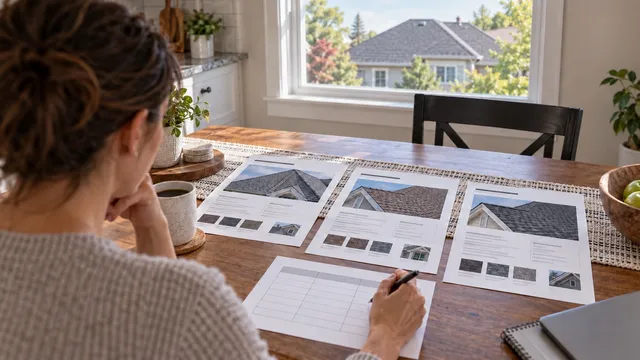
One roofing proposal says “tear off and replace.” The other offers to put new asphalt shingles over the old ones. Those bids buy different work, even if both promise a new-looking roof.
The lower bid avoids removing and disposing of an old covering. It also leaves the roof deck—the wood beneath the covering—out of view from above. If storm damage has already pushed you toward replacement, establish what is on the roof before comparing the totals.
Roof overlay vs. tear-off: what stays on the house?
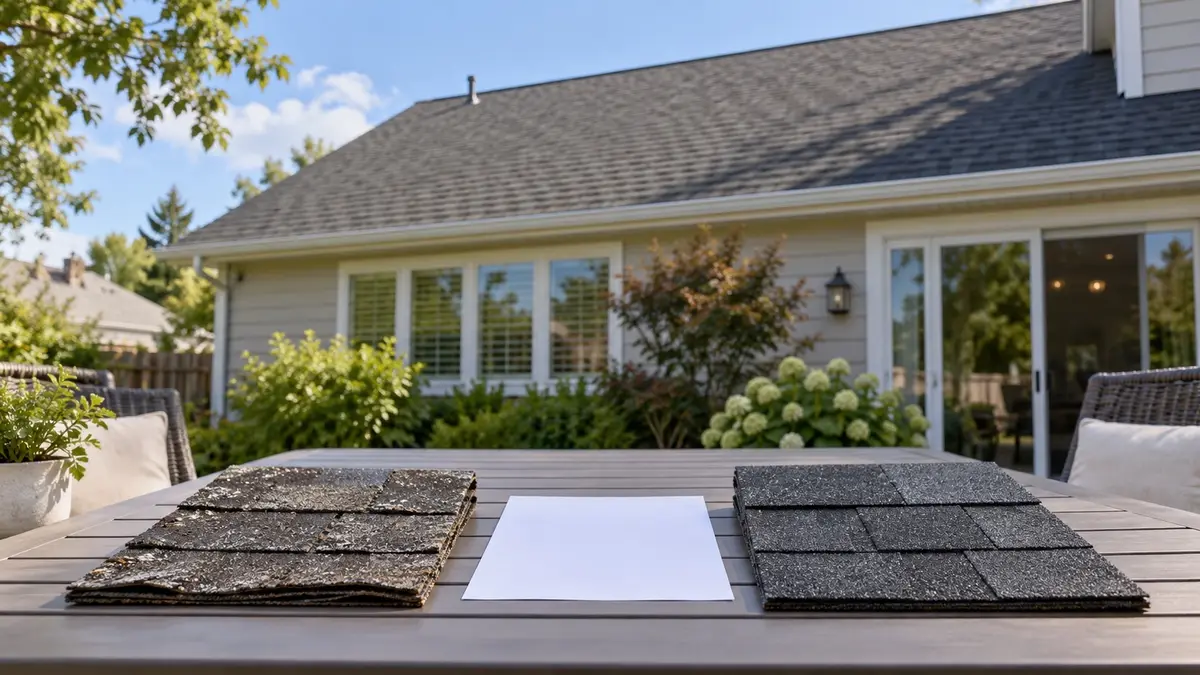
Roofers may call an overlay a roof-over, layover, or recover. The Asphalt Roofing Manufacturers Association (ARMA) defines a recover as a new roof covering over an existing one. A tear-off, or replacement, removes the old covering, repairs a damaged substrate, and installs a new covering. The replacement language in adopted residential code specifies removal down to the deck.
| Work | Recover | Tear-off |
|---|---|---|
| Existing covering | Stays beneath new shingles | Every covering layer comes off |
| Deck | Judged from attic and roof surface; hidden from above | Fully exposed for inspection and repair |
| Old flashing and edge metal | Replace rusted, damaged or deteriorated pieces | Same replacement rule; exposed for reconstruction |
| Removal and disposal | Usually avoided, except required local work | Included for removed materials |
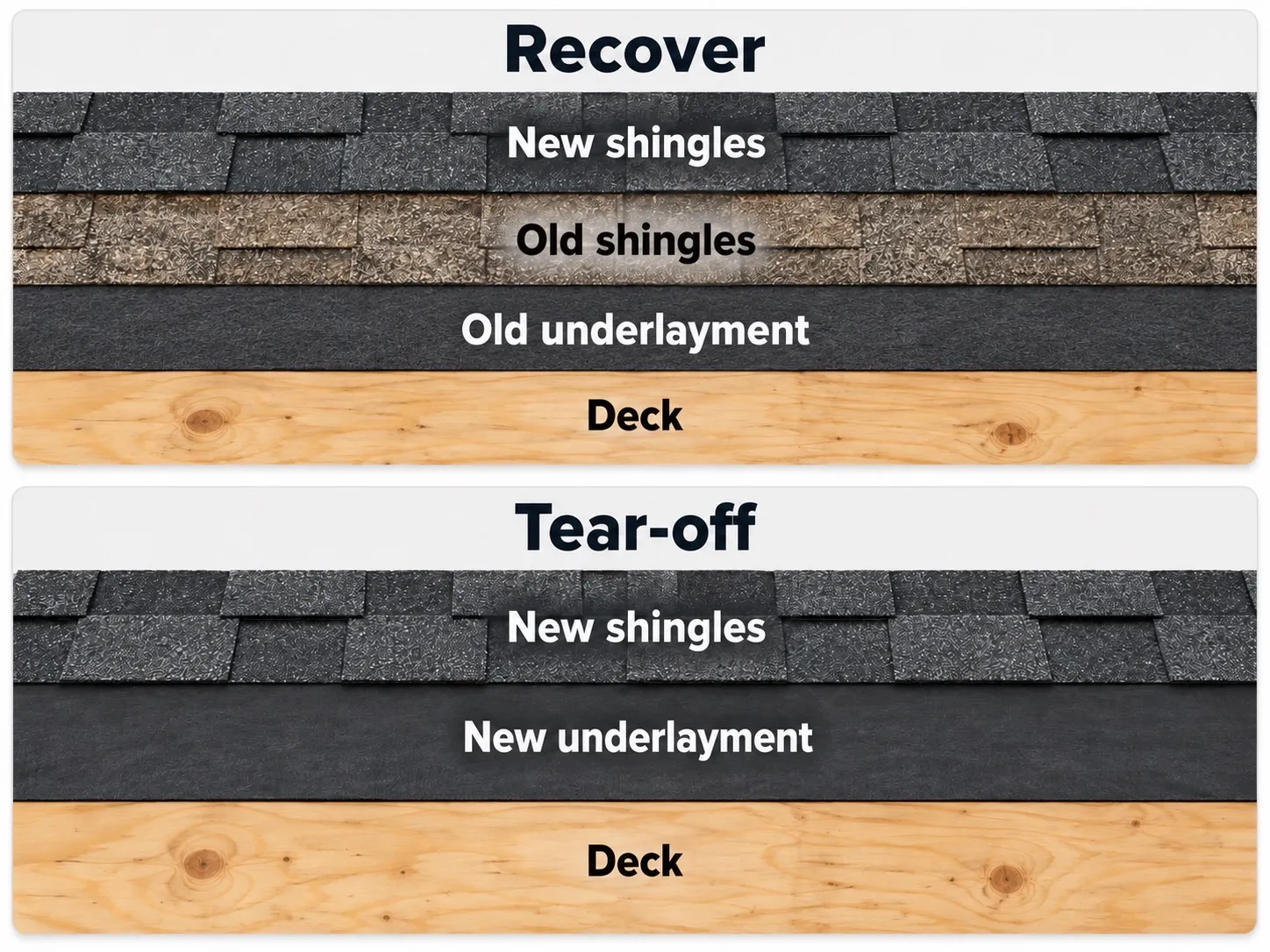
Conceptual layer comparison, not an installation specification.
An overlay is a legitimate option for some roofs. ARMA says one flat existing layer on a sound deck can serve as a secondary backup and save removal work. The question is whether this roof passes the checks below.
Is an overlay allowed with the layers already on your roof?
Start with local code. The model-code recover restrictions reproduced for a Colorado adoption bar a recover when the existing roof is water-soaked or too deteriorated to support new roofing; when the old covering is slate, clay, cement or asbestos-cement tile; or when there are already two or more applications of any type. One layer of asphalt laid over original wood shingles is already two applications. Adding a third is different from laying a second over a single sound layer.
These are model-code provisions adopted and sometimes amended locally, not a national permission slip. Florida’s adopted building code, for example, also names wood shake among coverings that must come off. Ask the building department which code and permit rules govern your address. The code also requires the roof structure to carry the new covering and construction loads. A roof with a sagging ridge needs a licensed structural engineer’s assessment before another layer is added.
How can you find the layer count without climbing up?
Find the last roof contract, reroof permit, purchase inspection and seller disclosure. An invoice saying “recover” is useful history; it does not replace a present check. From the ground, use binoculars to look at the eave and where the roof meets siding. HUD’s residential inspection guide shows how a second covering can crowd a former gap at a sidewall. A thick edge can also be a starter course, so appearance alone is not a count.
Ask the roofer to photograph an accessible edge and identify every covering there. The attic can show deck condition, but it does not tell you how many shingle layers are above it. Do not lift shingles or lean over an eave from a ladder to settle the question yourself.
Can the old shingles and roof deck support another layer?
One existing layer still needs to be flat and essentially intact. ARMA says rotten, warped or otherwise damaged deck boards must be replaced. Board gaps greater than ¼ inch are a separate reason to consider code-compliant sheathing over the plank deck. Shingles too distorted to flatten also weigh against a recover. A low spot or sag across a truss line calls for a structural engineer. A new shingle course cannot repair the wood beneath it.
The shingle type matters too. Laminated, or architectural, shingles have a dimensional surface. ARMA says most manufacturers do not recommend installing new shingles over existing laminated ones. TAMKO’s Heritage instructions explain that laminated-over-laminated installation is not recommended because unevenness may prevent the sealant from sealing properly; laminated shingles over flat, essentially intact three-tab shingles are acceptable under those instructions. Ask what is on your roof and what the proposed new product says. An uneven base can also explain why a new asphalt roof looks wavy.
Preparation is part of a recover. TAMKO calls for securing or removing curled and broken shingles, replacing missing ones to make a smooth base, correcting buckles or protruding nails, and replacing drip edge. The new courses must be placed correctly against the old profile. Fasteners must reach the deck through all those layers; the adopted residential code’s asphalt-shingle provision calls for at least ¾ inch of penetration into sheathing, or through sheathing thinner than that. “Shingles over existing” says nothing about this work.
What can you safely see from the attic and ground?
Before any attic observation, require safe access, good light and an installed walkway or secure framing; avoid extreme heat. If loose insulation resembles gray-brown or silver-gold pebbles, do not enter or disturb it. EPA says to assume vermiculite contains asbestos; tell the roofer and use an accredited asbestos professional before work that could disturb it.
From a safe position, look for stained or visibly damaged sheathing, rusted nail tips and nails that missed framing. HUD lists rusting nails and wet or rotted sheathing as signs needing closer inspection. Have a roofing contractor investigate; the attic view cannot clear the whole deck. For wet sheathing, distinguish a roof leak from attic condensation before covering the roof again.
From the ground, note broad curling, lumps, patched or rusted flashing, and any dip along the ridge. Ask a licensed structural engineer to assess any changed roofline before a contractor adds weight. Do not climb the roof or probe the deck.
What do shingle instructions and warranties say about a recover?
The model code includes installation under the new covering manufacturer’s approved instructions among its recover conditions. That makes the exact product document more useful than a broad warranty promise.
| Document to request | A documented example | Question for your roof |
|---|---|---|
| Installation instructions | TAMKO cautions against laminated over laminated | Does this product allow the existing surface? |
| Wind terms | TAMKO’s High Wind Warranty applies to new construction or complete tear-off, not recover | Which wind tier will this installation receive? |
| Extended coverage | IKO ROOFPRO excludes installation directly over an existing layer from two extended protection tiers | Which written tier applies? |
| Impact rating | ARMA says ratings may be affected by recovering | Does your insurer accept this installation? |
The IKO ROOFPRO terms say installation over existing roofing voids the named extended Iron Clad and CodePlus protections. That does not mean every IKO warranty, or every manufacturer’s warranty, is void. The IKO standard limited warranty separately excludes damage from deck or roof-base problems and inadequate ventilation, and does not cover tear-off and disposal costs during its early-coverage period. Read the exact product’s terms with the contractor.
NRCA’s warranty advisory cautions against choosing a roof by warranty length alone: warranties cover particular failures and typically do not promise a leak-free roof. The practical comparison is which coverage and installation rating each proposal actually qualifies for.
How do ice, wind and hail change the decision?
In an area where local code requires an eave ice barrier, a recover can involve a partial tear-off at the eaves. TAMKO’s recover instructions call for removing old roofing at least 24 inches beyond the interior wall line when new flashing is needed to protect against ice dams, then applying the barrier on the deck. If your roof has recurring ice dams, ask exactly how the new barrier will reach the deck. A tear-off may also leave an old barrier bonded to the deck under a code exception if removal would damage the deck; the roofer should explain it.
In high-wind areas, deck-level changes cannot be performed through an intact old covering. The FORTIFIED Roof program calls for a sealed deck, stronger deck attachment and edges. Florida’s statute adds specific roof-replacement mitigation work for qualifying homes; it is a Florida rule about replacement, not a blanket rule for every recover. Ask whether a proposed program or local requirement needs a full tear-off.
In hail areas, ARMA says a shingle’s impact-resistance rating may be affected when installed over old shingles. Oklahoma’s insurance department says many insurers offer discounts for impact-resistant roofing. Check your own insurer’s installation criteria before buying an impact-rated product for a discount. A hail inspection after a storm is a separate decision from choosing its replacement method.
Cold-weather recovering also demands a smooth surface: ARMA warns that unevenness under shingles installed in cold weather can become “locked in.” For shallow porch or dormer slopes, the adopted residential code permits asphalt shingles at 2:12 or steeper—two inches of rise per 12 horizontal inches—with double underlayment from 2:12 up to 4:12. HUD’s older 2000 guide says no less than 3:12. These differ: have the roofer identify the locally adopted requirement and the actual product’s instructions.
When is overlay reasonable, and what does tear-off buy later?
A recover is worth considering only after the local rules, one-layer count, flat allowed surface, sound deck and framing, product terms, and regional details all line up. It avoids removal and disposal, and ARMA describes the old layer as a backup. Its weakness is what stays concealed: the deck cannot be fully seen from above without removing shingles.
A tear-off exposes the deck for repairs and improved attachment. It also avoids leaving two layers for the next reroof; under the model-code limit, that future job must remove them both. HUD’s 2000 inspection guide estimated about 20 years for a first shingle layer and about 15 for a second, depending on weight, quality and exposure. That older estimate is context, not a prediction for your roof. Published savings percentages and claims that an overlay traps heat do not provide a reliable comparison here. Get local prices and have the contractor evaluate ventilation.
Think about upcoming work too. The Department of Energy tells owners considering solar to account for roof age and time until replacement. If solar is planned, compare the roof sequence before deciding that a cheaper covering now is best.
Why are the overlay and tear-off prices different?
There is no reliable national overlay-versus-tear-off price that can price your roof. NRCA’s homeowner resources point to differences in roof design, materials, location and work scope. Request local, itemized bids for the same shingle product and identify what one scope omits. Our roof-quote comparison guide breaks those line items down further.
| Cost driver | What to compare |
|---|---|
| Tear-off and disposal | Number and type of layers removed; cleanup and property protection |
| Deck work | Included repair quantity and price per additional sheet or board |
| Recover preparation | Flattening, replacement of missing shingles, fastener length and new edge metal |
| Water details | Ice barrier, underlayment, step flashing, chimney flashing and pipe boots |
| Administration | Permit, inspection, written change orders and payment schedule |
If asbestos-containing roofing is suspected, it cannot be identified by sight. EPA advises using accredited professionals for suspect material. That is a separate scope and price, not an unpriced surprise to bury in “remove old roof.”
What should you ask the roofer and insurer before signing?
Before signing, collect the edge photograph, attic findings, product instructions and written warranty tier. Confirm the new or reused flashing, ice-barrier access and permit responsibility. A roofer recommending a recover without checking the edge or attic has not resolved its two central uncertainties.
If insurance is involved, ask the agent whether the installation affects an impact-resistance discount or roof-condition underwriting. The Texas Department of Insurance says the insurer will inspect your roof when you apply for insurance and may charge more or refuse coverage based on its condition; it does not say that a particular layer count ends coverage. When a storm claim meets a code-required tear-off, ask about your policy’s ordinance-or-law terms. And read any assignment of benefits before signing: the NAIC says one is not required to get repairs done. For a claim involving interior water damage, see how cause and timing affect water-leak coverage.
Frequently asked questions
A home inspection says there are two layers. What should I ask a seller?
Ask for the prior roofing contract, permit and any warranty, then have a roofer confirm the layers and assess condition. In jurisdictions using the model-code restriction, another recover over two applications is barred. The likely next scope includes removing both, so compare that written scope when discussing the purchase.
Is a thick eave edge a second layer or only a starter strip?
You cannot reliably tell from a thick-looking edge at ground level. A starter course can create the same impression. Ask the roofer to photograph an accessible edge and identify each covering; do not lift shingles from a ladder.
Is an overlay smarter if I expect to sell soon?
Only if the roof passes the same code, condition and product checks it would for a long-term owner. Ask for both itemized options and keep the inspection and permit records for a buyer. A short ownership plan does not fix hidden deck damage or change the next tear-off requirement.
Does a second layer trap heat and wear shingles out faster?
That heat-retention explanation is not established by the available technical guidance. HUD’s older estimate gave a shorter life for second layers, with weight, quality and exposure affecting the result. Ask the roofer to inspect ventilation and follow the new shingle’s instructions rather than treating a heat claim as a diagnosis.
Sources
- ARMA — Asphalt Shingle Reroofing: Replacement vs. Recover
- UpCodes — Adopted Residential Code, Roof Assemblies
- UpCodes — Roof Recover Not Allowed
- UpCodes — Florida Existing Roofing
- HUD — Residential Rehabilitation Inspection Guide
- TAMKO — Heritage Application Instructions
- IKO — ROOFPRO Extended Warranty
- IKO — Limited Warranty for Asphalt Shingles
- NRCA — Roof System Warranties
- ARMA — Recommendations for Installation of Asphalt Roofing Shingles in Cold Weather
- FORTIFIED — FORTIFIED Roof
- Florida Senate — Florida Statutes §553.844
- Oklahoma Insurance Department — Wind and Hail
- EPA — Vermiculite Insulation
- EPA — Protect Your Family from Exposures to Asbestos
- DOE — Homeowner’s Guide to Solar
- NRCA — Roofing Guidelines Resources
- Texas Department of Insurance — Insurance and Your Roof
- NAIC — Assignment of Benefits: Consumer Beware