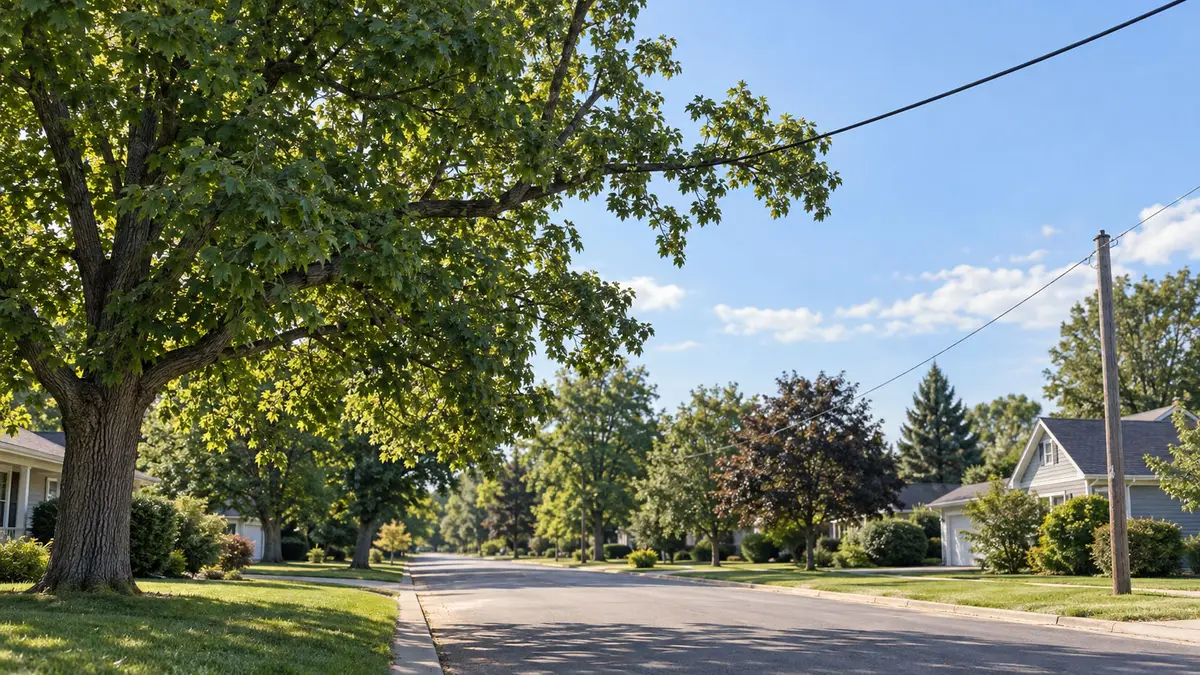
A branch is resting against an overhead wire, perhaps after last night’s wind. It may be a neighbor’s tree, and the wire may look insulated. Neither observation answers whether the area is safe or who can work there. The immediate job is to report the contact without approaching it.
The electric utility must identify the facility and set the electrical conditions for any tree work. No reliable national price or responsibility rule covers all utilities and properties: work scope, disconnect policy, cleanup and payment require local answers after the hazard is reported.
Who should you call when a tree touches power lines?
Call 911 from a safe location for a downed, dangling, unusually low or damaged wire; a broken tree or limb on wires; sparks, smoke or fire; or anyone in immediate danger. Follow the dispatcher’s directions. Then notify the serving electric utility through its emergency channel if dispatch has not arranged that contact. FirstEnergy routes downed-line reports through 911 and says dispatch alerts the utility; PG&E directs 911 followed by PG&E. Your serving utility’s current instructions govern the local follow-up.
If a standing tree appears to touch intact overhead wires without visible emergency signs, call the electric utility promptly for assessment. A tree can become energized through contact, according to Seattle City Light. Quiet contact is not permission to wait until the next scheduled trimming visit. If you cannot tell whether there is immediate danger, use 911.
If branches are merely approaching wires and contact is not known, request the utility’s vegetation assessment through its designated channel. New damage or electrical activity moves the situation to the emergency route. A web form, uploaded picture or outage report does not replace the call for a live hazard. A wire hanging in a tree is an emergency even if it never reaches the ground.
The emergency row overrides the standing-tree row whenever a wire’s condition is uncertain or any emergency sign appears.
| Already observed from safety | First contact | What not to wait for |
|---|---|---|
| Downed, dangling, unusually low or damaged wire; broken tree or limb on wires; sparks, smoke, fire or immediate danger | 911 first; then utility under dispatcher direction | Wire identification or account number |
| Standing tree touching apparently intact wire, with no emergency sign | Serving electric utility promptly | A spark or pruning schedule |
| Tree growing toward wire, with no known contact or emergency sign | Utility vegetation channel | A homeowner clearance measurement |
Report a neighbor’s tree or street tree the same way. Ownership can be sorted out after the electrical situation is assessed. Do not enter someone else’s land or walk under the contact to establish whose trunk it is.
What should you avoid near a tree touching wires?
Do not touch the tree, branch, wire, fence or nearby equipment. Do not push or shake the limb, pull it with a rope, cut it, climb, use a ladder or pole saw, or retrieve debris beneath it. Keep children and pets away without crossing the area yourself to place tape or move objects. Tell dispatch if a walkway, driveway or home exit is affected.
OSHA’s downed-wire fact sheet explains why apparent calm is unreliable: a fallen line may stay energized, circuits may restore automatically, and nearby trees, fences, buildings or other cables can become energized. Neither a silent wire nor a neighborhood outage proves isolation. A household breaker cannot establish that the overhead work area is safe. Ordinary gloves, boots and wooden tools are not substitutes for utility direction; Dominion Energy’s safety guidance warns against treating household protective items as electrical protection.
You do not need to identify a wire by height, coating or color. OSHA warns against assuming an unknown wire is harmless communications cable. Even if a communications provider owns a line, contact with an electric line or another energized object may change the hazard. Leave identification to the utility. Do not fly a drone, take a close-up photograph, or look for a pole number if that requires moving closer.
Remain well away. Emergency responders will set the exclusion area for the conditions they find. If a wire is on a vehicle or blocks the only exit, call 911 and follow incident-specific instructions instead of attempting a general escape procedure.
What should you tell the utility from a safe place?
Give the address or nearest intersection and say where the tree stands relative to the house or street only if you already know. Describe what you can already see: a standing branch on a wire, a broken limb draped over it, a low wire, smoke, fire, blocked road, injured person or affected service. State when you first noticed it. If the wire type or tree owner is unknown, say so. This is enough to begin a useful report; do not approach for more detail. FirstEnergy’s reporting guidance asks for location and observed conditions.
For a nonemergency report, ask for a reference number, who will assess the contact, and how to report a change. If the situation worsens while you wait, use the emergency route immediately. Do not interpret an outage map’s status as a safety clearance.
If the utility says private tree work will be needed, ask it to identify what electrical preparation is required and how the contractor must coordinate. Keep those instructions for the written tree-work scope. There is no reason to call a routine tree crew to the contact area before that utility assessment.
Does the utility or homeowner handle tree work near the line?
Ask three separate questions: Who owns and controls the electrical facility? Who is assigned vegetation maintenance? Who may authorize work near it? The answers do not always match. A service drop is the wire serving a building; distribution wires serve local areas, while transmission lines move power across a wider grid. The utility, not the homeowner, identifies which is present.
For example, PG&E’s vegetation program treats transmission, distribution and service-drop vegetation differently. PG&E says property owners are responsible for keeping service-drop wires clear of vegetation and dead or hazardous trees. The utility still directs electrical preparation before anyone works near its wires. National Grid’s Massachusetts guidance likewise describes utility assessment and coordination for work near a service line. These are utility-specific examples, not a national allocation of tree cost or legal responsibility.
If the utility declines routine pruning, clarify what it decided: Did it identify no immediate electrical hazard? Is the span maintained by the customer? Is another provider involved? What must happen before a private contractor works? A service refusal is not a tree-safety finding. Nor does a tree’s position across a fence give an owner permission to cut near electrical equipment. Neighbor ownership, street-tree authority, easements and permits can be resolved with the relevant owner or municipality once the area is protected.
Utility clearance work may prune toward future growth rather than make the canopy look symmetrical. FirstEnergy describes directional pruning and sometimes removal when effective clearance is not feasible. Ask the utility what it plans for this specific tree before making a separate tree-retention decision.
Who can do private tree work after the utility responds?
The utility first decides what electrical work or line clearance its crews or designated contractors will perform. If it directs the property owner to arrange further tree work, have the private tree contractor communicate with the utility before scheduling work at the tree. Some jobs require a utility-arranged temporary disconnect or other preparation. FirstEnergy’s disconnect service includes advance utility assessment; National Grid describes its own coordination for Massachusetts customers. Their charging and scheduling policies differ, so ask your utility directly.
An ISA Certified Arborist has broad tree-care knowledge. That credential alone does not establish specialized electrical qualifications or utility authorization. OSHA’s line-clearance rules distinguish trained line-clearance personnel and electrical workers; which occupational standard applies can depend on the work and employer. For the homeowner, the practical question is whether the utility has approved the electrical arrangement and whether the assigned crew is qualified for the exposure it identifies. A regular electrician is not a substitute for reporting the tree to the utility.
Ask the contractor’s written proposal to identify the tree work, utility coordination, who confirms work may begin, access and public exclusion, hauling, property restoration, and any locally required permission. Verify insurance and locally applicable licensing. A proposal based on “the wire looks coated,” “the lights are out,” or “we’ll just shut off your house” leaves the electrical problem unresolved.
After electrical access is resolved, an arborist should assess the remaining tree if storm damage or dead limbs remain. Utility clearance does not certify its structure. The broken-major-limb guide, storm-lean guide and dead branches over a house cover those separate decisions.
What should you confirm before cleanup begins?
Ask the utility whether electrical restrictions remain and whether the private crew is cleared to enter. Restored household power or a departed utility truck is not an all-clear. Confirm whether the utility repaired a line, pruned a branch, removed a tree, or only made access safe. Then put the rest of the work in a separate contractor scope.
Ask who handles the remaining trunk, large wood, brush, stump, hauling and property repair. FirstEnergy’s homeowner policy separates routine and emergency cleanup, and Mississippi Power describes its own vegetation scope. Neither establishes a nationwide cleanup promise. If stump work is left to you after the utility releases the area, compare stump grinding with full removal only then.
No reliable national price applies to an unidentified utility/tree scope, and utilities differ on disconnect fees. Request a written answer from the serving utility and itemized bids for any private tree work. If new wires sag, spark or become caught in a fresh break during cleanup, stop, keep clear and call 911 again.
Frequently asked questions
Why might utility pruning leave a one-sided canopy?
Utilities may prune directionally to keep future growth away from electrical facilities. Ask what the utility plans and have an arborist assess the remaining tree afterward if its structure is a concern. An uneven shape alone does not tell you whether the tree is sound.
What if I disagree with planned utility pruning on my property?
Ask the utility about its easement, notice and review process for that location, then raise the concern before scheduled work when safe to do so. A property disagreement does not authorize anyone to enter a live contact area or delay an emergency response. Check the applicable easement and local process with the utility or municipality.
Does utility tree removal include grinding the stump?
Generally no: FirstEnergy says its vegetation crews generally do not remove stumps or roots, though limited service may be available in some areas. Ask your own utility for its written scope before hiring a stump contractor.
What should I check before planting a replacement near power lines?
Ask the utility about corridor restrictions and choose for the tree’s mature size, not its nursery size. FirstEnergy’s planting guidance is one utility example. Have buried utilities located through the local 811 process before any digging, and confirm any street-tree permission with the municipality.
Sources
- FirstEnergy — Downed Power Lines
- PG&E — Electric Safety
- PG&E — Trees and Powerlines
- OSHA — Working Safely Around Downed Electrical Wires
- OSHA — Electric Power Generation, Transmission and Distribution
- ISA — ISA Certified Arborist
- National Grid — Tree Safety During Storms
- FirstEnergy — Temporary Disconnection for Tree Work
- FirstEnergy — Homeowner Rights and Responsibilities
- FirstEnergy — Tree Maintenance Practices
- FirstEnergy — Selecting the Right Tree
- Mississippi Power — Trees and Right of Way Management
- Seattle City Light — Power Lines on Trees
- Dominion Energy — Safety Around Electricity