
The tub looks rusty near the drain and dull across the basin, but the tile around it still looks good. Removing the fixture could turn a surface update into a wall, floor, and plumbing job. Covering a damaged fixture could leave the real problem in place.
Before comparing estimates, check what you see on the finish from what may be happening in the body of the tub and its installation. There is no verified national price or remaining-life figure that can make that decision for a specific old fixture. Request local, written scopes for the work its condition actually needs.
Should you refinish or replace an old bathtub?
A coating changes the bathing surface. It cannot stabilize a moving tub, restore a broken shell, or seal a leaking waste connection. Conversely, a brown mark alone does not mean the tub body has corroded through. BOOTZ notes that foreign metal particles can leave rust-colored deposits on intact porcelain. That example is a reason to inspect, not proof that every rusty area is harmless.
| What you notice | What it does not prove | Sensible next step |
|---|---|---|
| Brown mark on an otherwise intact surface | Corroded tub body | Check the maker’s care guidance; ask about the substrate if the mark persists |
| One small chip | A failed fixture | Ask about a compatible local repair and exposed material |
| Broad dullness or worn finish | A need for demolition | Compare cleaning, repair, and full refinishing after a condition check |
| An added coating peeling | That another coat will adhere | Identify the old system and why it failed |
| Recurring crack, hole, or movement | That coating can fix it | Stop using it; have a bathware specialist assess the shell and a remodeler assess support |
| Water beyond the tub | That the tub body is leaking | Stop using it; have a plumber locate the source |
A stained, stable tub can usually be assessed on a normal project schedule. If water escapes, a sharp break or hole appears, or the tub moves, stop using it. Have a plumber locate leakage, a bathware specialist assess the shell, or a remodeler assess support as appropriate. This is a precaution, not a photograph-based verdict that the tub must go.
Record what you can see without taking anything apart
Photograph the whole tub, the affected area, the drain and overflow surrounds, and adjacent wall and floor finishes from stable footing. Note when a mark appeared, whether a crack spread, whether an earlier coating peeled, and whether water had already appeared outside the tub during ordinary use. Keep any accessible model label, installation paper, repair invoice, and coating-care instructions.
Leave the defect as found. Scraping a chip can turn a small repair into a larger one, and filling a suspected leaking tub to reproduce the symptom can spread water. A plumber can check connections; a bathware specialist can evaluate shell and finish. If the adjacent floor feels soft, follow the separate soft-floor investigation before planning cosmetic tub work.
Match the repair to the tub material and the damage
Ask the assessor to identify both the tub body and the visible surface. “Porcelain tub” can describe an enamel finish on cast iron or steel, while acrylic, fiberglass, and named solid-surface products have different repair systems. The original fired enamel and a later field-applied coating are also different materials. OSHA and NIOSH describe in-place refinishing as applying a synthetic coating; it does not recreate a factory-fired porcelain finish.
Start with the narrowest remedy that addresses the defect. Cleaning under the correct original-surface instructions may solve deposits. An isolated blemish may qualify for a manufacturer-approved local repair. Broad surface wear on a sound tub can make professional refinishing worth pricing. None of those routes substitutes for a repair to the structure or installation.
Cast iron or steel with an enamel finish
Look for the difference between discoloration resting on intact enamel and a chip exposing metal. BOOTZ describes both surface deposits and localized chip-repair options for its porcelain-finished steel tubs. The proper product and suitability still depend on the actual fixture. Visible missing metal, a hole, or suspected leakage calls for a bathware specialist to assess the body and a plumber to locate any leak, not just a spot of color-matched filler.
A valued older shape may justify keeping the fixture if its body and installation are sound. Its age or weight alone tells you little about that condition. Ask the specialist whether a limited repair can protect the damaged spot or whether the surface needs broader work.
Acrylic, fiberglass, and solid-surface tubs
Acrylic and fiberglass tubs can have a visible surface over reinforcing material. Multi-Tech distinguishes cosmetic fracture repair from structural reinforcement, and its structural-repair guidance addresses damage that a coating alone cannot handle. A through-crack is serious, yet a qualified specialist may find a feasible repair for a particular shell. Ask what would reinforce it, whether support also needs correction, and what would remain unaddressed.
Do not apply an acrylic-repair rule to every product called “solid surface.” KOHLER’s Lithocast guidance distinguishes minor marks from deeper gouges or chips needing professional attention. That guidance belongs to Lithocast, not to all tubs. Get the actual material and its maker’s repair instructions before accepting a proposal.
A peeling previous refinish needs a different estimate
Refinishing, resurfacing, and in-home “reglazing” commonly mean adding a new surface coating. A fitted liner is a cover shaped over the existing tub; it is a separate option, and it does not by itself establish that hidden damage was fixed. The question for a peeling tub is what remains beneath the added layer and why the layer released.
Gather any old invoice or product name. Show the contractor where peeling starts and whether the problem returned after a prior patch. Bathworks’ guidance treats a sound layer of its own coating differently from an unknown or failing previous coating. That is a product-specific example of why compatibility matters, not a rule that every earlier finish must be removed.
Ask the refinisher to state whether the old layer can stay, what preparation the new system requires, and what part of that work the price includes. Then ask what could have caused the first failure: a coating or preparation problem, movement, persistent moisture, or something else discovered on site. Peeling alone does not identify poor workmanship. An estimate that says only “spray tub” leaves the biggest uncertainty unpriced.
Fix leaks and support problems before paying for appearance
Water next to a bathtub does not pinpoint a source. Supply fixtures, the drain and overflow, the tub shell, caulked edges, and the surrounding assembly are separate places for a professional to assess. A plumber should evaluate suspected supply or waste leakage. A bathware specialist should evaluate shell damage. A remodeler should evaluate wet surrounding materials and access needs, bringing in structural expertise if the floor or framing is in question.
If the basin flexes or a crack returns, ask whether the installed support matches the model’s requirements. A KOHLER drop-in bath installation guide addresses support, access, connections, and the wall interface for particular models. It demonstrates how many parts of the installation affect a tub, but it is not a universal support recipe. A coating quote should say plainly if it does nothing to correct those parts.
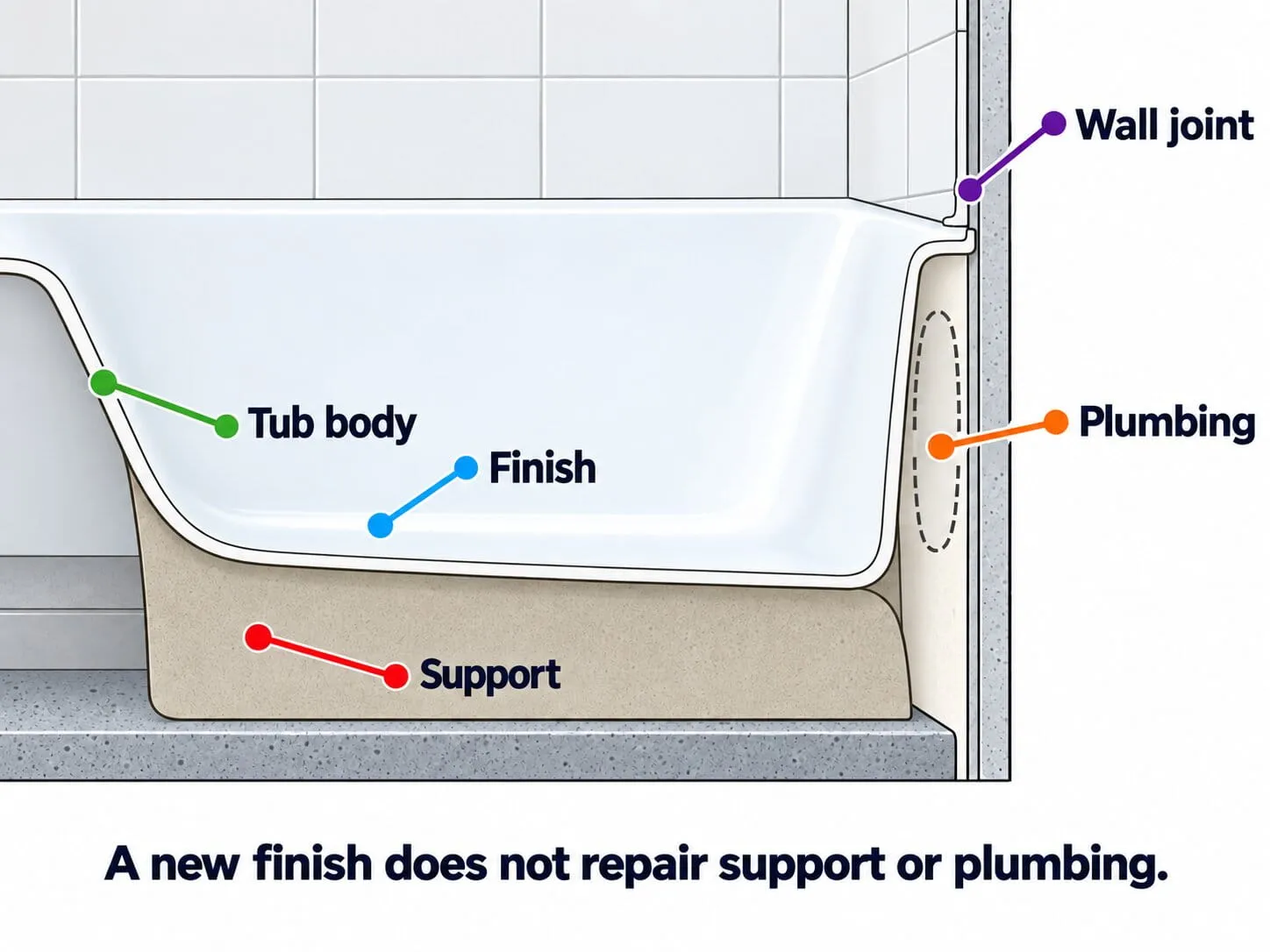
For a leak that persists around a tub/shower enclosure, a separate shower-leak diagnosis helps distinguish a plumbing fix from a waterproofing repair. When meaningful structural repair is impractical, opening is already necessary, or the whole room is being rebuilt, get a full replacement scope too.
Compare the whole replacement job with the whole refinishing job
There is no reliable national refinishing-versus-replacement price, and no defensible universal savings percentage or lifespan promise. Local labor, concealed conditions, material, and restoration work set the real difference. Compare written estimates for equivalent outcomes, not a store-shelf tub price against an installed coating bid.
| Scope item | Keep and refinish | Replace tub |
|---|---|---|
| Fixture condition | Diagnosis and any shell repair separate from coating | Removal and disposal of old fixture |
| Existing surfaces | Old-coating assessment, compatible finish, protection and cleanup | Wall and floor opening, restoration and finish work |
| Plumbing and support | Leaks or support repairs priced separately | New fixture fit, connections and model-specific support |
| Access and discoveries | Occupant protection and return-to-use conditions | Route in and out, concealed-damage allowance, local approvals |
| Written closeout | Coating care, exclusions and finish warranty | Fixture, installation and labor warranty terms |
Consider two hypothetical rooms. In one, a stable vintage tub sits among tile the owner wants to preserve; targeted repair plus refinishing may avoid opening a serviceable assembly. In another, the tub shifts and the floor already needs rebuilding; a new coating would leave the central work undone. The desired layout matters too: a finish cannot change the tub’s dimensions or step-over height. If the goal is a different bathing arrangement, see what a tub-to-shower conversion changes and what to plan for aging in place.
The right choice can also be a small repair, or postponing a cosmetic refresh. Have each bidder mark what is included, excluded, and contingent on opening the room. That makes the comparison possible even when the quotes arrive in different formats.
Ask about downtime in separate stages
Get separate milestones for work on site, occupant reentry, plumbing reconnection, coating cure, and first permitted water use. A surface that looks dry is not necessarily ready for a bath. Ask for the selected coating’s written conditions and who will confirm each milestone. If this is your sole bathroom, use an only-bathroom access plan before booking either project.
Verify local requirements before assuming a swap is exempt
A same-location replacement is not automatically permit-free. Boston’s fixture-replacement guidance requires a plumbing permit and licensed trade for work there; other jurisdictions differ. Have the responsible plumber or remodeler confirm the actual project’s permit and inspection needs locally.
If removal would disturb painted surfaces in a pre-1978 home, have a certified lead inspector or risk assessor evaluate suspected lead paint and use a lead-safe certified renovation firm for covered work. EPA’s renovation guidance concerns disturbed lead-based paint. See how to plan work around pre-1978 paint before opening old finishes. It does not mean old tub enamel contains lead or that coating a tub is lead abatement.
Choose a professional who can explain both the limits and the safety plan
Ask a refinisher or bathware specialist experienced with the actual material to identify the damaged layer, the proposed repair, and the finding that would change the recommendation. Use a plumber for drain or supply concerns and a remodeler for surrounding construction. Verify any required trade credentials with your local authority. A second opinion is useful when a moving fixture receives a coating-only bid or a local chip leads straight to a demolition proposal.
As of October 2026, ordinary commercial bathtub stripping with methylene chloride is prohibited under the EPA rule. 40 CFR §751.107(b)(6) prohibits most commercial and industrial uses after April 28, 2026; the continuing-use list in §751.109(a) does not include ordinary residential bathtub work. The limited historic-object provision is not automatic permission for an old tub. EPA separately restricts consumer distribution, and its current overview says the later compliance extension applies to non-federal laboratories, not bathtub stripping. The 2013 OSHA/NIOSH alert describes serious exposure hazards, but its older discussion of controlled methylene chloride use does not override the current rule.
Ask the contractor to identify current products, provide their safety information, and explain containment, exhaust, occupant protection, cleanup, reentry, and water-use conditions in writing. “Low odor” or “methylene-chloride-free” by itself is not a safety plan. Do not enter a restricted work area or attempt the stripping and spraying yourself. Request comparable completed-work examples and the coating’s written care and warranty exclusions. Leave the estimate meeting with three things: a diagnosis of what is damaged, a scope that resolves it, and a schedule your household can actually use.
Frequently asked questions
Can I keep using a suction-cup bath mat after my tub is refinished?
No, not on a Bathworks coating: its care guidance prohibits suction mats and stick-on strips because they cause coating-bond failures. Another coating may have different care rules, so check its written directions. If you need a slip-management aid, ask the refinisher for a compatible option rather than removing a needed accommodation without a substitute.
Can I use the same cleaners on a refinished tub that I used on its original surface?
No, not by assumption. Bathworks specifies a liquid, nonabrasive cleaner for ordinary coated areas and rules out bleach. Its care sheet permits carefully used Soft Scrub only on the applied non-slip floor area, not across the whole coating. A later coating may need different care from factory enamel or acrylic, so get the selected system’s directions in writing.
Can the new finish match an existing vintage sink or toilet exactly?
An exact match is not assured. Multi-Tech’s acrylic repair document describes technician color adjustment for its own repair system, but that does not guarantee a whole-tub coating will match an aged fixture. View a physical sample in the bathroom light before committing if color matters.
If the tub has a lifetime manufacturer warranty, could I still have to pay to remove and reinstall it?
Yes. KOHLER’s limited warranty for specified enameled cast-iron baths excludes removal, installation, and labor costs and has eligibility and alteration terms. Check the exact warranty for your fixture, purchase date, and ownership; “lifetime” is not a promise about the entire replacement project.
Sources
- BOOTZ — FAQ
- OSHA and NIOSH — Methylene Chloride Hazards for Bathtub Refinishers
- Multi-Tech Products — MMA System: Cosmetic Fracture Repair
- Multi-Tech Products — Structural Reinforcement Repair Procedures
- KOHLER — Remove Minor Scratching from Lithocast Material
- Bathworks — FAQs
- KOHLER — Drop-In Baths Installation and Care Guide
- City of Boston — Install or Replace a Sink, Toilet, Shower, or Bathtub
- U.S. EPA — Lead-Safe Renovations for DIYers
- eCFR — 40 CFR §751.107
- eCFR — 40 CFR §751.109
- U.S. EPA — Risk Management for Methylene Chloride
- Bathworks — Care Tips for Refinished Surfaces
- KOHLER — Enameled Cast Iron Bath and Shower Base Lifetime Limited Warranty