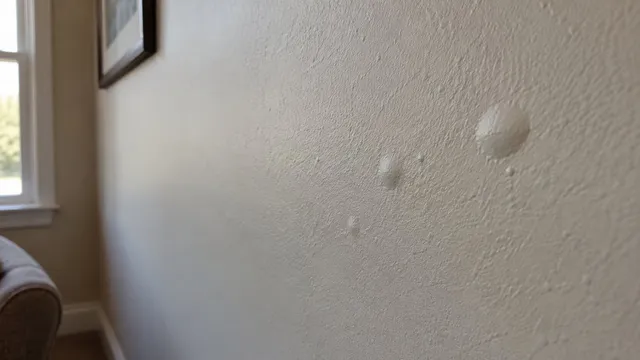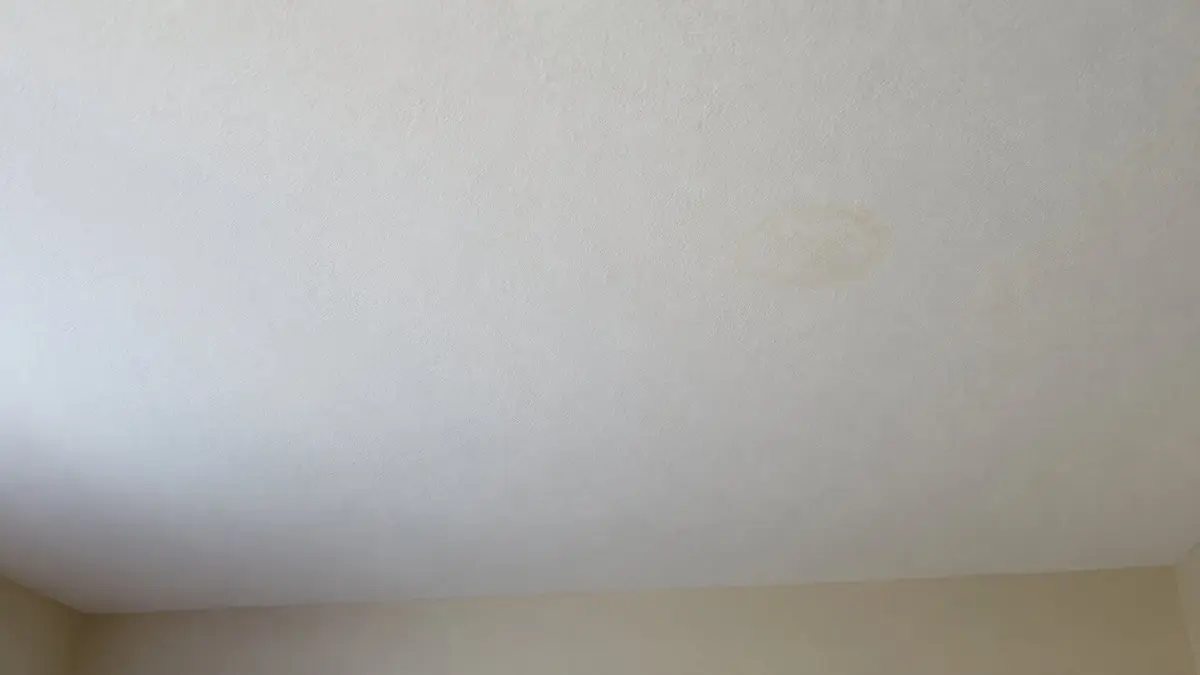
The same brown water stain has come through another fresh coat of ceiling paint. A new layer of paint can hide color briefly without answering the important question: is water still reaching the surface, or is an old mark passing through a coating that cannot isolate it?
The order matters. First settle safety and the water history. Then decide whether the wall or ceiling material is dry and sound enough to keep. Only then choose a stain-blocking system and test its finished appearance.
There is no reliable national price for fixing water damage and repainting together. Access, concealed damage, hazard controls, finish area and local labor determine the scope.
Is the ceiling wet, sagging, or near electricity?
A wet bulge, new sag, or falling ceiling material calls for keeping people out of the affected area and getting urgent assessment from a water-damage restoration contractor. Do not stand beneath it, press it, or puncture it to drain water. NOAA cautions that water-damaged ceilings can fail. Water reaching a light, fan, outlet, or other electrical equipment is a stop point too: stay clear, do not use or dismantle it, and have a licensed electrician assess it. CDC warns against using wet electrical devices. Imminent collapse, fire, or shock danger calls for emergency services.
An enlarging mark or ongoing drip without deformation still needs prompt source investigation. An old unchanged ring can move to assessment, but its steady outline does not prove the material behind it is dry. A cosmetic coating decision comes later.
Why do water stains bleed through fresh ceiling paint?
A previous water event may leave discoloring material in or on a surface. An unsuitable coating can let that color show through again. Sherwin-Williams’ stain guidance places source and damaged-material repair before sealing. A returning mark alone cannot tell you whether the original event ended.
Record the first water event, repair work, when the primer and topcoat went on, and when the mark returned. Dated room-view and close-up photos help show size and change; keep product and contractor records. A mark appearing during or soon after coating can fit residual bleed-through, but it does not clear the leak history. Recurrence after rain, appliance use, cooling operation, or persistent condensation points to a water path worth investigating. It does not identify a roof, pipe, or HVAC fault remotely. For marks beneath an attic, roof leaks and attic condensation need different investigations.
| Existing observation | What to investigate | What remains unproven |
|---|---|---|
| Old ring, water repair documented, mark returns under coating | Residual stain and material readiness | Dryness of concealed layers |
| Mark enlarges or returns after rain or use | Renewed water entry or condensation | Exact source and full extent |
| Sticky or glossy brown runs on a humid-room surface | Surface residue, including possible surfactant leaching | Mold or stain chemistry by appearance |
For sticky surface runs rather than an underlying ring, bathroom surfactant leaching is a separate possibility. Sherwin-Williams describes surfactant residue in humid conditions; do not use its appearance to declare the wall harmless or mold-free. Do not hose-test the area, enter an unsafe attic, or open a wall to prove a theory.
Is the material dry and sound enough to keep?
Stopping new water and drying retained material are different jobs. EPA advises against coating formerly wet materials before their interiors are dry. A face that feels dry, a pale patch, or a week on the calendar does not establish the condition behind it. A water-damage restoration contractor can assess the assembly and interpret material-appropriate readings in context.
The Gypsum Association explains that handheld gypsum readings may be relative and depend on instrument and material calibration. Its current resource overview does not offer one acceptable moisture percentage for all wallboard. An isolated number is not a universal permission to repaint.
Source, exposure, contamination, drying, and physical condition all affect whether gypsum board is worth keeping. Crumbling, distorted, delaminated, or poorly attached material calls for repair or replacement assessment, not simply a stronger primer. Drywall, plaster, wood, and patch compound need different judgments. Contaminated water, suspected mold, or musty concealed damage belongs with a water-damage restoration or mold-remediation contractor. EPA says not to paint over mold. A coating labeled mildew-resistant does not make contaminated material suitable to keep. The Gypsum Association says gypsum panels exposed to sewage or floodwater must be replaced; have a water-damage restoration contractor plan safe removal and replacement.
Before anyone disturbs older paint, have a certified lead inspector or risk assessor evaluate it; a trained asbestos professional assesses suspect ceiling texture. EPA says pre-1978 paint may contain lead, and suspected asbestos-containing material should remain undisturbed pending professional assessment. Appearance cannot identify either. Do not collect chips, scrape texture, or drill for reassurance. What to check before scraping or sanding a pre-1978 home covers the lead decision in more depth.
Which stain blocker fits this surface and finish?
“Primer” is not a performance specification. Check the exact variant’s stated stain severity, substrate, interior or exterior use, existing coating, repair material, intended topcoat, and restrictions. A product rated to bond to glossy paint or seal porosity does not automatically isolate an old water mark.
| Manufacturer example | Stated use | Limit to keep in view |
|---|---|---|
| KILZ 2 ALL-PURPOSE | Water-based, minor water stains and lighter staining | Not proof it will hold a persistent heavy mark |
| KILZ RESTORATION | Water-based, heavier stain blocking | Interior use; not for mold/mildew-prone areas |
| KILZ ORIGINAL Interior | Oil-based, heavy interior water staining | Not recommended for mold- or mildew-prone surfaces; follow its other substrate and preparation limits |
| Zinsser B-I-N Shellac-Base | Interior stain blocking | Exterior spot use only; not prolonged water contact |
These are examples of different labeled roles, not a product ranking. The actual container, current technical sheet, and safety data sheet govern ventilation, protective equipment, ignition precautions where applicable, application, and disposal. Do not copy timing, thinning, or room-reentry rules from a different formulation. KILZ ORIGINAL’s published page gives inconsistent minimum-temperature information, so ask its manufacturer rather than adopting a number from that page.
Nor should you assume every “paint and primer” product fails here. BEHR MARQUEE’s specific ceiling paint includes a water-stain spot-priming procedure. That says something about this product’s instructions, not every self-priming paint. Ask the painter or manufacturer to specify the complete system for the actual surface.
What does a small primed-and-painted test tell you?
Only test the coating after source control, material assessment, and hazard-aware preparation. A sample is not a leak test. The surface must be sound and within the selected product’s preparation limits. New plaster or patch material is not necessarily ready because its surface looks pale.
Where the manufacturer directs it, prime a limited area and apply the intended topcoat after the required interval. KILZ RESTORATION and KILZ ORIGINAL direct you to test a small topcoated area. If the stain bleeds through, their instructions call for a second coat of that primer and another test. Continued bleed-through calls for a longer drying time before topcoating. That sequence applies to these products; use the instructions for the exact primer you selected. A primer’s own white appearance is not the final performance check. If color passes into the finish, stop before coating the whole room. Review drying, product suitability, application, and label-specific next steps with the painter or manufacturer.
Do not stack unrelated primers or pile finish coats over a failed sample by default. Separate stain isolation from the final area’s appearance. Once the mark is contained, why a wall touch-up still looks different addresses texture and sheen rather than water chemistry.
Who comes before the painter, and what should the estimate say?
Match the investigation to the observed water path: a plumber for likely plumbing, a roofer or building-envelope specialist for weather entry, an HVAC technician for equipment or condensate, and a restoration specialist for drying or retained-material decisions. Electrical equipment that got wet belongs to a licensed electrician. A painter or drywall/plaster specialist takes over the finish after the underlying problem is addressed. Location suggests a trade to call; it does not prove a source.
Give the team the event timeline, dated photos, repair reports, building age, product labels, and any documented material assessment. Ask what shows the source is controlled, which materials can remain, which exact coating system is specified, and how its completed sample will be judged. A second assessment helps when experts disagree about concealed moisture or a proposal promises a permanent cover without addressing the water history.
Use separate estimate lines when comparing painting quotes: investigation, source repair, drying or monitoring, material repair, hazard controls, preparation, primer, finish area, and cleanup. Note exclusions and what happens if the mark returns. The visible ring can be small while the cause is not. Agree on readiness evidence before authorizing another finish coat.
Frequently asked questions
Can I leave white stain-blocking primer exposed on the ceiling?
Use the product’s instructions. A primer that happens to look white is not automatically a finished ceiling coating. The manufacturer may require a topcoat for the intended appearance and service; the tested system should include that finish.
Must the primer hide the stain completely before the topcoat?
Not necessarily. Visual opacity in the primer and isolation through the finished system are different observations. Follow the exact manufacturer’s topcoat-test instructions; if the stain passes through, reassess instead of assuming more ceiling paint will solve it.
What if the old stain is on a textured ceiling?
Assess the water source and material as before, but do not scrape or sample old texture casually. A trained asbestos professional must assess suspect texture before disturbance; a certified lead inspector or risk assessor can evaluate pre-1978 paint. A qualified painter can plan finish restoration after those issues are resolved.
Why is the repaired patch brighter after the brown stain is gone?
The remaining difference may be sheen, color, or texture rather than bleed-through. Compare the area in normal light and at an angle, then use the touch-up guidance linked above. A bright patch does not prove that the stain blocker failed if the brown mark has stayed isolated.
Correction, October 9, 2026: We clarified that gypsum panels exposed to sewage or floodwater must be replaced, and added the manufacturers’ specific steps when a primer test still bleeds through.
Sources
- Sherwin-Williams — How to Fix Water, Smoke and Other Paint Stains
- NOAA — After a Flood
- CDC — Returning Home After a Flood
- Sherwin-Williams — Surfactant Leaching
- EPA — Flood Cleanup to Protect Indoor Air and Your Health
- Gypsum Association — Moisture in Gypsum Panel Products
- Gypsum Association — Storms and Flooding Technical Resources
- EPA — A Brief Guide to Mold, Moisture and Your Home
- EPA — Lead-Safe Renovations for DIYers
- EPA — Protect Your Family from Exposures to Asbestos
- KILZ — KILZ 2 ALL-PURPOSE
- KILZ — KILZ RESTORATION
- KILZ — KILZ ORIGINAL Interior
- Rust-Oleum / Zinsser — B-I-N Shellac-Base Primer
- BEHR — MARQUEE Advanced Stain-Blocking Ceiling Paint & Primer