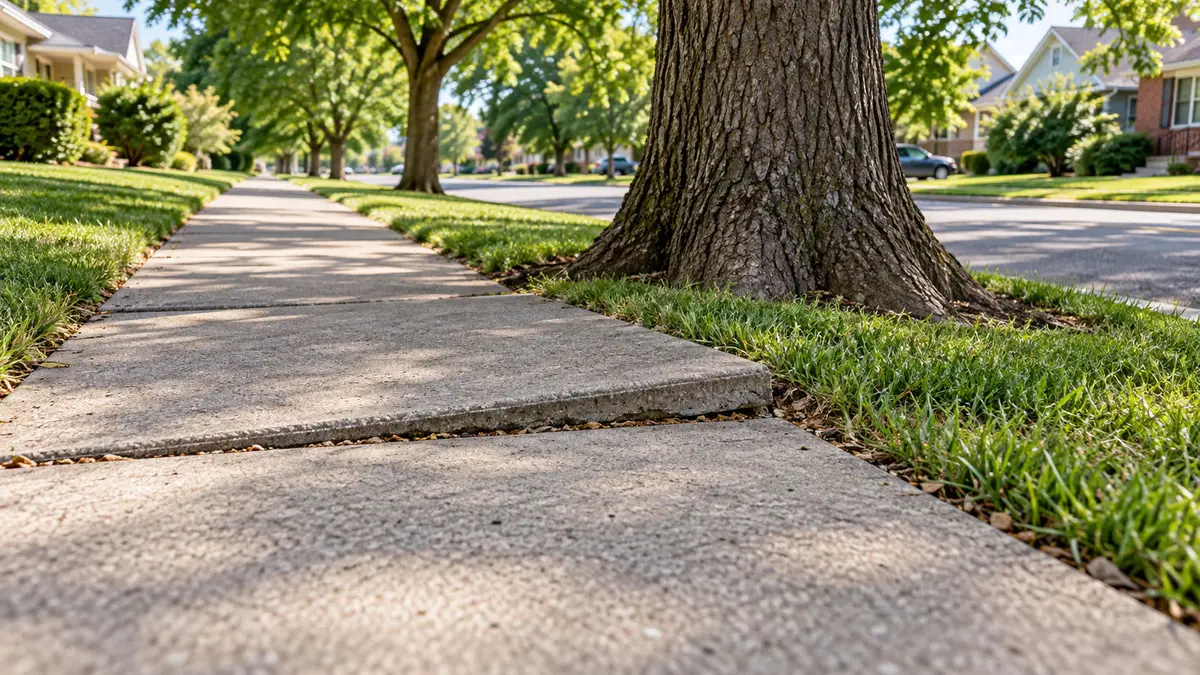
One sidewalk panel has risen beside a mature tree. Someone proposes removing the root below it so new pavement will lie flat. That plan may remove a walking hazard while changing the tree’s support, and the first green summer after repair will not settle whether the tree was harmed.
Tree roots thicken as they grow and can lift pavement, as Iowa State University Extension explains. The visible rise still needs a pavement assessment to confirm the cause and full repair area. No reliable national installed price covers a permitted tree-sidewalk job; grade transitions, design, access and tree protection change the scope. Start with who controls the site and what the professionals can preserve.
What should you do about a raised sidewalk now?
A sharp edge, loose panel or narrowed clear path can trip walkers and obstruct a wheelchair or stroller. Report a public-sidewalk location to the city or public works agency and ask how it wants the hazard managed while a repair is planned. If the path is private, prevent use of the affected area where you can do so safely and ask a pavement professional for an interim recommendation. Do not place a loose board or improvised barrier that directs people into traffic or implies the route has been repaired.
From a safe position, look for a new lean, fresh soil lifting or cracking near the base, or a serious hanging limb. Those signs change the call from routine paving: keep people out and request a prompt tree-risk assessment from a qualified arborist or the responsible tree authority. An immediate threat to people warrants emergency services. The ISA’s tree-risk guidance treats changed lean and soil movement as assessment prompts, not a remote verdict. Use the storm-lean guide for that branch. If a tree touches overhead wires, use the utility-contact instructions before any tree or pavement work.
What can you record without disturbing the site?
Photograph the lifted panel, adjoining panels, the whole tree and the usable route from safe ground. Note when you first saw movement, recent storms or construction, older patches, and any city notice or deadline. Do not lift the slab, dig to reveal a root, test the trunk’s movement, drive equipment over the area or cut anything. If a notice sets a date, contact the issuing office now to coordinate a review; do not assume requesting an assessment pauses it.
Who controls the sidewalk and the tree?
Separate a private front walk from a sidewalk in the public right-of-way. Ask public works who maintains the pavement, urban forestry who manages the tree, and the relevant office who can approve a design or root disturbance. A tree standing beside your house may still be a street tree. An easement or protected-tree designation may impose another approval. Maintenance responsibility, tree ownership and funding are three different questions.
The rules can differ sharply. New York City’s current 311 guidance says pruning city-tree roots is no longer permitted and describes an inspection-based sidewalk program for certain qualifying properties. That is not a nationwide ban or a promise of program eligibility. Portland’s street-tree root-pruning FAQ describes a non-development permit and a tree inspector who decides what root work may be authorized. Its process is not permission to expose or cut a root yourself elsewhere.
Ask the local offices which approvals, inspections, materials and contractors apply and whether an existing notice affects timing. An approval to repair pavement is not necessarily a finding that the tree can tolerate root loss. For a private path, verify property lines and any local tree-protection rules before work. No national answer can allocate liability or reimbursement from the location of the trunk alone.
What should the arborist and pavement professional assess together?
Ask an arborist experienced in construction and root conflicts and a qualified pavement contractor to view the same repair footprint. Include the city tree inspector when public-tree rules require one. The pavement professional should identify the panel condition, drainage and how a proposed fix joins neighboring panels and driveways. The arborist should assess species, size, health, root collar, previous injury, rooting space and what disturbance the proposed work would cause. UC Agriculture and Natural Resources says the exact effect of cutting a root on an individual tree is usually impossible to predict; harm can be delayed, and failure is not inevitable.
Ask each professional to show the full planned area, not only the high edge. A smooth repair may need a longer transition into the existing route. Roots outside the visible lift could be affected when old pavement and its base come out. If root exposure is necessary to decide, let the professionals and authority set that investigation. The discovery is a pause point for a revised plan, not permission to cut whatever is uncovered.
The written assessment should distinguish what is known from what cannot yet be seen. Ask which roots are intended to remain, how the crew will protect soil and trunk, who can stop work when unexpected roots appear, and which non-cut alternative was considered. ISA’s construction guidance emphasizes early arborist involvement and protection from compaction and grade changes. A second independent arborist opinion is reasonable before irreversible work on a valued tree, unless new movement requires urgent response.
What are the sidewalk repair options before cutting roots?
Ask for options by the problem they solve. None is automatically approved for a particular street, tree or available width.
| Option for professional evaluation | What changes | What still needs checking |
|---|---|---|
| Grind or bevel pavement edge | Reduces a discontinuity | Panel thickness, approvals, continued root growth |
| Reroute walk or enlarge tree opening | Gives roots more growing space | Clear route width, property limits, connections |
| Bridge or ramp over retained roots | Moves walking surface above roots | Support, transitions, drainage, root protection |
| Alternative paving or rooting-space design | Changes surface or base behavior | Traction, joints, maintenance, local acceptance |
Surface treatment can reduce a trip edge without severing the root. Iowa State Extension says grinding and patching are temporary because roots continue enlarging. A pavement contractor and local authority should decide whether the slab can accept such treatment. Shaving a living root is a different proposal with tree consequences.
Moving the route may preserve more root space. Seattle’s 2011 transportation account records rerouted walks and expanded planting areas as real examples; Portland’s 2021 urban forestry account describes offset walks. These are design precedents, not current permit approval for your property. The remaining clear route cannot be sacrificed without accessibility review.
Bridging or ramping leaves roots in place beneath a redesigned walking surface. It is more than piling material onto the raised slab. Support, grade on both approaches and root clearance must be engineered for the site. Portland’s March 2018 Sidewalk Repair Manual documents a ramp-over-root option; ask current local inspectors whether it remains accepted.
Pavers, pervious concrete or structural soil are other concepts Portland discusses. A more flexible surface can still move and create a new edge; a permeable surface still needs a sound supporting base. Structural soil is a designed base with room for roots, not loose soil packed under an ordinary slab. A root barrier installed in an existing mature root zone may itself require damaging excavation, so treat it as an arborist-design question, not a retrofit cure.
Why can a one-panel repair need a longer route design?
Raising one slab changes how walkers approach it from both directions. The designer must consider travel grade, cross slope, change in level, usable width, transitions at driveways and adjacent property, drainage and temporary pedestrian access during construction. A smooth-looking hump can still be hard for mobility aids or send water toward a house or tree base.
The U.S. Access Board’s public-right-of-way guidelines address these as distinct technical topics. The Board explains that its 2023 guidelines and agency adoption do not create one identical, directly applicable rule for every public and private path. Ask the local authority or designer which adopted standard governs this route. Avoid a single internet slope or width number as a design approval.
Root protection matters in the same drawing. New fill can bury the root collar where trunk meets roots, while heavy compaction can impair the soil the tree uses. ISA’s construction guidance warns that keeping roots physically uncut is not enough if their soil environment is damaged. Ask the designer and arborist to show both the pedestrian route and root-protection zone, including drainage after the grade change. For the separate lawn problem, compare reseeding beneath the tree with a mulch bed.
When is cutting a root acceptable?
Only after a tree-specific assessment and any required authority approval. Ask the arborist to identify which root would be affected, the tree’s existing condition and other root injuries, why retaining it is impractical, and what alternate pavement design was rejected. A permit addresses local permission; it does not guarantee stability.
No root diameter, percentage or distance from the trunk is a universal safe-cut rule. A 2008 study of young willow oaks found root severance affected anchorage but expressly cautioned against applying its results to large urban trees and other species. UC Extension likewise notes delayed and uncertain effects. A canopy can stay green after cutting while support or long-term health remains in question. The University of Maryland Extension notes that root-damage symptoms may appear later.
Removal and replacement may be appropriate when an arborist finds unacceptable risk that cannot be adequately reduced, or when no feasible approved walk design preserves the tree. The raised slab alone does not decide that. Where removal is approved, the stump grinding versus removal guide helps plan what happens below grade afterward. If mushrooms or decay are found near the base during assessment, the basal-fungi guide addresses that separate sign.
How should you compare quotes and monitor the repair?
No reliable national installed-cost figure was established for this mixed tree-and-pavement work. Ask each bidder to itemize the assessment, demolition area, longer grade transitions, specialized supports or materials, pedestrian access during work, tree and soil protection, permits or inspections, disposal and any separately approved tree work. Identify who coordinates the arborist, pavement crew and inspector, and who can stop work for unexpected roots.
Ask which surfaces may need future adjustment as roots grow and which settlement is covered by the contractor’s warranty. Record the finished grade and tree condition, then keep dated photos of renewed lift, drainage changes and canopy condition. Leaf thinning after construction warrants its own diagnosis; do not treat one green season as proof that cutting was harmless. The arborist should set tree follow-up based on the actual disturbance and prior condition.
Frequently asked questions
Should the canopy be pruned to compensate for roots already cut?
Generally no. ISA’s post-construction tree guidance advises against reducing the canopy to compensate for root loss, though an arborist may identify an exceptional case. Have the arborist assess the root injury and crown before any further live-wood work.
Can a renter or neighbor request a city sidewalk inspection?
In New York City, the 311 sidewalk-tree page describes inspection requests that are not limited to the property owner. Elsewhere, check the local public works reporting process. Being able to report a hazard does not establish program eligibility or who pays for a repair.
What if a grade transition crosses a neighbor’s frontage?
Have the pavement designer and local authority coordinate the full transition before work. Portland’s 2018 manual recognizes adjoining-property transition issues. Permission, access and cost allocation need local resolution; do not stop a ramp abruptly at a property line.
Would fertilizer help after sidewalk roots were cut?
It will not restore severed anchorage. ISA says to limit fertilization immediately after construction damage: excess nitrogen can favor top growth over roots. The arborist should base any nitrogen recommendation on soil or foliar nutrient analysis; do not add a product by default.
Sources
- Iowa State University Extension — How to Manage Trees Near Sidewalks
- UC Agriculture and Natural Resources — Root Cutting May Have Long Term Consequences
- ISA — Root Pruning and Stability of Young Willow Oak
- ISA — Recognizing Tree Risk
- Seattle Department of Transportation — Trees and Sidewalks
- Portland Urban Forestry — Trees and Sidewalks
- NYC311 — Trees and Sidewalks Repair
- City of Portland — Street Tree Root-Pruning FAQ
- Portland Bureau of Transportation — Sidewalk Repair Manual
- U.S. Access Board — Public Right-of-Way Technical Requirements
- U.S. Access Board — About PROWAG
- ISA — Avoiding Tree Damage During Construction
- University of Maryland Extension — Damaged Tree Roots
- ISA — Treatment of Trees Damaged by Construction