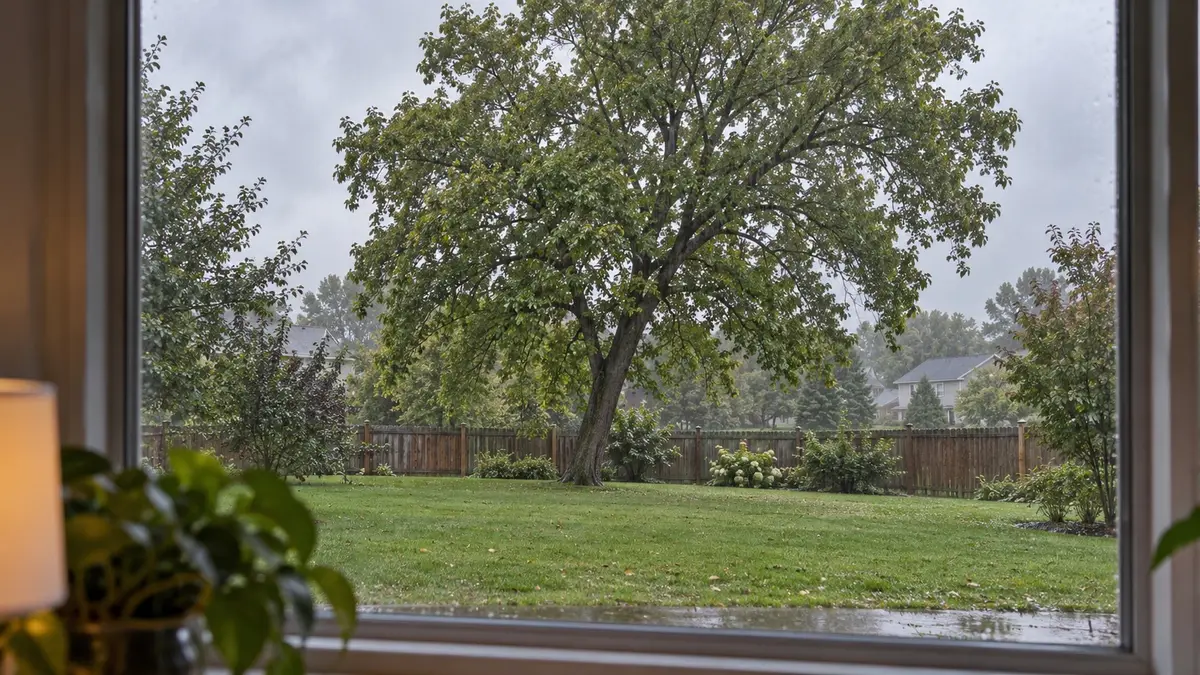
The oak outside your window appears to have shifted after wind and rain. The leaves are still green, but the trunk now lines up differently with the fence. That recent change matters because the anchoring roots and soil may have moved even while the upper tree looks ordinary.
You do not need an angle measurement or a closer view at the base to make the first call. Tell an arborist what changed, when you noticed it, and what the tree could affect. Keep the area clear while the response is arranged.
A tree started leaning after a storm: who do you call now?
Request urgent triage from an arborist experienced in tree risk assessment when a tree starts leaning or its old lean increases after a storm. Alabama Cooperative Extension’s post-storm guidance distinguishes a long-standing growth pattern from a recent change. It also recommends professional assessment even when obvious ground cracking or mounding is absent. A small-looking change is still a change worth reporting.
If a broken limb hangs in the canopy, the base appears to shift, a trunk has a fresh split, or the tree rests on another object, tell the responder immediately. ISA’s storm-damage guidance warns that damaged trees and suspended parts can continue moving after the wind stops. Keep people and pets away; do not enter the area to retrieve a car, place a barrier, photograph roots or clear debris.
| Situation | First contact | What to say |
|---|---|---|
| Immediate danger to people or an unsafe occupied space or exit | Emergency services | Location, what changed, people affected |
| Fallen or dangling wire | 911, then serving electric utility | Wire location and any tree contact |
| Tree touching or threatening overhead lines, without immediate danger or fallen wires | Serving electric utility | Tree location and threatened lines |
| New or worsening lean without line involvement | Arborist experienced in risk assessment | Change, timing, visible clues and nearby use |
This routes the call; it is not a risk score for the tree. If access to an occupied building may be unsafe, follow emergency responders’ directions. A delayed arborist appointment is no finding that the tree is safe in the meantime. Ask the responder what access restrictions to maintain until the visit.
What if the tree touches or threatens a power line?
Contact the serving utility when a newly leaning tree threatens overhead lines, even before contact occurs. Treat contact as an electrical situation. Do not touch the tree, the line, a fence or another object it contacts, and do not infer safety from the absence of sparks or an outage. The ISA’s risk brochure directs owners to keep clear of utility lines. For a downed or dangling line, PG&E’s utility guidance says to stay away, call 911 and report it to the electric utility. Use your serving utility’s official contact route; PG&E’s reporting tools are local to its service area.
Let the utility coordinate any tree work near its lines. A tree crew’s ordinary removal estimate is not a substitute for utility direction.
Is it a new lean or a lean the tree has always had?
Use information you already have: an older yard photo, a view from the same window before the storm, or a reliable memory of how the trunk lined up with a roof or fence. A tree that has grown at an angle for years can have a different story from one that shifted overnight. But an old lean with newly raised ground is still a new symptom, not a clearance.
Sometimes the crown looks more lopsided because a large limb broke while the trunk’s base stayed where it was. Report that as a crown change rather than saying the entire tree moved. The ISA’s risk-assessment instructions distinguish trunk lean, growth correction and root/soil conditions as separate observations in a professional assessment.
If you cannot tell what the tree looked like before, say “history unknown.” If shrubs, a wall or fallen debris hide the base, say “base not visible from my safe viewpoint.” Neither uncertainty requires you to go closer. A period of calm weather or green leaves cannot replace the assessment, and no universal angle chart tells a homeowner when a newly leaning tree is stable.
What should you report about roots, trunk and surrounding ground?
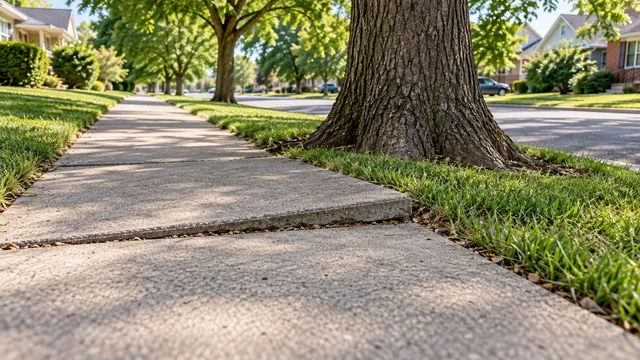
The root plate is the network of anchoring roots and soil around the base. Wind can load the tree while saturated or restricted soil gives roots less support. ISA’s managing-risk guidance and University of Minnesota Extension describe storm damage alongside root and site factors. A whole tree can shift while the trunk still looks unbroken.
From the place where you already are, tell the arborist whether you can see newly lifted or mounded ground, a fresh gap near the base, a newly exposed root, trunk splitting or hanging limbs. ISA lists soil separation with root movement as a warning sign. A surface root that was visible last year or an unrelated soil crack is not proof of storm damage. Timing is the useful detail.
Tell them about heavy rain, standing water, erosion, recent trenching or grade changes you already know about, and whether another tree was removed nearby. These are site facts for the arborist to investigate, not a diagnosis to make from your window. Hidden roots remain unknown even if the soil surface looks undisturbed. Do not dig, probe, push the trunk or walk around it for a better photograph.
What could the tree affect, and what should the risk assessment cover?
When you call, describe the usual use of spaces near the tree: a patio, occupied room, driveway, sidewalk, road, neighboring property or utility line. Do not assume that only the direction of the visible lean matters. ISA’s basic risk-assessment form records tree parts, site conditions, potential targets, time frame, recommendations and remaining risk. Those fields show why a lean angle alone cannot answer the question.
Ask who will actually assess the tree and whether written findings are included. An ISA Certified Arborist has a professional certification; Tree Risk Assessment Qualification (TRAQ) is a separate qualification in risk-assessment methods. Neither is a nationwide license or a guarantee about a particular tree. ISA explains its credential types, and its directory lets you verify an individual’s credential. For this problem, ask for someone experienced in tree risk assessment, preferably with current TRAQ.
What should the arborist explain after the visit?
Ask which tree part or site condition concerns them, what they could and could not inspect, what people or property they considered, and what action they recommend first. Ask for the assessment’s time frame, whether further examination is needed, what restrictions remain meanwhile, and when reassessment is advised. ISA’s instructions distinguish the professional worksheet from a final report and record limitations and remaining risk; a bare removal price or “looks fine” leaves those decisions unexplained.
You can also ask what would change the recommendation: another storm, new movement, a change in occupancy below the tree or information from a closer professional examination. The arborist should define the follow-up; the homeowner should not turn the form’s professional categories into a self-scoring quiz.
Can the leaning tree remain, or does it need removal?
An assessment may lead to removal, further investigation, or a management and reassessment plan. The right outcome depends on anchorage damage, the tree’s establishment and condition, the site and the people or property exposed. A recently planted tree moving in soft soil is not the same case as an established tree with major root movement. Extension sources discuss these situations differently; none supplies a universal tilt or waiting-time rule for your tree.
Ask what mechanism any proposed support would address. Cabling or bracing a weak branch or stem does not by itself restore damaged root anchorage. Do not stake, pull, winch, prune, cut roots or wait for soil to dry as a substitute for assessment. ISA’s storm guidance puts storm-damaged trees in professional hands because tension and movement can be unpredictable.
If two arborists disagree, compare their actual findings, access limits, time frames and proposed ways to reduce risk. Preserve the more restrictive interim access advice while resolving the disagreement; do not delay emergency or utility contact for another quote. The decision you need is what changed in the anchorage or tree structure, what the assessed tree could affect, and what action follows from those findings.
Frequently asked questions
The leaves are still green. Does that mean the roots are secure?
No. Green foliage tells you little about whether anchoring roots moved in the storm. Report the new lean and any already-visible ground change to an arborist; do not approach the base to test it.
Should upright trees nearby be assessed after the same storm?
Yes. After a severe storm, ISA says an ISA Certified Arborist should also check trees that appear undamaged, particularly larger trees near people or property. Ask the arborist to include them; an upright outline does not establish that roots and branches stayed intact.
Is an assessment from before the storm still useful?
Yes, give it to the arborist as a baseline. A changed position or new storm damage creates new information, so ask for a fresh assessment and updated restrictions rather than treating the earlier finding as current clearance.
How do I compare two different arborist opinions?
Ask each to identify observed defects, the people or property considered, limits of access, time frame and reason for the recommendation. A difference may reflect new evidence or a different assessment scope. Keep the area restricted while a material disagreement is resolved.
Sources
- Alabama Cooperative Extension — Caring for Trees: Post-Storm Assessment
- ISA — Storm-Related Tree Damage
- ISA — Recognizing Tree Risk
- ISA — Managing Hazards and Risk
- ISA — Basic Tree Risk Assessment Form
- ISA — Using the Basic Tree Risk Assessment Form
- ISA — Types of Credentials
- ISA — Find an ISA-Credentialed Arborist
- University of Minnesota Extension — Storm Damage to Landscape Trees
- PG&E — Report Electric Issue