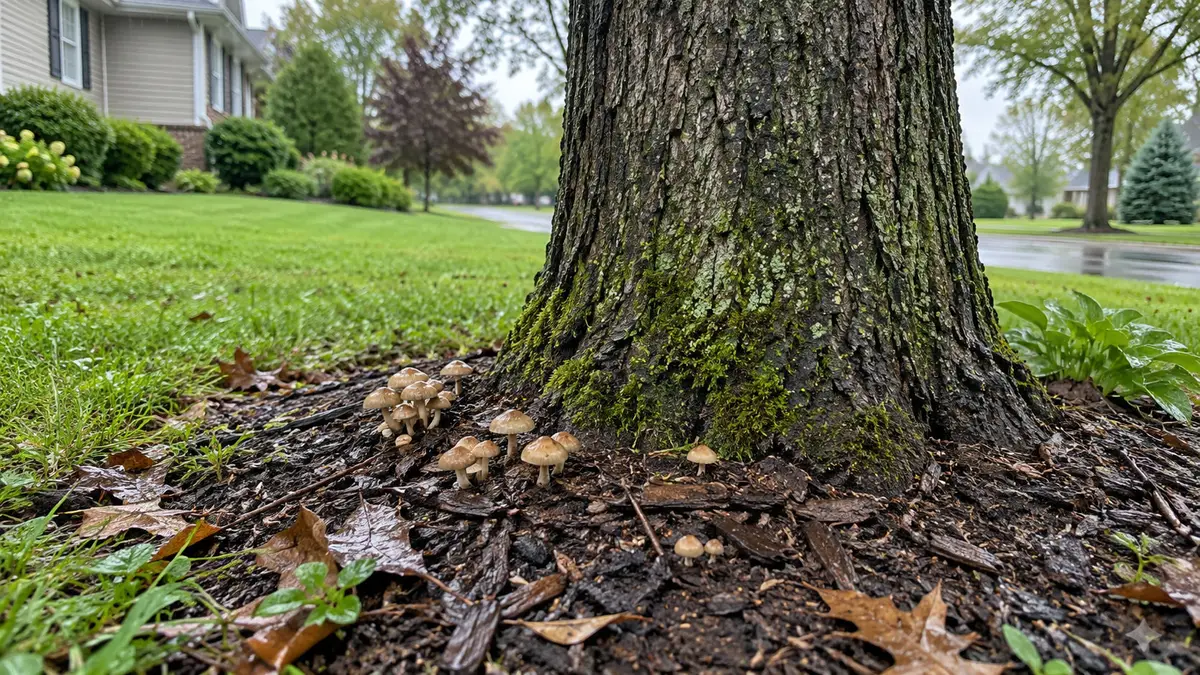
Several mushrooms have appeared beside the trunk after rain. They might be rooted in mulch, an old buried root or the tree itself. That distinction matters because fungal decay in anchoring roots or the lower trunk can change a tree’s structural condition even when its leaves look normal.
This guide helps you report the observation, understand what an arborist must determine and evaluate the next plan. It cannot name a fungus from its appearance. Reliable nationwide prices for this exact assessment and tree work are unavailable; site access, written findings, further diagnostics and any later removal or pruning should be scoped separately.
When do mushrooms at a tree base call for urgent help?
A change in the tree or ground changes the priority. ISA’s tree-risk brochure identifies new lean, root movement, cracks and hanging limbs as warning signs. If the tree newly leans with lifted ground, a split is opening, or a broken limb hangs over a used space, keep people and pets away and request urgent arborist help. For failure underway or immediate danger to people, call emergency services from a safe location. Do not enter the area to move a car, put up a barrier or obtain a better photograph.
If the tree or its branches touch wires, or a line is damaged or down, stay away from the tree, wire and anything contacting either. Contact the serving electric utility; use emergency services for immediate danger. ISA’s storm-damage advice treats moving damaged wood and electrical exposure as professional and emergency matters. Do not test the line or hire an ordinary tree crew to work near it before utility coordination; the tree and power-line guide explains the contact route.
With no observed acute change, arrange an arborist’s on-site evaluation and tell the office where the tree stands and what it could strike. That category is a request for assessment, not a declaration that the tree can wait through a season. A new lean has its own urgent tree-risk questions, and a visible opening in wood should be reported as a trunk crack as well.
Is the mushroom growing on the tree, in mulch or over buried wood?
A mushroom or shelf-like conk is a visible reproductive structure. Most of its fungus may be out of sight as mycelium, a network of fine strands in its food source. University of Maryland Extension explains that mushrooms can break down dead organic matter, live in beneficial associations with roots or come from fungi that infect a living tree. Wet weather can bring fruiting bodies into view; their first appearance does not date the start of the fungus.
“At the base” describes a location, not the food source. Growth apparently attached to the trunk or a surface root is worth reporting. Growth in mulch may be decomposing chips. Growth emerging from soil may be fed by a buried stump or old root, including one from a tree removed years ago. Maryland Extension also cautions that mushrooms close to a tree, or directly out of its trunk or surface roots, might come from wood-decay fungi infecting that tree. Soil versus trunk is not a reliable harmless-versus-dangerous rule.
If the apparent attachment is unclear, say exactly that. Do not uncover roots, pull apart mulch, peel bark or pick a conk to settle it. Color, shape and an app’s suggested species are not a stability assessment. A suitable arborist or plant-disease specialist can decide whether identifying the organism would change the tree plan. Iowa State’s explanation of landscape mushrooms also distinguishes visible fruiting from the hidden fungus and its weather-dependent appearance.
What would root, butt or heartwood decay mean for stability?
Root decay can affect anchorage below ground. Butt rot refers to decay at the lower trunk. Heartwood is inner wood; decay there can affect the trunk’s load-bearing structure. The terms describe location and tissue, and they can overlap. University of California’s wood-decay guide says a wood-decay fruiting body on the tree is usually associated with advanced decay, which may extend above or below it. The visible growth does not reveal the full internal pattern.
A green crown shows that the tree is still functioning biologically. It does not measure root anchorage or sound wood. Equally, one conk does not prove that all support is lost. UMass Extension’s account of Ganoderma sessile says conks can appear with localized decay and that even advanced infection may produce no canopy symptoms. Neither that species-specific exception nor the general finding diagnoses mushrooms near your tree; an arborist still needs to assess it thoroughly.
Another example, Armillaria root rot described by University of Minnesota Extension, can affect roots and the lower trunk. Its behavior and management cannot be assigned to every basal mushroom. The relevant assessment asks which parts are affected, how much structure remains, what could be struck and what is uncertain. Neither the number nor the size of mushrooms supplies a failure probability or a timetable. A calm week or a full canopy provides no structural clearance.
What can you tell an arborist without inspecting the tree?
Your first call can rely entirely on what is already known. The ISA’s professional assessment form records site, tree parts, possible targets and limits of inspection. You can help the assessor prepare without doing that fieldwork yourself.
- Identify which tree is involved and the house, entrance, play area, sidewalk or neighboring space it could affect.
- Say when the growth first became visible and whether it has appeared in earlier seasons. “I don’t know” is useful.
- Describe apparent trunk attachment, mulch or soil emergence only if visible from a safe position. Leave uncertain substrate as unknown.
- Report already visible changes in lean, soil, cracks, broken limbs or canopy; known storms, construction, paving or root disturbance also belong in the history. If thinning leaves began after nearby work, see the construction-related root-damage guide for that separate question.
- Mention overhead lines and any route you are avoiding so the arborist can plan the visit safely.
An existing photo or zoomed image from a place already safely accessible may help the office recognize the issue. Do not walk beneath the tree, approach an unstable base or enter a line-hazard area to take one. A picture can communicate an observation; it cannot establish the hidden extent of decay.
What should an on-site tree risk assessment establish?
Ask for an arborist experienced in both tree risk and wood decay. ISA Certified Arborist is a voluntary individual certification; Tree Risk Assessment Qualification (TRAQ) is a distinct qualification in assessment methods. Neither is a nationwide license or a guarantee of a result. ISA describes TRAQ’s scope; ask who will conduct the visit and verify that person’s current credentials.
The assessment should distinguish the suspected defect from the chance of failure, the chance of striking a target and the likely consequences. That is the structure of ISA’s current basic risk-assessment instructions. The professional form collects observations and analysis; it is not itself a final report or a checklist for homeowners to score. Ask for an understandable explanation of the crown, trunk, roots, site, use of nearby space, and the time frame covered by the opinion.
Fungal identification may matter if it changes the management plan. Ask how confident the assessor is about the source of the growth and whether diagnostic help is warranted. Further assessment can be appropriate where the initial view leaves a material gap. No one instrument is automatically required or able to certify the entire tree; UMass notes that a root-focused decay problem can evade a test concentrated on the trunk.
Agree on the scope and written findings
Ask for the concern, evidence, inspection limits, options and reasons for recommended timing in writing. The report should say which areas remain unused while uncertainty is resolved, what action addresses the risk and when the tree needs reassessment. If a high-value tree draws conflicting nonurgent opinions, a separate consulting assessment can help. Keep interim exposure controls in place while arranging it.
Separate the price of the visit, a written report, specialist identification, additional assessment and later work. Ask whether stump or root work, disposal, access protection and a return visit are included in a removal proposal. No generic mushroom-count rule or automatic spray package answers those scope questions.
Can the tree stay, or does fungal growth mean removal?
The answer depends on the on-site findings. ISA’s risk brochure describes management choices that can include changes in how a space is used, professional work, reassessment and removal. Retention needs stated conditions and a follow-up plan. Removal may be reasonable where the assessed risk cannot be managed acceptably. A recommendation should explain why the chosen option addresses the identified part of the tree and what remains uncertain.
Pruning a branch will not rebuild decayed anchoring roots. A support system addresses selected structural problems and does not cure disease. Pulling off a mushroom does not remove the hidden fungus or restore lost wood. Kansas State’s tree-mushroom guidance distinguishes the visible fruiting body from internal growth. Do not spray fungicide, seal wood, cut roots or excavate as a homeowner remedy for uncertain decay.
If the tree stays, ask what signs warrant earlier contact and who will reassess it. If removal is advised, ask the crew to identify local permission requirements, utility coordination and disposal in its scope. Once the area is cleared by the arborist, future care can address avoidable wounds and site stress; it cannot reverse wood already lost. Leave the visit with the written findings and the next review trigger.
Frequently asked questions
Could the fungus spread to other trees in my yard?
Yes, some identified pathogens can spread through infected wood or root contact, but nearby mushrooms alone do not show that another tree is infected. University of Minnesota Extension’s Armillaria guidance describes persistence and spread for that organism. Ask the arborist whether a confirmed diagnosis calls for examining nearby trees; do not cut roots yourself.
Can I plant a new tree in the same spot after a diseased tree is removed?
Possibly, but the plan depends on the identified organism and what infected wood remains. Minnesota Extension notes that Armillaria can persist in old infected material and affect new roots. Ask for a site-specific replanting plan; stump grinding alone is not a guarantee that a disease source is gone.
Why do mushrooms appear where an old stump was ground out?
Buried stump fragments and roots can remain as food for fungi. Maryland Extension describes mushrooms emerging from old stumps and roots, sometimes after the tree is long gone. If future yard plans require a decision about the remnants, compare stump grinding and full removal without treating either as a universal disease cure. Their return there alone does not diagnose a nearby living tree.
Is yellow foamy growth on mulch the same as a shelf on a trunk?
No. Some yellow or beige mulch growth is slime mold, which Maryland Extension distinguishes from true fungi. An individual patch still should not be identified from a verbal description alone. A shelf apparently attached to trunk wood calls for the tree-focused assessment described above.
Sources
- International Society of Arboriculture — Recognizing Tree Risk
- International Society of Arboriculture — Storm-Related Tree Damage
- University of Maryland Extension — Mushrooms and Slime Molds in Lawns
- Iowa State University Extension — Mushrooms in the Landscape
- University of California IPM — Wood Decay Fungi in Landscape Trees
- UMass Amherst Extension — Root and Butt Rot Caused by Ganoderma sessile
- University of Minnesota Extension — Armillaria Root Rot
- International Society of Arboriculture — Basic Tree Risk Assessment Form
- International Society of Arboriculture — Tree Risk Assessment Qualification
- International Society of Arboriculture — Using the Basic Tree Risk Assessment Form
- Kansas State University Extension — Trees with Mushroom Growth