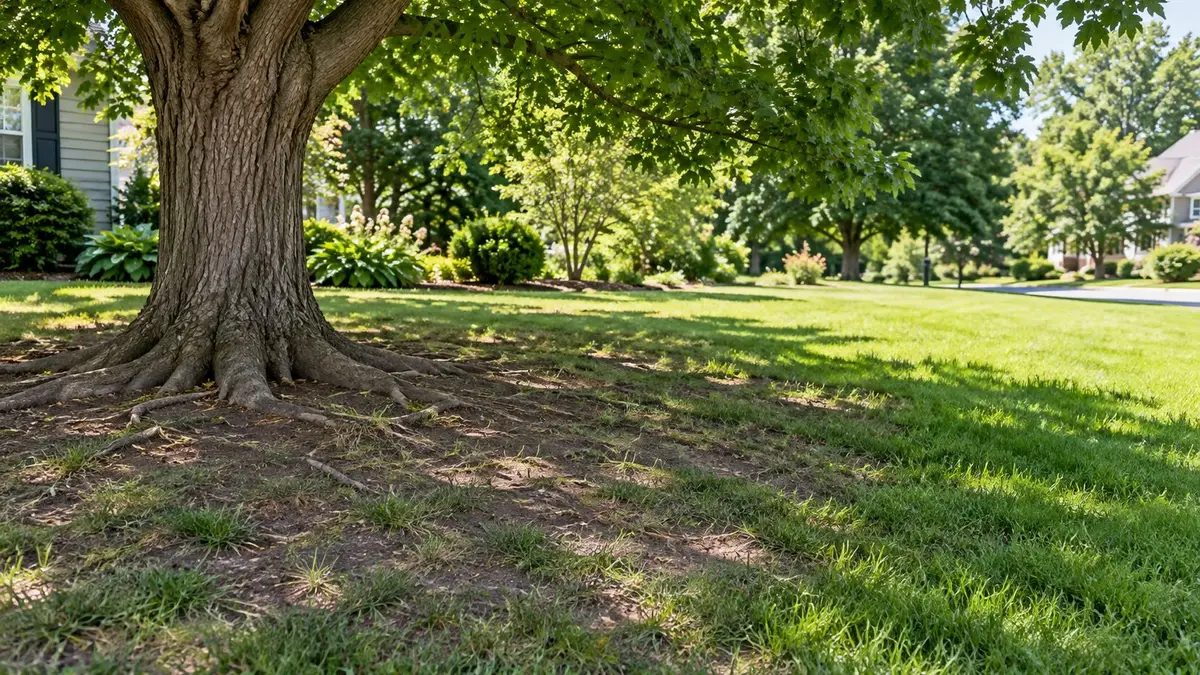
The seed germinates, the patch turns green, and then the grass fades when the tree leafs out. That pattern points beyond a bad bag of seed. Under a mature tree, both the light above the lawn and the roots below it change through the season.
Before buying more seed or cutting branches, spend a clear summer day watching the patch. A few observations can tell you whether a different turf program has a chance or whether the tree’s root zone should become a bed.
There is no dependable national price for either choice. Reseeding means recurring seed, watering and labor; conversion has an initial bed cost and later mulch top-ups. Pruning, if justified, brings its own periodic cost.
Why won’t grass grow under a tree even after reseeding?
Shade cuts the energy grass can make. The tree’s roots also compete for water and nutrients, often beyond the outer edge of its branches. Purdue Extension explains that tree roots usually win, especially close to the trunk where they are densest. A shade-tolerant seed mix does not remove that competition.
Spring can give a false reading. A deciduous tree without leaves lets in far more light than it does in summer. NC State Extension says a fully leafed deciduous tree can block nearly 95% of summer sunlight, compared with nearly 50% when leafless. New grass may establish in spring, then lose light just as roots draw more water.
Notice whether the area is dry shade—soil that dries hard beneath a maple, for example—or moist shade that stays damp and grows moss. Grass species suited to one site may struggle in the other. Leaf and needle buildup can also smother seedlings. Heavy walking, pets and compacted soil add stress; if traffic is the issue, consider a path. Core aeration versus dethatching helps distinguish compaction from a thatch problem, but keep aeration equipment clear of exposed tree roots.
Are pine needles or black walnut stopping the grass?
Pine needles don’t supply a reason to spread lime. University of New Hampshire Extension says the pine tree does not determine the soil’s acidity; shade and shallow roots are more likely reasons for bare ground under white pines. Needles piled on grass can still block light, so rake them away. If pH is a concern, use a soil test. The moss and lime guide explains why treating moss without correcting its growing conditions fails.
Black walnut can affect sensitive garden plants, but don’t assume juglone explains a failed lawn. University of Wisconsin–Madison Extension says lawn grasses, including Kentucky bluegrass and fescues, tolerate juglone. Check the same light, roots and moisture conditions you would under another tree.
How much sun does grass need under a tree?
Measure direct sun in midsummer, when the canopy is fully leafed. On a clear day, check the spot hourly or take timestamped photos. Record when direct light actually reaches the grass, not merely when the sky looks bright. Repeat at the canopy edge; it may receive a very different amount.
Extension recommendations aren’t one universal threshold. Illinois Extension recommends at least two hours of direct sun even for the most shade-tolerant grass. NC State and Clemson Extension treat less than four hours as too shady for good turf; Clemson says tall fescue can do adequately with about five. Nebraska Extension uses six hours for healthy, vigorous turf. These are different standards for different expectations and species, not a promise that any seed will survive at a particular hour.
| Summer observation | What it means for your choice |
|---|---|
| Under roughly 2–4 hours direct sun | Turf is a difficult bet; plan a bed or a much smaller lawn. |
| Around 4–6 hours | Shade-adapted turf may work if moisture, roots and traffic cooperate. |
| Strong light at canopy edge, bare soil by trunk | Keep the outer turf and mulch the inner root zone. |
Also log whether the soil dries between waterings, remains damp, or has exposed roots. Note foot traffic and what grass you previously planted. A soil test through your state land-grant extension lab can answer a pH or nutrient question; it cannot create missing sunlight. For a sunny but thin lawn elsewhere, the overseed-or-start-over guide addresses the broader renovation choice.
If the light is borderline, which shade grass should you try?
Choose grass for your region and the actual soil moisture. A bag labeled “shade mix” may contain a fast-sprouting species that doesn’t last under trees. In cool-season areas, fine fescues are the main shade-tolerant group; Penn State Extension points to fine fescues for drier shade and rough bluegrass for consistently moist shade. Straight Kentucky bluegrass is a weak bet there, while Nebraska Extension says perennial ryegrass may last only a season or two in shade.
| Region and condition | More plausible choice | Establishment note |
|---|---|---|
| Cool-season, relatively dry shade | Fine fescue mix | Seed in late summer or early fall. |
| Cool-season, consistently moist shade | Rough bluegrass | Check whether site drainage also needs attention. |
| Cool-season, moderate shade | Tall fescue or local shade mix | Match cultivar to state extension guidance. |
| Warm-season, moderate shade | St. Augustinegrass; some zoysia cultivars | Use locally appropriate cultivars and methods. |
| Warm-season, deep shade | Bed rather than bermudagrass | Bermudagrass has very poor shade tolerance. |
In the South, Clemson’s St. Augustinegrass guide matters before you buy “shade seed”: St. Augustinegrass cannot be grown from seed. It is installed as sod, sprigs or plugs, and even it needs about four to six hours of sun. Its cold tolerance varies by cultivar. Centipedegrass and bahiagrass handle only light pine shade, while bermudagrass is a poor shade choice. Ask the local extension office which cultivar fits your climate.
Adjust care as well as species. Mow shaded turf roughly half an inch to an inch higher than the same grass in sun, within that species’ recommended range. Water deeply and less often, early in the day, rather than keeping leaves and soil wet with frequent short cycles. Remove fallen leaves promptly, especially over seedlings, and redirect traffic. Penn State finds fall seeding more successful than spring seeding under trees partly because tree competition is lower.
Fertilizer advice differs. Clemson recommends only one-half to two-thirds as much nitrogen in shade as in sun; Illinois warns excess nitrogen can stress weak shaded turf. Penn State recommends higher rates with slow-release nitrogen. Don’t settle that conflict by applying a heavy dose. Use a soil test and the guidance from your state extension office for your grass and region.
Which grass fixes can hurt the tree?
The tree is the lasting asset here. Avoid changing its root zone just to get one season of grass.
| Tempting fix | Tree-safe direction |
|---|---|
| Pile topsoil or build a raised bed over roots | Keep the existing grade; roots need oxygen. |
| Grind or cut exposed roots | Leave them intact; cutting can reduce tree health and stability. |
| Rototill beneath the canopy | Leave roots intact; hand-dig only small planting pockets. |
| Heap mulch around the trunk | Spread a flat ring with a clear gap at the trunk. |
| Strip branches to let in sun | Ask an arborist whether limited pruning can meaningfully improve light. |
Purdue treats added soil and raised plantings over roots as harmful. It describes a compost-and-soil topdressing under two inches as a temporary remedy where roots surface, with roots likely to reappear. That is not permission to build up the grade. For a related root decision, see options before cutting roots lifting a sidewalk. If soil was already piled on the root zone and the canopy is thinning, nearby construction and tree-root damage covers what that history may mean.
Grass fertilizers and herbicides can affect trees too. Utah State University Extension advises separating the tree’s mulch zone from lawn care. Follow any product label’s restrictions around tree roots; don’t use herbicide as a shortcut to clear the bed.
Will pruning the tree let enough light reach the lawn?
Sometimes a modest change in a borderline spot helps. Clemson and NC State discuss raising low branches to about six feet to improve light and air movement. Have an ISA Certified Arborist evaluate what that would do to this tree and the ground beneath it. The tree will regrow, and pruning cannot turn deep shade into full sun.
The International Society of Arboriculture’s pruning guidance says generally no more than 25% of a crown should be removed at once, and less for mature trees. That is an upper limit, not a target. Routine thinning doesn’t necessarily improve tree health; heavy pruning is stressful. Timing also depends on species and region, including oak wilt transmission periods. Never top a tree for lawn light. Don’t climb, use power saws above ground, or work near lines; call the utility about line clearance.
When should you stop reseeding and redesign beneath trees?
Use the sun log and your past attempts to choose a path:
- Keep turf where direct summer sun is roughly four hours or more, failure is patchy, and the earlier species or care program was a poor match. Give the right grass one properly timed attempt. Iowa State Extension notes that periodic overseeding may be needed in viable shade turf; that is maintenance, not proof of failure.
- Keep a smaller lawn where grass persists at the canopy edge but disappears close to the trunk. Expand a mulch ring over the root-heavy inner zone and maintain turf outside it.
- Change the landscape where there is under roughly two to four hours of sun, roots dominate the whole spot, or correct-species attempts have failed across multiple seasons. Repeating the same seed, water and labor will not change those site limits.
Price the actual scope rather than relying on a national number. Bed size, mulch volume, plants and regional labor drive conversion cost; tree size, access, crown work and cleanup drive pruning cost. Compare those with annual seed, water, fertilizer, leaf removal and your time. If the new bed is on a slope, keep mulch and soil from washing away as part of the plan.
How can you replace grass without harming the tree?
Smother existing turf with mulch instead of tilling through roots, as Utah State advises.
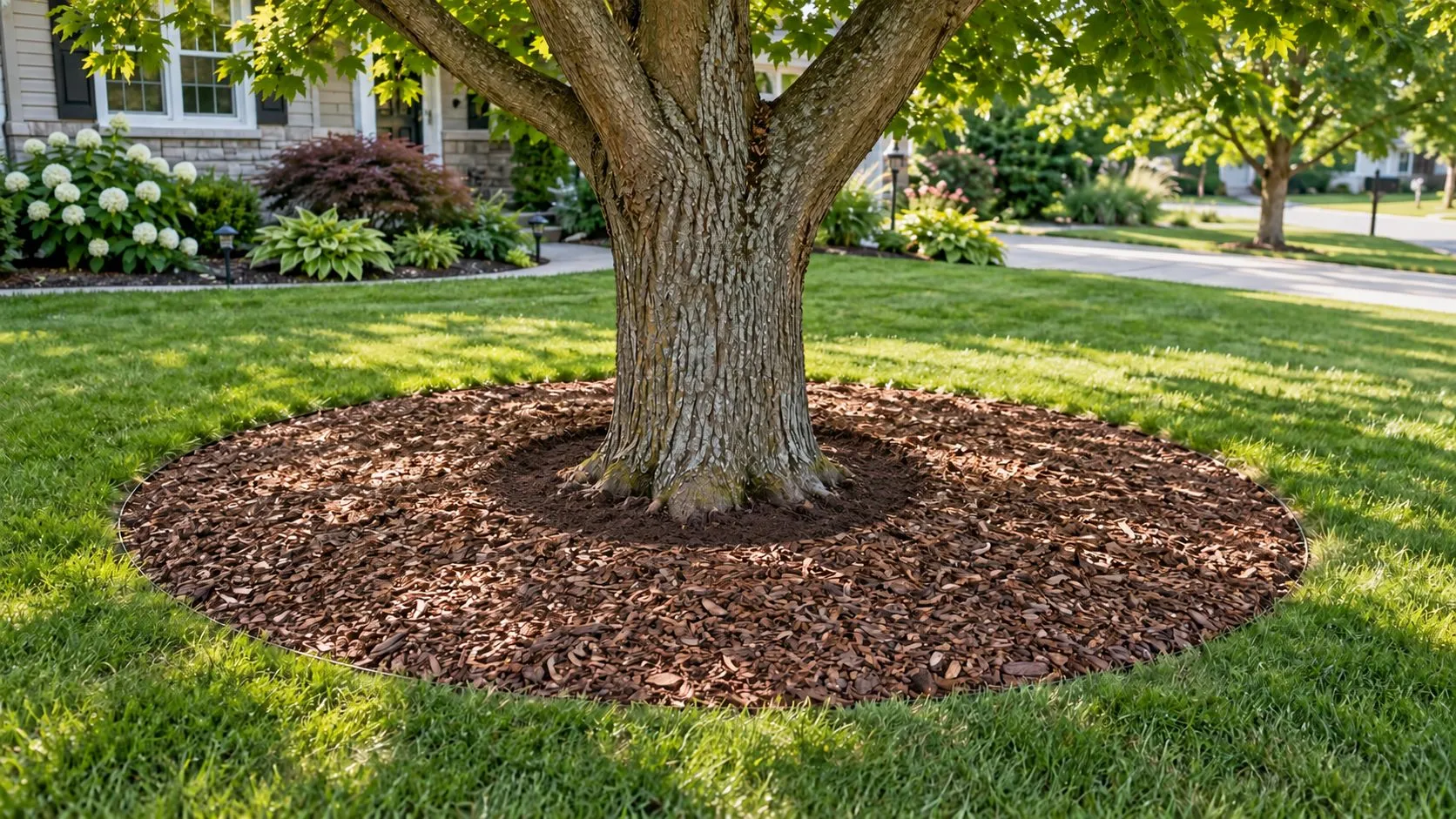
The inner root zone becomes a flat bed while the outer lawn remains where light allows. The ISA mulching guide gives a general depth of two to four inches: roughly two to three for fine mulch and three to four for coarse wood chips. Keep it off the trunk and extend the ring toward the drip line where practical; ISA gives a three-foot radius as a general minimum. On wet soil, it cautions against more than two inches. Other extension recommendations vary, so let site moisture and local guidance refine the depth.
For plants, hand-dig small pockets among roots rather than turning the whole soil surface. Ask your extension office for native or non-invasive groundcovers suited to your region and shade. Familiar lists sometimes include English ivy, but Maryland Extension identifies it as invasive, and Washington lists specified English ivy cultivars as Class C noxious weeds. Check your state’s list before planting any spreading groundcover. Where people must cross the shade, a designed path can spare both turf and roots. Avoid substituting gravel or lava rock as a default; Utah State advises against them beneath trees.
What should you ask a landscaper or arborist to quote?
Tell the ISA Certified Arborist or landscape professional your measured summer sun, tree species if known, past seed or sod, soil test, and any root cutting or soil fill. An arborist should inspect crown structure, root flare, surface roots and mower wounds before proposing crown or root work. Ask how much light pruning could realistically add, for how long, and whether the plan follows ANSI A300 pruning practices. Get another opinion for topping, heavy thinning, large-root cutting or a soil mound over roots.
A turf estimate should identify species and cultivar, seed versus sod or plugs, preparation and follow-up care. A conversion estimate should identify turf removal method, mulch type and depth, plant list, edging and cleanup. That makes the recurring-lawn and bed options comparable without sacrificing the tree.
Frequently asked questions
How many hours of sun does grass really need under a tree?
There is no single number for every species. Illinois gives two direct hours as a minimum for the most shade-tolerant grass, while NC State and Clemson call fewer than four too shady for good turf, Clemson notes about five for tall fescue, and Nebraska uses six for vigorous turf. Count summer sun with the canopy leafed out.
Can I put new topsoil down over tree roots and seed on top?
Don’t build up soil over the root zone to establish lawn. Purdue says a mix under two inches may temporarily cover exposed roots, but they tend to resurface; a deeper fill or raised bed can restrict the oxygen roots need. Ask an ISA Certified Arborist about the tree and grade before changing the surface.
Why does grass grow in fall and die by the next summer?
Fall offers a cooler establishment window and less tree competition, according to Penn State. By summer, a fully leafed canopy cuts light and active roots draw moisture. Measure summer light before repeating the fall seeding.
Should I lime the soil under my pine tree?
Only if a soil test and local extension recommendation call for it. UNH says pine needles don’t determine the soil’s acidity, and shallow roots plus shade commonly explain bare ground. Rake accumulated needles, then test instead of guessing.
What can I plant under a maple where nothing grows?
A flat organic mulch bed is the simplest starting point around dense surface roots. For living groundcover, ask your local extension office for plants suited to dry shade and check the state invasive list. Plant in small hand-dug pockets without cutting roots.
How often should I overseed a shady lawn?
Some periodic overseeding can be normal in a viable shade lawn. If the correct species repeatedly fails despite suitable summer light and care, reassess root competition, moisture and traffic; the site may be better as a smaller lawn with a larger bed.
Sources
- NC State Extension — Selecting and Managing Lawn Grasses for Shade
- Clemson Cooperative Extension — Growing Grass in Shade
- Penn State Extension — Growing Turf Under Shaded Conditions
- University of Illinois Extension — Managing Shady Lawns
- Purdue University Extension — Surface Root Syndrome
- International Society of Arboriculture — Proper Mulching Techniques
- International Society of Arboriculture — Pruning Mature Trees
- Utah State University Extension — Mulching is Important for Tree Health
- Clemson Cooperative Extension — St. Augustinegrass
- University of New Hampshire Extension — Do pine trees and pine needles make soil more acidic?
- University of Wisconsin–Madison Extension — Black Walnut Toxicity to Plants
- University of Maryland Extension — English Ivy
- Washington State Noxious Weed Control Board — English Ivy
- Nebraska Extension — Lawns in Shady Areas
- Iowa State University Extension — Growing Grass in Shady Areas