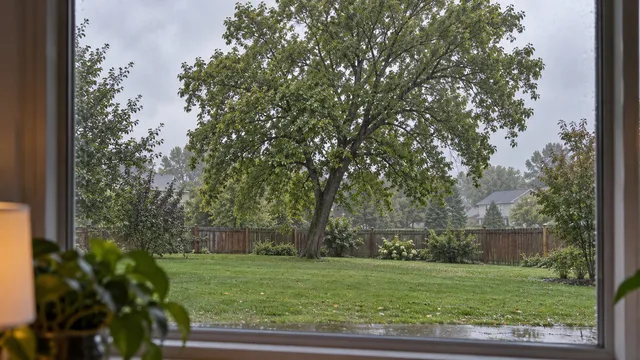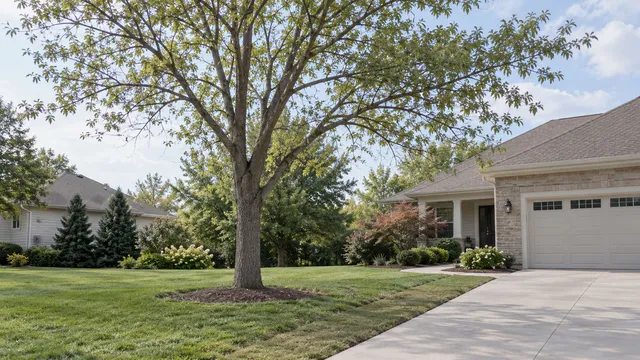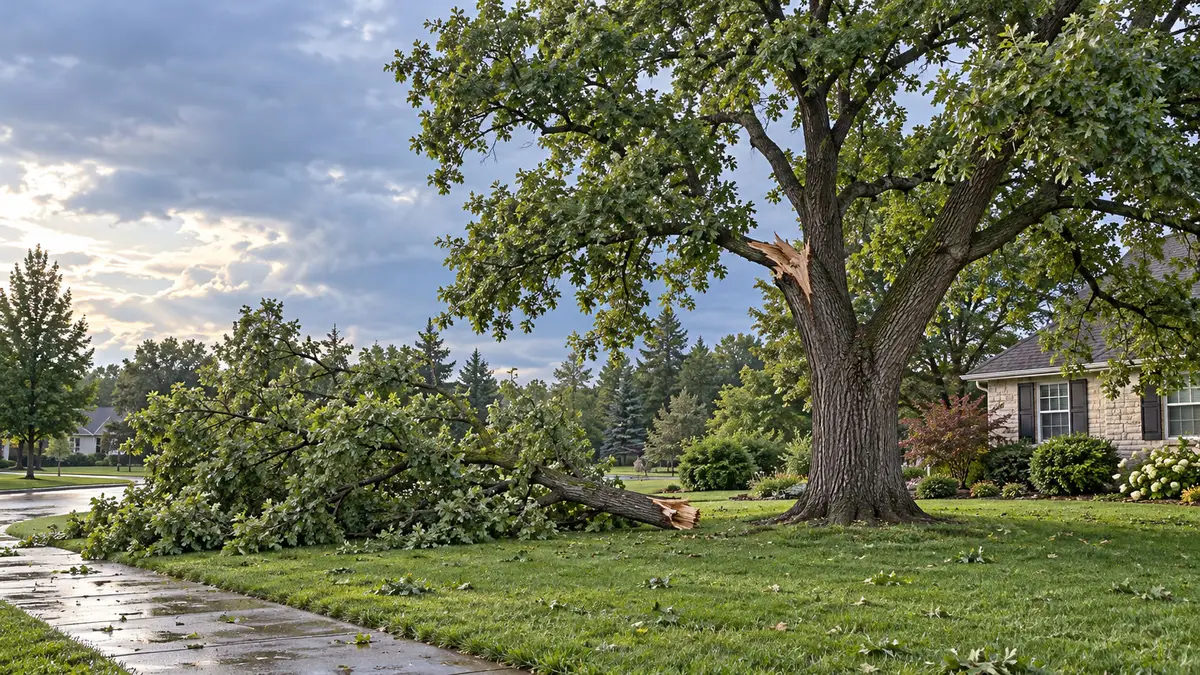
A large limb lies across the yard, and the tree looks suddenly lopsided. Its size can make removal seem inevitable. But the fallen piece alone does not show what the storm left in the trunk, root support and remaining crown—the top framework of branches and leaves.
First keep people out of the damaged tree’s reach. A qualified arborist can then separate an urgent limb-removal job from the slower decision to retain the tree. There is no reliable national price or recovery clock for a broken major limb; access, equipment, disposal, restoration work and follow-up have to be scoped locally.
What should you do first after a major tree limb breaks?
Keep people and pets away from hanging, partly attached or lodged wood. A limb resting on a roof or another tree can shift after the storm ends. ISA’s storm-damage guidance warns that tension-loaded wood may react unexpectedly when cut or moved. Do not stand under it, use a ladder, pull it down, or begin chainsaw cleanup. You need not walk closer for photographs.
If the tree or limb touches a wire, or a wire is down, stay clear and call 911 from a safe place; then notify the electric utility if dispatch has not. The line and tree may be energized without visible sparks. Follow the tree and power-line response before arranging any private tree work. An immediate threat to an occupied building, public route or people belongs with emergency services as appropriate.
A branch already on the ground does not certify the rest of the canopy. Ask a storm-work arborist to assess the remaining attachments before reopening the yard beneath it. If the trunk now leans or soil has lifted, the new-lean assessment guide covers that separate urgent sign.
If wires are involved or people face an immediate threat, the emergency row overrides every tree-work row. Even a limb already on the ground requires a storm-work arborist to assess the remaining tree before the yard reopens.
| What is already visible from safety | Next contact | What remains unanswered |
|---|---|---|
| Wire contact, downed or damaged wire, or immediate threat | 911; then electric utility if dispatch has not | Electrical conditions and authorized work |
| Hanging or lodged major limb, without wires or immediate threat | Storm-work arborist | Remaining loaded wood and attachment |
| New lean, soil heave or trunk split, without wires or immediate threat | Urgent arborist | Whole-tree stability |
| Major limb on ground, without wires or immediate threat | Storm-work arborist before yard use resumes | Remaining tree and attachments |
Does the place where the limb broke change whether the tree can be saved?
Yes. A break toward the end of a branch leaves a different structure from a limb tearing away at its attachment to the main stem. A large competing stem that splits into the trunk raises a still larger question. The arborist must see the remaining wood, not just measure the pile on the ground. UF/IFAS’s storm-tree assessment distinguishes branch loss, major stem injury and root condition when deciding what to do.
| Break pattern to describe | What the arborist must examine | Why it matters |
|---|---|---|
| Branch end broke | Remaining branch and crown framework | Local injury versus wider defects |
| Limb tore from attachment | Parent stem, bark tear and remaining union | Extent of structural injury |
| Competing stem split into trunk | Trunk crack and remaining stems | Whole-tree retention and targets |
The branch attachment is where a limb joins its parent stem. Hanging strips of bark may make a wound look dramatic, but deeper splitting may be less obvious from the yard. Do not pull bark aside, probe a cavity or try to test the tree by shaking it. Note the apparent break location and tell the assessor what a photograph cannot show.
A large wound can admit decay organisms over time. The USDA Forest Service’s 2003 tree-risk manual explains that trees can compartmentalize damage and close over a wound surface; severed original wood does not knit back together. Even a closed-looking surface is not proof of sound wood within. This background explains why follow-up matters after a tree looks green again.
From a safe location, record the storm date, whether the limb remains attached, where it appears to have torn, what it could strike, and any pre-storm photo of the whole tree. Share previous decline, pruning or construction history if you know it. Do not turn the absence of a visible crack in a distant photo into a finding that the trunk is intact.
Can the tree be saved after a major limb breaks?
An arborist considers the entire tree: its condition before the storm, species, roots and soil, trunk and remaining branch framework, plus what people or property could be struck by another failure. Texas A&M Forest Service says a mature shade tree can usually survive one major-limb loss, while more extensive structural injury changes the outlook. Its simplified crown-loss rule is not a pass/fail test for every species or site.
Leaf stripping, broken small twigs and missing main scaffolding are not equivalent. UF/IFAS restoration guidance says trees can recover from complete leaf loss or several broken limbs, but major trunk damage is often irreparable. An arborist must assess the individual tree before recommending retention or removal. Pine and palm responses differ from many broadleaf trees. The arborist should identify which woody framework remains capable of supporting future growth, rather than estimate survival from a percentage of green canopy alone.
Ask specifically about cracks in the remaining trunk and branch unions, a new lean, soil heaving at the base and signs of decay. ISA’s tree-risk brochure treats these as signs for professional interpretation. A split may need a different decision from an isolated broken limb; see when a trunk crack needs assessment and, only if an arborist finds a potentially supportable remaining union, the cabling-versus-removal question. A detached limb cannot be reattached by a cable.
“Targets” in a tree-risk discussion means people and things that could be struck: the house, cars, play area, sidewalk or road. A qualified assessor may discuss restricted use of an area or moving a target where feasible. Do not enter beneath damaged wood to relocate a vehicle or furniture. The ISA’s risk-management page lists pruning, support, care, target changes and removal as situation-dependent tools. None makes a tree risk-free.
What could the arborist recommend?
Retain with a plan: The remaining trunk, root support and useful crown make restoration credible after hazardous wood is removed. Assess further: Hidden or unresolved damage matters, and continued exclusion or another inspection is needed before normal use. Remove: Structural injury or risk at this site cannot be reduced acceptably. These are paths for a professional explanation, not categories a homeowner can assign from a photo.
Ask which finding drives each recommendation. A valuable shade tree is worth considering carefully; sentiment does not establish that its remaining structure can manage the site. If preexisting dead limbs are found, the dead-branches-over-house guide addresses that separate work.
What does a plan to save the tree include?
“Save it” should mean more than removing a broken piece and leaving. The arborist should specify immediate hazard work, how much live structure to retain, whether later restoration pruning is anticipated, what area stays restricted and when the tree will be reassessed. UF/IFAS recommends restoring useful living growth in stages after storm damage rather than stripping sound branches for symmetry. A lopsided tree is not an invitation to top it.
Ask which observations require an earlier return: new cracking, another failure, altered lean or changes around the base. A burst of shoots shows the tree is alive; it does not prove the original attachment or trunk has regained strength. The arborist’s interval should reflect the particular tree, injury and site. No universal number of months makes the space beneath it safe.
Avoid dressing, filling or carving a wound yourself. General advice against routine wound paint has a local disease exception. The University of Minnesota’s oak-wilt guidance changes advice for oaks by region and season. Ask the arborist or local extension office what applies where you live, including handling of oak wood if disease is suspected. Do not adopt a national coating or pruning calendar from one region.
Watering or fertilizer also needs the tree and soil’s condition considered. Storms can leave saturated soil; a fixed national aftercare schedule would be misleading. The arborist should say what site care supports the retained tree and what observation would change the plan.
What should you ask an arborist to put in the proposal?
Choose an arborist experienced with storm damage and the local species. ISA’s hiring guide advises verifying credentials, insurance, references and written terms. For a complex retention choice, ask about tree-risk assessment experience and the ISA Tree Risk Assessment Qualification, TRAQ. ISA’s program guide calls TRAQ a qualification with several eligibility routes, not a license or a guarantee about an individual tree.
Ask the arborist to answer these in writing: What failed? What trunk, root and crown condition remains? What could fail next, and what could it strike? What cannot yet be determined? What treatment and follow-up would make retention reasonable? What future finding would trigger removal? A report should distinguish observations from assumptions and say whether additional assessment is needed.
Compare two scopes. The urgent scope identifies dangerous limb work, access, equipment, protection of buildings, debris removal and immediate restrictions. The longer-term scope identifies restoration, monitoring and optional removal if retention fails. Ask whether hauling, stump work and property repair are included; do not assume a low initial cleanup bid covers them. No reliable national restoration price exists because access, tree size, equipment and future visits vary. Request itemized local proposals and confirm permits or local tree rules before nonemergency work.
Where the hazard area can remain protected, a second tree-risk opinion may clarify a disputed removal recommendation. Do not delay emergency wire or hanging-wood response to collect routine bids. If recent construction may have injured roots, tell the arborist; the post-construction leaf-thinning guide explains why that history matters.
Frequently asked questions
What if the storm broke the top of a young tree?
Most young trees recover well if corrective pruning is done early, according to Iowa State Extension. The central leader is the main upward stem; the professional goal is one sound leader rather than competing upright stems. Ask a qualified arborist or local extension office to assess the tree and plan the work.
Does leaf loss mean the same thing for a pine and a palm?
No. UF/IFAS separates recovery patterns by species and injury. A pine that lost its leader, a palm with damaged growing tissue and a broadleaf tree with stripped leaves cannot share a single crown-loss threshold. Ask the arborist which living structure remains, not just how green the tree looks.
Should I fertilize a retained tree to help it recover?
Not automatically. Fertilizer does not restore a split attachment or a lost branch. An arborist should assess soil and nutrient needs before recommending any product, especially when a tree has just experienced saturated soil or root disturbance.
Can I keep the broken oak limb as firewood if oak wilt is suspected?
Ask your local extension office or state forestry authority first. Minnesota’s oak-wilt guidance includes wood-handling measures for its disease context, but rules and seasonal risk vary by location. Do not move suspect wood on the assumption that a general storm-cleanup practice applies.
Who handles a storm-damaged street tree?
Report the exact location and immediate hazards to the city or county tree/public-works office; use 911 for an immediate threat or wire involvement. Iowa State’s storm guidance notes that public-tree work follows the responsible authority. Confirm who owns, authorizes and pays for work locally before contracting for it.
Sources
- ISA — Storm-Related Tree Damage
- UF/IFAS — Restoring Trees After a Hurricane
- UF/IFAS — Assessing Hurricane-Damaged Trees
- Texas A&M Forest Service — Can My Tree Be Saved
- Iowa State University Extension — How to Manage Storm-Damaged Trees
- USDA Forest Service — Urban Tree Risk Management
- ISA — Recognizing Tree Risk
- University of Minnesota Extension — Oak Wilt in Minnesota
- ISA — Why Hire an Arborist?
- ISA — Managing Hazards and Risk
- ISA — Tree Risk Assessment Qualification Guide
- Iowa State University Extension — Broken Top of a Young Tree