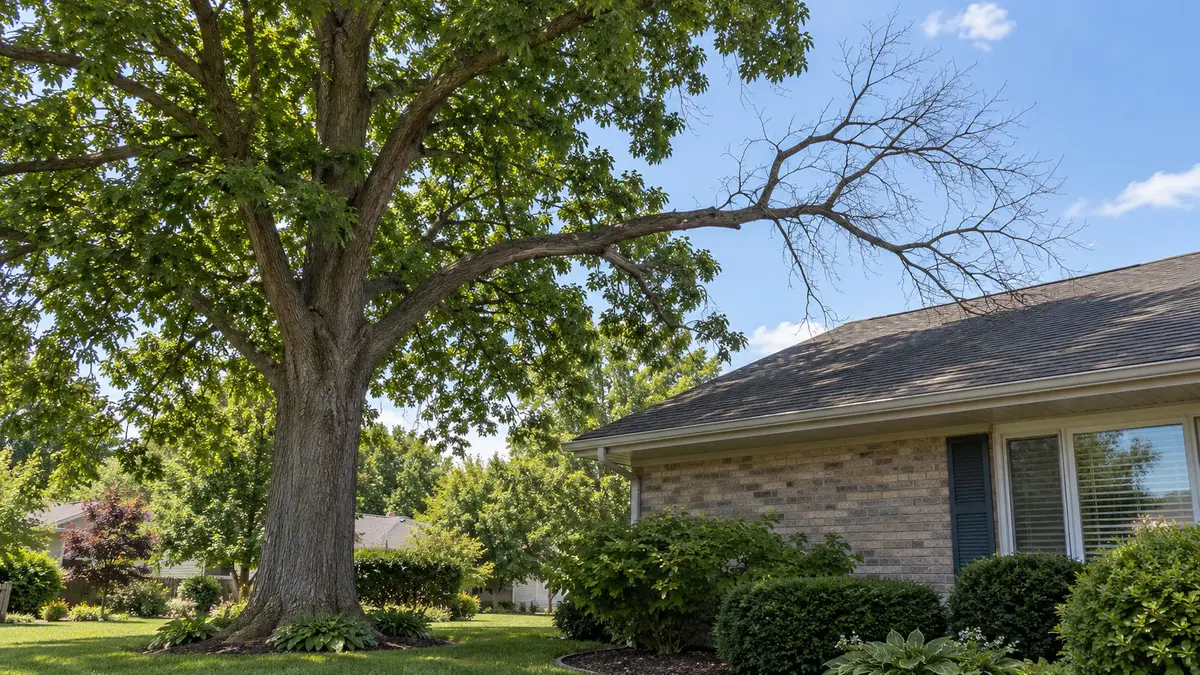
The bare limb above your roof may have stood out only when nearby branches leafed out. You want to protect the house without losing a tree that still gives shade. What matters is whether this is a branch problem the tree can live with, or a sign of wider decline or structural weakness.
The branch, trunk, roots and site need an on-site assessment before that choice is made. No reliable national price range covers this exact overhead work: access, rigging, debris handling, separate assessment and later care can change the scope. Ask for itemized proposals rather than relying on a generic pruning-versus-removal price.
What should you do while dead branches hang over a house?
Keep people and pets out of the outdoor area beneath the suspect limb, including a porch or entrance if another safe route exists. Leave cars and belongings where they are if reaching them would take you beneath it. ISA lists large dead or hanging branches among signs for professional examination. A branch may shed naturally and still be a concern because a roof or person is below it. A freshly storm-broken major limb raises a separate retention question.
If a branch is partly detached, new breaks are appearing, the limb’s position is changing, or the tree has shifted with disturbed ground, request urgent arborist guidance. Mississippi State Extension’s tree-risk publication discusses cracked and hanging wood in the context of people and property it could hit. For active failure threatening people or an occupied building, move people by a safe route and contact emergency services. Do not ask a photograph to decide whether a room or doorway is safe.
Treat line contact or a downed conductor as a separate electrical emergency. Stay away from the tree, line and anything touching them. Call 911 for a fallen or hanging wire or a broken limb on wires; notify the serving utility if dispatch has not. FirstEnergy warns that downed lines and objects touching them may remain energized. Utility direction and qualified line-clearance workers govern tree work there; see the tree and power-line response for that situation.
With no observed active change, arrange a prompt arborist assessment and tell the office that the limb extends over the house. Neither a calm forecast nor an appointment date predicts how long the wood will stay attached. If the tree newly leans with root movement, use the separate post-storm leaning-tree guidance while arranging the response.
Is a bare branch necessarily dead?
No. Species, temperature, stress and injury can delay leaf-out. Iowa State Extension explains late leaf emergence in its regional context. That does not authorize waiting beneath a substantial suspect branch until a date on an Iowa calendar.
From a place already safely accessible, note whether the limb stayed bare when the rest of the tree leafed out, lost leaves early, held brown leaves, or looked similar in prior seasons. Describe the pattern: scattered lower or interior deadwood, one-sided loss, or a thinning upper crown. Iowa State’s branch-dieback guide explains that shade, weather, site and root stress, trunk injury, pests and disease can all contribute. An arborist needs the species and site history to interpret the pattern.
Tell the assessor about known storms, earlier pruning, nearby digging or paving, and changed drainage. If leaves thinned after work near the tree, the construction-related root-damage guide explores that history. Existing wide photographs may be useful if taken without entering the affected area. Do not climb, pull, snap or scratch an overhead branch to prove it dead. Testing a reachable twig would not certify the large limb above the roof.
What should the arborist assess beyond the dead limb?
Ask the arborist to consider the crown (branches and foliage), trunk, root collar (the transition at the trunk base), roots and surrounding site. ISA’s 2025 basic tree-risk form records potential failures of different tree parts and the targets they could strike. A branch finding does not automatically settle a separate trunk or root problem.
Which part could fail, and what could it hit?
For the crown, ask which branches are actually dead, whether their attachments are cracked or decayed, and whether earlier failures show a broader pattern. For the trunk, ask about splits, cavities, old wounds and the connection of the suspect branch. For roots and site, ask whether nearby excavation, compaction, saturation or lifted ground suggests an additional concern. Mississippi State Extension frames assessment across roots, trunk and crown rather than one photograph.
The house remains a target even if you can move a lawn chair. Tell the arborist which rooms, entrances and outdoor spaces people use. Ask what the assessment covers and what time frame it addresses. This lets the professional explain the possible failure, the chance of impact and its consequences without turning a homeowner checklist into a risk score.
What remains unknown after a ground-level visit?
Ask which areas were inaccessible or hidden and whether further professional assessment would change the recommendation. ISA’s current form records inspection limits, possible additional assessment, mitigation and reassessment. The form itself says it is not a report. Request understandable written findings rather than a bare rating or removal estimate.
A leafy crown can coexist with a structural defect. Conversely, dead-looking foliage does not prove that roots or trunk have failed. A crack in the trunk or mushrooms at the tree base gives the arborist separate evidence to interpret, not an automatic order to remove the tree.
Should you prune the limbs or remove the tree?
The decision follows the identified defect. ISA’s managing-risk guidance includes pruning, support, changes in target exposure and removal among possible responses. None is chosen by branch size alone. Use this comparison to question a recommendation, not to diagnose the tree yourself.
| On-site finding needed | Possible path | What remains to ask |
|---|---|---|
| Dead branches are confirmed and the rest of the tree can be retained under a defined plan | Professionally prune specified deadwood | What trunk/root concerns remain, and when is reassessment due? |
| A key attachment, decay extent or root condition is unresolved | Further professional assessment, with interim access restrictions | Which result would change the work recommendation? |
| Tree-wide decline or structural defects leave risk that cannot be acceptably managed | Professionally remove the identified tree | What access, protection, disposal and replacement planning are included? |
When can pruning preserve the tree?
Pruning can reduce the hazard from the specified dead branch when the arborist finds the rest of the tree suitable for retention. It does not eliminate every risk from other branches, trunk or roots. ISA’s pruning guidance calls for a clear pruning objective and warns against topping. Ask the arborist to distinguish deadwood removal from cutting living limbs for clearance or load reduction.
Taking a substantial living branch can leave a significant wound and remove useful foliage. ISA’s mature-tree brochure and Colorado State University Extension’s mature-tree guidance give different live-foliage limits: ISA gives a general ceiling of 25% of the crown at once, with less for mature trees; CSU gives 10% of mature foliage per cycle from a plant-health perspective, with exceptions based on health and objectives. CSU excludes deadwood from that dosage. These are reasons to request tree-specific pruning limits, not homeowner cutting allowances or percent-dead removal rules. Ask what each live cut accomplishes; do not authorize extra work merely to make the crown look symmetrical.
When may removal be more reasonable?
A tree confirmed dead, severe progressive decline, or important trunk or root defects shifts the discussion beyond one limb. University of Maryland Extension’s removal guide considers condition, site and management options. Ask why pruning would leave an unacceptable concern, what other mitigation is feasible and how much ongoing reassessment retention would need. Age, height, distance from the house or one dead branch alone is not the decision rule.
If evidence is incomplete, further assessment is a real third path. It needs interim restrictions for the house or yard, a defined question to resolve and a prompt plan to resolve it. Do not let “watch it” become indefinite use of the area beneath a suspect limb.
Why is “cut everything above the roof” a poor specification?
It describes a location, not a pruning objective or tree condition. Indiscriminate stripping or topping can damage the remaining tree, as ISA’s pruning guide warns. Roof clearance can be discussed, but the arborist should identify the particular limbs, why they should change and what the remaining crown will be like. Cabling is a separate option for selected structural concerns; it does not restore dead wood or guarantee against failure. Read the split-tree cabling versus removal guide if the arborist identifies a support question beyond the dead limb.
How do you compare written scopes and prices?
Start with who will evaluate the tree. ISA Certified Arborist is an individual, voluntary certification; Tree Risk Assessment Qualification (TRAQ) is a separate risk-assessment qualification. ISA’s TRAQ program guide describes the method. Neither credential is a nationwide business license. Verify the actual assessor’s credentials, and check applicable local licensing and current insurance separately. ISA’s hiring guidance explains the value of training and equipment for large-tree work.
Ask for assessment findings and the work proposal as distinct documents or clearly separated sections. Colorado State Extension recommends objective-based written pruning specifications. A quote should identify:
- Assessment: assessor, tree, concern, limitations, written findings and any separately scoped diagnostics.
- Pruning: exact branches or parts, deadwood versus live-wood objectives, clearance goal, cleanup and follow-up.
- Removal: exact tree, house and landscape protection, access, wood and debris handling, stump work, site restoration and utility coordination.
Ask whether overhead access changes equipment or crew needs, whether urgent work is separate from later work, and who handles cleanup. A small number of hard-to-reach limbs can still involve major professional work. Do not assume pruning always costs less than removal. Confirm any protected-tree permission and ownership issues locally before work; there is no nationwide exemption for dead trees.
When nonurgent proposals conflict, request each assessor’s written reason for retention or removal. A separate consulting opinion may help. Do not delay an urgent keep-clear plan while comparing prices, and do not assume a removal recommendation is improper because it is costly. Question guarantees that a tree cannot fail, unexplained percentage rules, topping sold as routine safety work and a quote that says only “trim tree.”
If the tree stays, what happens after pruning?
Ask the arborist to record the work completed, concerns that remain and the recommended reassessment interval. ISA’s 2025 assessment form distinguishes mitigation from remaining risk and follow-up. No pruning visit makes the whole tree permanently safe.
Ask which changes should prompt an earlier call: another large dead limb, new hanging wood, a trunk crack, changed lean or ground movement, major storm damage, or fresh disturbance near roots. Repeated dieback deserves a cause discussion, since pruning cannot reverse severed roots or every disease. Protecting the root zone during future projects is part of a site-specific care plan, not a cure for current structural defects.
Coordinate planned, nonurgent pruning with local species and disease guidance. For example, University of Minnesota’s oak-wilt guidance and its general pruning guide differ in detail: the general guide says to avoid oak pruning April–October; the oak-wilt guide separates April–July high risk from lower-risk and weather-dependent transition periods. These are Minnesota disease precautions; confirm current dates for your location with the arborist. A dangerous overhead limb needs an immediate exposure plan even when the best work timing is being decided. Before the crew leaves, confirm the remaining restrictions, the next review and whom to call if the tree changes.
Frequently asked questions
Should an arborist paint or seal the cut after removing a large limb?
Usually no. ISA’s mature-tree pruning brochure generally discourages wound dressings. Disease-specific exceptions exist: University of Minnesota’s oak-wilt guidance discusses promptly covering unavoidable pruning wounds during risk periods. Let the arborist apply local species and disease guidance rather than use a universal rule.
Could emerald ash borer treatment change the choice for an ash tree?
Yes, for some ash trees after species, pest and tree condition are confirmed. University of Minnesota Extension ties treatment suitability to remaining health and notes difficulties with brittle dead ash. It does not turn a canopy percentage into a nationwide structural-removal rule; ask the arborist to explain whether treatment changes this tree’s over-house risk and future care.
Can I keep removed limbs as firewood or move them to another property?
Ask the arborist about the wood’s condition and local movement rules before planning to move it. USDA APHIS warns that firewood can carry pests. Disease and pest restrictions vary by location and destination. Have the quote say whether wood stays, is hauled away or needs special handling.
Can deadwood elsewhere in the yard remain for wildlife habitat?
Sometimes, where an on-site assessment finds that targets and consequences allow it. University of Maryland Extension includes habitat value in tree decisions. A dead limb over a house is a different situation; ask the arborist to assess that location separately.
Sources
- International Society of Arboriculture — Recognizing Tree Risk
- Mississippi State University Extension — Tree Health Assessment and Risk Management
- FirstEnergy — Downed Power Lines
- Iowa State University Extension — Late Leaf Emergence
- Iowa State University Extension — Causes of Branch Dieback on Trees
- International Society of Arboriculture — Basic Tree Risk Assessment Form
- International Society of Arboriculture — Managing Hazards and Risk
- International Society of Arboriculture — Pruning Trees
- International Society of Arboriculture — Pruning Mature Trees
- Colorado State University Extension — Pruning Mature Shade Trees
- University of Maryland Extension — How Do You Decide When to Remove a Tree?
- International Society of Arboriculture — TRAQ Program Guide
- International Society of Arboriculture — Why Hire an Arborist?
- University of Minnesota Extension — Oak Wilt in Minnesota
- University of Minnesota Extension — Pruning Trees and Shrubs
- University of Minnesota Extension — Emerald Ash Borer in Minnesota
- USDA APHIS — Only Buy Firewood Where You Burn It