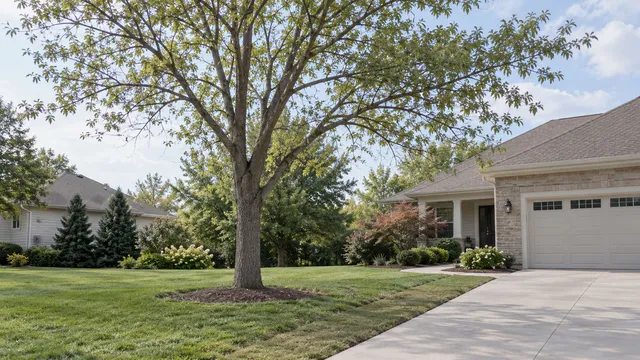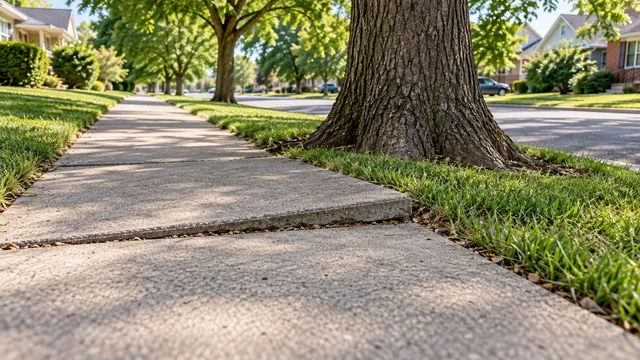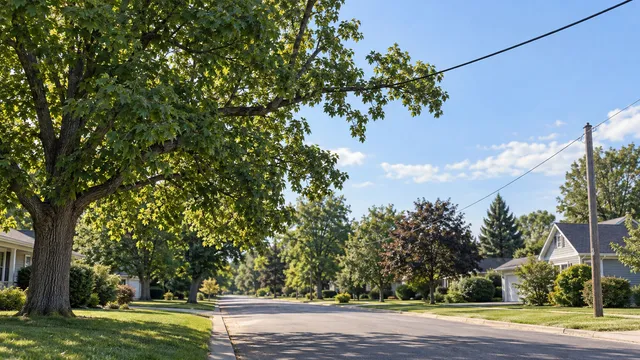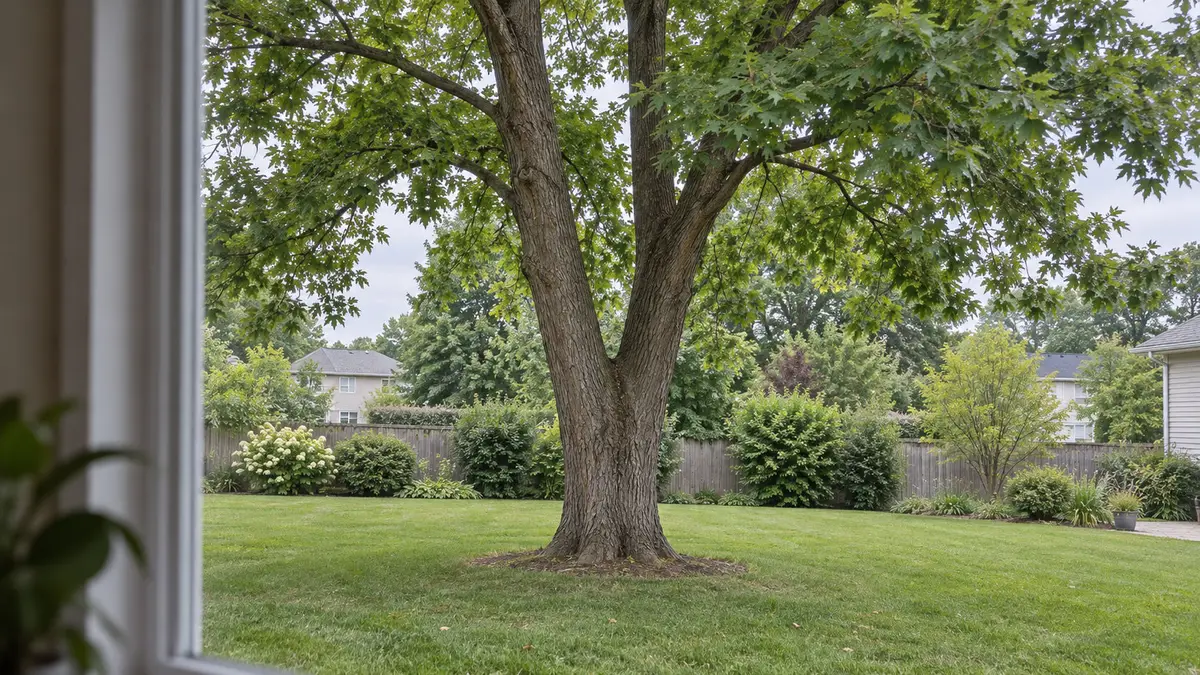
The tree still casts the shade you value, but two main stems appear to be separating. One proposal recommends a cable and pruning; another recommends removing the tree. Green leaves tell you the crown is functioning. They do not tell you whether the wood holding it together can carry its loads.
There is no dependable national price comparison for retaining a split tree versus removing it. Compare local estimates for the assessment, work and continuing visits, because a hardware-only price leaves much of the decision out.
Is the split opening or a stem moving right now?
Treat fresh separation, a partially hanging stem, or movement accompanied by cracking as a reason to keep clear and request prompt help from an arborist experienced with compromised trees. Stay out of the area the tree could affect. Do not move underneath it to park a car elsewhere, place caution tape or get a better photograph. Tell the responder what you can see from your existing safe position.
When people, an occupied building or public access face immediate danger, contact emergency services. The arborist or emergency responder should establish practical access restrictions; a distance guessed from a photograph cannot do that. Lack of movement during a quiet moment does not clear a newly discovered split.
Power lines change who coordinates the response: report contact or threatened lines to the serving utility before any tree crew begins work. PG&E’s electrical-safety guidance directs people away from fallen or dangling lines and contacting objects and tells them to call 911. Use your own utility’s reporting route. Stay away from a possibly energized tree, cable or fence. The tree-and-power-line guide explains that handoff.
Is cabling preventing a split or supporting an existing failure?
A union is the junction where branches or stems join. Codominant stems are two competing main stems of similar size. Bark can become trapped between them, called included bark, instead of a strong wood connection developing across the attachment. An arborist evaluates that feature in the context of the whole tree; a V-shaped fork alone is not a verdict.
TCIA distinguishes preventive support from support after mechanical failure. A weak attachment that remains intact presents a different problem from a union that has already cracked, split or torn. After damage, a support design is reasonable only when the risk left after treatment is acceptable for the setting.
This is why “cabling can save trees” does not answer your particular question. Hardware does not reconnect torn wood or return the tree to its undamaged condition. If you only see a bark line and do not know whether the wood is separated, use the trunk-crack assessment guide; do not pry into the opening. An arborist also needs to evaluate what remains attached after a major limb breaks in a storm.
What must the arborist evaluate beyond the gap?
Ask for findings about the damaged part and the rest of the tree. The ISA’s tree-risk assessment form treats branches, trunk, roots, site conditions and nearby people or property as distinct parts of the assessment. A proposal focused on one fork can miss a second problem.
| Assessment area | Question the finding should answer |
|---|---|
| Split and remaining wood | Can this structure support the proposed treatment? |
| Crown and previous failures | Which loads and other weak parts matter? |
| Roots, soil and exposure | Is anchorage a separate concern? |
| People, buildings and activities | What could a failure affect, and how often? |
| Unseen areas and limits | What remains unknown before deciding? |
The arborist considers the location and extent of separation, decay, remaining attachment, prior supports, crown distribution, species and vitality. A large canopy is not proof of sound supporting wood. Likewise, a cable high in the crown does not restore damaged root anchorage. Tell the arborist about a new lean after a storm or fungi at the tree’s base without approaching either for a closer look.
Construction, altered drainage, removed neighboring trees and changed wind exposure belong in the history. Describe the normal use of nearby rooms, paths, parking and play areas. “Nothing is directly below the split” is too narrow: the assessment considers which parts could fail and what they could strike.
The ISA form instructions also record limits, further assessment and a reassessment time frame. Ask the arborist to explain what could not be inspected and whether resolving that uncertainty could change the recommendation. Ask how those unknowns could change the choice between support and removal.
What can cables, braces and pruning actually change?
Purdue Extension’s 2017 guide describes cables as limiting movement between selected parts and redistributing loads. Braces provide more rigid restraint around vulnerable stems or unions. Some professional designs combine the two; the terms are not interchangeable.
A static system restrains movement differently from a dynamic system designed to allow some movement. The cobra manufacturer manual distinguishes those applications. A flexible system or one installed without drilling is not automatically suitable for an already separated union. The arborist must select a system for the actual defect, usable attachment areas and intended loading.
Prescribed reduction pruning can be part of the plan. Ask which parts would be reduced and what load or defect that addresses. “Thin it out” is not an adequate scope, and topping is not a substitute for a specific treatment objective. TCIA’s discussion of bracing and planning emphasizes matching combined work to the tree.
Support has limits: it does not cure decay, solve every root problem or prevent failure elsewhere. No homeowner tightening, temporary strapping, pushing or cutting belongs in this decision. Installation and adjustment require an arborist with the relevant support-system experience.
When does keeping the tree make sense, and when is removal stronger?
Retention is worth considering when the arborist identifies a workable treatment, the whole tree’s condition permits it, and the remaining risk fits the site. The owner must also be able to maintain the follow-up plan. A tree retained beside a rarely used corner presents a different exposure from one beside a bedroom or daily play area.
Removal becomes the stronger option when damaged or decayed structure cannot support a defensible treatment, another serious failure mode remains, important occupied areas cannot be protected, or ongoing care cannot be maintained. The ISA’s risk-management guidance identifies removal as the best choice for some trees with unacceptable risk and explicitly says supports are not guarantees against failure.
An arborist may compare support, targeted pruning and changes to how an area is used. Moving a picnic area may reduce exposure after professional assessment; it does not turn an actively separating tree into a casual monitoring project. Keep immediate restrictions in place while deciding.
Once feasible options are clear, include shade, habitat, sentimental value and a replacement planting site in the choice. Age or a species name alone should not settle it. If removal is selected, define site protection and cleanup, then decide whether grinding or excavating the stump fits the next use. Confirm ownership and local permission requirements with the responsible authority before work.
How do you compare a cable quote with a removal quote?
First verify who assessed the tree and who would perform the work. An arborist who holds the ISA Tree Risk Assessment Qualification brings a defined assessment background. TRAQ is a qualification, not a contractor license or proof of cabling-installation experience. Ask about both assessment and support-system work, insurance and locally applicable licensing.
University of Minnesota Extension’s hiring guide recommends specific written agreements and checking qualifications and insurance. Send each bidder the same questions:
- What failure are you trying to prevent, and what evidence supports this recommendation?
- What alternatives did you consider, and what would remain at risk afterward?
- Which support system and pruning are included, and what is excluded?
- Who handles utility coordination, local approvals, access and site protection?
- What inspection, reassessment and replacement work follows, and what does each visit cost?
Compare the initial assessment and report, installation or removal, cleanup, site repair and continuing care. Difficult access, equipment needs and urgency can change the scope. A lower cable price is not necessarily a lower long-term cost, and a higher price is not evidence of a better design.
If recommendations conflict after immediate danger has been addressed, a consulting arborist experienced with supplemental support can provide a second onsite opinion. Share the first reports. Ask why the recommendations differ rather than asking which hardware to buy. Photo-only selection, a “storm-proof” promise or no maintenance explanation are reasons to pause the purchase.
What follow-up comes with a retained tree?
Before accepting the work, obtain the system type, installation date, intended purpose and responsible professional’s details. Keep the assessment, work description and inspection records together. The cobra manual requires installation documentation and qualified inspections, and calls for defects to be corrected promptly, with serious defects addressed immediately. Those are professional tasks.
Separate hardware inspection from whole-tree reassessment. The first checks the support’s condition; the second revisits the tree, site and risk remaining. Ask for dates, who performs each visit, replacement criteria and changes that trigger an earlier call.
Purdue’s older examples and manufacturer service-life figures do not establish one maintenance calendar for every tree. Nor does a cable’s rated service life say how many years the tree will remain suitable for retention. Growth, decay and changed use of the property can alter the decision before hardware reaches a scheduled replacement date.
Report a newly opening split, movement, partial failure or electrical contact through the urgent routes above. A cable that looks different is a reason to contact the arborist, not climb up or adjust it. Before choosing retention, put the next inspection, next reassessment and contact person in the written agreement.
Frequently asked questions
I bought a property with a cabled tree but no records. What now?
Arrange an inspection by an arborist experienced with support systems and request a whole-tree assessment. Ask the seller for any installation or service records, but do not infer age or adequacy from appearance. Establish a documented maintenance plan for the system actually present.
Does a slack-looking cable mean it has failed?
Not necessarily; intended movement differs between systems. An arborist must compare its condition with the design and tree, rather than judge it by a ground-level tension test. Report the appearance without touching or adjusting the cable.
Could removing one stem avoid removing the whole tree?
Sometimes a different pruning plan is worth discussing with the arborist. Purdue’s advice about correcting competing stems early in a tree’s life does not justify cutting away a large mature leader. The arborist must evaluate the cut, remaining structure and resulting loads before recommending that option.
Should I get another assessment before adding a patio or play area nearby?
Yes. More frequent use beneath the tree changes what a failure could affect, and construction can change root and soil conditions. Give the arborist the proposed layout before work begins so the retention decision accounts for the new use.
Sources
- PG&E — Electric Safety
- TCIA — The Need for Supplemental Support
- ISA — Basic Tree Risk Assessment Form
- ISA — Using the Basic Tree Risk Assessment Form
- Purdue Extension — Large Tree Cabling and Bracing, 2017
- cobra — Tree Cabling Manual
- TCIA — How to Brace, Guy or Prop
- ISA — Managing Hazards and Risk
- ISA — Tree Risk Assessment Qualification Program Guide
- University of Minnesota Extension — How to Hire a Tree Care Professional