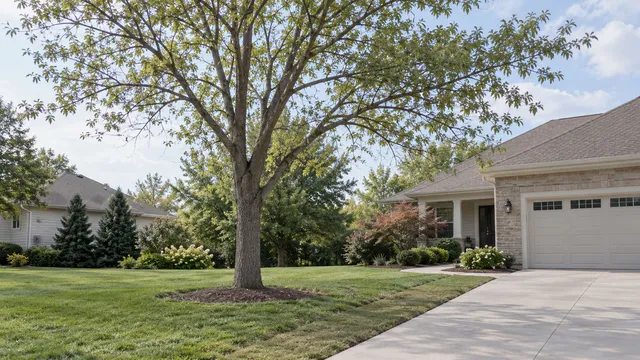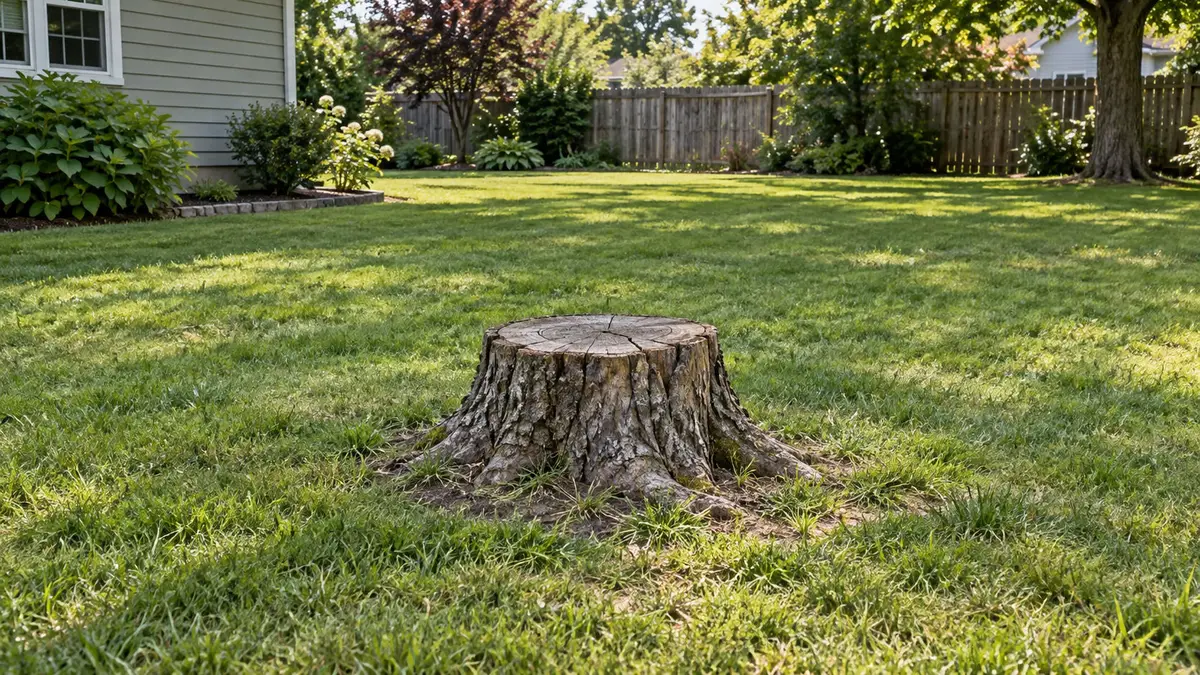
The tree is gone, and two stump quotes describe very different jobs. One leaves a pile of grindings. Another includes digging, hauling and soil. Before comparing their totals, decide whether this spot needs to hold grass, a new tree or part of a future patio.
There is no independently verified national price range that fairly compares those finished outcomes. Access, the agreed root extent, hauling and restoration need local itemized estimates; a low base price may leave the lawn repair to you.
Stump grinding vs. full removal: what will this part of the yard become?
Start with a sketch of the next use and its footprint. Include timing, even if the patio or replacement tree will come later. A contractor can price a clearly defined result more usefully than “make the stump disappear.”
| Desired result | Starting discussion | Who confirms suitability |
|---|---|---|
| Mowable lawn | Grinding plus debris removal and lawn repair | Stump and landscape contractors |
| Planting bed | Required rooting space and remaining wood | Arborist or landscape professional |
| Replacement tree | A new location or preparation of the old one | Qualified arborist |
| Patio, driveway or structure | Project-specific removal and ground preparation | Project designer and relevant contractor |
This is a planning aid, not approval to build or plant over buried wood. A flexible planting layout may avoid the old root crown entirely. A fixed shed-post location might require a different removal scope, additional design work or moving the post. Decide that before buying a limited grind.
What does each method actually take away?
Grinding reduces the specified stump area to wood chips below the agreed surrounding ground level, or grade. Excavation removes the stump and root crown—the central woody base where the roots join—and the major roots included in the contract. It leaves an excavated area and material to haul or manage.
Iowa State Extension distinguishes grinding from digging. Grinding can include selected large surface roots, but roots outside that work remain. Excavation removes more central wood, yet “full removal” does not mean every distant root across the yard is recovered. The contract needs a boundary for both methods.
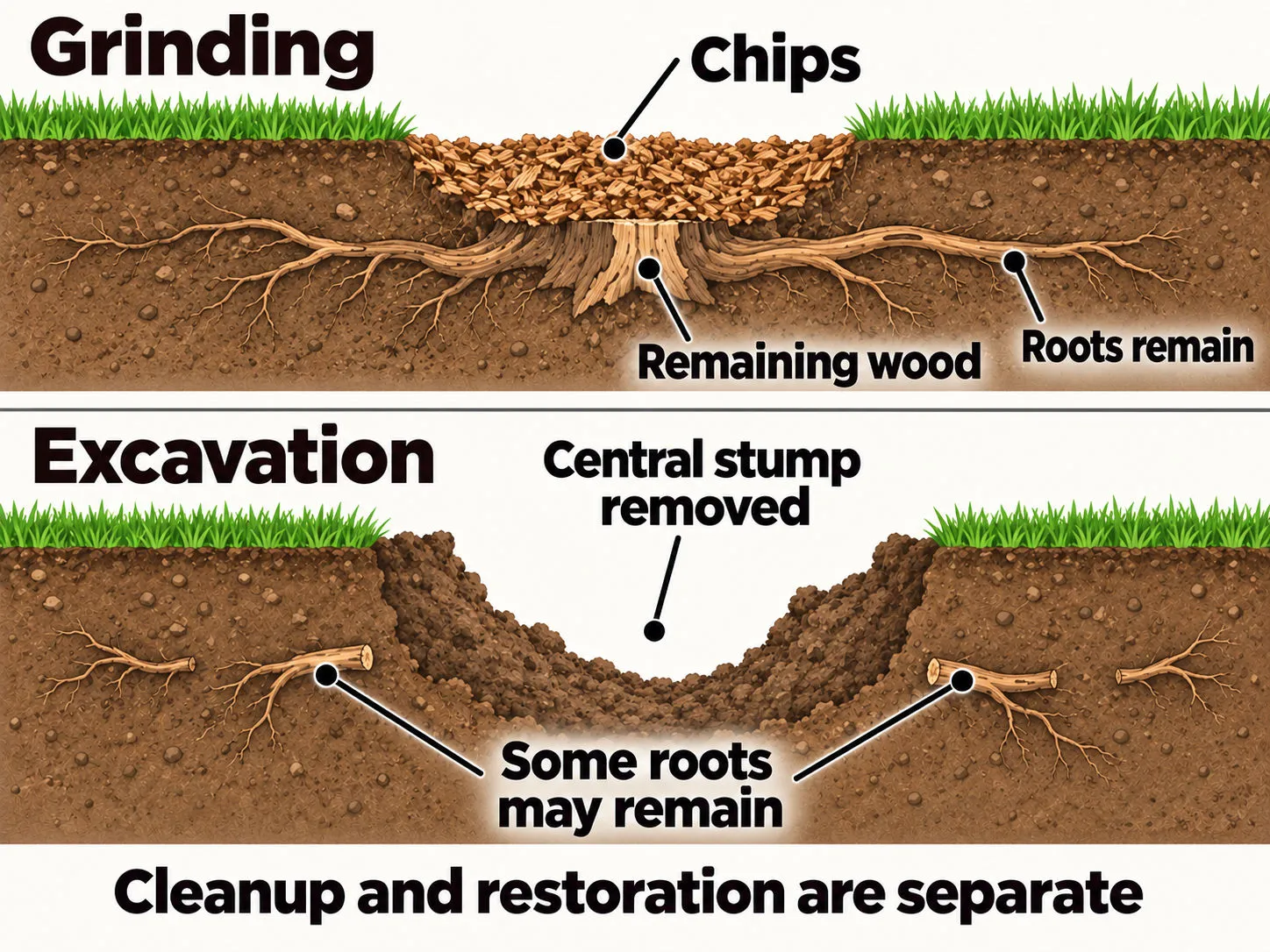
Neither a machine’s maximum reach nor a typical depth quoted online defines your job. Establish the finished use, site obstacles and work limits with the contractor. Grinding generally disturbs a more limited area than extracting the central stump, but access and cleanup can affect the surrounding lawn with either method.
What should “below grade” and “full removal” mean on the estimate?
Have the contractor identify the reference ground level, work footprint, roots included and any obstacles that restrict work. Ask what happens if more wood is found later within that agreed area. A promise to “grind the stump” does not say whether a large surface root crossing the future lawn is included.
Keep removal separate from finishing. Iowa State says most arborists do not remove the grindings or fill the hole unless requested, and both typically cost extra. Specify hauling, soil, grading and grass or planting work rather than assuming they follow automatically.
Can equipment reach the stump without creating another problem?
Provide photos taken from ordinary accessible ground, plus gate openings, steps, slopes, fences and paved areas. Identify irrigation controls and any known buried systems. Let the contractor assess the entire route, turning space, ground conditions and protection needed, not just the narrowest gate.
A manufacturer’s stump-cutter specifications illustrate why this is equipment-specific: width, weight and cutting reach differ by model. One machine fitting through an opening does not establish that the ground or nearby paving can take the job. Ask whether fence removal and reinstatement, lawn protection or repair are included.
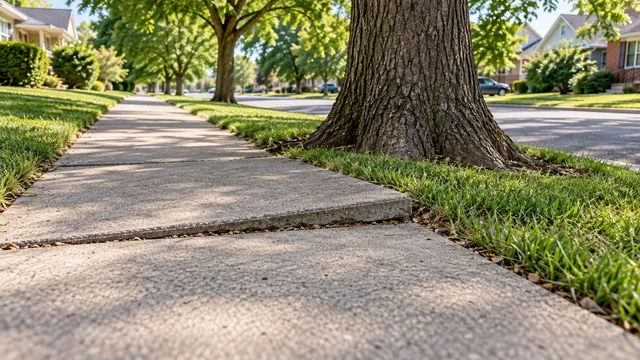
Point out living trees near both the stump and equipment route. Root direction at the surface does not establish which tree a root belongs to. Have an arborist assess work that could injure a retained tree. Construction-related root damage may become visible long after the equipment leaves; roots lifting a sidewalk call for a live-tree assessment before any cutting decision.
Does an 811 request locate everything underground?
No. The one-call center notifies participating facility operators; it is not a crew that clears the entire yard. OKIE811’s homeowner guidance says the contractor is responsible for the notice when an Oklahoma homeowner hires the work. It also tells owners to request the ticket and check responses. Confirm the actual notice, marking and response requirements with your local center.
OHIO811 explains the private-line gap: owner-installed systems may need a separate private locate. Tell the contractor about irrigation, outbuilding power, septic-related lines and other private facilities. Have a private utility locator or the appropriate system specialist resolve uncovered facilities before disturbance.
Old marks, no paint in one spot or a “shallow” grind do not establish clearance. The contractor must resolve missing responses and uncertain locations under the applicable local process. Supply old plans as clues, without probing the ground to check them yourself.
What needs to happen before grass or plants go in?
A mound of chips is an intermediate result. Iowa State’s lawn-restoration guidance identifies buried wood, compacted soil and uneven grade as obstacles to turf establishment. It says wood debris and sawdust should be removed because they affect soil moisture and nutrient availability.
Ask the landscape contractor to price a repaired area with appropriate soil and grade, not just seed scattered over grindings. Surface wood mulch used for an appropriate planting is different from a hole dominated by wood beneath new grass. Decomposition can also produce later settling, so a level appearance on departure is not a permanent-level guarantee.
For lawn repair, define the cleanup boundary, seed or sod suited to the climate and site, establishment timing, watering handoff and who returns if the patch settles or establishes poorly. Iowa’s planting calendar is not a nationwide one. If the area already stays wet, address the yard’s drainage problem as part of restoration.
Can a replacement tree go in exactly the old spot?
Iowa State says a different planting location is best. Residual roots, disturbed soil and the previous tree’s disease or pest history can complicate the old position. Moving the planting may be a better use of the budget than excavating solely to preserve a point on the plan.
If the location is fixed, have an arborist or landscape professional evaluate rooting space, remaining material, soil and the proposed species before choosing the stump service. Waiting a fixed number of months alone does not resolve those conditions. Ask whether the planting plan includes further preparation beyond the stump contractor’s scope.
What changes if a patio, driveway or building goes here?
Show the proposed footprint to the paving contractor, builder and project designer before stump work starts. Have the designer identify what must be removed, which ground conditions need checking and who specifies and accepts replacement fill and any testing. A geotechnical or structural engineer should resolve soil-support or foundation questions where the project requires them.
FHWA’s archived road-fill guidance separates suitable fill from roots, stumps and other unsuitable material. It explains the underlying concern, but it is not a residential foundation specification. Your soil, loads, pavement or building design and local requirements set the acceptance criteria.
A deeper grind is not proof of bearing capacity. Neither is an excavated hole covered with soil. If a shed support conflicts with buried wood, the designer must resolve the location and preparation before a contractor treats the site as ready. Keep that acceptance separate from the stump invoice.
Can roots sprout again, or keep a disease in the site?
Some woody plants produce shoots from the root crown; others also sucker from lateral roots farther away, as University of Minnesota Extension explains. Grinding the visible stump therefore cannot promise that all future shoots stop. Ask an arborist about the species and what follow-up is included if regrowth appears.
If the tree died or had a diagnosed root disease, provide that history before deciding where debris goes or what to plant. UC Integrated Pest Management’s Armillaria guidance explains that this root-rot organism can persist in woody material left underground. Reducing infected material does not sterilize the soil or guarantee the replacement tree’s outcome.
A USDA-published 2012 long-term forest study also found incomplete Armillaria control despite intensive stump and root treatments. That severely infected forest is not a prediction for a residential yard; it is a reason to reject an eradication guarantee. Disposal and planting recommendations belong to the diagnosed organism and local guidance. Do not begin chemical treatment, burning or root excavation yourself.
How do you compare quotes for the same finished yard?
Give each contractor the same sketch and desired completion condition. Compare inclusions, exclusions and unresolved items across these rows:
| Scope line | What should be clear |
|---|---|
| Stump and roots | Method, footprint, agreed depth and remaining material |
| Access and protection | Route, fence work and protection of retained trees |
| Locating | Ticket/responses and any private locate |
| Debris | Chips, woody material and soil hauled or retained |
| Restoration | Soil, grade, planting or turf, and watering handoff |
| Follow-up | Settling, regrowth and additional wood within scope |
Ask who pays for an inaccessible root, concealed obstacle or extra hauling, and how a change is approved before work continues. Stump size, removal extent, access, equipment and restoration can all change the price. Compare totals only after both bids describe the same endpoint.
Confirm applicable local licensing or permits and insurance suitable for the work. Arborist certification does not replace them. Seek another qualified opinion when bids disagree about a fixed planting or building location, or one promises complete disease elimination or a root-free yard without defining the work. Choose the finished condition first, confirm it is feasible, and put that result in the written scope.
Frequently asked questions
Can I leave a low stump in an unused corner for wildlife?
Yes, if its location and condition do not create an unacceptable risk to people or property. Iowa State describes dead stumps as food and shelter for wildlife and advises regular evaluation as they decay. Have an arborist assess instability or a changing hazard and arrange professional removal when the decaying stump poses a risk if it falls.
Can I reuse grindings as mulch if the tree was diseased?
It depends on the disease. Wisconsin Extension says mulch from trees with Verticillium wilt should be avoided because it can transmit the fungus; evidence for other organisms differs. Give the diagnosis to an arborist or plant diagnostic clinic before reuse, and keep surface-mulch decisions separate from filling the stump hole.
Why do mushrooms appear where the tree stood?
They can grow from buried wood still decomposing, according to University of Maryland Extension. Their appearance alone does not identify the fungus or establish that nearby trees are healthy or diseased. If mushrooms appear in the lawn close to a living tree, or grow from its trunk, base or surface roots, ask an arborist to assess the tree; do not infer edibility.
Does a depression years later always mean roots are decaying?
No. Florida’s geological survey lists several possible causes of subsidence, including buried wood, fill and underground-system problems. Keep people away from a growing void; have a foundation specialist or geotechnical engineer investigate changing ground or effects on structures, with the relevant utility if a buried service may be involved. Do not simply cover a developing hole with more soil.
Sources
- Iowa State — How to Remove Tree Stumps
- Vermeer — SC30TX Stump Cutter Specifications
- OKIE811 — Homeowners
- OHIO811 — Private Utility Locating
- Iowa State — How to Plant Grass After Tree Stump Removal
- Iowa State — Replanting in the Same Spot
- FHWA — Embankment or Fill Application Description
- University of Minnesota — Controlling Unwanted Trees and Shrubs
- UC IPM — Armillaria Root Rot
- USDA Forest Service — Armillaria Inoculum Reduction: 35-Year Results
- Wisconsin Extension — Wood Mulch and Tree Health
- University of Maryland — Mushrooms and Slime Molds in Lawns
- Florida Geological Survey — Sinkhole FAQ