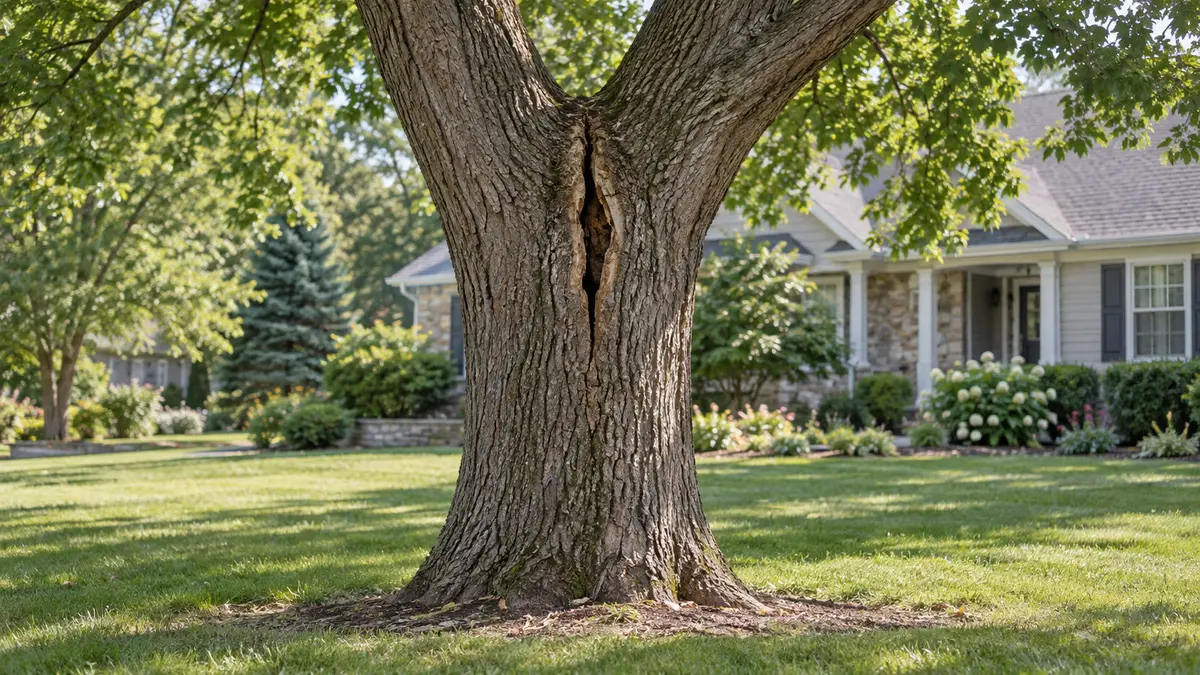
A vertical seam appears on the trunk of a tree near your house. Perhaps you noticed it after a storm, but you have no older photo that shows whether the opening has changed. That uncertainty matters: the condition of the wood and what the tree could hit both shape the response.
An assessment is a separate service from cutting or removing the tree. This guide helps you describe what you already see, decide whom to call and ask for findings that explain the next step. No reliable nationwide price range exists for evaluating this particular defect. The visit, written report, further investigation and eventual tree work can be separate parts of a quote.
Has the crack changed—or is anything moving?
Keep clear first if the tree or a section is moving. The International Society of Arboriculture (ISA) lists cracks in trunks and branch unions among signs that warrant professional examination. The response also depends on whether the tree threatens a porch, room, path or another place people use. This table routes calls; it does not rate the tree.
| What you already observe | Action from a safe place | First contact |
|---|---|---|
| Ongoing splitting or movement; a section detaching over an occupied area; new lean with disturbed ground | Keep people and pets away; leave belongings in place | Urgent arborist help; emergency services for immediate danger to people |
| Tree touching or threatening a wire; damaged or fallen wire | Stay away from tree, line and anything touching either | Serving electric utility; emergency services for immediate danger |
| Newly seen or changing wood opening, major-fork crack, associated cavity or decay sign | Avoid the affected area and describe the uncertainty | Arborist experienced in tree risk assessment, promptly |
| Previously assessed, unchanged outer-bark feature | Follow the documented plan; report any change or new use of nearby space | The arborist who assessed it or another qualified arborist |
Do not enter a possible fall area to move a vehicle or put up tape. If a line is involved, do not try to judge whether it is energized. Iowa State’s storm-damage guidance separates hazardous suspended wood and utility hazards from work an owner can handle. The serving utility must coordinate line-related tree work; the power-line contact guide covers that handoff. A fresh lean also needs its own assessment; the guide to a tree that started leaning after a storm explains what to report without approaching its base.
Even when you see no movement, an unassessed crack has no established safe waiting period. Tell the arborist whether the tree overhangs an entrance or occupied room so the service can triage the visit and advise on interim use.
Bark fissure, trunk split, or cracked fork: what can you see?
“Crack” describes appearance, not depth. Some trees develop outer-bark fissures as the trunk grows; the grooves can expose developing bark without dividing structural wood. University of Maryland Extension distinguishes normal growth cracks from winter damage. Other species naturally peel or show deep-looking bark patterns, as Iowa State Extension explains. Neither fact clears a particular tree when its opening is new or changing.
A wood split visibly opens beyond bark into the trunk. A branch union is where a major limb or second stem joins the trunk; an opening there raises a question about that attachment. A narrow V-shaped fork alone does not establish failure. An actual opening or movement at the fork is a more useful observation to report. N.C. Cooperative Extension advises professional evaluation for deeper splits in larger trees.
Use ordinary location words: “on the main trunk,” “below the fork,” “at the joint of two stems,” or “above the porch.” Say “depth unknown” if you cannot see it from where you already stand. Do not scrape away bark, insert an object, tap the trunk or walk around it to complete the description. A close photograph could show the surface yet miss the structural condition and the targets around the tree.
Does an old covered seam mean the wood is strong again?
No. A tree can grow new tissue around an injury and compartmentalize damage, meaning it walls off injured tissue. That is different from rebuilding the original wood connection. An Ask Extension explanation of tree wounds makes that distinction. A covered seam is useful history for the arborist, but its appearance does not establish strength inside.
An older photograph can show that a line existed years ago. Compare it only from the same safe location if an image is already available. It may reveal a change in the opening or bark, but cannot prove that the tree is stable today.
Can weather or earlier damage explain a trunk crack?
Yes, weather and injury history may help an arborist explain the mark. They cannot substitute for evaluating a structural concern. Separate “I first noticed it after Tuesday’s wind” from “I saw the opening widen during Tuesday’s wind.” The first gives a discovery date; the second reports a change.
In colder regions, sunscald injures bark and the growth layer beneath it, while a true frost crack extends into wood. Their everyday names are often used loosely, and a vertical line or compass direction alone does not identify either condition. University of Minnesota’s frost-crack guide draws the tissue distinction. Iowa State reports that an older weak area can reopen during cold weather. A gap narrowing when temperatures change does not rebuild damaged wood.
Storm loading can reveal a weak attachment, though a post-storm discovery does not date the original defect. A known impact, lightning strike, old trunk wound, nearby digging or changed grade belongs in the history. If nearby work preceded thinning leaves, the construction-related root-damage guide covers that separate pattern. If a major branch broke, the storm-broken limb guide addresses that separate problem. Iowa State’s bark guide recommends evaluation after lightning damage; a limited visible strip of bark loss does not tell the whole story.
For susceptible bark, Maryland discusses reflective paint or wraps, while Minnesota questions conclusive evidence for wraps and notes possible harm; Iowa says established frost cracking has no known effective prevention or treatment. These address different injuries and contexts: have the arborist assess today’s defect before discussing local prevention advice.
What should you tell the arborist without getting closer?
Give the service what you know already. “Unknown” is useful where a view or record is missing. A phone description can help triage, but it does not replace an on-site assessment.
- When you first noticed the seam, whether an older photo shows it and whether you know it changed.
- Whether the line appears on the main trunk, at a major fork or beside an earlier wound, as seen from a safe place.
- Any visible changed lean, hanging limb, cavity, wet staining or disturbed ground already in view.
- Recent wind, lightning or impact; earlier pruning, support hardware, construction, excavation or grade change you know about.
- The house, porch, path, play area, driveway, neighbor’s property or overhead line the tree could affect, and when people use that area.
- Any earlier arborist report or tree-care record. Species and size can remain unknown.
Existing photographs are optional. A zoomed image from a place already safely accessible can communicate location, but do not enter the area under the tree to improve it. Tell the arborist which view is inaccessible and which outdoor areas you have stopped using. Emptying a space changes exposure, not the defect.
What should a tree risk evaluation include?
Ask for an arborist experienced in assessing structural defects, and ask who will actually perform the evaluation. ISA Certified Arborist is an individual certification. Tree Risk Assessment Qualification (TRAQ) is a separate ISA qualification focused on assessing risk; it is neither a nationwide business license nor a promise about the tree. ISA’s TRAQ program guide describes the qualification and the tree, site and target information an assessor considers. Verify the individual’s current credentials, plus any locally applicable licensing and insurance separately.
Say that you need findings about the crack and the affected space, not only a price to remove the tree. Ask whether the visit includes written findings and whether further investigation would carry a separate scope. The assessor should explain what part might fail, what it could hit, the assessment’s time frame, what was inaccessible and what uncertainty remains. ISA’s sample written report shows how scope, limits, targets, options, remaining risk and reassessment can be communicated; its sample tree is not a prediction for yours.
Ask these questions before accepting a recommendation:
- What did you find in the bark, wood and attachment, and what could not be inspected?
- Which areas should remain unused until work or reassessment, and why?
- Would further professional assessment change the choice between retention and removal?
- What action is proposed, what concern does it address, and what remains afterward?
- Who will reassess the tree, when, and after which new changes should you call sooner?
How do you compare conflicting recommendations?
Get the assessed defect and proposed work in writing. University of Minnesota Extension advises a defined tree-work scope, including the work and cleanup. Ask whether the site visit, written report, additional diagnostics and tree work are quoted separately. Overhead access, the part at issue and the extent of investigation change the work, so an unsupported national price would not clarify your own quote.
If one assessor recommends support and another recommends removal, ask each to explain their findings and remaining concerns on the same basis. A separate consulting opinion can help when the situation is not urgent. Do not postpone immediate exposure control to compare bids. A guarantee from a photo, a vague “fix the crack” proposal or pressure to approve work without a scope deserves specific questions.
What should a keep-or-remove recommendation explain?
The arborist may propose a documented monitoring plan, professional pruning, a support system in selected cases or removal when the assessed risk cannot be managed acceptably. ISA’s risk brochure describes multiple mitigation options. Each one addresses a different part of the problem. Pruning a damaged branch does not resolve a separate trunk or root concern; a cable does not make the tree unable to fail.
Ask exactly which defect a proposed action addresses and what risk remains. If the tree stays, monitoring needs a responsible person, a reassessment date or condition, and clear signs for earlier contact. The detailed tradeoffs of cabling a split tree versus removing it deserve a separate discussion after the defect is identified. If fungal growth appears at the base, mushrooms near the trunk raise another question about decay and anchorage.
Do not fill or seal the split, strap the stems, cut a suspect limb or trim bark as an experiment. Iowa State’s bark guidance does not recommend wound coverings as a cure. Leave the visit with a written explanation, any present use restrictions, the work scope and the trigger for follow-up.
Frequently asked questions
Does sap or wet staining from a crack mean rot inside the trunk?
No. Wet staining has more than one possible explanation; University of Minnesota Extension describes wetwood as one cause of liquid at a wound. Its appearance does not tell you the depth of a crack or the tree’s strength. Report the staining along with the structural concern to the arborist.
Can insects around a crack be a result of earlier damage?
Yes. Iowa State says insects and other agents around damaged bark are typically secondary invaders, although the visible insects alone do not date or explain this tree’s opening. Tell the arborist what you saw without peeling bark to identify them.
Can an arborist assess a tree when I have no older records?
Yes. The arborist can evaluate the present tree, site and targets while recording that the earlier history is unknown. ISA’s assessment guidance accounts for the scope and limits of an evaluation. An old record could help explain change, but its absence does not require you to reconstruct one.
Does a visible crack mean an existing cable or brace failed?
No. A crack alone cannot show whether a support system is functioning or whether the tree around it has changed. Ask the arborist to assess both the tree and the existing system, including its records and follow-up plan. Avoid touching or adjusting the hardware.
Sources
- International Society of Arboriculture — Recognizing Tree Risk
- Iowa State University Extension — How to Manage Storm-Damaged Trees
- University of Maryland Extension — Winter Damage on Landscape Plants
- Iowa State University Extension — Shedding, Peeling, and Splitting Bark on Shade Trees
- N.C. Cooperative Extension — Splits and Cracks in Bark
- Ask Extension — Persimmon Wound Question and Response
- University of Minnesota — Frost Cracks and Cankers
- Iowa State University Extension — Frost Cracks and Exploding Trees
- International Society of Arboriculture — TRAQ Program Guide
- International Society of Arboriculture — Sample Written Report
- University of Minnesota Extension — How to Hire a Tree Care Professional
- University of Minnesota Extension — Non Harmful Tree Conditions