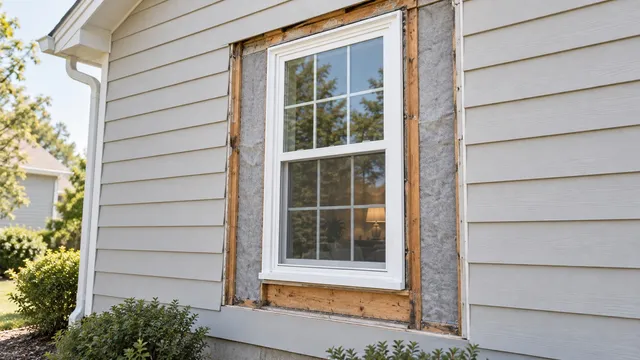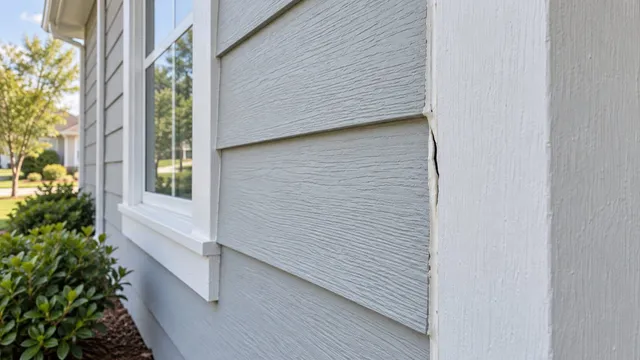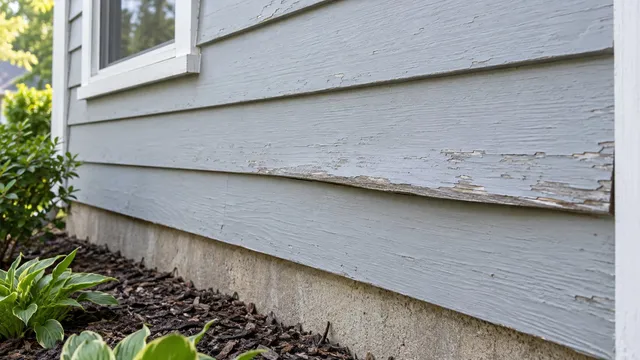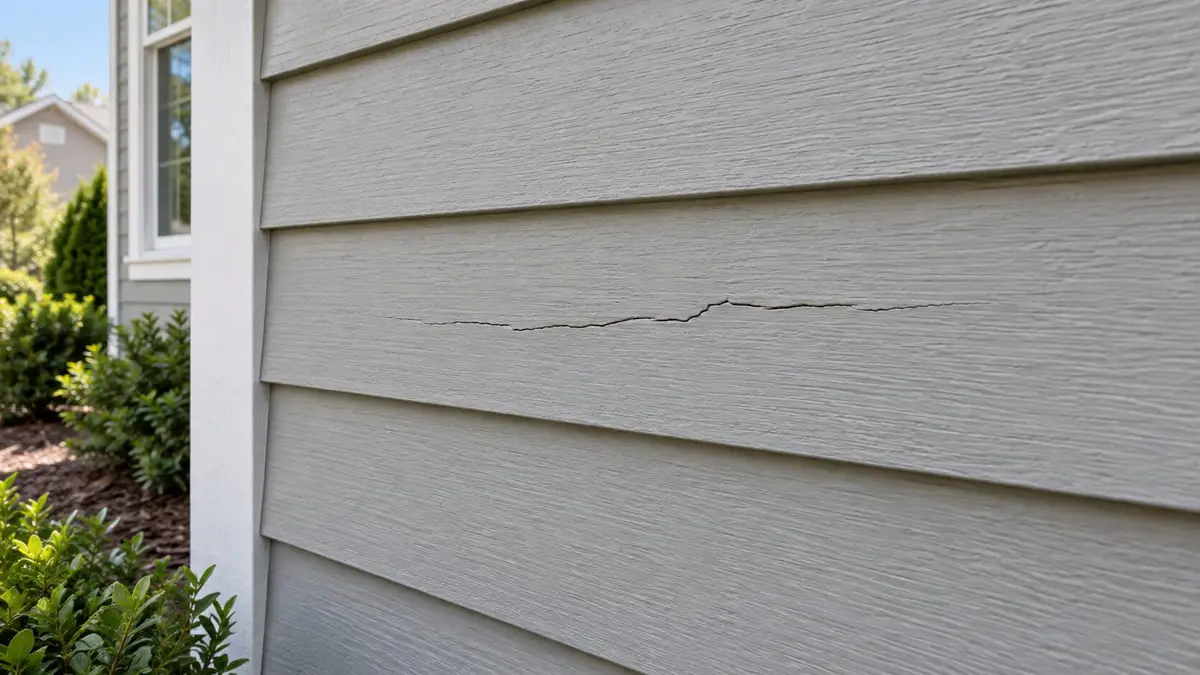
A narrow line across a fiber-cement board looks like a simple patch job until the finish flakes away or the same spot opens again. A chip, a cracked coating, an end joint, and a broken board demand different decisions. The edge you can see is only part of the story.
There is no reliable national price for this repair without knowing the product and scope. One eligible surface repair, one replacement board, and work involving hidden moisture or finish restoration are different jobs. Get an itemized local estimate after the damage is classified.
Is the fiber-cement siding surface marked, or is the board broken?
Crack width alone is not a repair test. A thin-looking line can cross a board edge or an attachment area. Conversely, a mark confined to coating may leave the board sound. The Nichiha care bulletin for specific product families separates cosmetic damage from physical breakage, but its product rules do not classify another brand’s board.
| Ground-level observation | Question for the inspector | What you cannot infer |
|---|---|---|
| Coating check or small surface chip | Is substrate and finish repair approved? | Sound board from appearance alone |
| Line at an exposed board edge | Does separation run through the board? | Depth from line width |
| Missing corner or broken piece | Is replacement and adjacent support needed? | Extent behind the siding |
| Opening between two board ends | Is this a designed joint or a fracture? | That caulk is the correct fix |
| Unclear depth or a line by a fastener | Is attachment compromised? | Holding strength from a photo |
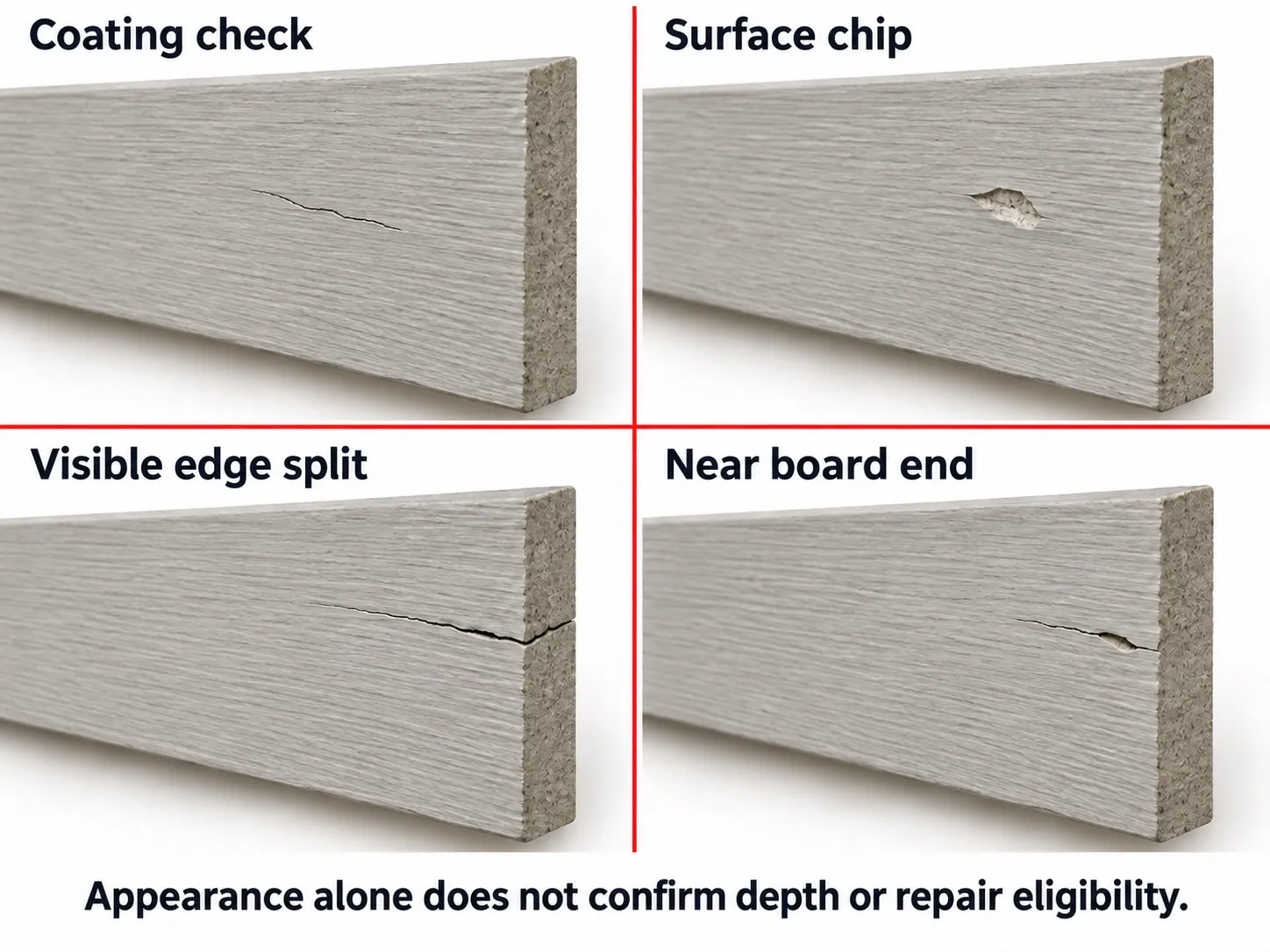
A board crack is not, by itself, proof that the building’s frame has failed. For a hanging piece, keep clear and call a fiber-cement siding contractor urgently. Have a structural engineer assess a visibly displaced wall; call a building-envelope specialist or siding contractor promptly for active indoor water entry. Do not tug a board to check stability.
What should you record before calling?
Take a wide photograph of the wall and a zoomed view from secure ground. Record the date, exact board location, whether an impact, storm, painting job, or earlier patch preceded the mark, and whether it has changed. Note a matching interior stain without assuming it came through the crack. Existing invoices, leftover labels, paint records, and warranty documents can help identify the product. Do not climb or remove a board for a stamp.
The homeowner’s useful role ends before dust-producing preparation. OSHA documents silica exposure from cutting fiber-cement board. Leave cutting and dust-producing preparation to a fiber-cement siding contractor. Cement-like legacy siding cannot be identified by appearance. The EPA recommends trained help for suspected asbestos material before it is disturbed.
Why do the siding product and finish decide whether a patch is allowed?
Ask for the manufacturer, product family and profile, factory finish or field paint, region, and approximate installation date. A siding maker’s approval, the repair material’s compatibility, and an acceptable finish result are three separate questions. The James Hardie consumer FAQ broadly discusses cementitious patches for small cracks, chips, and dents. That wording does not establish the depth, attachment, or finish eligibility of this particular board.
The documents can be narrower. A 2012 manufacturer-authored Hardie ColorPlus notice restricted certain patch methods for that historical finish. It is not verified as today’s controlling U.S. instruction. The Allura October 2025 manual permits chip and dent patching but does not approve caulk or cementitious patches for nail heads, nail holes, or other surface imperfections. Its February 2026 M03.A care bulletin allows filling small holes. Because those passages differ, get written clarification for the identified product and finish before paying for the work.
A paint-touch-up size in one document is not a crack-length allowance for every board. Neither a familiar filler name nor the word “hairline” bypasses the product and finish question. If identification remains uncertain, ask the manufacturer or an experienced fiber-cement contractor to resolve it before committing to a cosmetic method.
Why did the fiber-cement board crack?
An impact may explain an isolated mark, but it does not prove the damage stayed at the surface. A crack near a fastener, edge, cutout, window, or unsupported span raises a different inspection question. The Allura manual addresses fastening and vulnerable opening details; Nichiha’s NichiProducts guide has its own support and attachment rules. A contractor should compare what is installed with the applicable instructions, not assume one manual applies to all fiber cement.
| Visible pattern | What the contractor should check |
|---|---|
| Known impact in one place | Board, finish, and nearby attachment |
| At a fastener or board end | Placement, edge condition, support |
| Beside an opening | Cutout, flashing, adjacent water path |
| Similar cracks or a reopened patch | Repeated movement, support, or wetting |
| Persistent dampness nearby | Drainage, finish, and hidden layers |
These are questions, not a diagnosis of settlement, freezing damage, or a defective batch. An installation deviation seen later may matter, but it still needs to be connected to the actual damage. If the line recurs, simply adding more paste leaves the mechanism unanswered.
What if moisture is involved?
The cladding is only one layer in the wall’s rain-control system. A water-resistive barrier and flashing behind it must direct water out. Stains or wet siding do not prove rot or mold, but persistent water symptoms justify a building-envelope specialist’s investigation. Near a window, the siding and flashing repair may need one coordinated scope. An apparent line at a joint calls for identifying whether that opening seals or drains, rather than treating it as a broken board.
When is a surface repair enough, and when do boards need replacement?
A surface repair is a candidate when a contractor confirms the board and its attachment are sound, the damage is cosmetic, the cause is resolved, and the exact product and finish permit the method. A through-board split, broken or missing material, damaged fastening region, broad deterioration, or a manufacturer restriction calls for replacement assessment. There is no nationwide measurement cutoff that makes every shorter crack patchable.
The Nichiha 2018 bulletin recommends replacement for physical cracks and breakage in its named products. Nichiha’s FAQ describes individual-panel replacement for one of its panel systems. Neither is a lap-board removal procedure or a promise that one board alone can always be changed. A contractor may need to open adjacent material for safe access and correct attachment. Require the reason in the proposal.
The replacement must match the system and restore the intended support, water management, and finish. A new board without cause correction can crack again. If a loose attachment is the core issue, follow the reattach-or-replace decision for flapping siding. If verified damage spans an elevation, use the one-wall-or-whole-house assessment rather than assuming one damaged board dictates a full reside.
What will the finished patch look like?
Functional repair and appearance are separate. Texture, color, sheen, and weathering can make a sound patch visible. Ask what finish restoration is approved and what result the contractor expects. A sample in an inconspicuous area may help set expectations if the product permits it. Do not accept a guarantee of an invisible patch without seeing how the actual finish will be matched. If a replacement color is discontinued, matching replacement siding becomes a separate budget decision. Paint touch-ups can also differ in appearance.
How should you compare repair estimates?
Begin with a fiber-cement-experienced siding contractor. Give them the location, dated photographs, event and repair history, product records, and any related indoor symptoms. Ask them to state what is observed, what cause is inferred, and what cannot be confirmed without controlled access. If water entry remains unclear, involve a building-envelope specialist. If findings suggest framing damage, a structural engineer should assess it. The crack itself is not a structural diagnosis.
The written estimate should identify why patching is allowed or rejected; the document and edition used; cause correction; boards and neighboring material affected; finish plan; safe access and dust controls; and disposal. Separate known work from possible concealed repair. Ask how discoveries will be photographed, priced, and approved before expanding the job. An itemized quote reveals whether two contractors propose the same outcome. Access height, product availability, selective opening, hidden wall layers, finish restoration, and local labor all change cost.
If older painted layers would be disturbed, use appropriately lead-safe renovation help under applicable rules. Do not scrape to identify the coating. Confirm any permit or licensing requirements locally for the proposed scope. Preserve the existing condition and consult the actual product warranty before permanent cosmetic work; a historical notice cannot promise present coverage. Seek another experienced opinion if one proposal demands wide replacement without mapped findings, or another proposes repeated filler without investigating recurrence.
What should you watch after the repair?
Keep the before-and-after photographs, the product and finish documents, and the contractor’s record of any hidden work. At ordinary ground-level checks, compare the repaired location with its earlier appearance. A reopened line, new looseness, spreading damage, or recurring wetness means the cause and repair eligibility need reassessment. There is no supported patch lifespan or fixed number of attempts to rely on.
Maintain only the joints the actual siding assembly specifies, and keep its drainage route open. Follow the identified product’s maintenance guidance rather than a blanket schedule. The Allura care bulletin illustrates why joint and finish care are product-specific. If the same crack returns, send the dated record to the contractor and ask which finding in the original assessment needs revisiting.
Frequently asked questions
Can old leftover fiber-cement boards be used for replacement?
Possibly, after the contractor confirms the exact product and profile, storage condition, finish, and current suitability. The NichiProducts installation guide sets storage and product-inspection requirements for that product family. Age alone does not establish that a leftover board is acceptable.
Does white powder near a repair mean the siding is moldy?
No. The Nichiha AWP troubleshooting guide describes efflorescence as salt deposits that may signal water intrusion behind AWP siding. A white deposit does not establish mold or prove the wall is dry. Have a siding contractor assess the deposit and possible water entry before treating it as cosmetic.
Should newly delivered boards with chips or cracks be installed?
No. Nichiha’s NichiProducts guide says not to install material damaged in shipment or with damaged primer or finish. Photograph it, record the damage on the delivery paperwork, and notify the original supplier immediately, as Nichiha’s FAQ directs.
Could repainting factory-finished siding affect its warranty?
Yes, coverage can depend on the exact finish and the applicable written warranty. The historical 2012 ColorPlus notice excluded certain third-party touch-ups from its finish coverage, illustrating why written confirmation matters. Ask for the terms that apply to your installed product before authorizing repainting; that historical notice does not determine today’s coverage.
Can cold or rainy weather delay an approved patch?
Yes. The approved repair material and finish may require particular application and drying conditions. The Allura manual distinguishes its Spectrum finish work, and the NichiProducts guide has finish restrictions. Ask the contractor which actual product instructions set the schedule rather than relying on one universal weather rule.
Sources
- Nichiha — NichiProducts, Sierra, and Savannah Care and Maintenance
- OSHA — Handheld Power Saws Used to Cut Fiber-Cement Board
- EPA — Protect Your Family from Exposures to Asbestos
- James Hardie — Frequently Asked Questions
- James Hardie — Touch-Up Notice to Contractors and Consumers, 2012
- Allura — Fiber Cement Siding Installation Manual
- Allura — Technical Bulletin M03.A: Care & Maintenance
- Nichiha — Installation Guide: NichiProducts
- Nichiha — Fiber Cement Siding FAQs
- Nichiha — AWP Troubleshooting Guide