The finish is worn, the door style feels dated, and someone has suggested refacing. Before choosing new fronts, look at what stays behind them. A shiny surface is a poor investment if the sink cabinet is deteriorating or the pantry is still across a busy walkway.
You can make a useful record without taking a cabinet apart. Then a cabinetmaker or refacing specialist can examine the boxes, attachments, and surfaces while a kitchen designer checks whether those boxes sit where you need them.
Neither option comes with a reliable national price, and no percentage or cabinet age tells you when refacing stops being worth it. Both totals turn on opening count, custom sizing, finish, repairs, accessories, labor, and the work around the cabinets, so compare itemized local proposals for the same finished kitchen.
Decide what needs to change before choosing a cabinet service
Write down the complaint for each cabinet run, a continuous line of cabinets. Is it the door profile, worn paint, unreliable drawers, hard-to-reach storage, or the position of the refrigerator? These point to different scopes.
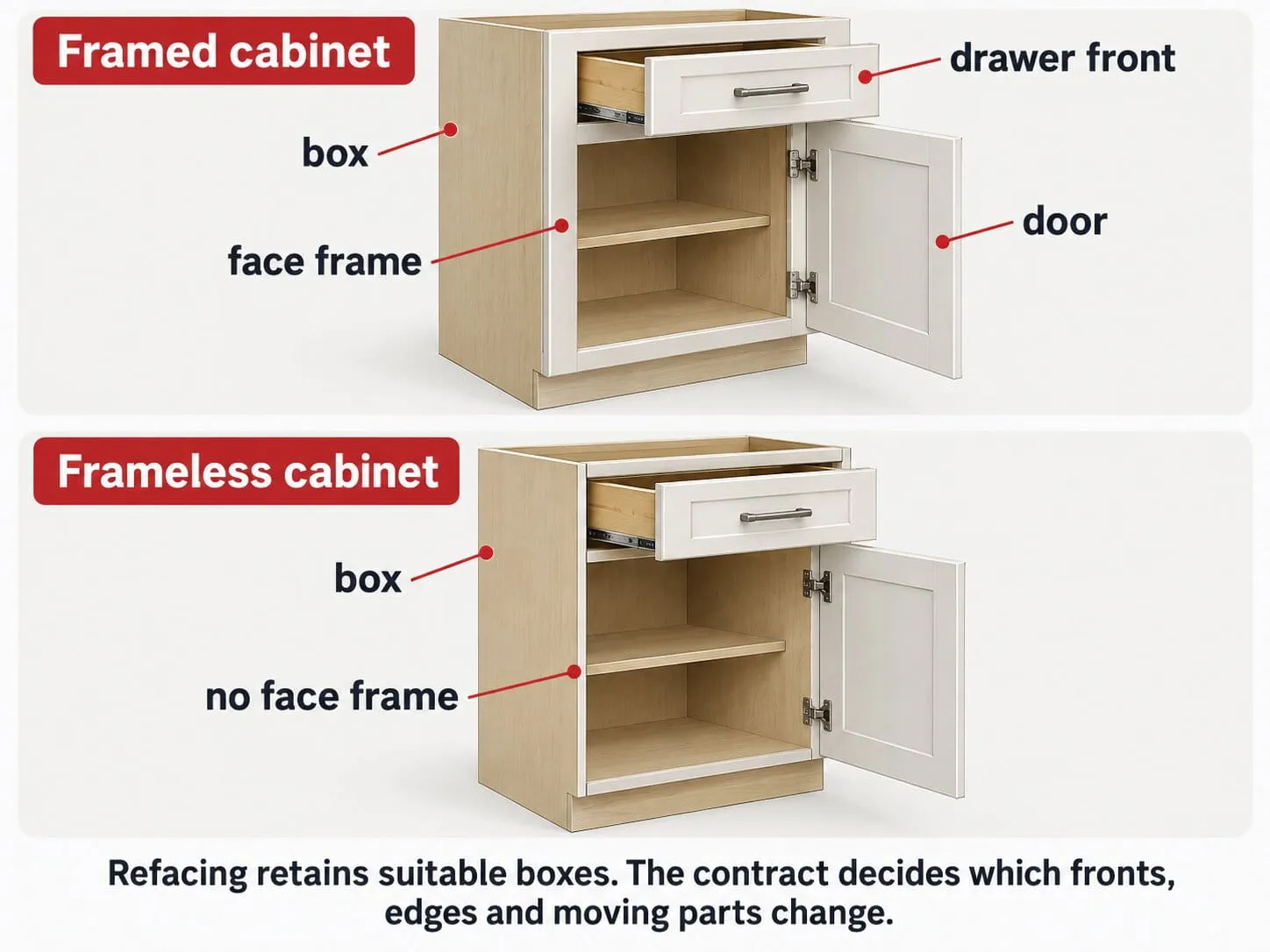
Refinishing or repainting keeps the doors and boxes and changes their finish. Refacing (some companies call it resurfacing) normally keeps the cabinet boxes, replaces doors, drawer fronts, and hardware, and covers visible frames and sides with matching veneer or laminate. New cabinets replace the boxes too. A limited hardware repair may be enough if you like the fronts and the layout works. WalzCraft’s refacing description shows the retained-box approach, but each contract must name its actual parts.
Think of a cabinet as several pieces: the box is the fixed case; the door and drawer front are visible faces; the drawer box is the container that slides; hinges and slides make those parts move. Framed cabinets have a face frame around the front opening. Frameless cabinets do not. An exposed side panel, toe kick (the recessed strip at the floor), or edge can still show the old finish after new doors go on unless the proposal includes it.
Look inside the cabinets before judging the doors
Record the condition without pulling, probing, or dismantling
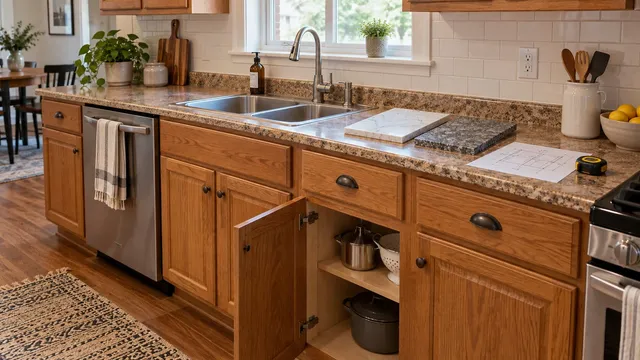
Photograph accessible interiors, hinge areas, visible joints, exposed edges, and the floor of the sink base. Mark where each symptom is and whether it has changed. Open stable doors and drawers normally. Note rubbing, binding, uneven gaps, and screws that repeatedly loosen; do not force a stuck part or keep operating a unit that moves with it.
Use what you see to ask a better question, rather than diagnosing the box from a photo.
| What you can see | Question for the cabinet professional |
|---|---|
| Worn color or isolated scratches; normal operation | Would finish repair or new fronts address the complaint? |
| One rubbing door or binding drawer | Is the cause hardware, obstruction, damage, or cabinet alignment? |
| Lifting exterior film (thermofoil) or veneer | Can the old surface support the proposed treatment after appropriate preparation? |
| Stain, swelling, distortion, or crumbly material near plumbing | Is moisture still present, and which components can be repaired? |
| Separated joints or several failing attachment areas | Can the boxes and attachment be restored reliably? |
KraftMaid’s adjustment guidance documents ways fronts and moving hardware can be adjusted. Its installation guide also explains that uneven walls and floors can rack a cabinet, twisting it out of square so its doors and drawer fronts no longer line up. A crooked gap therefore does not, by itself, mean every box needs replacement. The installer still needs to establish why the gap changed.
Cabinet age and material name are background, not pass/fail tests. IKEA specifies particleboard for the frame of a current SEKTION wall cabinet, so the word alone is no reason to replace a box. Nor is “plywood” proof that a box is sound. Exposure, joints, installation, and current condition matter.
Stop the cosmetic assessment when safety or moisture is unresolved
If a wall cabinet visibly sags, separates, or shifts during ordinary use, keep people out of the area beneath it and arrange prompt assessment by a cabinet installer or qualified remodeler. Do not tug on it to “test” attachment, climb under it to unload it, or try to rehang it. IKEA’s own warning for one of its wall cabinets treats a cabinet that is not securely anchored as a falling hazard.
If the sink base is wet, have a plumber identify and stop the leak before paying for a cosmetic finish. A stain may remain after a past leak; it does not prove current dampness or hidden damage. A surface that now feels dry does not establish that a concealed joint is sound. Have a cabinetmaker or water-damage restoration contractor assess the affected cabinet before deciding whether a repair will last.
The EPA says to fix the water problem and not to paint or caulk moldy surfaces. A dark mark is not a mold identification. Suspected extensive or hidden growth needs a qualified restoration professional; damage from sewage or other contaminated water needs a restoration professional experienced with contaminated-water cleanup. Do not hide an unresolved area with a new panel.
In a home built before 1978, settle the lead question before any painted cabinet part is sanded, scraped, or removed. The EPA recommends having a certified lead inspector or lead risk assessor test the surfaces to be disturbed, and hiring a lead-safe certified contractor for the work. The date alone does not establish that a cabinet contains lead. Our pre-1978 paint planning guide covers what to settle before old paint is disturbed.
Box strength and surface bonding are also different questions. WalzCraft’s veneer instructions require a smooth, clean, dry surface. Its peel-and-stick veneer, they add, bonds to varnished, lacquered, or enameled surfaces that are not flaking or peeling. It generally will not stick to bare wood, sanding sealers, melamine, or other plastics. That is one product’s rule, but it shows why a sound box can still need different preparation or a different covering. Ask the installer to name the selected material and show the surface requirements in its current instructions.
Check whether keeping the layout would also keep the frustration
Walk through a normal meal and cleanup
Follow an everyday task from groceries to cleanup. Where do you set a full bag? Where do plates live relative to the dishwasher? Can someone open the trash pullout while another person cooks? Record the reach or conflict that actually slows you down. KraftMaid’s kitchen layout guidance connects cabinet arrangement with counters, appliances, and household movement; there is no one layout that fits every room.
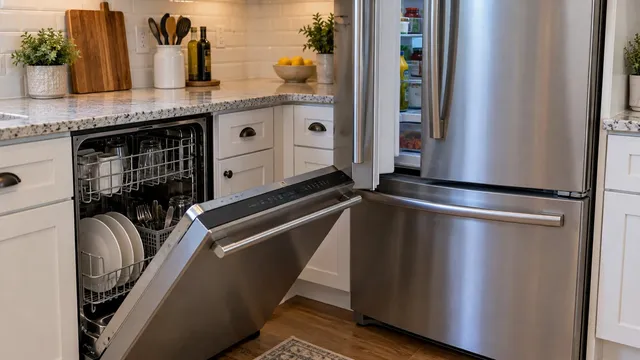
List planned appliance changes and accessibility needs now. A refrigerator that needs a different position can change the cabinets beside it. New fronts won’t relocate a box, enlarge an opening, or turn an unreachable corner into a useful shelf. If the refrigerator and dishwasher already compete for the same space, resolve their door collision on the new plan before choosing cabinet sizes.
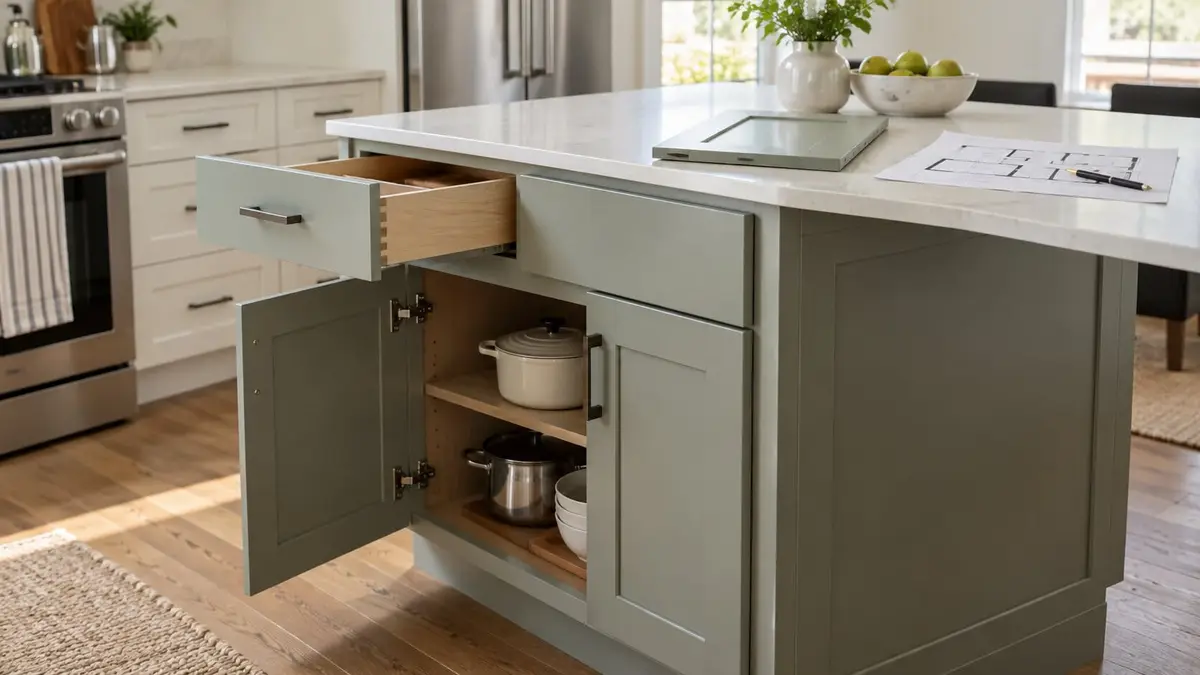
Distinguish lack of storage from storage you cannot reach. If the dishes fit but retrieving them means kneeling in front of a deep base, a compatible pullout may help. If the only useful location for dishes is occupied by an appliance, the answer may require a different plan. When a proposed island is part of that plan, check its working aisles and occupied seating before sizing new cabinets.
Ask which improvements fit inside retained boxes
An organizer, slide change, hinge change, or drawer conversion can be part of a refacing job, but compatibility is specific to the opening and chosen product. Home Depot’s service description shows possible storage additions; it does not promise them in every contract.
Ask the installer to check interior dimensions, plumbing obstructions, available fastening surfaces, door clearance, and usable space after the insert goes in. Have them show the proposed hardware on the drawing. A pullout that technically enters the box but collides with a nearby handle solves little.
If your goal needs another footprint, depth, height, or appliance position, request a revised kitchen plan. Selective replacement may preserve useful runs while changing a problem area. A hybrid design still needs coordinated finishes, levels, and connections; it is not an automatic shortcut to a lower bill.
Should you reface or replace your kitchen cabinets?
This table helps choose which proposal to request after on-site assessment.
| Finding after assessment | Scope worth requesting |
|---|---|
| Suitable boxes and attachments; layout works; exterior is the complaint | Refacing, with identified repairs and accessories |
| Localized defect; other cabinets remain useful | Repair or selective replacement with coordinated fronts |
| Boxes are suitable but layout must change substantially | Replacement design that resolves the recorded tasks |
| Extensive damage or no credible durable repair | Replacement after the cause is corrected |
| Safe, usable kitchen; a larger redesign is planned later | Limited repair or postponing cosmetic work |
Ask for the reason behind each proposal. “We can cover that” is not an answer to a deteriorated joint, and “it’s old” is not an explanation of why a stable box cannot stay. A proposed repair should restore the necessary function and attachment, not just conceal the symptom.
Adjacent finishes matter. A countertop, backsplash, floor, and connected fixtures may make cabinet removal more involved. If you intend to keep the existing boxes and change the top, check whether countertop replacement can be coordinated with them. Have the remodeler plan access and possible finish damage before signing; do not assume that existing materials can be removed and reinstalled intact.
Compare what the complete cabinet proposals include
Give each bidder the same inventory: number of openings, photos, water or repair history, appliance plans, must-change tasks, and desired finish. Ask for separate required repairs and optional upgrades. Then compare installed outcomes, not a materials quote against a completed job.
| Item to identify | What the written proposal should say |
|---|---|
| Boxes and attachments | Retained, repaired, selectively replaced, or new |
| Visible fronts and edges | Door and drawer-front counts; sides, frames, toe kicks, trim |
| Moving parts | Drawer boxes, slides, hinges, pulls, organizers |
| Surface preparation | Old-film treatment, selected system, samples, finish compatibility |
| Related work | Countertop, backsplash, floor, walls, plumbing, electrical, disposal |
| Unknown conditions | Access needed, allowance, decision owner, change-order process |
“Refacing” alone does not settle whether drawer boxes, interiors, or organizers are new. Similarly, “replace cabinets” does not say who disconnects fixtures, removes debris, patches a floor, or completes trim. Ask who coordinates licensed trades when the actual project needs plumbing or electrical changes. The responsible contractor and local authority should confirm any permit requirements for that scope.
Ask each bidder to itemize the proposal for the same finished kitchen. An allowance reserves money for an unresolved item; an exclusion leaves that item outside the quoted price. If bids describe different larger scopes, use the whole-remodel quote comparison to normalize them.
Have the installer show why the cabinets are worth keeping
Ask a cabinetmaker or refacing specialist to walk the kitchen and explain box condition, joints, attachment, alignment, prior repairs, and surface compatibility. Bring the photos and task list, and ask what cannot be seen until work begins.
Review a sample in the actual light of the kitchen. Ask how the new front meets an old side panel, what the exposed edges and seams will look like, and how the chosen finish is maintained. Check who corrects a door that rubs or an edge that lifts after installation. Ask for care instructions for the installed material and keep recurring moisture away from it.
Get another on-site opinion if one proposal relies only on age or “particleboard,” or if repair details are vague while another bidder found a specific attachment problem. Choose the scope that addresses both the recorded condition and the tasks your kitchen must handle. If floors and appliances are changing too, settle the installation order before ordering fronts. Resolve measurements, moisture work, and edge details before the order is placed.
Frequently asked questions
How can I identify who made my existing cabinets if I have no paperwork?
Look for a KCMA seal, which KCMA says is typically on the inside of a cabinet door or the outside edge of a drawer. The seal carries a company code of letters and numbers, or sometimes the full company name. The search box on that KCMA page turns a code into the maker’s contact details. An absent mark does not establish that the cabinets are poor quality; a cabinet specialist can still measure and evaluate them.
Can refacing affect the original cabinet manufacturer’s warranty?
Yes, depending on the actual terms and what is altered. KraftMaid’s warranty, for example, covers only the original purchaser, is not transferable, and excludes damage or defects caused by alteration. Find your own manufacturer’s documents and ask for written clarification before work; one brand’s policy does not decide another’s coverage.
Can new doors be made for older cabinets with unusual opening sizes?
Often, but the door maker and installer must measure the actual openings, hinge positions, and clearances. Home Depot describes custom-sized fronts within its service. Verify what the chosen supplier can make and how it will meet neighboring panels.
Can I keep using the kitchen while a refacing project is underway?
Often, yes, but not always. Home Depot says its refacing service lets customers keep cooking in the kitchen during the project. Your access also depends on the repairs, utility work, and finishing in your own contract. If lead-based paint may be disturbed, have the lead-safe contractor identify where access must be restricted. Ask for a daily access plan, and keep order lead time separate from days of work in the kitchen.
Does a KCMA certification label tell me whether my older cabinets are still suitable to reface?
No. KCMA describes laboratory testing of cabinet structure, operation, and finish for certification. The label does not inspect today’s attachments, water exposure, or remaining life in your installed kitchen. An on-site assessment still decides what to retain.
Sources
- WalzCraft — Cabinet Refacing / Recrafting
- WalzCraft — Veneer Application Instructions
- KraftMaid — Adjusting Cabinet Hinges, Drawers and Fronts
- KraftMaid — Cabinetry Installation, Care and Cleaning
- IKEA — SEKTION Wall Cabinet
- EPA — A Brief Guide to Mold, Moisture and Your Home
- EPA — Lead-Safe Renovations for DIYers
- KraftMaid — Kitchen Layouts
- The Home Depot — Cabinet Refacing
- KCMA — Who Made My Cabinets?
- KraftMaid — Cabinetry Warranty Information
- KCMA — Why Choose Certified Cabinetry?