The upper cabinets are nearly ready to order, but the range hood choice is still written as “ducted or ductless.” That blank affects cabinet cutouts, the space above the stove, and where cooking air ends up.
No reliable national figure exists for the cost gap between the two. It turns on the duct route, exterior work, cabinet changes, any makeup-air equipment, replacement filters and local labor, so compare written proposals for your kitchen.
Ducted or ductless range hood: where will cooking air go?
A ducted hood (also called vented) captures some air over the cooking surface and sends it through a duct to an outdoor termination, the wall or roof cap where the duct ends. A ductless, or recirculating, hood moves air through filters and returns it to the kitchen. A convertible hood can be installed either way; the mode is set at installation and does not switch by itself. Broan-NuTone’s range-hood FAQ uses “convertible” for a hood that ships with the parts for both modes, though the charcoal filters for ductless use may be sold separately. It calls a hood “non-duct capable” when it recirculates only with a separately purchased kit and charcoal filters. Have the order list the parts your chosen mode needs.
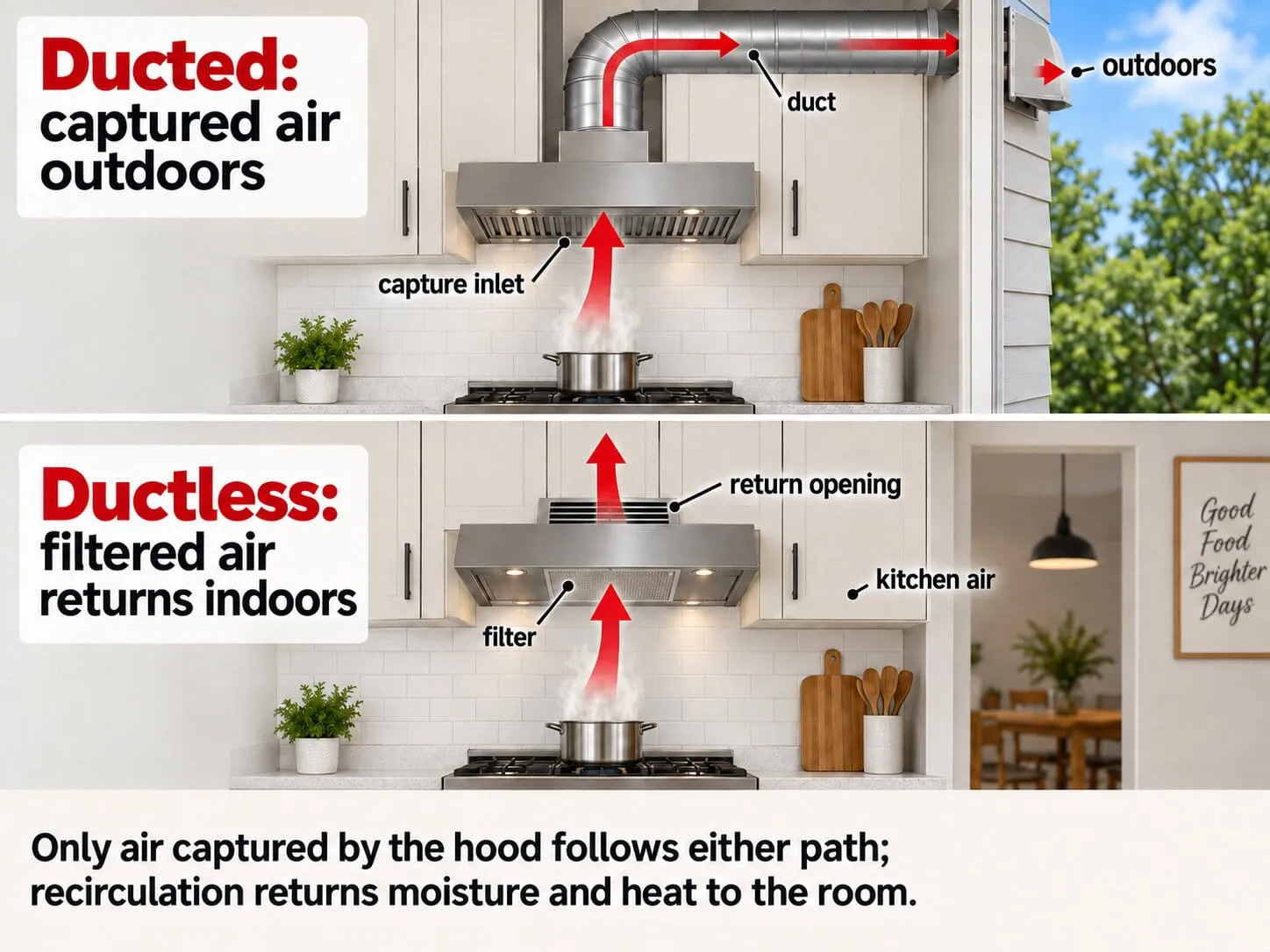
Investigate a workable outdoor route first. The EPA recommends a hood exhausting outdoors where possible to reduce indoor cooking particles. If an outdoor route is impractical, ask the ventilation contractor what recirculating model and cabinet arrangement can work and ask the local authority whether it meets the rules for this project. A retailer’s “ductless” label does not decide legality.
Write “outdoor exhaust” or “recirculating return” on the plan. Fan noise, a quoted airflow rating, and the hood’s appearance do not reveal its installed air path. Ask which separate kitchen-exhaust requirements, if any, apply to the property.
What the existing installation can tell you
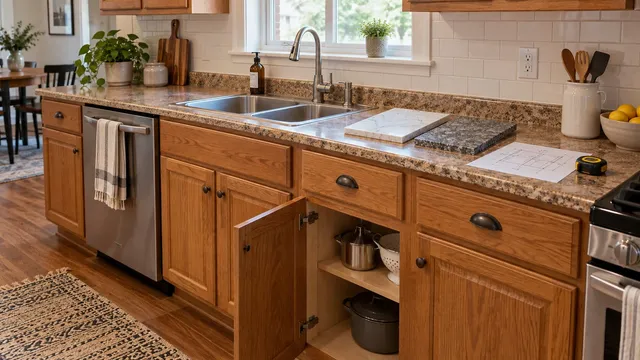
From normal access, photograph the hood model label, visible grille, cabinet interior, and any exterior cap you can see from the ground. A grille inside may suggest a return path, but equipment can be configured differently. A cap outside may belong to another system. Have the installer trace the entire route and identify where the hood actually discharges. Do not remove electrical covers, move or disturb gas equipment, adjust a damper, go onto the roof, or open a concealed cavity to investigate.
Compare what each approach can remove—and what remains
First ask whether the hood catches the cooking plume. Then ask what happens to the captured air. Those are different questions.
| Question | Ducted outdoor exhaust | Ductless recirculation |
|---|---|---|
| Destination of captured air | Outside the home | Back to the kitchen |
| Grease handling | Filter needs cleaning per model | Filter cleaned or replaced per model |
| Odor handling | Captured odor leaves with exhaust | Charcoal filter traps some odor until it is spent |
| Moisture, smoke and heat | Captured portion goes outdoors | Return to the room |
| Main dependency | Suitable duct route and installation | Clear return outlet and correct filter parts |
Only emissions the hood captures can follow the duct. A recirculating filter does not turn returning air into outdoor exhaust. EPA’s air-cleaner guide distinguishes particle and gas filtration and cautions that no cleaner removes every pollutant; its advice covers portable units and furnace filters rather than hoods. Do not treat a charcoal filter’s odor claim as proof it removes every gas-combustion pollutant.
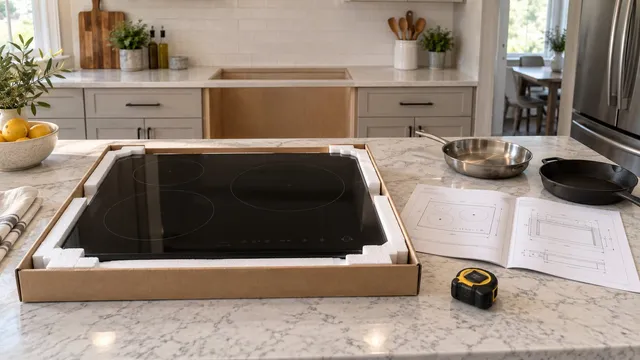
Cooking on induction still produces food and oil particles, so fuel choice does not erase the ventilation question. If you are switching from gas to induction, coordinate the hood with the new appliance, while keeping any combustion equipment elsewhere in the home in the makeup-air review.
Check capture and usable airflow before choosing a blower size
Look at the burners you actually use, especially front burners. Does the hood cover their position without violating the cooking appliance’s or hood’s required clearances? The answer depends on the selected products and installed location. Lawrence Berkeley National Laboratory’s 2011 study tested 15 installed devices. A device that did not extend over the burner in use captured far less, and almost every device captured substantially more from back burners than from front ones. Designs with a capture hood also did better than flat-bottomed ones at similar airflow. The sample is small and dated, so it shows why coverage matters; it cannot rank today’s hoods. Cook on back burners where possible.
An advertised airflow rating describes a tested or stated operating point, not necessarily what an installed system moves through its actual duct. Bends, transitions, and the selected speed matter. PNNL’s kitchen exhaust guidance says fans are typically rated in a factory setting and that ductwork, the termination and the installation may bring the measured airflow below that rating. It recommends having the installed flow tested by a certified energy rater. Ask the ventilation contractor what performance information is available for the exact model and how the completed installation will be checked.
Compare sound and airflow at the same operating speed. Airflow is rated in CFM (cubic feet per minute) and loudness in sones; a lower sone number is quieter. Broan’s FAQ says the sone figure is typically measured at maximum speed, though some newer products are also rated at a normal speed. Check which speed each number on the label belongs to and ask for HVI-certified ratings. Broan adds that there is no national standard for measuring CFM or sones on a hood installed ductless. Neither rating tells you how much of the cooking plume—the rising air over the pan—the hood captures. Select a blower from the installation design, not a generic stove-power formula alone.
Have the installer prove the route to the outdoors
Ask for a drawing from hood discharge to exterior termination. It should show whether the duct goes through a cabinet, soffit, wall, or ceiling, and where it ends outside. Have the ventilation contractor mark sections that are verified versus concealed and still need inspection. A promise to “find a route later” leaves the cabinet designer guessing.
Have the contractor evaluate any existing duct’s condition, size, material, bends, transitions, and compatibility with the proposed hood. PNNL’s guidance calls for rigid, smooth-walled metal duct that is airtight, has a backdraft damper and is independent of every other exhaust system. It warns that an undersized duct could trap grease and create a fire hazard. A duct must not stop in a cabinet, wall, ceiling, space between floors, attic, crawlspace, or garage, where grease and moisture can collect. Broan’s FAQ says most of its hoods need at least a 3¼-by-10-inch duct, equivalent to a 6-inch round duct; stronger models can need up to 10 inches round. Check the chosen model’s specification and keep the duct at or above its required size. The contractor should also address the exterior cap, damper, weather protection, and any duct segment through unconditioned space.
For a condo or shared building, determine who controls the exterior wall, roof, and shafts before calling a new route feasible. Board or owner approvals can change the design and schedule. If the proposed route crosses a wall you intend to remove, have a structural engineer assess that wall first.
Match the cabinet drawing to the exact hood and cooking appliance
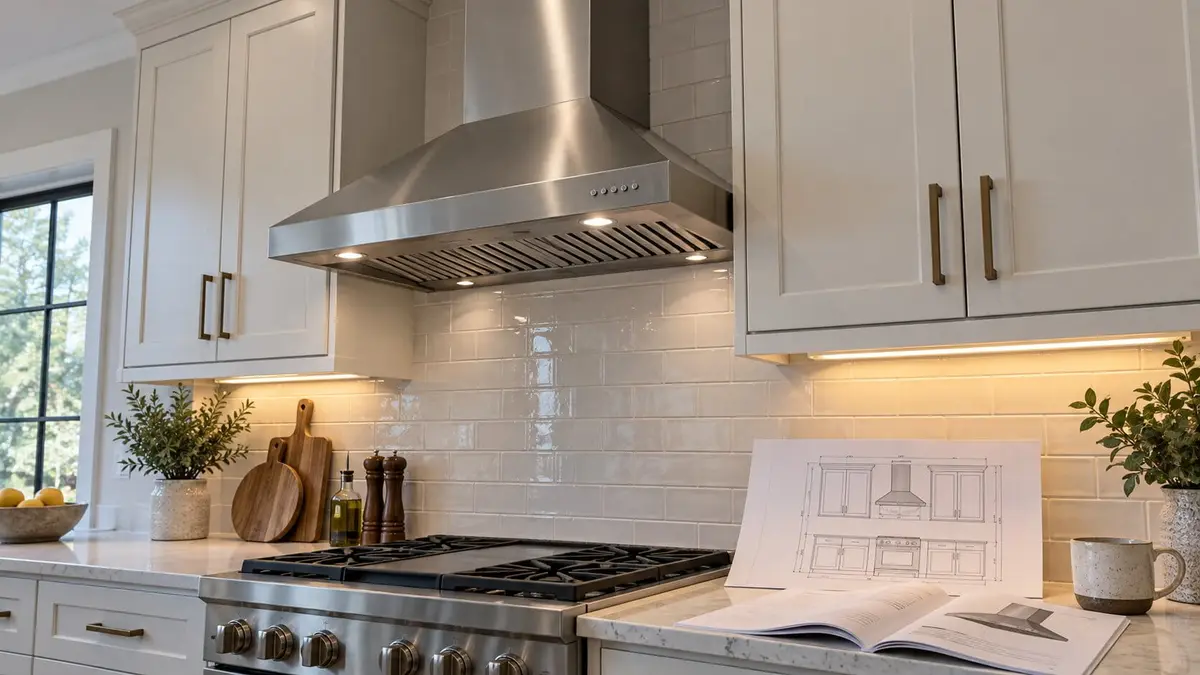
Put both model numbers and current manuals on the drawing. Verify the hood’s mounting arrangement, cabinet depth and construction, appliance separation, nearby combustible materials, usable storage, and access to filters or controls. Do not specify one generic mounting height; the hood and cooking appliance instructions both matter. If their requirements appear inconsistent, resolve them with the manufacturers and installer before fabrication.
A custom decorative enclosure needs a compatible insert or liner (the hood unit built into the enclosure), its listed parts, and a service opening. Do not assume any blower fits inside any decorative box. For recirculation, draw the return-air outlet into the room and the path from the hood to it. A deep cabinet can block some models’ discharge. Broan’s support answer, for example, says its hoods are built for standard 12-inch-deep cabinets and release recirculated air from vents at the top of the hood. A deeper cabinet can trap that air under its front edge. A sealed decorative enclosure is not a workable return-air plan merely because the hood has a filter.
The Broan BUEZ installation manual shows how much depends on configuration: the cutouts differ for top and rear ducting, and the mounting differs for framed, frameless and recessed-bottom cabinets. It also gives one mounting-height range on its first page and a different one on its installation page. When a manual disagrees with itself like that, get the manufacturer’s answer for your model in writing before the cabinet height is fixed. If changing the cabinets to fit the hood also changes useful storage, revisit the cabinet refacing-versus-replacement decision before placing the order.
Resolve makeup air and local approvals before ordering
Makeup air is air brought in to replace air exhausted from the building. It is not the same as air recirculated through a ductless hood. The EPA calls backdrafting a serious problem that, in some cases, a hood with a high airflow rate can cause. It happens when the hood exhausts more air than the house brings in. That can disrupt the draft of a natural-draft appliance, such as a gas water heater or furnace, and draw carbon monoxide and other combustion products into the living space. A qualified HVAC or ventilation professional should consider how tight the home is, other exhaust fans, fireplaces, and natural-draft combustion equipment, including equipment outside the kitchen. Do not try to recreate a suspected venting problem yourself.
Ask the professional what design or combustion-safety assessment is needed and who will perform it. Broan’s FAQ cites a model-code makeup-air trigger above 400 CFM. States and cities amend it; Minnesota’s rule uses 300 CFM for some existing homes, based on the home’s age, combustion appliances and proposed equipment. It waives the requirement when an approved test shows the vented appliances still work properly. No threshold shows whether your own fuel-burning appliances will keep venting. Have your local building department identify the adopted rules, permits and inspections. California’s 2025 energy-code guidance says replacing a vented hood on its existing ducts needs no field verification by a rater, while a new vented hood on entirely new ducting does.
If a manufacturer offers a blower-control limit (a setting that caps the fan’s output), ask whether the exact configured hood is acceptable locally and still serves the ventilation design. Do not rely on an open window as an automatically compliant makeup-air system. The designer should also consider comfort and any treatment of incoming outdoor air in your climate.
Compare complete installation scopes, then release the cabinet order
Have bidders price the same intended mode and finished cabinet arrangement. A ducted proposal should identify hood, duct, exterior work, cabinet changes, electrical work, any makeup-air work, approvals, finish repairs, and operational verification. A recirculating proposal should identify the approved return opening, kit and filters, service access, electrical work, and any separate exhaust requirement. A cheap hood-only quote is not a complete comparison with a built route.
Get a second technical opinion if a contractor:
- Ends the duct in the attic.
- Hides the recirculating outlet behind cabinetry.
- Reduces the duct without the chosen model’s documented approval.
- Dismisses makeup air because the house is old.
Ask who coordinates cabinet supplier, ventilation installer, electrician, and exterior specialist. Mark concealed conditions as allowances with a decision and change-order process. Confirm filter type and model-specific maintenance instructions; some parts are washable, others need replacement, and there is no universal calendar interval. For broader estimates, use our kitchen quote comparison guide.
Bring the contractor your cooking habits, fuel types, other exhaust fans, planned air-sealing work and any condo restrictions. Before cabinet release, record:
- Exact hood and cooking-appliance models and manuals
- Approved operating mode and duct route or return outlet
- Required accessories and cabinet cutouts
- Clearances and service access
- Makeup-air decision and local approval path
At handover, request the manuals, filter information, applicable inspection or test records, and a demonstration of the installed mode. Set the cabinet and appliance installation sequence around those verified decisions.
Frequently asked questions
Can an over-the-range microwave provide useful cooking exhaust instead of a separate hood?
Yes, some do, but design and burner coverage decide how much. In LBNL’s 2011 tests, flat-bottomed devices with no capture hood captured much less than hooded designs at similar airflow. Both over-the-range microwaves were in that group, although one of them was among the better performers. The microwaves did substantially better on back burners than front ones. Check whether the exact unit exhausts outdoors or returns filtered air, how far it reaches over the front burners, and the appliance and cabinet instructions.
Would a portable air cleaner help with cooking particles if outdoor venting is unavailable?
Yes, for particles. EPA’s air-cleaner guide says most portable air cleaners can filter particles from the air, and to choose one whose clean air delivery rate (CADR) suits the size of the room. It also says filtration does not replace ventilation: a cleaner captures nothing at the stove and sends no moisture or heat outdoors. Treat it as a separate room-air measure, not proof a recirculating kitchen arrangement meets local exhaust rules.
Can an additional in-line fan improve a hood that has weak suction?
No, not on a hood that already has its own power unit. Broan says not to install an in-line or exterior booster on that type of hood: it is generally ineffective, can overload fan switches matched to the original motor, and voids Broan’s warranty. A hood designed for a remote blower is a different product. Have an HVAC or ventilation contractor find the cause of weak performance, such as a filter, duct, or installation problem.
Why does a range hood sometimes switch on or increase speed by itself?
Some hoods have a heat sensor. Broan’s version, Heat Sentry, turns the fan to high or up one setting when it detects excessive heat. Once the temperature drops, the fan returns to off or its previous setting. Check the exact manual to identify the feature and its normal behavior. If the behavior differs from the manual, contact the manufacturer’s service line rather than changing wiring or controls yourself.
Sources
- EPA — Sources of Indoor Particulate Matter
- Broan-NuTone — Range Hood FAQs
- EPA — Guide to Air Cleaners in the Home
- Lawrence Berkeley National Laboratory — Performance of Installed Cooking Exhaust Devices
- PNNL — Kitchen Exhaust Fans
- Broan-NuTone — 15-inch Deep Cabinet Hood Guidance
- Broan-NuTone — BUEZ0/BUEZ1/BUEZ2 Installation Instructions
- Minnesota Office of the Revisor of Statutes — Minnesota Rules 1346.0501
- California Energy Commission — 2025 Single-Family HVAC Guidance