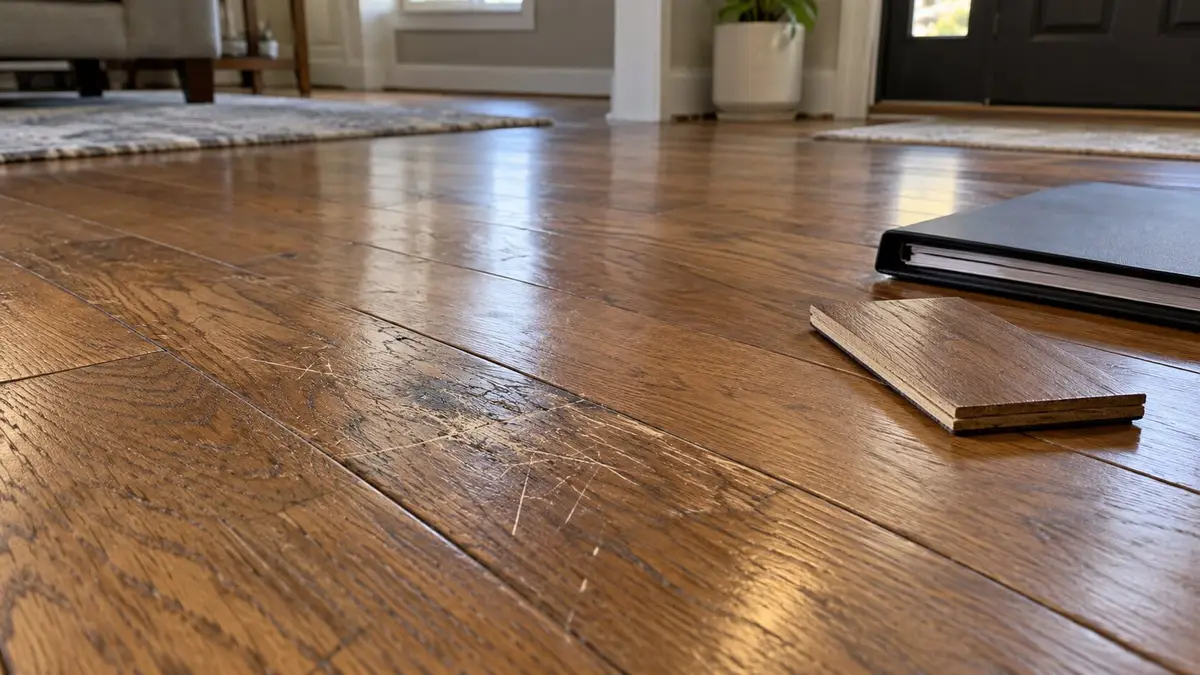
The gray traffic lane or deep scratch you see is only the top of the decision. Beneath it are the finish, the usable wood, and the installed floor’s condition. One can be worn while the others remain serviceable.
Before accepting “sand everything” or “tear it all out,” identify the result you want and the material available to achieve it. A wood-floor professional can then map which areas need work and which can stay.
Should you recoat, refinish, repair, or replace hardwood flooring?
Refinishing means sanding to bare wood and applying a new finish. A maintenance recoat renews a compatible existing finish without removing the same amount of wood. NWFA describes both options. Damaged boards need a separate repair decision under either route.
| Condition to investigate | Possible scope | What inspection must confirm |
|---|---|---|
| Dull or lightly worn finish | Cleaning and compatible maintenance coat | Finish identity, residues, preparation, adhesion |
| Worn-through finish or desired color change | Sanding and refinishing | Enough usable wood and achievable appearance |
| A few deeply damaged boards | Selected-board repair, then agreed blending | Matching material and surrounding-floor feasibility |
| Broad damage or limited sanding margin | Wider replacement assessment | Why smaller work cannot meet the goal |
These are candidates, not a photo-based diagnosis. Minor marks may call only for a manufacturer-approved cleaning or touch-up. Bruce’s hardwood FAQ distinguishes product constructions and repair questions, which is why the installed product matters before selecting a treatment.
Resolve moisture and instability before choosing a surface treatment
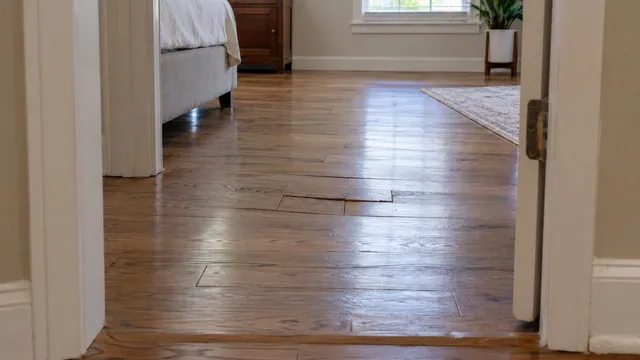
Raised board edges are commonly described as cupping. Buckling means flooring has lifted from its intended position. The words do not describe the same condition, and neither reveals a moisture source by sight alone. NWFA’s installation guidance says a buckled floor requires replacement wherever it buckled once the moisture source has been eliminated. The rest of the floor is assessed, not automatically replaced.
Have the leak corrected and the floor and subfloor assessed before deciding what to sand. NWFA says minor water-related distortion often diminishes or disappears as flooring dries, so allow a measured drying assessment before pricing sanding or replacement of those areas. A dark stain does not prove rot, and a dry-looking surface does not prove the support beneath it is dry. New wood or an underfloor layer cannot correct continuing water entry; NWFA’s moisture discussion explains why source control remains part of the job. For raised board edges, see how to investigate hardwood cupping before refinishing.
Keep people off visibly unstable areas. A new localized depression needs a layer-by-layer soft-spot assessment. Ask a structural engineer about significant support movement, and a plumber or restoration professional about an active leak. If noise is the main issue, assess squeaks before selecting new flooring. Photograph visible conditions from stable ground; do not open the floor or enter a wet crawlspace to settle the question yourself.
Ask how much usable wood remains—not how thick the board started
The number printed on a box describes a new board. The installed floor may have been sanded, may be uneven, or may have a profile that leaves less material at its lowest point. A wood-flooring professional can often view the board profile at a floor register or by removing a transition molding, then document measurements in the installed floor. NWFA’s discussion of refinishing feasibility gives those access examples and says the wear layer should not be less than 3/32 inch (about 2.5 mm) when a floor is considered for refinishing. That is a professional assessment threshold, not a sanding-count promise.
How much wear layer do solid and engineered boards have left?
Solid wood is wood through the board; its wear layer for sanding is the wood above the tongue. Engineered wood has a real-wood face bonded to a core; that face is its wear layer. Sanding capacity depends on what remains in that layer, not total board thickness. On some engineered boards, measuring down to the tongue overstates the face wood available for sanding. A spare untouched board may identify the product, but cannot prove the remaining thickness in the installed floor.
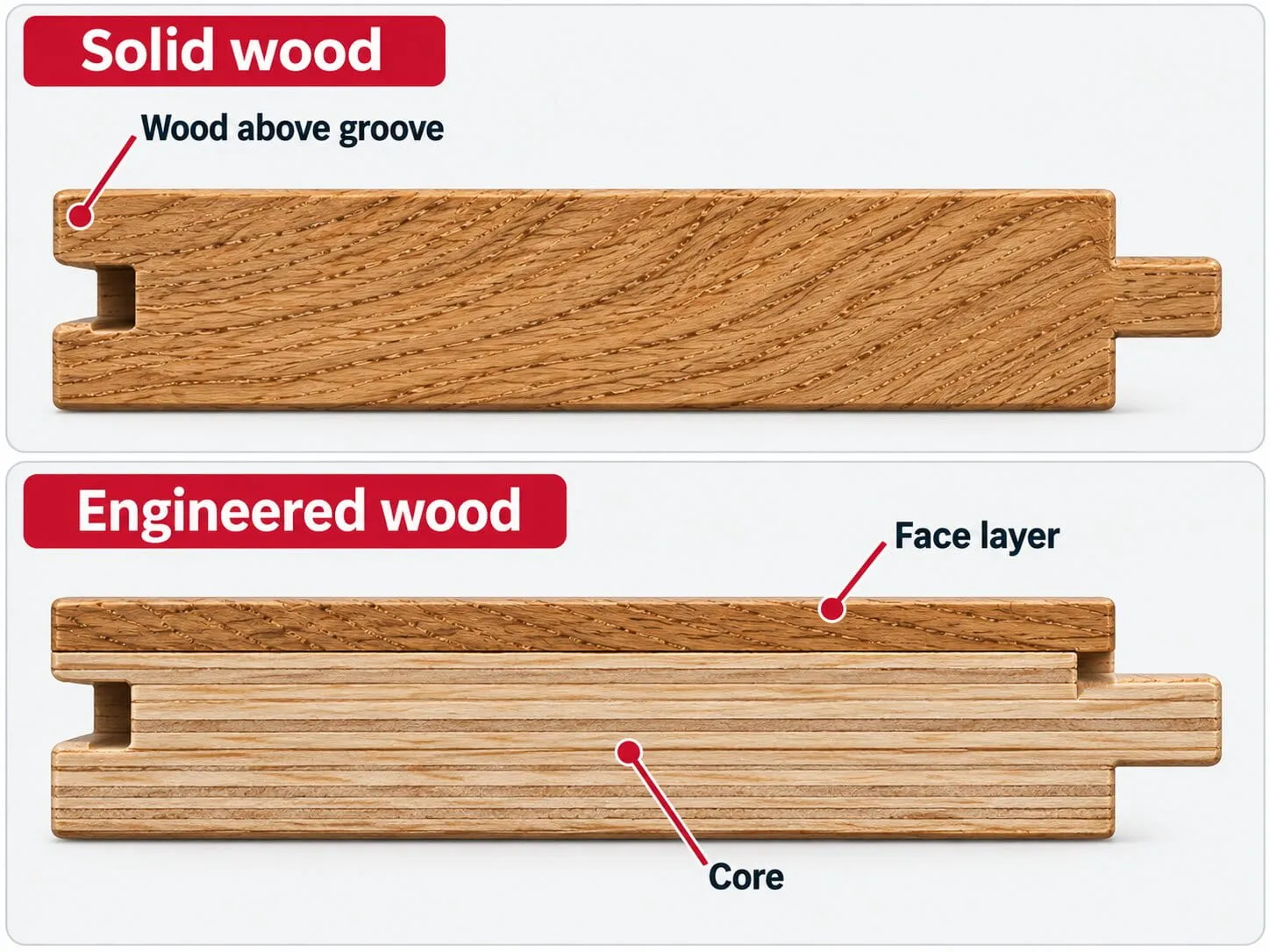
For the solid profile, the wood above the groove’s top corresponds to the wear layer above the tongue. A professional measures what remains in the installed floor.
“Factory finished” describes where a finish was applied; “engineered” describes construction. A factory-finished floor can be solid or engineered. Identify both, then ask which maintenance, recoat, or sanding instructions apply. A certification benchmark for new engineered products, such as the NWFA refinishable program, is not a pass/fail assessment of an aged installation. No age or nominal thickness guarantees a fixed number of future sandings.
Flatness, bevels, and texture can consume the margin
A professional may need to remove more from high spots to make a floor appear even. Beveled edges also have low points and their shape may change with sanding. NWFA says scraped, wire-brushed, and sculpted floors are extremely difficult and often cannot be sanded because the wear layer in their low areas may be too thin. A broad “engineered floors can be sanded twice” rule skips all of these conditions.
If the floor’s remaining margin cannot be established, its sanding feasibility has not been established. Do not test it by sanding a corner yourself. Agree on a professional inspection method and an authorization point before irreversible work.
Decide whether damaged boards can be repaired without sacrificing the whole floor
Mark the rooms and boards with traffic wear, gouges, persistent stains, movement, and worn finish. This map helps distinguish widespread wear from a handful of deeper defects. It cannot tell you from a photo which marks will sand away.
A deep mark may call for a board repair, not deeper sanding everywhere
Sanding an entire floor deeper to chase one gouge can consume good wood without removing the mark. A selected-board repair may be more proportionate if the surrounding floor remains viable. NWFA’s repair guidance describes the limits of local color and finish work. Ask which mark may remain after a proposed sanding and whether an authorized sample would clarify the result.
Do not assume a dark stain can be hidden with darker finish. It may reflect different wood appearance or damage requiring another scope. The professional should explain what is known, what remains uncertain, and the repair boundary before promising an invisible match.
Matching and installation details can change a partial-repair plan
Ask whether compatible replacement boards are available, how new material will meet the old, and where the finish boundary will fall. A repair can be technically sound yet visibly different. Decide what level of difference you can accept before authorizing it.
If an engineered board’s wood layers are separating, distinguish that from a coating that peels. A recoat cannot restore a failed bond inside the board. Seek product-specific assessment. Broader replacement may make more sense when too many areas require repair, the margin is insufficient, or the requested appearance cannot be delivered. There is no universal percentage of damage that decides it.
Check whether the result you want requires new flooring
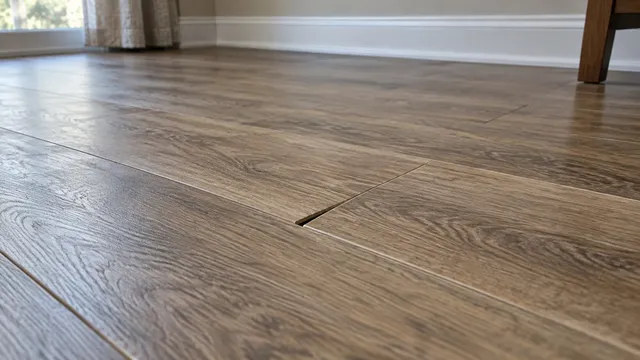
Rank your goals: preserve the existing wood, change color, alter sheen, remove texture, or change species, width, or pattern. Sanding can change finish and perhaps color; it cannot turn narrow boards into wide planks. A serviceable floor may be worth keeping even if some character remains visible. Seasonal gaps between hardwood boards also need their own assessment before they are treated as a replacement reason.
Do not declare a prefinished floor automatically unsandable. Coating compatibility also cannot be guessed. Bona Prep’s technical sheet describes a specific polyurethane-finish preparation route with exclusions for some maintenance histories. Bona’s Recoat System sheet addresses a different acrylic-maintained polyurethane situation. Neither authorizes a treatment for unknown, waxed, or oiled finishes. Ask the contractor to identify the existing finish and propose a documented system.
Request a sample of the intended color or finish on suitable wood and record the old marks, bevels, or blend lines expected to remain. A showroom photograph is not an appearance guarantee for the installed floor.
Compare complete project scopes and the time your rooms will be unavailable
Get paired written scopes if both routes remain feasible. Compare the same rooms and finished result, including furniture handling, access, selected-board repairs, preparation, finish products, trim and transitions, cleanup, disposal, and concealed-condition allowances. A replacement proposal must specify the new product, installation method, substrate work, and floor-height effects. For a kitchen project, coordinate the cabinet, flooring, and appliance installation order. An overlay is a separate assembly decision, not an automatic shortcut.
For refinishing, require the finish system, sample approval, repair allowance, and the boundary between refinished and untouched rooms. Ask which stains or profile differences may remain. A low quote that excludes needed board work is not comparable with a complete replacement quote.
Is it cheaper to refinish hardwood than to replace it?
There is no reliable national price ratio for these specific choices. A replacement quote adds removal and disposal, new material, installation, and often floor-height and transition work; a refinish quote may still need board repair and finish blending. Local labor, access, matching-board availability, and hidden damage change the result. Compare current local written quotes for the same rooms and finished goal.
Plan household use with the contractor. Work completion, permitted foot traffic, replacing furniture or rugs, and full cure are different milestones. For example, the Bona Traffic HD technical sheet says the floor may be walked on after 24 hours, reaches full cure in approximately three days, and should stay uncovered by area rugs until then. That timing applies to that named finish under its stated conditions; get the schedule for the product actually used. Arrange exit access, pets, dust control, ventilation, and finish-waste handling. Low odor is not an assurance of no exposure.
Ask for the evidence behind the recommendation before you authorize the work
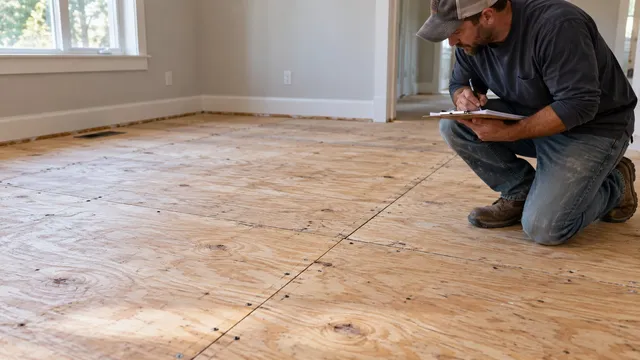
Before authorizing work, get the product and construction identification, locations of wear-layer measurements, a damaged-board map, the expected result, and the finding that would change the plan. NWFA’s jobsite checklist shows the value of recording product and site conditions.
Request photos or notes locating measurements, relevant product instructions, and written assumptions. Agree on who stops and calls you if hidden damage changes the scope. An independent wood-floor inspector can help when replacement is based only on age or sanding is promised without checking construction. Different recommendations may reflect different proposed outcomes.
If pre-1978 painted trim or painted flooring will be disturbed, EPA recommends a certified lead inspector or lead risk assessor to test the affected surface and a lead-safe certified firm to do covered renovation work. The pre-1978 painting guide explains the planning boundary. This concern applies to painted surfaces, not every clear wood finish. If removal encounters suspect old resilient flooring, stop and have an accredited asbestos inspector assess it under EPA guidance. Put these steps in the written scope before work starts.
Frequently asked questions
Will refinishing affect my remaining manufacturer’s warranty?
It might. Obtain the actual product warranty and ask the manufacturer or seller how the proposed work affects its written terms. A contractor’s workmanship promise is a separate document.
Why is the wood under a rug a different color, and could that difference return?
Sunlight can darken or lighten the exposed wood while the area under the rug receives less light, as Bruce explains. Ask the finisher whether sanding and the proposed finish can produce an acceptable blend, and assess a sample. The color can diverge again if the rug goes back in the same place.
Is there a finish that will prevent a large dog from denting the wood?
No finish can guarantee that wood beneath it will not dent. Ask about the wood’s condition and the chosen finish’s care instructions; separate dents in wood from scratches in the coating.
Can I keep using my current floor polish afterward?
Only if the new finish’s care instructions allow it. Save the polish name and show it to the finisher before work, because past maintenance products can also affect recoat preparation.
Correction
Correction — October 1, 2026: Clarified NWFA guidance: flooring that has buckled requires replacement in the buckled area once the moisture source is removed; the rest of the floor is assessed separately.
Sources
- National Wood Flooring Association — Refinishing Your Floors
- NWFA / Hardwood Floors Magazine — Refinish Your Floor
- NWFA — Refinishable Program
- Bruce — Hardwood Flooring FAQs
- Bona — Bona Prep Technical Data Sheet
- Bona — Recoat System Technical Data Sheet
- NWFA — Wood Flooring Installation Guidelines
- NWFA / Hardwood Floors Magazine — Color & Finish Repairs
- NWFA / Hardwood Floors Magazine — Managing the Migration of Moisture
- Bona — Traffic HD Technical Data Sheet
- NWFA — Jobsite Checklist
- U.S. Environmental Protection Agency — Lead-Safe Renovations for DIYers
- U.S. Environmental Protection Agency — Protect Your Family from Exposures to Asbestos