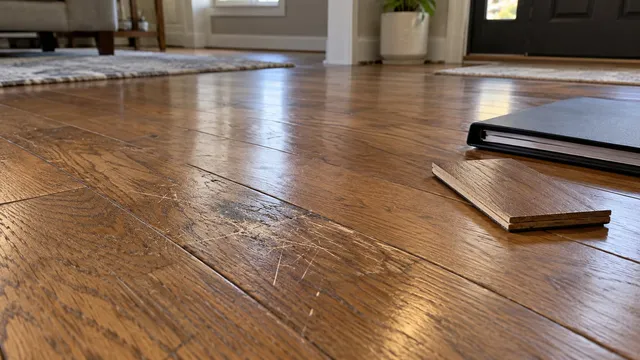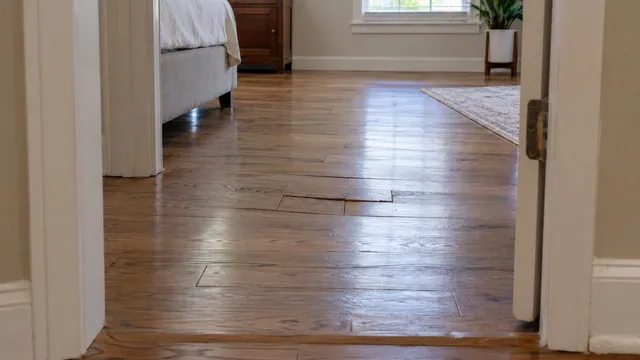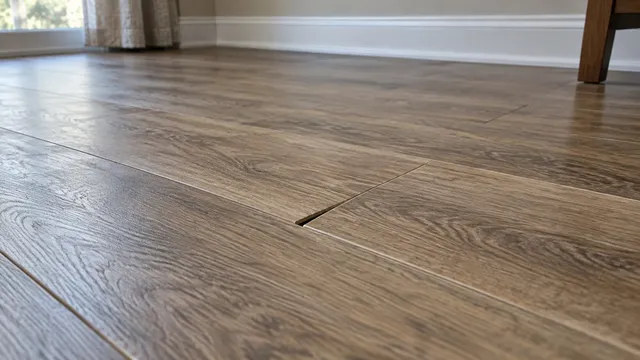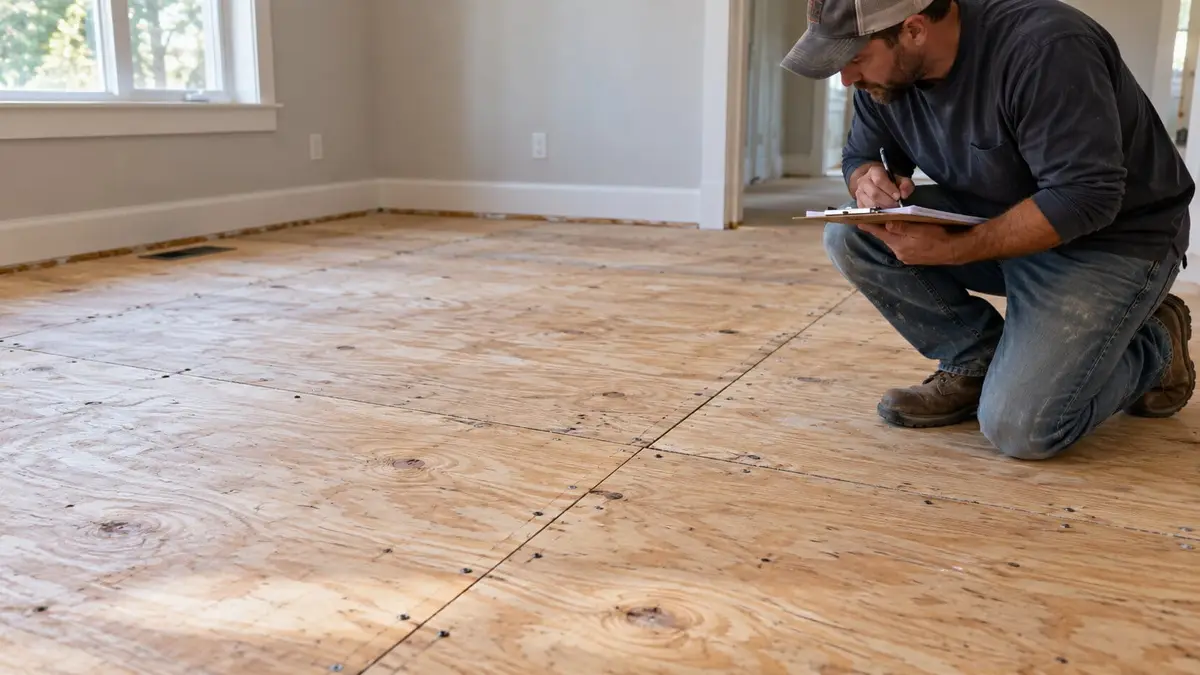
A squeak before new flooring often signals movement at a connection in or around the subfloor—the plywood or OSB panels under the finish floor. Once the old covering is removed, an installer can see which layer moves and choose a repair.
The decision is not simply how many screws to add. First separate damaged or unsafe conditions from a localized moving connection. Then have the repaired base checked against the exact flooring that will go on top.
Which squeaky-subfloor problems should delay the new flooring?
Use this order when planning the work:
- Investigate before proceeding: active water, significant deterioration, visible instability, or marked and worsening movement.
- Repair a confirmed moving source: an accessible connection, damaged material, or adjacent interface identified by inspection.
- Verify before covering: moisture, material condition, flatness, support, and any method-specific requirements for the selected finish floor.
Use this sequence to plan the installer’s inspection and repair scope. A longstanding isolated squeak with no other changes can be scheduled for ordinary inspection. A new sag, strong springiness, damage, or related changes in nearby walls and doors should be assessed before installation. HUD’s rehabilitation inspection guide describes several possible causes of springing and sloping; sound alone cannot identify one.
If the floor feels unsafe or visibly gives way, stop walking on that area. Do not jump or add weight to test it. Ask a plumber about a suspected pipe or drain leak, or a roofer about a roof leak. A qualified restoration professional should assess damaged materials before closure; contaminated water calls for one experienced with that hazard. The EPA’s moisture guidance emphasizes correcting water sources before enclosing affected materials.
Record where and when the floor makes noise
On a floor that feels stable, note squeaks during ordinary walking and mark their locations on a room sketch. Record whether they occur along a board, panel seam, wall edge, or register, without assuming that visible position identifies the sound source. Make a short recording if it helps the contractor find the spot.
Add the existing covering, planned replacement, known layers, leak history, and the date of any remodeling. If the noise is strongest during dry indoor conditions, record that pattern. Weyerhaeuser’s winter-squeak explanation says seasonal squeaks are almost never cause for alarm. Still record pronounced movement or other changes so the installer can check them independently. For separate gaps between hardwood boards, the hardwood-gap guide covers the moisture pattern.
From normally accessible areas, photograph visible staining, separated layers, or damaged supports. An unfinished basement can offer an ordinary viewing angle if it is safe to enter; do not go into a wet or hazardous crawlspace or remove a ceiling to gather evidence.
Match the clue to the inspection question
| Observation to record | What the professional should distinguish |
|---|---|
| Localized noise under a step | Finish-floor movement versus a connection below |
| Noise along a wall or duct route | A nearby interface versus the walking surface |
| Noise mainly during dry indoor conditions | Seasonal movement versus a connection problem revealed by it |
| Noise with softness, dampness, or strong bounce | Material condition and support before a noise-only repair |
| Noise over concrete | Covering, underlayment, or bond rather than assuming wood joists |
An interface is where two materials meet and can move against each other. The APA’s floor-squeak summary lists several. The table tells the installer what to investigate, not which repair to perform from sound alone. If the floor also feels soft, follow the soft-spot guide rather than treating it as a simple squeak. If click-lock vinyl seams are opening too, the separating-plank guide covers the layer and movement checks.
Use removal of the old covering to find the moving layer
Put an inspection pause between approved removal and installation of the next layer. Name who will attend, who can document exposed conditions, and who can authorize a change in scope. Ask the installer to identify finish flooring, optional underlayment, structural subfloor, and framing. Two plywood layers by themselves do not mean one is unnecessary.
Compare your original map with what happens after removal. Noise that remains gives the crew a narrower set of layers to inspect; noise that disappears is also useful evidence. Neither outcome certifies the base for the new product. Have the installer photograph and describe relevant findings before reattachment or replacement hides them.
The Weyerhaeuser floor-squeak technical sheet describes different connections and the difference between access from above and below. Its repair details apply to identified assemblies, not a blind fastening pattern for every home.
Decide whether access from above or below is practical
Removing the old covering may expose a useful repair surface. Access from below may instead require opening and later restoring a finished ceiling. Compare those scopes before approving demolition. Hidden pipes, wiring, and radiant heating matter wherever fasteners or openings are proposed; Bruce’s engineered-hardwood instructions include radiant-system precautions.
If old resilient flooring, backing, or adhesive may contain asbestos, stop before disturbing it. EPA remodeling guidance says appearance cannot rule asbestos out and calls for assessment by a properly trained and accredited asbestos professional when disturbance is planned. Do not scrape, drill, or sand a suspect layer to locate a squeak.
Match the repair to the connection that is actually moving
The goal is to retain serviceable material when possible and correct damaged or unsuitable material when needed. Ask which interface was observed to move, what evidence supports the proposed repair, and whether the work addresses noise, substrate preparation, or structural support. Bruce’s installation instructions warn that excessive vertical subfloor movement is likely to remain after new flooring is installed.
Sound materials with a localized loose connection
Targeted reattachment may be appropriate when the panel, underlayment, or finish is sound and the moving connection has been found. A missed fastener and a moving panel edge are different findings. APA and Weyerhaeuser describe that range. Repair categories include re-fastening a subfloor to joists, shims or adhesive from below, blocking, and replacement of a damaged panel; the observed connection determines the choice. Fastener selection, placement, penetration, and adhesive compatibility follow the actual framing, panels, services, and finish method. A screw pattern quoted before anyone identifies which layer moves is a red flag. A pattern drawn from the selected floor’s installation instructions is appropriate.
Damaged panels or questionable support
A plumber or roofer should correct the identified water source; a qualified restoration professional should assess the extent of damaged material before closure. Replacement may be local or wider, depending on condition and support. A noisy OSB panel or old plank subfloor is not automatically unserviceable because of its age or sound. The selected flooring’s requirements still matter.
Joist, bearing, hanger, or altered-support concerns need a qualified carpenter or framing contractor and, where adequacy remains uncertain, a structural engineer. This is not a reason for a homeowner to jack, notch, or add an improvised support. If movement has also caused repeated tile damage, the recurring cracked-tile guide covers that separate failure path.
A sound-producing interface outside the finish flooring
Bridging, a wall connection, a hanger, or a duct can make sound near a walking spot. Ask which trade owns that interface: an HVAC contractor for a duct, or a qualified carpenter or framing contractor for a structural connection. A flooring installer should not be assumed to repair work beyond their scope. The noise may remain even after an otherwise suitable finish floor is installed unless the cause is addressed.
Check the repaired base against the flooring you have chosen
Silence is only one observation. Give the installer the exact product and installation method, then ask for the acceptance checks that apply. Flatness describes surface geometry; stiffness and soundness under load are different questions. Patching a low spot cannot establish adequate support.
Ask what moisture test applies to each relevant material and what the chosen product, adhesive, or underlayment requires. A dry-looking surface or a fixed number of days after a leak is not clearance. If a pad, new panel, or patching compound is proposed, ask how it fits the complete system and how added height affects transitions. A floating finish also has movement and attachment rules; a fastening repair in the subfloor must not become an instruction to fasten the floating planks themselves.
Use product instructions as examples, not nationwide specifications
Bruce’s engineered-hardwood instructions distinguish installation methods and call for substrate checks. COREtec’s installation page directs users to product-specific preparation and testing. Schluter’s DITRA guidance likewise calls for a suitable substrate; an uncoupling layer is not structural repair. Each source gives requirements for its own product or assembly; its numbers and methods do not transfer to every new floor.
Ask the installer to leave a concise pre-covering record: repaired source, condition of retained materials, moisture findings and applicable criteria, flatness findings, system suitability, and any remaining concern. That record gives a later callback a starting point beyond “it was quiet that day.”
Put access, repair scope, and retesting into the installation agreement
One proposal may cover only installing the new finish. Another may include investigation and subfloor correction. Ask each bidder to mark diagnosis, targeted reattachment, panel replacement, moisture work, structural consultation, and final verification as included, excluded, or conditional. Name who pauses work for concealed damage, who can approve additional work, and how it will be priced.
There is no single price for squeak correction before a new floor. The number and location of affected spots, access, opening and restoring finishes, replacement material, supporting trades, drying delay, and local labor all alter the scope. Compare written proposals on the same assumptions. Extensive replacement without identified damage, or a promise that new flooring will cure unexplained movement, warrants a second opinion.
Before covering, revisit the original map with the responsible contractor and record the completed work and any remaining noise or movement. After installation, ordinary walking checks can help confirm the observed result. Agree on a callback route and written repair-warranty terms. Bring the squeak map and chosen flooring instructions to the inspection pause before installation resumes. In a kitchen remodel, include that pause in the cabinet, flooring, and appliance schedule.
Frequently asked questions
Can an old plank subfloor remain when carpet is being replaced with hardwood?
Yes, if inspection finds it suitable for the chosen hardwood system and the installer prepares it as that product requires. Its age alone is not a replacement verdict. Ask which substrate requirements it meets and what work remains.
How should I compare a proposal to add plywood with one to replace existing panels?
Ask each bidder what defect the proposed work addresses, which layer is structural, how added thickness affects transitions, and which product instruction supports the assembly. Replacement needs evidence of material or support that cannot reasonably remain; an overlay needs a compatible sound base.
How should a repair warranty address a squeak that only appears in winter?
Record the location and seasonal history in the agreement, then ask how a callback will be documented under comparable conditions. The written warranty should say which repair was performed, what it covers, and who assesses a recurrence. No one visit can guarantee every future seasonal condition.
What should I do if the original squeak returns after the new flooring is installed?
Send the installer the original map, before-and-after recordings, repair record, and the location of the returned sound. Ask for a joint inspection of the finish and underlying assembly before approving another surface-only fix.
Sources
- APA — Floor Squeaks: Causes, Solutions and Prevention
- Weyerhaeuser — Prevention and Repair of Floor System Squeaks
- Weyerhaeuser — Remedying Winter Floor Squeaks
- U.S. Department of Housing and Urban Development — Residential Rehabilitation Inspection Guide
- U.S. Environmental Protection Agency — A Brief Guide to Mold, Moisture and Your Home
- AHF Products / Bruce — Engineered Hardwood Installation Instructions
- U.S. Environmental Protection Agency — Remodeling and Asbestos Guidance
- COREtec — Installation and Maintenance
- Schluter-Systems — DITRA and DITRA-XL Guidance