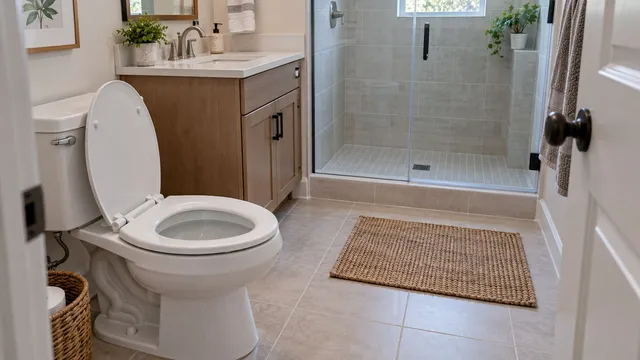
You hear a brief rush from the bathroom when nobody has been inside for hours. The toilet seems to refill by itself; the sound is worth checking even if the floor looks dry.
A simple gravity tank can usually be assessed without buying a part. There is no dependable national price for this repair; the failed part, access, and local labor determine the quote.
Is that sound a refill, full flush, hiss, or gurgle?
Listen once and note the duration and interval. A refill is a short rush, then silence until the tank loses enough water for the float to fall again. A constant hiss or trickle suggests water continuously entering the overflow tube or a fill valve that never fully shuts. A true full flush has the bowl-clearing whoosh; a standard gravity toilet needs its flush mechanism triggered for that to happen. Sensor, smart, and pressure-assist toilets require model-specific checks. A gurgle from the bowl when another fixture drains is a drain or vent warning, not a tank refill.
When the bowl drains normally, slow tank-to-bowl water usually leaves by the drain. If the bowl level is high or rising, or water appears behind the tank or on the floor, close an accessible toilet shutoff without forcing it, do not flush again, and call a licensed plumber. Keep clear of wet electrical access. For wet floors or a ceiling below, also call a water-damage restoration contractor; coverage depends on the cause and timeline.
Does this toilet have an open gravity tank or a pressure vessel?
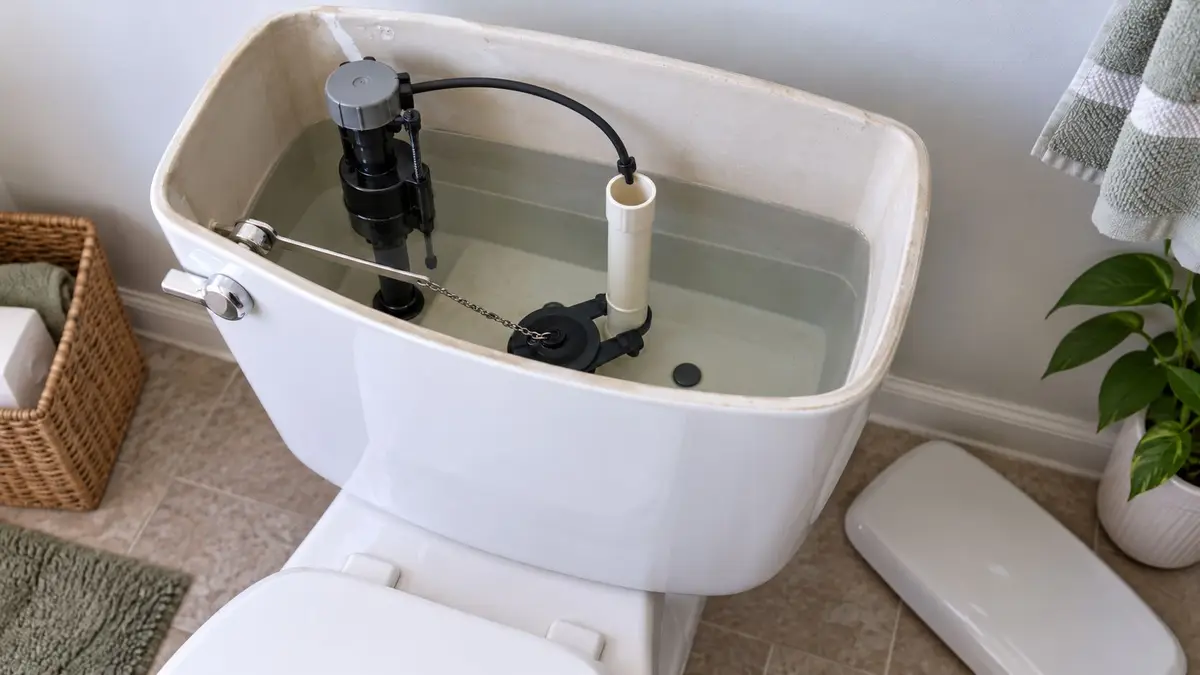
Look at the toilet model before any tank test. An ordinary gravity tank holds visible open water under its ceramic lid. A pressure-assist model contains a black plastic vessel inside the ceramic tank; a powered or sensor toilet has a different control system. Do not open or service a pressurized vessel or powered components.
The CPSC recall of certain Series 503 Flushmate III units covers date codes 101497–063009 from earlier notices and 070109–043011 in the 2016 expansion. The vessel can burst, lifting the lid and shattering the tank, with impact and laceration hazards. Check current recall information against the exact model and date code; other pressure-assist units are not thereby declared recalled. For a recalled unit, CPSC says stop use immediately, turn off its water, flush to release internal pressure, and contact Flushmate for a free repair kit. If the bowl is high or cannot safely receive a flush, keep water off and ask the manufacturer or authorized servicer how to release pressure safely; do not override the rising-bowl stop.
For sensor or smart units, use the model manual and manufacturer support. A licensed electrician handles a suspect receptacle. The tests below apply only to a basic gravity tank.
How do you find the water-loss path in a gravity toilet?
In a gravity toilet, a float follows the tank’s water level. As the level falls, the fill valve opens. When the tank refills, the float rises and shuts the valve. The mechanism is working; the unexpected loss is the problem.
The water has three broad exits. It can slip past the rubber flapper or flush seal at the tank bottom into the bowl. It can run down the vertical overflow tube when the level is too high or the fill valve does not shut. Or it can leave the tank through a crack, gasket, bolt, or supply connection and reach the floor. Korky’s ghost-flush guidance emphasizes the first path; Fluidmaster’s running-toilet guidance also identifies overflow through a fill-valve or water-level fault.
That is why replacing the fill valve just because you hear it running can miss the cause. The valve may be responding to water lost past the flapper. Two observations separate the paths.
What do the dye and marked-level tests show?
Only with a dry floor, normally draining bowl, and ordinary open-water gravity tank, lift the tank lid and set it flat where it cannot fall. A rising bowl or external leak ends this procedure; close the accessible toilet supply if safe and call a licensed plumber. For a pressure-assist or powered unit, stop the gravity-tank test and contact the manufacturer or an authorized servicer. Notice whether the full water level sits below the top of the overflow tube. If water is already crossing its rim, skip the dye test: the overflow path is visible. A licensed plumber can correct a valve or setting that will not shut off. If that fault follows pressure changes elsewhere, map one-faucet versus whole-house pressure symptoms before proposing a regulator adjustment.
For the first test, put a few drops of food coloring in the tank and do not flush. EPA WaterSense says color in the bowl after 10 minutes means a leak. San Jose Water uses 15 minutes, giving slower movement more time to appear. Flush after the test only if the bowl remains at its normal level and no water is outside the tank; otherwise close the accessible supply and call a licensed plumber. Color in the bowl confirms tank water reached it, but does not uniquely identify the flapper or seat. Look for visible overflow before assigning a route. A clear bowl during a short test does not clear an intermittent leak.
For the second test, let the tank refill fully only while the bowl drains normally and the exterior stays dry. Mark the full waterline lightly, close the accessible supply gently, and leave the toilet unused. Fluidmaster describes a 10–15-minute first check. Korky says wait at least 25 minutes to see whether the level drops, then leave water off a couple of hours to see where it finally stops. Do not force a valve or conclude from a short unchanged level that the fill valve is at fault.
| Result with supply off | What it points toward | Next step |
|---|---|---|
| Level falls to the flapper or flush-seal height | Seal or seating surface | Inspect model-specific seal and seat |
| Level continues below the seal | Flush valve, tank connection, or external path | Close supply; call a licensed plumber |
| Level holds over longer observation, but water ran with supply on | Fill valve or overflow possible | Inspect visible overflow; call a licensed plumber if unresolved |
| Water appears outside tank | Supply, tank, bolts, or gasket | Keep supply closed; call a licensed plumber |
The final-level rows require that longer observation, not merely the 25-minute drop check. If water appears outside, stop the test, close the supply safely, and call a licensed plumber. A slow leak may also take longer than one check to show itself, so repeat observations rather than treating a single negative result as a guarantee.
Why might a new flapper still leak?
First, confirm the exact tank model and flush-valve size. Korky’s sizing guide distinguishes common 2-inch and 3-inch openings. A seal that looks close but does not match the valve may never sit evenly. Korky recommends one to two chain links of slack so the flapper can settle without loose links falling under it. Tower, canister, and dual-flush models may need a model-specific seal rather than a generic flapper.
Second, inspect the surface under the seal for grit or scale. A new soft flapper cannot seal against debris or a damaged seat. New York City’s toilet-leak guidance notes that sediment can damage the flush valve. Cleaning accessible loose debris according to the toilet maker’s directions may help; a pitted or damaged flush valve is a licensed plumber’s repair, often requiring more disassembly than a seal change. Ask the plumber which test showed this was needed.
Tank cleaners matter too. Kohler’s toilet guide instructs owners not to use in-tank cleaners: chlorine products can damage fittings, causing leakage and property damage, and use of in-tank cleaners will void its stated warranty. This is Kohler’s policy for its products, not a claim about cleaners used in the bowl. EPA recommends checking flappers periodically and replacing them at least every five years. Water chemistry and tank products can change how a particular part wears.
Could the sound be coming from another device?
If you are unsure the toilet is the source, EPA WaterSense advises comparing meter readings before and after two hours with no water use; any change probably means a leak. If it changes and the toilet’s supply valve is dry, accessible, and turns easily by hand, close just that valve and repeat the quiet-meter check. Do not force it. Flow that stops only while the toilet is isolated points back to that toilet; continued flow calls for a wider search. A still reading cannot rule out an intermittent loss.
Check the programmed schedule of a softener, ice maker, irrigation controller, or other device that might operate when the house is quiet. A well pump can also be the noise you hear. The full high-water-bill meter sequence helps separate a toilet from other hidden water use. A bang exactly when the washer stops belongs to the water-hammer check.
On a private well, a leaking toilet can make the pump run more often even without a water bill. Once the toilet is isolated, continued cycling calls for a licensed well contractor. On septic, the extra water also adds load: EPA septic guidance says a leaky or running toilet can add as much as 200 gallons per day and that efficient water use helps the system operate. Slow drains, odors, or wet spots around a drainfield warrant a septic service provider; do not inspect wastewater yourself.
How urgent is it, and what could it cost?
A short refill with a normally draining bowl and a dry floor can generally wait for a planned repair, but close the toilet’s own shutoff if leaving home or wanting the cycling to stop. If the bowl rises, a connection weeps, or water reaches the floor, close that valve and call a licensed plumber promptly. If the valve is stuck, do not force it; use the accessible house main if safe and call.
The leak’s volume depends on its actual path and rate. EPA’s as much as 200 gallons per day concerns a leaky or running toilet, not every occasional refill. San Jose Water describes an upper case of 72,000 gallons per year. NYC DEP describes up to 4,000 gallons per day for a fill valve failed wide open. These are different scenarios. For your own estimate, subtract two quiet-period meter readings, convert to gallons if needed, then calculate gallons used ÷ gallons per billing unit × your utility’s rate per unit. Ask the utility whether it offers a leak adjustment; policies vary.
A seal swap, fill-valve repair, tank removal, shutoff repair, and damage beneath a toilet are different scopes. Request an itemized local quote showing diagnosis, parts, labor, any floor or flange work, and disposal. A recommendation to replace the whole toilet after one refill deserves an explanation of why the tank parts or valve seat cannot be repaired.
Pressure-assist and powered toilets need model-specific service; do not apply these gravity-tank tests to them.
Frequently asked questions
Does a clean dye test rule out a toilet leak?
No. Dye shows that tank water reached the bowl without a flush. Check the overflow and use the marked-level test over the longer period with the supply off; water outside the tank is a separate urgent path.
Can a toilet refill every few hours and still waste much water?
Yes, repeated losses add up, but the refill interval alone does not tell you gallons. Read the meter before and after a quiet period and use your own utility’s rate rather than a national cost guess.
Will the utility adjust a high bill caused by the toilet?
Possibly. Each utility sets eligibility, documentation, deadlines, and any credit. Save the repair invoice and meter readings, then ask for its policy.
Can a drain problem make the toilet refill?
A drain restriction does not ordinarily make the tank lose water. It can make tank water entering the bowl raise the bowl level instead of draining away. Close the supply if the level rises and call a licensed plumber.
Is an older toilet worth repairing?
Age alone does not answer that. Ask whether the seal, fill valve, and flush valve are serviceable and whether the tank or bowl is cracked. Bring the model number and both test results to a licensed plumber for an itemized repair-versus-replacement quote.
Sources
- U.S. Environmental Protection Agency WaterSense — Fix a Leak Week
- U.S. Environmental Protection Agency — How to Care for Your Septic System
- New York City Department of Environmental Protection — Toilet Leak Detection
- Fluidmaster — How to Fix a Running Toilet
- Korky — How to Fix a Running Toilet
- Korky — How to Stop Ghost Flushing
- Korky — What Size Flapper Do I Need?
- Kohler — Homeowners Guide: Toilets
- U.S. Consumer Product Safety Commission — Flushmate III Recall
- San Jose Water — Checking for Toilet Leaks