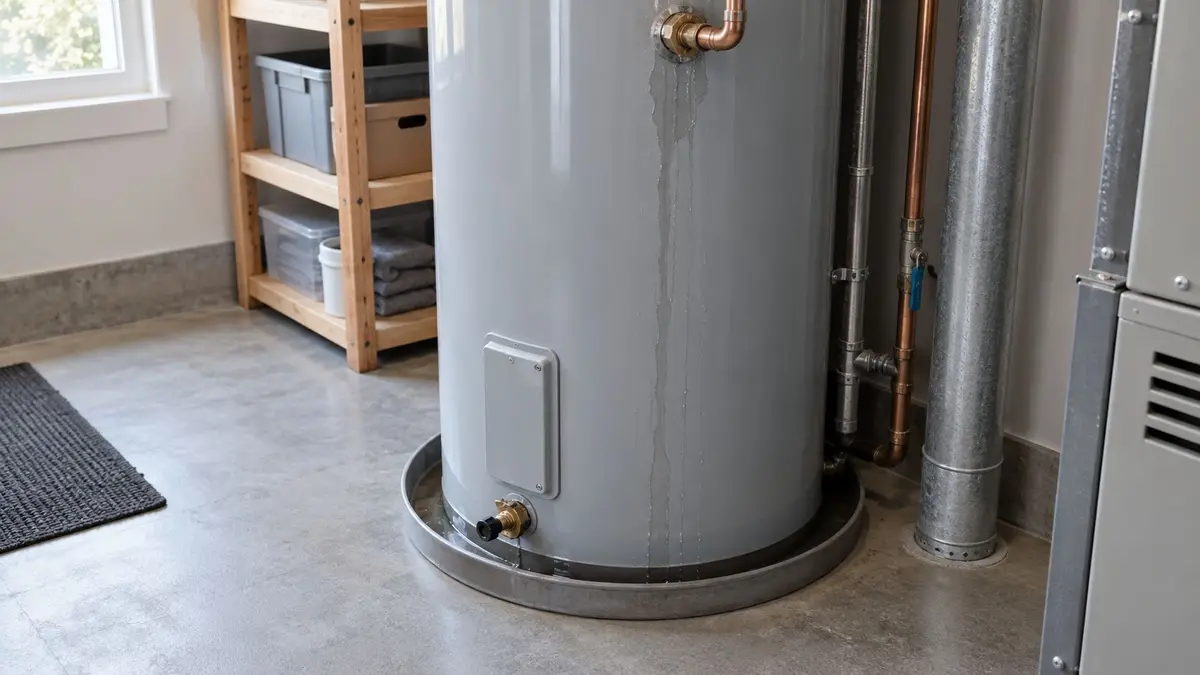
A puddle under the heater is an urgent water problem, but it is not yet a tank diagnosis. Water from a fitting at the top can travel down the jacket and collect at the base. The decision turns on where water first appears after the exterior is dry.
There is no dependable national average for this repair or replacement. A quote changes with the part, access, heater type, local code, and work needed around the appliance. The sections below help you identify the likely category before you compare prices.
What should you do when a water heater is leaking?
Keep people away from wet electrical equipment. If water is actively escaping, stop using hot water and close the heater’s cold-water supply valve only if you can reach it safely. If the valve will not stop the flow, use the home’s main water shutoff if accessible. For an electric or heat-pump unit, switch off its labeled breaker only from a dry, intact, safely accessible panel; never remove the cover or approach wet electrical equipment. For a gas unit, follow only the manufacturer’s external OFF instruction if you can do so safely; otherwise have a qualified gas-appliance technician shut it down. Do not drain or restart the heater. A qualified gas appliance technician handles the gas controls, burner, and venting after the gas utility has secured any suspected leak.
Call a licensed plumber promptly if the leak is increasing rapidly, the tank is bulged or deformed, or water is above a finished ceiling. Stay out of unsafe attic access. Take photos of the puddle and the unit before cleanup. If water reached a finished floor, wall cavity, or lower level, call a water damage restoration professional as well as a licensed plumber. The plumber locates and stops the leak; restoration addresses the wet building materials. Do not turn a submerged unit back on. CPSC guidance says submerged gas controls must be replaced, and AHRI advises replacing flood-exposed water heaters.
Is the water actually a tank leak?
Ask the plumber to dry the outside and trace the highest wet point as water returns. A wet pan is a collection point, not necessarily the source. Look above it: cold inlet, hot outlet, relief-valve discharge, drain valve, and fittings. A. O. Smith’s leak guide distinguishes connection, valve, and tank leaks. Temporary condensation can appear during warm-up on a conventional gas tank; a repeatable wet point still needs tracing. On an electric tank, insulation usually hides condensation from view. Heat-pump and condensing tankless units have separate condensate drains. Another appliance or supply line can also drain into the pan.
| Highest wet point | What it suggests | Decision |
|---|---|---|
| Top connection | Pipe or fitting leak | Confirm part and repair scope |
| Relief discharge outlet | Pressure, expansion, heat, or valve issue | Measure cause before replacing valve |
| Drain valve | Valve seal or connection | Plumber checks repairability |
| Element opening or gasket | Technician-only internal seep | Electric-water-heater technician traces with energy off |
| Another appliance or supply pipe | Water entering pan from outside heater | Trace upstream source |
| Tank seam or shell | Failed vessel | Replace the unit |
| Condensate line on heat pump or condensing unit | Drainage issue or normal output | Trace condensate path |
A replacement verdict based only on pooling at the bottom is premature. If the symptom is discolored hot water, use the hot-tap brown-water checks to separate tank, piping, and supply causes. Conversely, a tank shell that is wet after the fittings above remain dry is different from a replaceable valve. A plumber should document that distinction before quoting.
Does a dripping relief valve mean the valve is bad?
The temperature-and-pressure (T&P) valve is a safety device. Its discharge may be telling you about high supply pressure or thermal expansion in a closed water system. Rheem’s technical bulletin describes periodic release during heating, with an example around one cup per ten gallons of capacity per cycle, and warns that repeated excess pressure can shorten tank life. That signature is not proof that your valve is healthy or that expansion is the only cause.
If pipes bang when the washer stops, see the water-hammer guide for a separate pressure symptom. Have the plumber measure water pressure and check whether the system is closed by a pressure-reducing valve, backflow device, or meter arrangement. If an expansion tank is present, its sizing and charge matter. A new T&P valve alone will not solve a pressure problem. Never plug, cap, or add a shutoff to the relief discharge. ICC’s discussion of model-code water-heater safety explains why the discharge path must remain available. Your local adopted code determines its exact installation details.
When is repair sensible, and when is replacement necessary?
A repair is sensible when a plumber confirms that a connection, drain valve, or other serviceable component is leaking and the tank itself is sound. Ask what caused that part to fail. Repairing a repeated pressure symptom without correcting pressure or expansion can leave the underlying problem intact.
A leak through the tank wall or seam calls for replacement. Patch, weld, or sealant offers are not a sound substitute for a new pressure vessel. Corrosion streaks, deformation, and repeated shell wetness are findings a plumber should document. If water from the top appears to run behind the jacket, the plumber needs to trace it rather than guess from the puddle.
There is also a third path: repair a confirmed small component now, then plan replacement on your schedule if the unit is old or inefficient. The hot-water-running-out guide helps assess performance while you plan. ENERGY STAR advises planning when a heater is more than ten years old; that is a planning cue, not an expiry date. Its replacement guide warns that emergency replacement can cost more and typically limits choices to inefficient models. If the tank is leaking, planning time is over; if a fitting is repairable, you can compare options calmly.
What if the unit is tankless or a heat pump model?
Heat pump water heaters remove moisture from air, so condensate must drain. Pacific Northwest National Laboratory describes condensate management and location requirements. A blocked or disconnected condensate path can wet the floor even when the tank holds water. The plumber should distinguish condensate from tank leakage and check the specific model’s installation instructions.
Condensing tankless equipment also produces condensate. Noritz explains that this water is a normal byproduct, while poor drainage can look like a leak. Water at a service connection or inside the case is a different matter. Do not remove the case or work on gas or electrical parts yourself; a qualified service technician traces the source.
How do you check age and warranty before calling?
Photograph the rating plate. Record the brand, model, serial number, fuel type, and capacity. Find the manufacturer’s date-code guide for that brand and model; serial numbers are not decoded the same way across brands. Locate the purchase and installation records, then read the specific warranty document before assuming parts, labor, or installation are covered.
Manufacturer instructions can make maintenance and installation conditions part of warranty eligibility. In one Bradford White manual, the first two serial characters encode manufacture year and month; the year letter repeats every 20 years, so A may mean 2004 or 2024. Use your brand’s date-code guide. Another Bradford White manual permits anode removal for inspection or replacement; operating with the anode removed voids warranty coverage, and thermal-expansion damage is excluded. These are model-specific examples, not universal terms. If a relatively new unit is proposed for replacement, ask the plumber to check the actual warranty claim route and state what it covers.
What does replacement actually include?
The appliance is only one line of the job. A written estimate should identify its make, model, capacity, and efficiency; removal and disposal; water connections and shutoff; relief valve and discharge; pan and drain; expansion control if needed; and any gas venting or electrical changes. Ask which provisions apply under your local adopted code, and whether a permit and inspection are required there. Those rules vary by jurisdiction.
For an electric-to-heat-pump change, ask whether the room meets that model’s air-volume and temperature requirements and whether a licensed electrician must add or change a circuit. The published examples disagree, as the comparison below shows. They are planning inputs, not installation instructions; the selected model’s manual governs.
| Decision input | Published examples | What to use |
|---|---|---|
| Heat-pump air space | ENERGY STAR guide: about 700 cubic feet, some models 450; product page: 1,000 cubic feet | Selected model’s installation manual |
| Anode and sediment service | Bradford White model manual: anode inspection every two years; drain and flush annually; A. O. Smith: annual anode inspection and at least annual flushing | Qualified technician and your model’s manual |
| Projected lifetime energy savings | ENERGY STAR 2025 factsheet: more than $6,300 for a four-person household; replacement guide: more than $4,500 | Projections, not guaranteed savings |
For a gas unit, a qualified gas technician must assess venting and combustion air. In earthquake-prone areas, restraint requirements may apply; California has a specific state law, which is not a national rule.
Do not treat a dated tax-credit statement as current. Check current federal-credit status and your utility’s rebate programs before choosing equipment. The price difference between two quotes may reflect added code work, access, or included restoration rather than a different heater alone.
What should a repair or replacement quote show?
No authoritative nationwide price dataset captures this mix of appliance, labor, local rules, and damage. Ask for line items instead of comparing one total. The diagnostic fee, specific repair part, labor and draining should be separate from a replacement alternative. For replacement, include the equipment, labor, removal, plumbing, venting or circuit work, permit, inspection, and warranties for equipment and labor. Make exclusions explicit, especially floor or drywall repair.
A second opinion is useful when someone calls a tank failed without locating the wet point, replaces a dripping T&P valve without a pressure check, or recommends a heat pump unit that does not fit the space. Have the second plumber examine the same photos and rating plate. Ask each one, “Where exactly did the water start, and how did you confirm it?”
What about water damage and insurance?
Dry the area and document what got wet. Prolonged wetting of porous material can create conditions favorable to microbial growth, and hidden water may require a restoration professional. The Insurance Information Institute describes common policy distinctions involving accidental appliance discharge, flood, and maintenance. Coverage for your loss depends on the policy, endorsements, deductible, state law, and the insurer’s decision. The water-leak insurance guide explains why cause and timeline matter. Contact your insurer with the photos and the plumber’s written finding.
Once the source is confirmed, schedule the repair or replacement promptly. Ask the plumber to verify pressure and expansion control on the finished job; that is what keeps a new heater from inheriting an old problem.
Frequently asked questions
Can a leaking water heater be repaired?
Yes, if a serviceable part or connection is the source and the tank is sound. A breached steel vessel calls for a new unit. The highest wet point is more useful than the puddle location.
Should I repair or replace a heater above finished rooms?
A leak above finished rooms can damage ceilings and hidden materials, so call a plumber promptly and stay out of unsafe attic access. Compare the repair’s remaining risk with planned replacement, and include the pan, drain, and leak-detection options in the quote.
Should I turn up the temperature to deal with a leak?
No. Temperature adjustment does not repair leakage and can increase scald risk. The CPSC recommends 120°F for reducing scald risk; households with mixing valves or special equipment should have a plumber assess their setup.
Sources
- A. O. Smith — Water Heater Leaking
- Rheem — Thermal Expansion Technical Bulletin
- ICC — Water Heater Safety in the International Codes
- ENERGY STAR — When Should You Replace Your Water Heater?
- ENERGY STAR — Water Heater Replacement Guide
- PNNL — Heat Pump Water Heaters Code Compliance Brief
- Noritz — Tankless Water Heater Condensation
- Bradford White — Installation and Operation Manual 238-55123-00
- Bradford White — Installation and Operation Manual 238-54649-00
- A. O. Smith — Water Heater Maintenance
- ENERGY STAR — Heat Pump Water Heaters
- ENERGY STAR — 2025 Heat Pump Water Heater Factsheet
- CPSC — Flooded Gas Controls
- CPSC — Tap Water Scalds
- AHRI — Floods and HVACR Equipment
- California — Health and Safety Code Section 19211
- Insurance Information Institute — Covered Disasters