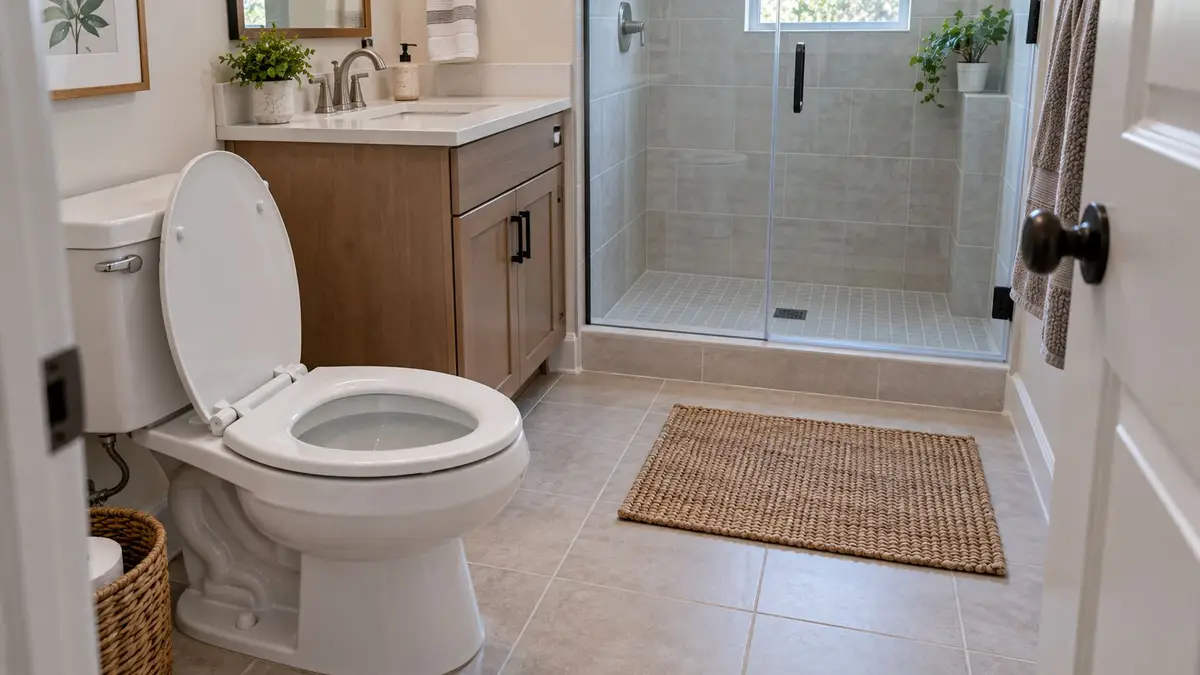
You turn on the shower and hear bubbles from the toilet beside it. The bowl is the place you notice the sound, but it may not be the place with the fault. Both fixtures often join the same drain branch, and water from the shower changes air pressure in that branch.
Look at whether bubbles rise or the bowl level falls, and whether other drains react. Those observations tell a licensed plumber more than “the toilet makes noise.” Cleaning a branch, testing a vent, and repairing a buried lateral are different scopes; the observed pattern determines the first call.
Is a gurgling toilet urgent while the shower runs?
Before using the map below, stop all water use if any water rises or backs up, drains across the house slow together, sewer odor accompanies sluggish drainage, the septic system shows failure signs, or rain has caused a current surcharge. Do not reproduce the symptom. Seek urgent licensed plumbing diagnosis; for a septic home, contact an onsite wastewater service provider. If wastewater reached a room, close it off and arrange cleanup by a sewage-restoration contractor.
If drainage remains normal and only a brief gurgle occurs, record the pattern and schedule a diagnosis. A shower is a sustained, modest flow. A system that reacts to that steady flow deserves attention even if it has not backed up. Avoid chemical drain cleaner: it cannot correct a vent or distant pipe defect and can leave hazardous liquid in the line a professional must open.
| What you observe | Likely search area | First move |
|---|---|---|
| Only toilet and shower in one bathroom react | Shared branch or vent | Licensed plumber |
| Kitchen, laundry, or other bath also reacts | Building drain or sewer lateral | Licensed plumber or sewer specialist |
| Water appears at the lowest opening | Downstream restriction or backup | Stop water use; urgent plumber |
| Only after heavy rain | Public surcharge or outside drainage | Wastewater utility or public works |
| Only during hard freezes | Vent terminal may frost closed | Licensed plumber; no roof access |
| Septic home with slow drains, odor, or wet drainfield | House line or septic system | Stop water use; septic or onsite wastewater provider |
What makes the toilet gurgle?
The toilet’s trap holds water to block air from the drain. As shower water travels along the shared branch, it can pull air behind it or push air ahead. If the system cannot exchange air through its vents, air crosses the toilet’s water seal and makes bubbles or a gulping sound. The Ohio adoption of the International Plumbing Code’s vent provisions section 901.2 limits trap-seal pressure variation to 1 inch of water column; local code editions and amendments vary.
Bubbles rising through the bowl suggest air is being pushed back toward that opening. A bowl level that drops as the shower runs suggests suction pulled water from the seal. Code Check’s vent explanation describes both back pressure and siphonage. Neither observation by itself proves a blocked vent or pinpoints a pipe defect; it gives the plumber a useful direction to test.
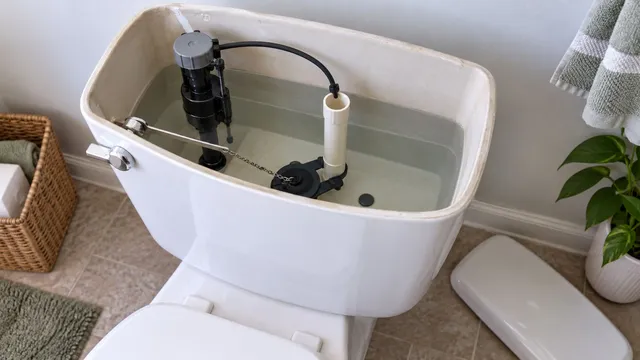
The toilet is therefore often a reporter, not a broken fixture. Replacing it would leave a shared drain restriction or vent problem untouched. A short refill from the tank when no fixture is draining is a different toilet refilling problem.
Which other fixtures react, and when?
Use what you already saw during ordinary use; do not run a shower, laundry cycle, or flush to provoke another gurgle. Write a compact log: triggering fixture / reacting fixture / bubbles rising or bowl level falling / drain speed / rain or freeze / recent remodel / septic last service / drain chemicals used. A bathroom-only pair may implicate their common branch or vent. Reactions in distant rooms suggest a shared downstream route, but do not locate the exact defect. Traverse City’s sewer guidance treats gurgling as an early lateral warning and recommends professional video inspection when a line recurs.
Tell the plumber whether the sound is new, whether drains have slowed, and whether anyone recently moved a toilet, added laundry, or finished a basement bathroom. Gradually slowing drains, several rooms reacting, and a stronger reaction as flow rises lean toward a restriction. A recent remodel, normal-speed but noisy drainage, and a falling bowl level lean toward vent trouble. Both can coexist; neither is a diagnosis. After a remodel, a licensed plumber can check trap-to-vent length, slope, and vent arrangement. Moving a toilet during a remodel changes vent and drain relationships, so that history matters.
Do not climb to inspect a roof vent. A terminal can collect debris or frost, but roof access and vent clearing are professional work. An air admittance valve (AAV) is a one-way vent device sometimes used on a branch; it can also fail. Oatey’s technical explanation says an AAV admits air under negative pressure but cannot provide the two-way air exchange of a traditional outdoor vent; at least one traditional roof-stack vent remains required. An AAV must remain accessible for inspection and replacement. Whether it is accepted and how it may be installed depend on the local building department. Ask a licensed plumber to verify the actual vent arrangement rather than adding a device on speculation.
What if the house uses a septic system?
Whole-house gurgling with slow drains in a septic house changes the first call. EPA’s malfunction guidance lists gurgling, slow drainage, backups, sewage odor, and damp ground near the tank or drainfield among signs of a system problem. Stop adding water and call a septic or onsite wastewater service provider. The local health department may hold the permit and system record. Do not open the tank or investigate wastewater yourself.
EPA recommends inspection every one to three years and pumping every three to five years or as needed, but the actual interval depends on household use and system conditions. Give the provider the last service date and describe which fixtures react. A main line in the house might still be restricted; a septic professional can distinguish that from tank, outlet, or drainfield trouble. A bottle of drain cleaner is not a diagnosis for either.
Why does it happen only in rain or freezing weather?
A rain-only pattern can point beyond your bathroom. EPA’s sanitary-sewer-overflow guidance describes stormwater and groundwater entering sanitary sewers through defects or improper connections. That extra water can surcharge a public line and affect nearby homes. Call the wastewater utility or public works department with the dates and conditions before paying to open a private line. If you also have basement water, describe its entry path to the utility rather than assuming every puddle is sewer water.
A freeze-only pattern that ends with a thaw can point to frost narrowing a vent terminal. The Ohio IPC adoption section 903.2 applies a cold-climate vent-size provision where design temperature is 0°F or less; local adoption and design conditions vary. A licensed plumber can inspect and test from safe access. Do not go onto an icy roof or push a tool blindly down the vent.
Weather correlation is evidence, not an all-clear. Record whether it takes heavy rain, a hard freeze, or ordinary daily shower use to produce the gurgle. Include any neighborhood wastewater notices in the call.
What should the plumber inspect and document?
The first visit should turn the fixture map into a location. The plumber can inspect an accessible cleanout, test fixture interactions, assess venting, and camera the implicated drain when needed. Do not open a cleanout during an active backup; retained wastewater may be under pressure.
Ask the technician to name the affected segment—bathroom branch, building drain, or lateral—and the distance to the obstruction or defect from a reference point. If a camera is used, request footage or stills showing pipe material, condition, and the exact finding. Clearing a blockage answers “can water pass today?” A camera may answer “why did this come back?” That distinction matters if a line gurgles again a few weeks after snaking. The recurring kitchen-sink clog discussion explains when a camera inspection adds value to repeated clearing.
Roots are a reason to assess the pipe, not automatically the original cause of its damage. A City of Riverside audit says broken or misaligned laterals generally allow roots in; roots typically do not break an intact lateral, though Traverse City notes roots can later expand and worsen an already defective joint. If cleaning repeatedly removes roots, ask what crack or joint defect the footage shows and whether spot repair, lining, or replacement is appropriate. Those options depend on material, depth, access, and local rules.
Whose sewer pipe is it, and what moves the price?
The boundary between homeowner and utility responsibility is local. An April 2019 Riverside audit recorded contrasting California examples: Riverside then took responsibility from the property line toward the public main, while Los Angeles assigned owners responsibility for house connections to the main even under the street. It also recorded East Bay Municipal Utility District private-lateral certification triggers at sale or significant remodel. These dated examples do not establish today’s rule for your address. Ask your own wastewater utility or public works department for its boundary before authorizing excavation. Get the camera location and footage first.
Price depends on which pipe or vent is affected and whether it needs clearing or repair. Ask for an itemized local estimate: diagnostic fee and whether it is credited, cleanout access, clearing method, camera deliverable, defect location, repair length, depth, vent access and any opened finishes, surface restoration, permits and inspection where locally required, and warranty. A full lateral replacement without footage or a vent replacement without a supporting test deserves a second opinion.
Coverage and pipe ownership are separate questions. The National Association of Insurance Commissioners lists sewer or drain backup among optional coverages; actual terms, limits, and availability depend on the policy and state. Ask your insurer or agent about your policy if damage occurred. If the damage came from another water source, cause and timeline also shape leak coverage.
Frequently asked questions
Does gurgling mean sewer gas is poisoning the house?
No. A disturbed or dry trap can admit sewer gas, but noise alone does not establish exposure. Persistent sewer odor needs a licensed plumber.
Is it safe to keep showering until the plumber arrives?
If any bowl, shower, or low drain is rising, stop all water use immediately. If drainage remains normal, arrange an appointment and share observations already made during ordinary use; do not deliberately repeat the gurgle.
Why did gurgling return after the line was cleared?
Clearing may have removed the obstruction without resolving a damaged joint, root entry, or vent defect. Ask what the first visit found and whether a camera or vent test can document the recurring cause.
Do I need a camera inspection?
It is most useful when symptoms involve several fixtures, return after cleaning, or suggest a buried lateral defect. Ask what segment will be viewed, from which cleanout, and whether you will receive footage and a distance to the finding.
Who owns the pipe if the problem is under the sidewalk?
The answer varies by local utility and municipal rules. Get the defect location from the plumber, then ask the wastewater utility or public works department where its maintenance responsibility begins before approving excavation.
Sources
- UpCodes — Ohio IPC Chapter 9: Vents
- Code Check — Why Vent Plumbing Systems?
- U.S. Environmental Protection Agency — Resolving Septic System Malfunctions
- U.S. Environmental Protection Agency — Sanitary Sewer Overflow Frequent Questions
- Oatey — What Are Air Admittance Valves?
- City of Riverside — Municipal Approaches to Sewer Laterals
- City of Traverse City — Tree Root FAQ
- National Association of Insurance Commissioners — Homeowners Insurance