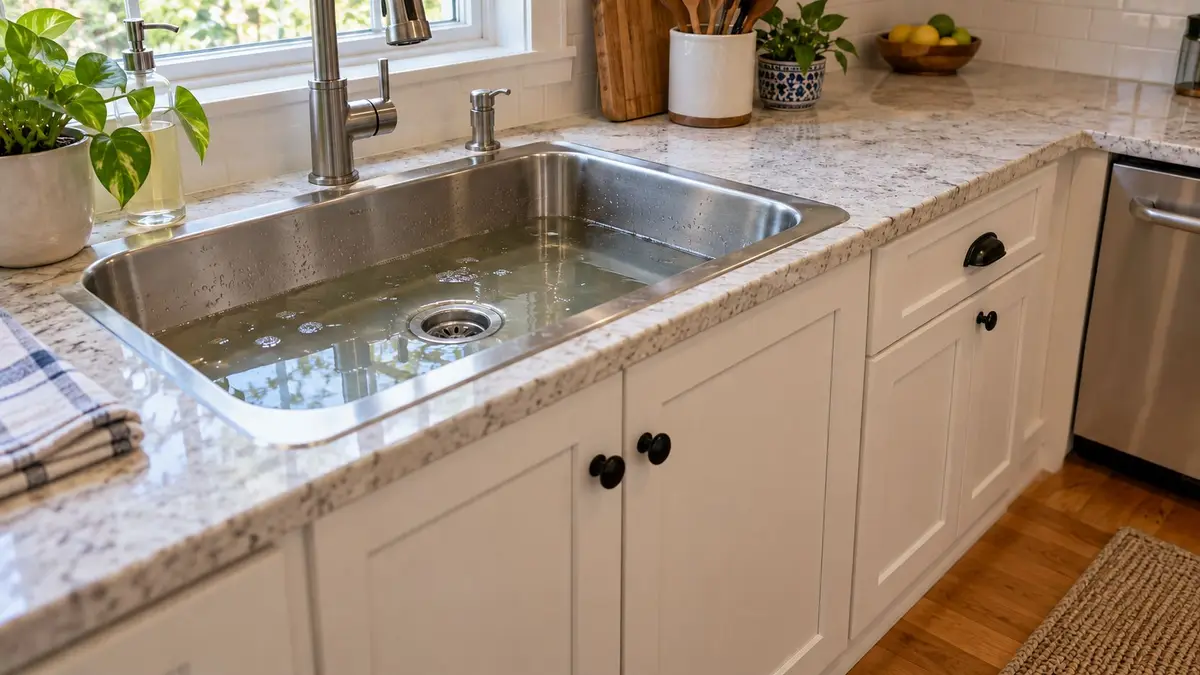
The sink clears after the cable comes out, then the water begins to pool again. That cycle matters: a cable can restore a narrow path through buildup while the material coating the pipe stays in place. The time between clogs, and which fixtures join in, will help you decide what the plumber should inspect next.
The price question deserves an honest answer early. There is no authoritative national dataset for a kitchen branch cleaning or camera inspection. The useful comparison is the scope of the work: branch versus main, access, cleaning, recording, locating, and any proposed repair.
What do repeat kitchen sink clogs tell you?
Record when each clog happened, how quickly the sink slowed, and whether it ever drained normally after cleaning. A gradual decline over weeks or months fits a restriction accumulating on the wall. A sink that was still slow when the plumber left calls for a different question: how far did the cable go, and did it reach the obstruction? Sudden trouble after a disposal or dishwasher installation also puts the under-sink connections in view.
Texas’s environmental agency explains that fats, oils, and grease build up inside sewer pipes and restrict flow. Clemson Cooperative Extension adds that hot water and soap do not eliminate that material; it can reform farther along the pipe. Scraping grease into the trash changes the input. Pouring hot water after it does not change the underlying drain condition.
| Pattern you notice | First place to look |
|---|---|
| Kitchen sink alone slows gradually | Kitchen branch and wall buildup |
| Sink gurgles or drains poorly even after cleaning | Venting and trap arrangement |
| Toilet gurgles or floor drain gets wet during laundry | Building drain or sewer lateral |
| Dishwasher trouble began after a new disposal | Dishwasher connection and disposal knockout |
If a toilet gurgles when another fixture runs, use the cross-fixture drain and vent guide before paying for a branch camera. A pattern is a starting point, not a pipe diagnosis. Give the plumber dates and the entry point of the last cable. Ask what head was used, how far it traveled, and what came back.
Why does snaking help for a while?
Snaking opens a passage so water can move again. If the cable head is smaller than the pipe’s inside diameter, it can pass through deposits without cleaning the circumference. The same buildup can narrow the passage again. Cleaning from the sink may also stop before a restriction where the branch meets a larger drain.
Cabling, jetting, and descaling do different jobs. A cable commonly restores flow; jetting washes the pipe wall; descaling removes hard buildup in a suitable pipe. A plumber should identify the material and condition before selecting aggressive cleaning. If the pipe may be fragile, viewing it first can guide that choice. If the camera’s lens would be submerged in dirty standing water, cleaning and draining first may be necessary to see the pipe. Ask which order applies here and why.
The NC State research described in this report found hard calcium-soap deposits in municipal collection systems. That work centered on sewer conditions, including concrete surfaces; it does not establish the chemistry of your kitchen branch. It does explain why some drain deposits are more stubborn than soft cooking grease.
Is it the kitchen branch or the main line?
Use observations from normal water use; do not run a tub or washer to reproduce a previous backup. If there has been sewage odor indoors, multiple backups, a wet floor drain, or a backup returning within minutes, stop water use and call a licensed plumber. With none of these signs, notice whether an ordinary fixture use makes the sink rise, a toilet gurgle, or a low drain respond. Stop using water at the first gurgle, rising water, or slow cross-fixture response; do not wait for a spill. Traverse City’s sewer guidance identifies toilet gurgling and wet floor drains after laundry as warning signs of a sewer problem.
If other fixtures behave normally during ordinary use, focus on the kitchen branch: its trap, vent, and connection to the building drain. Cross-fixture symptoms point toward the larger building drain or sewer lateral. Leave powered main-line drain equipment to a drain-cleaning professional. A plumber handles the drain; a restoration professional handles contaminated flooring and materials.
For a septic home, the tank and drainfield add other possible causes that a pipe camera will not assess. The EPA advises septic owners to keep grease out and limit garbage-disposal use. Tell the plumber that the home is on septic before they propose the next test.
What else looks like a kitchen drain clog?
Look at the under-sink arrangement without opening a pipe. A dishwasher drain hose that falls low under the cabinet, a connection downstream of the trap, or a newly installed disposal can change the symptoms. The residential-code examples in this state-adopted code text put the dishwasher connection before the trap and call for a high rise secured under the sink rim or counter. Local adopted codes and air-gap rules vary; have the plumber check the actual installation.
A sink that drains only while the disposal runs raises a disposal or connection question. A dishwasher that stopped draining immediately after a disposal replacement raises the knockout-plug question. Water standing in the dishwasher after a sink backup can instead be a consequence of the branch restriction. Describe which problem appeared first; do not assume the dishwasher failed because its tub has water.
Persistent gurgling after a good cleaning can point to venting. If the sink was relocated, the island-sink plumbing guide explains why the layout matters. A camera inside the drain cannot tell whether the sink is correctly vented. One state-adopted IRC example limits a 1½-inch trap arm to 6 feet from the vent. Its island-vent provisions require access to rod vent piping below the sink-rim level. An air-admittance valve—a fitting that admits air into the drain—must be accessible and cannot replace every outdoor vent. These are code examples, not a national rule; the plumber must apply the edition and amendments adopted where you live.
Which camera would actually inspect the kitchen pipe?
A sewer camera and a small branch camera are different tools. One manufacturer’s Gen-Eye POD has a 1.625-inch camera head specified for 3- to 10-inch lines; its smaller 1.125-inch version is specified for 2- to 3-inch lines. A small-diameter Micro-Scope3 is described for 1½- to 4-inch drains. These are equipment examples, not universal sizes.
A camera run through the main cleanout can inspect the main and miss the kitchen branch entirely. Ask: “What is the smallest line your camera fits, where will it enter, and will the recording show my kitchen branch?” Entry might be through an accessible branch cleanout or a trap removed by the plumber. An absent cleanout means access can be a separate charge. Roof vent access belongs to a professional; do not climb onto the roof to pursue it.
A camera can show standing water that may indicate a low spot or another restriction, along with displaced joints, deposits, cracks, or roots in an outdoor lateral. It cannot directly establish a leak or measure remaining metal wall thickness. It cannot prove a vent works or make dirty standing water transparent. Roots are relevant to a buried sewer line, not the default explanation for a single kitchen fixture. If an outdoor lateral passes near a tree, the root and sidewalk guide covers the separate landscape decision.
When is a camera inspection worth buying?
It earns its price when the clog returns after a thorough, documented cleaning, the plumber suspects pipe damage, or a repair location must be found. It is less useful as the first purchase for a one-time clog, an unexplored under-sink defect, or a vent symptom with no evidence of an internal obstruction. In a dirty, water-filled pipe, ask how the crew will get a view that can answer your question.
A camera finding should change the proposed work. General Pipe Cleaners’ diagnostics guidance treats visual confirmation as a way to choose cleaning, repair, or access. The finding should be described at a specific distance, with its limits.
| What the recording shows | What to ask next |
|---|---|
| Wall deposits | Which cleaning reaches the full restriction, and how will recurrence be reduced? |
| Roots in a buried line | Where is the entry opening? Root cutting is maintenance, not a pipe repair. |
| Crack, offset, or collapse | Can a scoped section be repaired? Where is it located? |
| Standing water | Is there a low spot or another restriction? Locate it before excavation. |
Replacement of an entire line needs a reason tied to the recorded condition. NASSCO’s condition-coding programs show that consistent defect descriptions exist for utility work. A residential kitchen inspection does not need a formal coded report, but “bad pipe” without a location or description is too little to support a large repair.
Before digging, ask for a surface locate and mark. The camera maker’s locating guidance gives approximate depths of 10 feet for cast iron and 20 feet for plastic or clay with its equipment; conditions and interference affect that result. Ask where the suspected defect is, its distance from the entry point, how depth was determined, and what the recording actually shows.
What should a quote and inspection include?
There is no reliable nationwide price for this work. A main-line camera, branch-size camera, opening a cleanout, washing the line, after-hours dispatch, and locating are different services. Get them broken out so you can compare estimates. Ask whether the diagnostic fee applies to later work and what you owe if the result is inconclusive.
A useful estimate separates access, cleaning method and distance, camera inspection, recording and written findings, locate, and repair. Excavation adds local permit questions, disposal, and restoration of whatever covers the pipe. A proposal to replace a buried line should show the recording, a located defect, and why cleaning or a smaller repair would not solve it. Seek a second plumbing opinion if those pieces are missing.
Ownership of an outdoor lateral is local. San Francisco describes a split in who performs work on upper and lower portions. Your sewer utility or public works department can tell you the boundary at your address. Programs are local too: Saint Paul’s 2026 program covers 90% of eligible costs up to $10,000 inside qualified census tracts, or 50% up to $5,000 outside. It requires three bids from city-licensed sewer contractors; cleaning and televising qualify only under its equity or resulting-repair conditions. Seattle’s assistance program offers qualifying owners interest-free loans up to $15,000 for broken or collapsed side sewers but excludes maintenance, clearing, emergency service, liner-only work, and repairs made before approval. Those caps are program terms, not repair prices.
Tell the plumber if anyone has used a drain opener, and when. Poison Control explains that many products are corrosive and can burn skin or eyes. Chemical residue can remain in a blocked trap. Do not add another product or open the trap yourself. Hand over the clog timeline, the other fixtures’ behavior, and the previous cable details. Leave with the recording, distance-based findings, pipe material if visible, and a quote that separates what the camera showed from what the plumber inferred.
Frequently asked questions
Is a free camera inspection tied to a repair a good deal?
Ask for the standalone diagnostic price and whether you receive the recording even if you decline the repair. Compare the documented finding and a separate repair quote before agreeing. A free inspection that does not leave you a usable record is difficult to compare with another plumber’s diagnosis.
Does a clear camera view mean the drain is fixed?
No. A camera is an inspection tool. Ask what cleaning or repair addresses the cause and whether a follow-up view confirms the pipe is clear.
Will my homeowners insurance pay for the inspection?
Check your own policy. The NAIC consumer guide says sewer or drain-backup endorsements may be available because most policies offer limited or no coverage for those events; it does not promise payment for an inspection.
Sources
- Clemson Cooperative Extension — F.O.G. Pollution
- Texas Commission on Environmental Quality — Fats, Oils, and Grease
- City of Traverse City — Tree Root FAQ
- EPA — How to Care for Your Septic System
- General Pipe Cleaners — Gen-Eye POD
- PHCP Pros — Gen-Eye Micro-Scope3
- General Pipe Cleaners — Camera Locating
- NASSCO — PACP, LACP and MACP
- National Capital Poison Center — What’s in Drain Cleaner
- Saint Paul — Sewer Lateral Grant
- Seattle — Side Sewer Assistance
- SFPUC — Sewer Lateral
- NAIC — A Consumer’s Guide to Home Insurance
- General Pipe Cleaners — Diagnostics
- UpCodes — Trap Distance from Vent
- UpCodes — Island Fixture Venting
- UpCodes — Air Admittance Valves
- UpCodes — Dishwashing Machines
- Phys.org — NC State Sewer Research Coverage