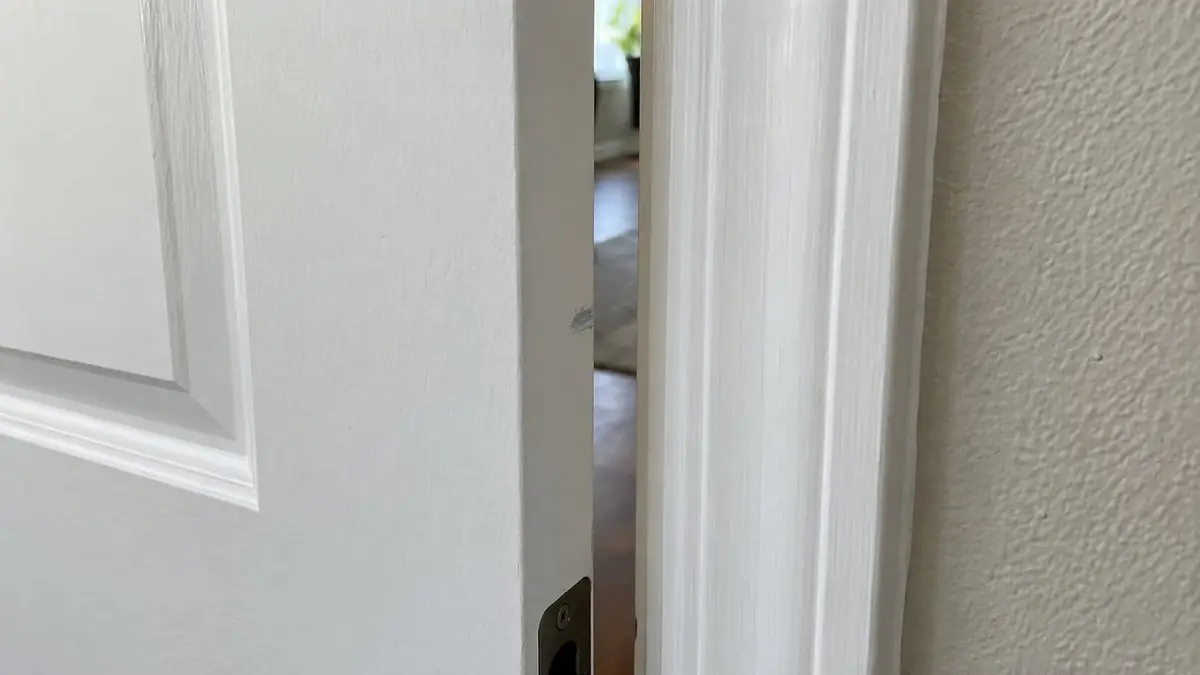
The door looked finished yesterday. Today it pulls free with a pop, leaves a mark on the stop, or drags its edge along the frame. Those symptoms can come from the new coating, from a door that no longer has room to move, or from both.
The useful first question is where contact happens. Record what the door has already done in normal use, then find the exact coating instructions. You do not need to force another sticky cycle to collect evidence.
Is the sticking door creating an access or safety problem?
A lightly tacky bedroom door that still opens and latches normally allows time to call the coating manufacturer. A door that blocks an exit or cannot close, latch or lock as needed calls for prompt service. U.S. Fire Administration escape guidance depends on usable exits. If someone is trapped or an active emergency makes escape unsafe, seek emergency help.
Do not slam, pry or repeatedly pull a stuck door to see whether it frees up. That can damage the finish and may make an access problem worse. If the affected door is an exterior entry, arrange a security and weather-protection plan while a qualified door professional assesses it. A shared-building entry needs the building manager involved.
A labeled or suspected fire or smoke door needs special care. Georgetown’s fire-door guidance explains why improvised propping defeats the protective function. Do not disconnect a closer, defeat a latch, remove a seal or wedge the door open as a drying trick. A qualified door professional and the building manager should determine what its listing and local requirements allow.
New paint does not prove the old layers are lead-free. EPA notes that friction at painted doors can create lead chips or dust when lead paint is present. For pre-1978 housing or uncertain old layers, arrange a lead-safe assessment before scraping, sanding, scoring or trimming. The pre-1978 painting guide explains that decision in more detail.
Does it stick only after resting closed, or rub as it moves?
Painters call unwanted adhesion between two contacting finished surfaces blocking. Sherwin-Williams describes paint blocking at contact points such as doors and jambs. It differs from poor adhesion of paint to the layer underneath. A door can have both problems: the contact pulls a poorly attached layer off when the door opens.
Observe only an ordinary, unforced opening or closing that you were already going to make. Stop if the door needs force or movement starts peeling paint. Record existing marks instead of reproducing damage.
| What you already observe | Possible explanation | What to record |
|---|---|---|
| A sticky release after the door rests closed; matching marks on slab and stop | Paint-to-paint blocking | Product name, final-coat date and contact photographs |
| A scrape before the slab reaches the stop; narrow-looking gap or hard edge ridge | Fit, buildup or a changed opening | Which edge rubs and whether it rubbed before painting |
| A catch at the latch or strike, or a changed-looking gap | Hardware or alignment issue | Whether the door was removed or hardware changed |
| Paint touching a rubber or vinyl seal | Paint-to-weatherstrip interaction | Seal material if known; whether it is painted, sticky or deformed |
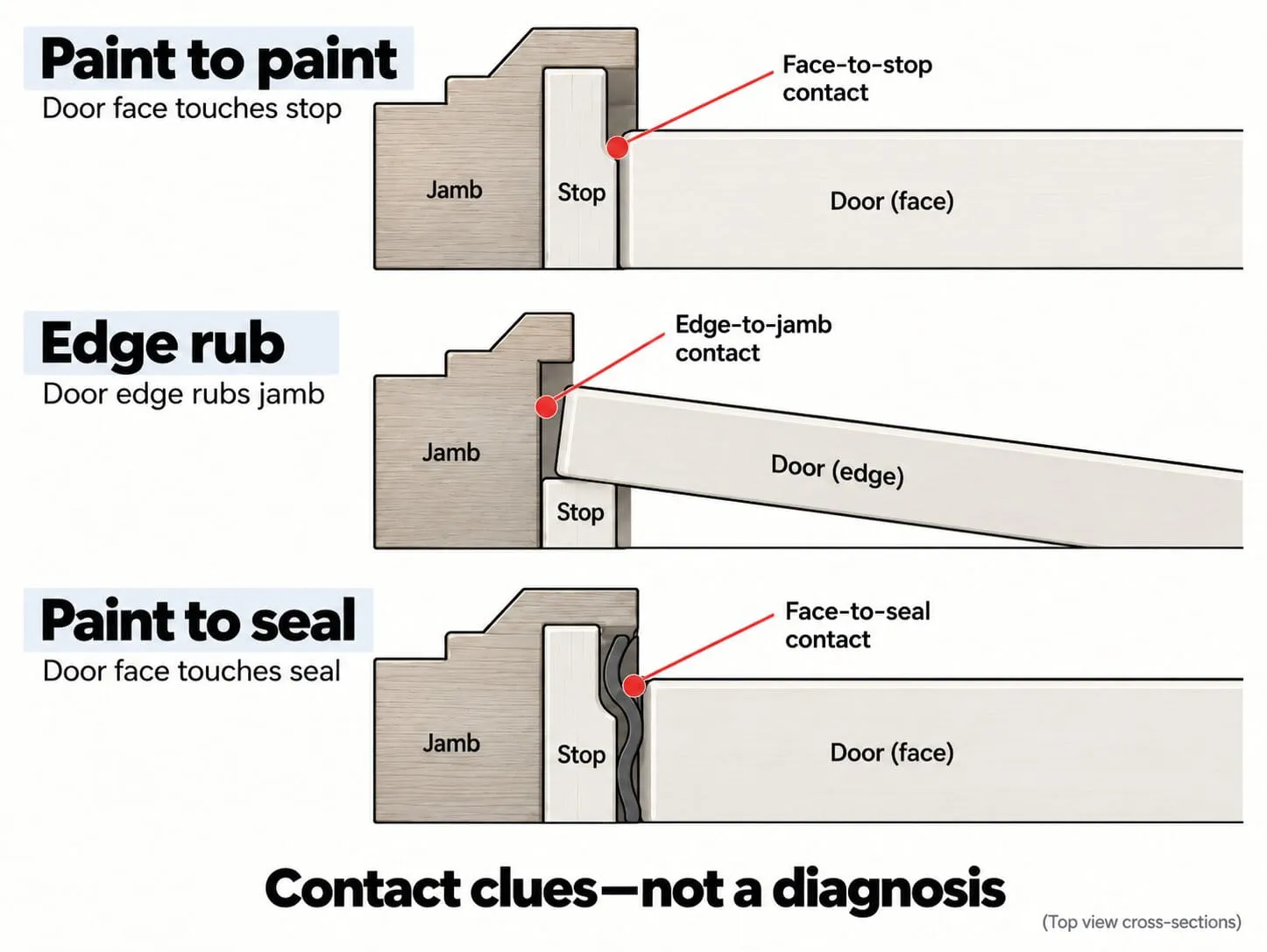
These are clues, not diagnoses. Schlage’s latch guidance discusses hinge condition, strike alignment and weatherstrip pressure as separate fit issues. A pop does not prove the paint is wrong; a scrape does not prove the slab needs trimming. For a sticking window, see why a window will not close or lock.
Record the contact location before deciding on a remedy
The slab is the moving door. Its edge can rub the surrounding jamb, while its face can meet the stop, the narrow strip the door closes against. The strike is the latch opening in the frame; the weatherstrip seals an exterior opening. Those names help a painter or door professional understand a photo.
Photograph the marks, the existing gap and any sticky seal without removing parts. Note whether the door was removed and reinstalled, whether several doors behave alike, and whether a wood door has been tight in humid seasons before. “Paint transfers at the upper stop” is a better service description than “bad paint.”
Which drying instruction actually applies to your paint?
Find the can or invoice and record the product name and number, sheen, base or color, primer, substrate, final-coat date and coat intervals. A brand name or “water-based enamel” is not enough. Get the current label or technical data sheet for that exact product.
Read four different milestones separately:
| Milestone | What it tells you | What it does not tell you |
|---|---|---|
| Touch-dry | The exposed surface can be lightly touched as specified | Two painted surfaces can safely press together |
| Recoat | When another coat may be applied under stated conditions | The door can be closed against its stop |
| Return to service or door closure | When this product allows normal contact, if specified | When washing is allowed |
| Developed hardness and cleaning | Longer-term use or detergent-cleaning guidance | A universal waiting period for every door paint |
The differences are real. Benjamin Moore’s ADVANCE 793 sheet (U.S. sheet 793 US 041023, April 10, 2023) lists 4–6 hours to touch and 16 hours to recoat at 77°F and 50% relative humidity. It separately calls for at least 5–7 days before heavy abrasion or shelf/tabletop use and notes that optimum hardness and final sheen may take up to 30 days. Those later limits are not a universal door-closing schedule.
A BEHR Cabinet, Door & Trim Enamel 7120/7123 sheet, revised March 2022 gives one hour to touch, two hours to recoat and conditional door closure as early as two hours after the final coat. It delays detergent cleaning for two weeks. Darker colors, cooler conditions and higher humidity may extend its drying times. Those numbers belong to that product, not the paint on your door unless the identity matches.
BEHR’s blocking guidance also names thick application and recoating too soon. A cooler or humid room and a heavy coat may make label times poor predictions of actual contact behavior. If the product has no door-closing instruction, ask its manufacturer specifically about your stop or seal contact; do not borrow a shelf-use or washability interval.
What to do while seeking the manufacturer’s answer
Ask the painter or manufacturer how to keep painted contact surfaces apart while maintaining the door’s required function. That may be simple for an interior door with another usable route, but it may be impossible for an exterior, shared-entry or rated door without a service plan. Follow label ventilation and temperature directions. Do not speed the job with a heat gun or space heater, wipe fresh paint with solvent, or add powder, wax or soap as a supposed cure.
Worsening transfer, broad tackiness or trouble beyond the manufacturer’s expected conditions deserves a coating assessment. Waiting longer may help an appropriate coating develop, but elapsed time does not prove that the system will recover.
When does waiting give way to a door-fit inspection?
A new paint film occupies some physical space. At a tight edge, an added ridge or several old layers can reduce clearance. That is geometry, not a claim that buildup is the most common cause or that a particular number of coats requires planing.
Ask whether the slab closed normally before painting. Was it removed and rehung? Was a hinge, latch, stop or seal changed? JELD-WEN’s door maintenance guidance separates inspection of the slab, frame, hardware and seals. A door-service professional can distinguish an added coating ridge from hinge movement, strike alignment, frame condition or deformation before any material is removed.
Wood adds another possibility. Simpson’s wood-door guidance explains that wood exchanges moisture with its surroundings even after finishing. A familiar humid-season rub on a wood door may predate the new paint. That does not explain every steel or fiberglass door.
Do not sand or plane toward a guessed gap. Repainting will not create missing clearance, and shaving a door does not explain why two painted faces adhere. Rated assemblies and particular door models can have modification limits. Have the qualified professional identify the cause and the permitted repair first.
Is the finish suited to a door that contacts its frame?
A suitable finish is an entire system: product approved for the door material and exposure, compatible preparation and primer, appropriate application thickness, coat timing and block resistance. “Semi-gloss,” “acrylic,” “alkyd” and “enamel” alone do not guarantee that system. Oil paint is not automatically better, and every latex finish is not automatically wrong.
Paint touching weatherstrip deserves its own diagnosis. Sherwin-Williams’ exterior troubleshooting discusses that interface; Therma-Tru also identifies painted or damaged weatherstrip as a fit problem. Ask both the coating maker and door or seal maker about compatibility. Do not strip off a seal, oil it or apply a solvent to fresh paint on the assumption that all weatherstrips behave alike.
If paint pulls off beyond the contact line, the problem may be substrate adhesion. Our guide to fresh paint peeling helps frame that separate question. If an older oil-based layer is suspected, latex-over-oil compatibility matters, but sheen alone cannot identify the old coating.
Match the repair scope to the cause before repainting again
| Finding to resolve | First professional | Scope the proposal should explain |
|---|---|---|
| Coating still developing without damage | Painter or coating manufacturer | Exact service instruction and safe closure arrangement |
| Torn finish or persistent blocking | Painter | Affected layers, compatible restoration and lead assessment if old paint is disturbed |
| Scrape, changed gap or latch problem | Door installer, carpenter or qualified door-service professional | Fit and hardware diagnosis before removing material |
| Painted or damaged weatherstrip | Door professional with coating manufacturer input | Seal compatibility and required weather function |
A replacement door is not the default response to a new sticky finish. Ask what damage, manufacturer restriction or repair infeasibility supports replacement. Likewise, another coat over unexplained tearing is not a repair plan.
A callback or quote should count doors and affected faces, edges and stops; identify the substrate and failed layers; and separate lead-safe work, fit or seal repair, finishing, access arrangements and return visits. There is no reliable national price range for this specific repair; the amount depends on that scope. Comparing painting quotes is more useful once the work is written down.
Ask the provider: “What points to blocking, insufficient clearance, or both? Which product instruction governs closure? What gets repaired before new paint? How will the door remain safe and secure while it dries? What finding would trigger a return visit?” Have operation checked before coating and after the work, with the coating and door-service responsibilities agreed in writing.
Frequently asked questions
Can a clear topcoat solve door paint that is still tacky?
Not as an assumed fix. Another coating may trap an unresolved problem or be incompatible with the system. Give the exact product and conditions to its manufacturer or a painter before approving a topcoat.
When can I clean fingerprints off a newly painted door?
Follow that product’s cleaning instruction, which differs from its touch-dry and door-closing times. For example, BEHR 7120/7123 delays detergent cleaning for two weeks; another product may differ. Ask the manufacturer what can safely touch the finish before that milestone.
Does a dark exterior door or storm door change the restrictions?
It can for particular products and doors. Simpson’s care instructions discuss dark color and storm-door exposure restrictions for its doors. Check your door maker’s warranty and finishing instructions and your paint’s service conditions; do not apply Simpson’s restrictions to every door.
Should I add felt pads or foam tape to the stop while paint dries?
Do not assume cushioning fixes blocking or fits fresh paint. Schlage’s noise guidance addresses an otherwise working door, not uncured coating or a rated assembly. Ask the paint and door manufacturers before adding material that changes the contact, seal or closure.
Sources
- Sherwin-Williams — How to Fix Paint Blocking
- BEHR — Blocking: Paint Problem Solver
- Benjamin Moore — ADVANCE 793 Technical Data Sheet
- BEHR — Cabinet, Door & Trim Enamel 7120/7123 Product Data Sheet
- Schlage — How to Fix a Door That Won’t Latch
- Simpson — Moisture & Wood Doors
- JELD-WEN — Care and Maintenance: Interior and Exterior Doors
- Sherwin-Williams — Exterior Troubleshooting FAQs
- Therma-Tru — Troubleshooting Guide
- Simpson — Door Care & Finishing
- EPA — Lead-Safe Renovations for DIYers
- EPA — Reduce the Risk of Lead Exposure at Home
- U.S. Fire Administration — Home Fire Escape Plans
- Georgetown University — How to Identify a Fire Door
- Schlage — Best Hacks for Fixing a Noisy Door