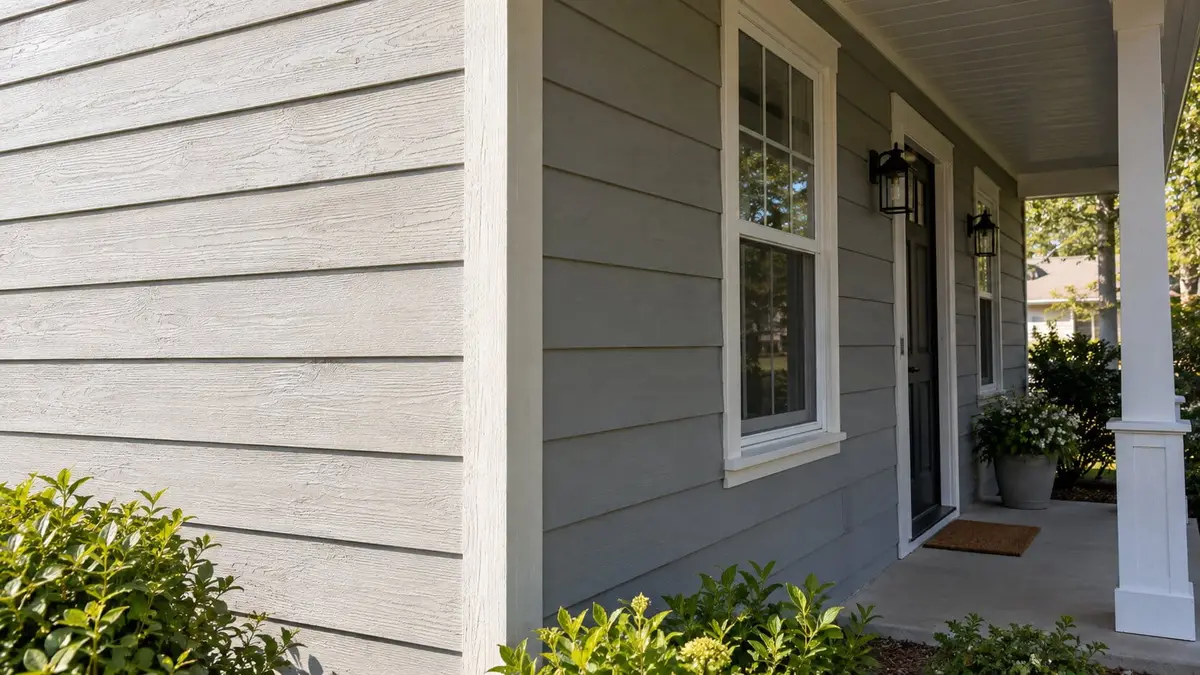
From the yard, pale siding may look like one simple repaint. Close up, it could be actual color loss, weathered paint that sheds powder, dirt sitting on top, or a coating that no longer protects the material beneath. Each asks for a different preparation plan.
A fresh coat works only if it bonds to what remains. That means identifying the material, checking for damage and moisture, cleaning within the siding maker’s limits, and verifying the proposed coating system. The first inspection can be done with photographs from stable ground; destructive testing belongs later, after hazards are resolved.
Is the color fading, the paint turning to powder, or something on top?
Color loss and loose coating powder are different observations
Fading is a color change. Chalking is powder released as the coating weathers; that powder can itself make a surface look lighter. Sherwin-Williams distinguishes fading from chalking. A sun-facing wall and a protected strip under an overhang may look different, but that comparison does not prove the remaining film adheres.
From a safe ground-level position, photograph the whole elevation, then a protected and exposed area. Record whether the change is even, follows runoff, or includes bare spots and lifting edges. Powder already on a previously touched sill or runoff path is a clue; do not rub suspect old paint with bare hands to run a chalk test. Sherwin-Williams’ chalking guidance describes weathered powder and the need to remove it before recoating.
| What you see | Possible explanation | What it cannot prove | Next question |
|---|---|---|---|
| Even lighter color on exposed wall | Fading, perhaps with chalk | Coating adhesion | Is the film continuous and sound? |
| Loose powder or wash-down streaks | Chalking or deposited residue | Identity of every white deposit | What remains after material-safe cleaning? |
| Flaking edges, exposed base or patchy erosion | Coating failure or damaged material | That washing alone will fix it | Is the substrate sound? |
| Crystalline deposits at masonry joints | Salt deposits linked to moisture | Exact water source | Why do deposits recur? |
Dirt, growth and mineral deposits can resemble weathered paint
Dark or green spotting may be dirt or growth; white on masonry may be efflorescence, a salt deposit linked to moisture movement. Color cannot identify mold, coating chemistry, asbestos or lead. Several conditions can occur on the same wall.
Uniform fading with a continuous sound-looking film can be planned as a coating project. Recurring wet patches, peeling, soft wood or crumbling masonry change the order: investigate and repair first. A cleaner surface is not automatically a paintable one.
What must you check before disturbing old exterior paint?
Gather the house age, siding records, previous paint labels, warranty information and any known lead or asbestos assessments. Photograph defects, joints, runoff paths and nearby gutter or window clues from stable ground. Note when a stain reappears after rain. Do not climb a ladder or roof, probe a weak area, or work around overhead wires for this check.
A pre-1978 home may have lead-based paint, including layers hidden under later coats. EPA’s DIY lead guidance explains the risk of scraping and sanding and recommends a lead-safe certified contractor for work on older painted surfaces. For applicable covered paid renovation, the federal RRP program requires certification; a homeowner’s own work has different federal treatment, and state or local rules may add requirements. A qualified lead-safe professional should determine how the planned preparation will be handled before anyone disturbs old paint. Our pre-1978 painting guide covers that decision.
Older, unidentified cement-like siding raises another question. EPA says appearance alone cannot identify asbestos. Do not break off a sample or treat a photo as confirmation. Have a trained, accredited asbestos professional assess suspected material before disturbance. An exterior painter can then plan around the documented material and any applicable restrictions.
Does the wall need repairs before it needs paint?
Separate coating failure from material failure
A painter should identify where old paint remains sound, where it is loose, and what bare material lies underneath. A coat over weak paint will depend on that weak layer. Bare wood adds its own challenge: USDA Forest Products Laboratory research describes how weathered wood fibers can become a poor base even after surface dirt is gone. That is a material-preparation issue, not just a paint-brand choice.
Swollen or deteriorated engineered wood, a soft board, a crumbling edge or a badly corroded metal section needs material assessment. Primer cannot restore lost structural material. Ask a siding carpenter or appropriate material specialist what can be repaired and what actually needs replacement. Limited damage does not prove the entire elevation must be replaced.
Resolve recurrent wetting and deposits
Photograph repeated blistering, dampness or crystalline deposits and note nearby joints, gutters, windows and roof runoff. Do not open a wall or infer the hidden path from a stain alone. Recurring efflorescence calls for a masonry or building-envelope assessment of moisture before paint goes on.
EPA’s moisture guide emphasizes fixing the moisture source and cleaning and drying affected material rather than painting over growth. That household guide does not give a universal exterior cleaning recipe or an outdoor DIY area threshold. If hidden growth or significant water damage is suspected, have a qualified professional assess the material and water source first. Repeated paint bubbles are another reason to investigate moisture rather than add coats.
How should chalky siding be cleaned before repainting?
First identify the siding and its current finish. Read the siding maker’s care instructions and the proposed coating’s preparation instructions together. Dirt, grease, growth and chalk do not necessarily use the same cleaner. A cleaning contractor should specify what will be used, how openings and adjacent materials will be protected, and how loosened material and runoff will be controlled.
A useful manufacturer conflict illustrates the point. Some generic paint guidance allows power washing. James Hardie advises a low-pressure hose and nonmetal soft brush for its siding and trim, and warns against high-pressure washing and abrasive tools. That restriction applies to its products; it is not a universal technique for every cladding. When siding and coating directions differ, ask both manufacturers before work proceeds. Do not pick a pressure setting from a general painting article.
The wash has to remove the unwanted material and be rinsed according to the relevant instructions; cleaner or loosened chalk cannot simply dry back onto the wall. Then inspect after the surface has dried. The wet wall may look darker and cleaner while hiding persistent powder, loose paint or moisture. Cleaning cannot prove adhesion, dryness, sound wood or topcoat compatibility.
If substantial powder persists or cleaning starts to damage the film, stop escalating force. A painter and coating manufacturer should decide whether more coating removal or another approved system is needed. There is no universal cloth-test amount of chalk that every primer can accept.
Which repairs, primer and topcoat belong on each material?
A primer has a job: promote adhesion, treat a bare or porous area, control a stain, or—only when the named product allows it—bind limited residual chalk. “Bonding primer everywhere” is not a material assessment. A self-priming topcoat still needs its specified preparation.
| Material | Condition to separate | Question for the painter and maker |
|---|---|---|
| Wood or engineered wood | Sound painted area versus weathered bare fiber or swollen board | What material repair and bare-area primer are specified? |
| Fiber cement | Factory finish versus field paint, exposed edge or repair | What cleaning and coating does this siding maker allow? |
| Metal | Intact factory coating versus bare metal or rusting steel | Which metal-specific preparation and primer apply? |
| Vinyl | Sound panel versus pitted or porous area | Are this coating and color approved for the siding? |
| Masonry or stucco | Sound paint versus salts or a fresh patch | Are moisture, porosity and patch requirements resolved? |
A Benjamin Moore exterior paint sheet shows why the branches matter: it calls for contaminant removal and varies primer guidance by surface. The reviewed October 2025 sheet is an example, not a specification for your house; verify the current label and technical sheet before choosing a system. Benjamin Moore’s vinyl guidance also distinguishes sound vinyl from pitted areas and directs readers to siding-maker requirements. A dark color that absorbs more heat can be a compatibility issue; do not choose it from a paint chip alone.
A specific Sherwin-Williams Loxon conditioner sheet permits binding light chalk after prescribed preparation on listed cementitious surfaces, including masonry, stucco and fiber cement. It prohibits heavy chalk and damp surfaces. This 2021 sheet is not approval for wood, vinyl or metal and is not a general “little chalk is fine” rule. Confirm the current sheet and the intended full system.
No primer repairs rot, an active leak or unsound layers. The painter should identify each primer location and why it is used, rather than naming one can for every wall.
When is the prepared surface ready for paint?
Before an application date is set, ask for a visible answer to each condition: repaired material; remaining paint judged sound; incompatible residue removed; moisture cause corrected; cleaning residue rinsed away; and a compatible primer/topcoat system identified. If one item is unresolved, pause that elevation rather than burying it.
Dryness depends on the substrate, weather and selected product. “Washed yesterday” is not a measurement. If the chosen system requires a moisture check, ask what method and specification apply. No national wait of a fixed number of hours or single moisture percentage covers wood, vinyl and masonry.
Check the actual product limits for air and surface temperature, sun exposure, humidity, dew, forecast rain and recoat windows. A paint advertised as rain-ready after application does not authorize painting a wet wall. If weather delays the job, inspect again for new dirt or moisture before coating. Record products, repairs, conditions and treated areas; no exterior system is guaranteed fade-proof.
What should an exterior painting quote show?
An exterior painter should list each elevation and material, the permitted cleaning method, how persistent chalk and loose coating will be handled, repairs and exclusions, primer locations and purpose, and the named coating system. Ask how dryness and compatibility will be verified and what happens if cleaning reveals more damage. Comparing painting quotes becomes easier when both bidders describe the same surface conditions.
A siding carpenter, mason or building-envelope specialist should assess damaged boards, masonry or water entry before the painter covers them. Hazard assessment is a separate handoff where old paint or suspect siding would be disturbed. Ask who coordinates the sequence and who documents the surface before it disappears under paint.
No reliable national price or repaint interval applies to every chalky or faded exterior. Price depends on the extent of preparation, damaged-material repair, access, containment, disposal, substrate mix and elevations included. A quote promising adhesion over unspecified chalk, pressure-washing every material alike or priming over recurring wetness needs a revised scope. Extensive replacement without documented material damage deserves another assessment.
Frequently asked questions
Will repainting siding remove chalk streaks from the brick below?
No. Repainting the siding does not clean deposits already on brick. Sherwin-Williams notes chalk can run down onto lower surfaces; the brick needs material-appropriate assessment and cleaning. If its white marks are crystalline and keep returning, have a masonry specialist check moisture before treating them as paint chalk.
Will the original color code match a faded wall for a small touch-up?
Not necessarily. The original formula describes the original color, while exposed paint may have changed. Compare an actual sample on the elevation after preparation and drying; a visible edge may remain. Ask whether a larger natural break offers a better boundary than a small isolated patch.
Should every siding lap joint be caulked during prep?
No universal rule covers every siding system. Sherwin-Williams’ surface-preparation FAQ raises the lap-joint question, but the siding maker’s drainage and joint details control the work. Ask which openings are meant to be sealed and which must remain able to drain; indiscriminate caulk can hide a water problem.
Does a lifetime exterior-paint warranty cover fading and repainting labor?
Read the specific warranty. Benjamin Moore’s AURA Exterior warranty names covered failures and a product-replacement remedy while excluding application labor. That is one example, not the terms of every paint. Ask the bidder to identify the chosen product’s coverage, exclusions and required preparation in writing.
Sources
- Sherwin-Williams — How to Fix Exterior Paint Chalking
- Sherwin-Williams — Fading
- Sherwin-Williams — How to Fix Efflorescence
- James Hardie — Tips for Cleaning Your Siding
- EPA — Lead-Safe Renovations for DIYers
- EPA — Protect Your Family from Exposures to Asbestos
- USDA Forest Products Laboratory — Testing Painted Wood
- EPA — A Brief Guide to Mold, Moisture and Your Home
- Benjamin Moore — Element Guard 763 U.S. Technical Data Sheet
- Benjamin Moore — Painting Vinyl Siding and Trim
- Sherwin-Williams — Loxon Acrylic Conditioner Data Sheet
- Sherwin-Williams — Exterior Surface Preparation FAQs
- Benjamin Moore — AURA Exterior Lifetime Warranty