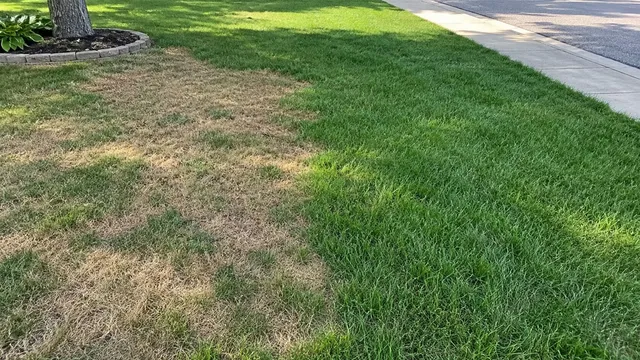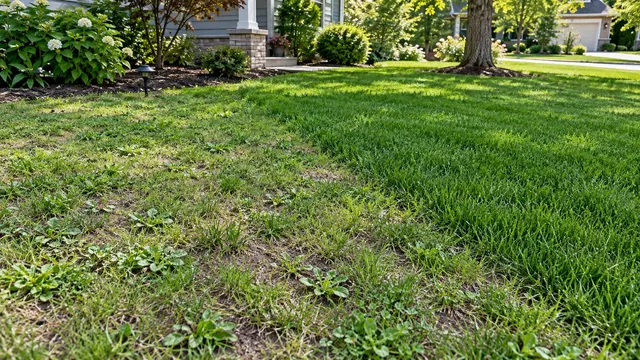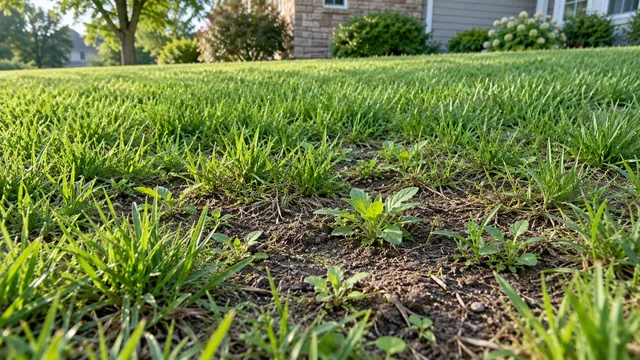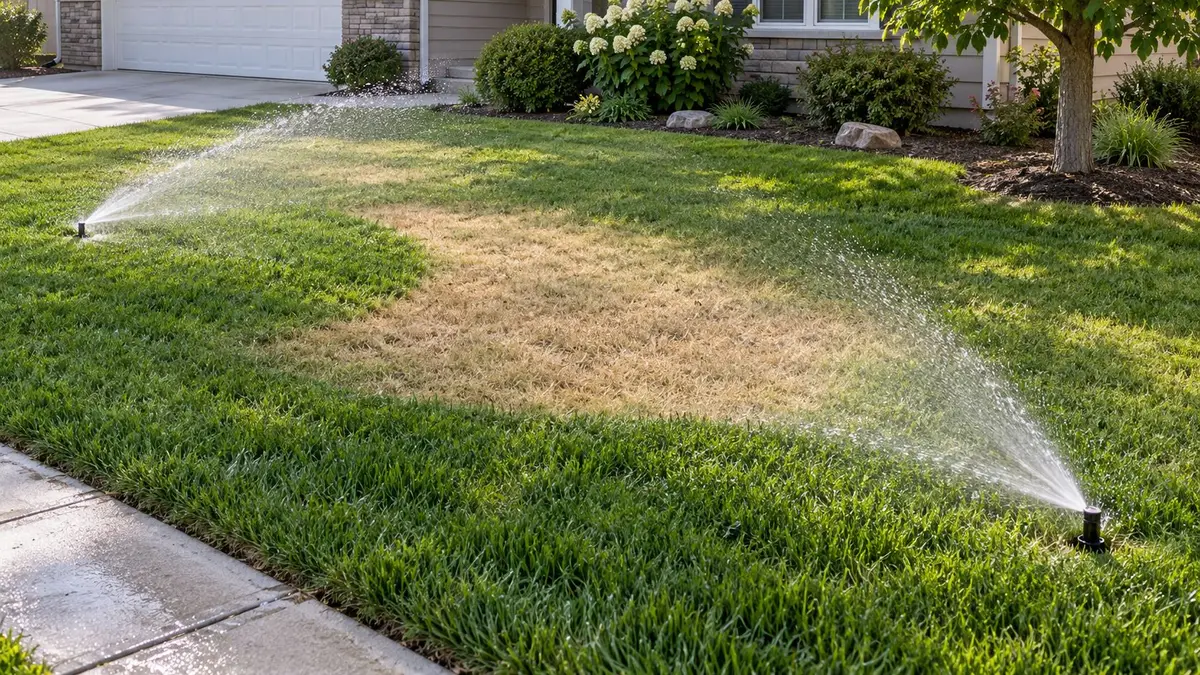
The controller finishes its cycle, yet the same corner stays brown. Extra minutes may soak the green lawn while barely helping that corner. Colorado State University Extension says uneven coverage is the most common brown-spot issue it sees in irrigation audits; a running system can look uniform when it is not.
Start with the shape of the dry area and a daylight view of its zone. Then catch the water where the grass is green and where it is brown. Those observations separate a head-level fault from a zone or soil problem before you pay for a repair.
Price depends on diagnosis, access, parts and whether this is a repair or redesign. A commercial LawnStarter guide updated in December 2025 gives a $130–$360 typical national repair range and $250 average. Local quotes can differ substantially; the measured cause matters more than that example.
What does the dry spot’s shape say about sprinkler coverage?
Run the affected zone manually in daylight and mark which heads surround the patch. EPA WaterSense’s sprinkler inspection guidance calls out heads that fail to pop up, tilt or miss head-to-head coverage—each head’s spray reaching the next one. Use the pattern as a starting clue, then verify it with cups.
| Pattern | Likely direction | First safe observation |
|---|---|---|
| Green ring around a head, brown beyond | Sunken head spraying into nearby grass | Watch its height while running. |
| Dry wedge from one head | Blocked, tilted or stalled head | Compare its spray shape with a matching neighbor. |
| Dry scallops between heads | Lost head-to-head overlap | Watch whether each spray reaches the next head. |
| Whole zone weak | Flow or low working pressure | Look for heads that barely pop up and any visible leak. |
| Fine mist from many heads | High working pressure | Note fog and drift in calm weather. |
| One zone both soggy and dry | Mixed head rates, slope or leak | Identify head types and wet spots. |
| Sharp-edged patch unrelated to heads | Soil, buried debris or turf problem | Compare cup depths first. |
| Dry strip by pavement | Coverage, soil depth or localized heat | Test water delivery rather than assume one cause. |
Folded blades, a blue-gray cast and footprints that remain visible are drought-stress signs in UF/IFAS lawn watering guidance. They show stress, not why that piece of turf is short of water.
What should you watch at a single sprinkler head?
Look while the zone runs; turn it off before touching anything. A head sunk into the lawn may wet a green circle nearby but fail to throw beyond it. Utah State University Extension notes that tilted heads, tall grass, shrubs or edging can also interrupt the pattern. A clogged nozzle or screen can shorten one spray, while a missing or broken nozzle can gush enough water to weaken other heads on the zone.
Compare the suspect head to another of the same type. Does it rise fully, stand straight, turn if it is a rotor, and throw where the design expects? Clear vegetation from the spray path. For a nozzle or screen, follow that model’s cleaning or replacement instructions with the zone off, using a matching part. If straightening or raising the head requires digging, contact your state 811 center first; shallow digging still counts, and private lines may require a separate locator.
A rotor that stops turning can leave a dry wedge. Replacement or a contractor assessment is more sensible than opening its internal drive. Recheck the area after a repair with the same cup placement, since visible spray alone does not prove uniform watering.
Why is grass dry between heads or at a spray’s edge?
Heads normally overlap; a head that no longer reaches its neighbor leaves a scalloped dry strip between them. One cause is a radius screw turned down too far to avoid a path or driveway. Colorado State’s sprinkler-type guide says spray nozzles can generally be turned down by about 30% before their pattern distorts. That is general guidance; check the manufacturer instructions for your nozzle. Don’t keep shortening it to solve overspray.
Low pressure, an obstruction or spacing that was too wide from installation can make the same gap. A random replacement nozzle can change the rate or reach of just one head. An irrigation contractor should assess whether the fix is a matched nozzle, a pressure repair or added heads. Running the zone longer cannot make a spray reach a gap outside its radius.
Is the problem low pressure or too much pressure?
Low working pressure makes heads rise poorly and spray fall short. Inspect for a broken gushing head, soggy or bubbling soil along a line, and whether every head on the zone is weak. Note if performance changes at a different permitted watering time. Those clues help a contractor find a leak, flow restriction or valve issue. Do not adjust a backflow assembly, main regulator or controller wiring yourself.
High pressure looks almost opposite: a fine mist or fog around spray heads, with droplets drifting in light wind. A 2020 EPA WaterSense technical report says most spray sprinklers are rated around 30–45 psi and that high pressure can cause misting, overspray and uneven coverage. Colorado State gives typical ranges of about 30–40 psi for pop-up sprays and 40–50 psi for rotors. These are equipment examples, not a pressure target for your entire system. A contractor should compare measured working pressure with the installed heads’ specifications.
Slope complicates a zone: Colorado State notes that more than about eight vertical feet of elevation change can make lower heads run at noticeably higher pressure while upper heads fall short. If a zone mists below and dries above, report that pattern. Pressure-regulating bodies or another design change may help after measurement. Check local rules for contractor licensing and backflow testing; they vary by state and water provider.
Can mixed sprays and rotors leave half a zone dry?
Yes. Precipitation rate means the depth of water a head applies in an hour. Colorado State gives broad rules of thumb: pop-up sprays apply roughly 1–2½ inches per hour, while rotors apply roughly ¼–¾ inch per hour. Actual nozzles vary. Put both on one zone, and a run time that suits the spray area can leave the rotor area dry; lengthening it may waterlog the sprays. Colorado State advises against mixing those types in a zone.
Look for mismatched head types after a past repair or new landscaping. Even changing one spray to a stream-rotor nozzle changes its application rate. An irrigation contractor can identify head types, rates and whether they should be separated or matched. The solution is a zone design decision, not a longer timer setting.
How do you prove the brown area gets less water?
Use Colorado State’s simple green-versus-brown catch test. It screens the zone; it is not a certified irrigation audit.
- Fix an obvious broken or blocked head first. On a calm day, place 5–10 identical, level, straight-sided containers around one zone. Put some in green grass and some in brown grass, a few feet from heads rather than beside a nozzle.
- Run a normal cycle, or about 15–20 minutes. Note whether any heads stall, mist, tilt or leak while the system runs.
- Use a ruler to measure depth in each cup. Compare the green-area group with the brown-area group. Colorado State’s example of 0.2 inch in green grass versus 0.1 inch in brown means the green area received twice as much.
- If the brown area receives clearly less, correct the head, overlap, pressure or head-type issue and repeat the test. If depths are similar, leave the timer alone and investigate soil or turf conditions.
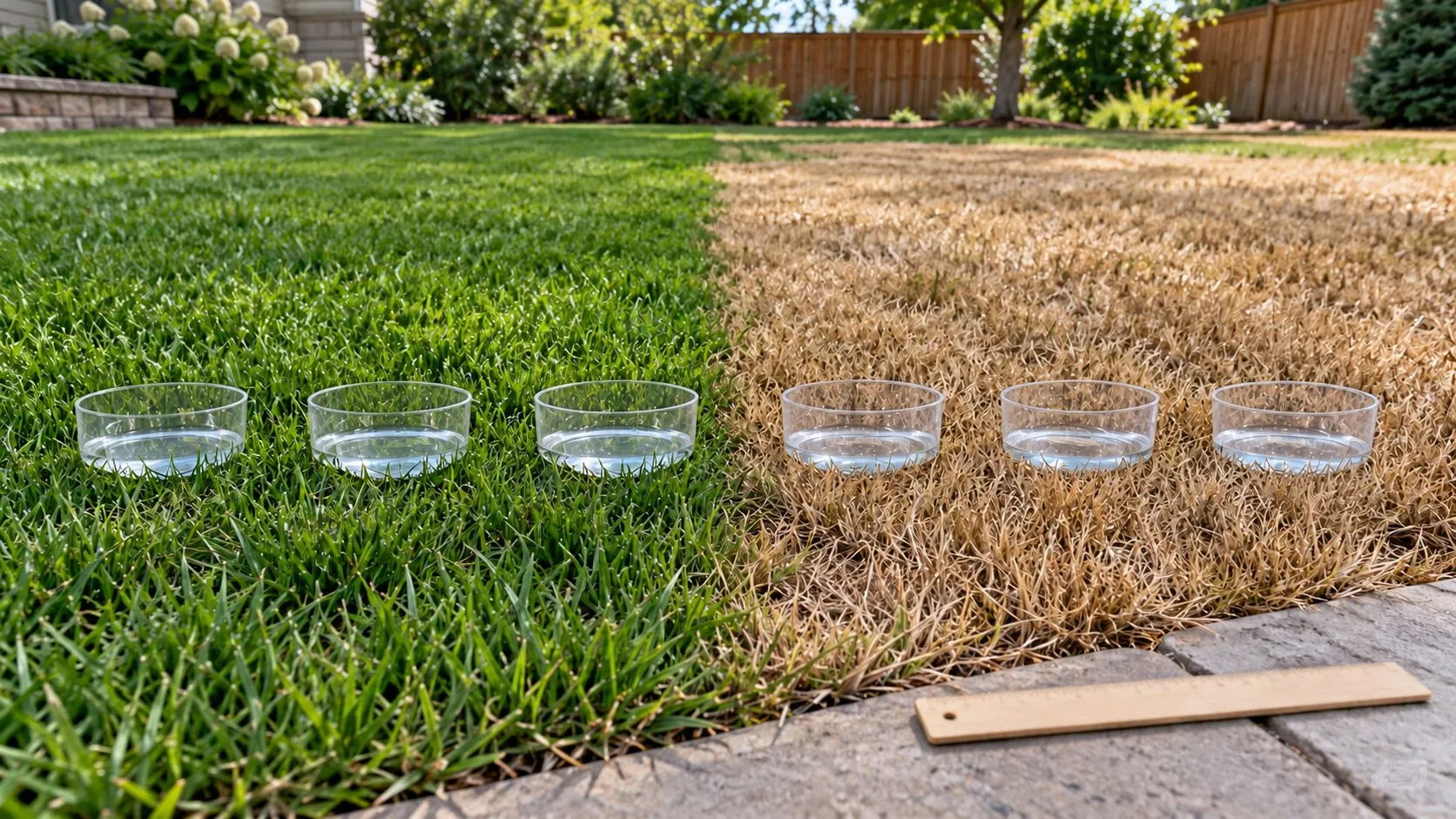
Compare the water depth in each group; the photograph alone does not establish a delivery difference.
Do not lengthen all run times to compensate for a gap. Oklahoma State Extension’s home-lawn audit illustrates the tradeoff: when one area gets half an inch per hour and another a quarter inch, watering long enough for the dry area doubles what the first receives. Professionals may use many more cups and calculate distribution uniformity; you need only a clear comparison to decide the next step.
What if the cups show similar water in green and brown grass?
Then a sprinkler repair is less likely to solve the patch. South Dakota State Extension explains that thick, dried thatch can repel water or keep it from entering the soil. A small turf wedge can reveal it; core aeration versus dethatching walks through the checks. Soil that is compacted or very shallow may shed water even when the surface catches enough. For a low area that stays soggy, see why a yard remains muddy after rain.
University of Maryland Extension notes that buried debris can limit rooting, with damage following the object’s shape. A shallow screwdriver probe is a clue, not permission to excavate without 811. If delivery is even and soil checks don’t explain it, the brown-patches guide covers insects, disease and other look-alikes. On recently installed turf, see why new sod browns and will not root.
What should an irrigation repair quote include?
Tell an irrigation contractor the zone number, dry-area shape, cup depths, head behavior, run time and recent repairs or landscaping. Ask them to measure working pressure, identify all head types and check spacing, leaks and valve operation. An irrigation auditor can perform a fuller catch-can test; EPA WaterSense-labeled professional certifications are one way to find one.
Ask for separate diagnostic labor, parts by type, number of heads, valve or pipe work, trench and sod restoration, and a post-repair coverage test. A whole-system replacement based only on one brown patch deserves another opinion. If a leak coincides with a sudden bill increase, the high-water-bill guide helps separate irrigation use from an indoor leak.
Inspect each zone at spring start-up and roughly monthly while it runs. Recheck after edging, aeration, sod installation or bed changes that can bury or tilt a head. Keep watering times within your provider’s current rules and use matching replacement nozzles so the next repair does not create a new dry corner.
Frequently asked questions
Why is grass green near my head but brown farther away?
The head may be sunken, so nearby grass gets water while the spray never clears it. Watch its height during a cycle, then confirm the difference with cups. A contractor can raise or replace it if buried lines or hardware make the repair more involved.
Should I increase the zone time for one dry spot?
First compare water depths in green and brown areas. A coverage gap means added minutes overwater the spots already receiving enough. Correct the delivery pattern before adjusting the schedule.
Can I put a rotor on a spray-head zone to reach a corner?
That usually creates a rate mismatch. Colorado State’s broad ranges show sprays applying water much faster than rotors. Ask an irrigation contractor to match heads or redesign the zone.
Does fine mist mean pressure is too high or too low?
Fine fog around spray heads is a high-pressure clue, according to EPA and Colorado State. Low pressure more often leaves heads barely rising and throws falling short. A contractor should measure working pressure against the installed heads’ ratings.
Why did a system that worked for years develop dry spots?
Heads can tilt, sink, clog or be damaged by winter and landscape work. A replacement nozzle may be the wrong type, and changing demand can affect pressure. Walk the zone and compare cups before assuming the whole system needs replacing.
How do I tell a sprinkler problem from grubs?
If identical cups show less water in the brown area, correct coverage first. If they collect similar amounts, inspect soil and roots and use the brown-patches guide to check insect and disease clues before treatment.
Sources
- U.S. EPA WaterSense — Sprinkler Spruce-Up
- U.S. EPA WaterSense — Relieve Pressure and Reduce Water Waste From Spray Sprinklers
- Colorado State University Extension — Sprinkler Types Used for Lawn Irrigation
- Colorado State University Extension — Lawn Irrigation Audit Tutorial
- Utah State University Extension — Irrigation System Maintenance
- University of Florida IFAS Extension — Watering Your Florida Lawn
- Oklahoma State University Extension — Simple Irrigation Audit for Home Lawns
- South Dakota State University Extension — Understanding Thatch in Turf
- University of Maryland Extension — Lawn Problems Not Caused by Pests or Diseases
- 811 — 811 Before You Dig
- LawnStarter — How Much Does Sprinkler Repair Cost in 2026?