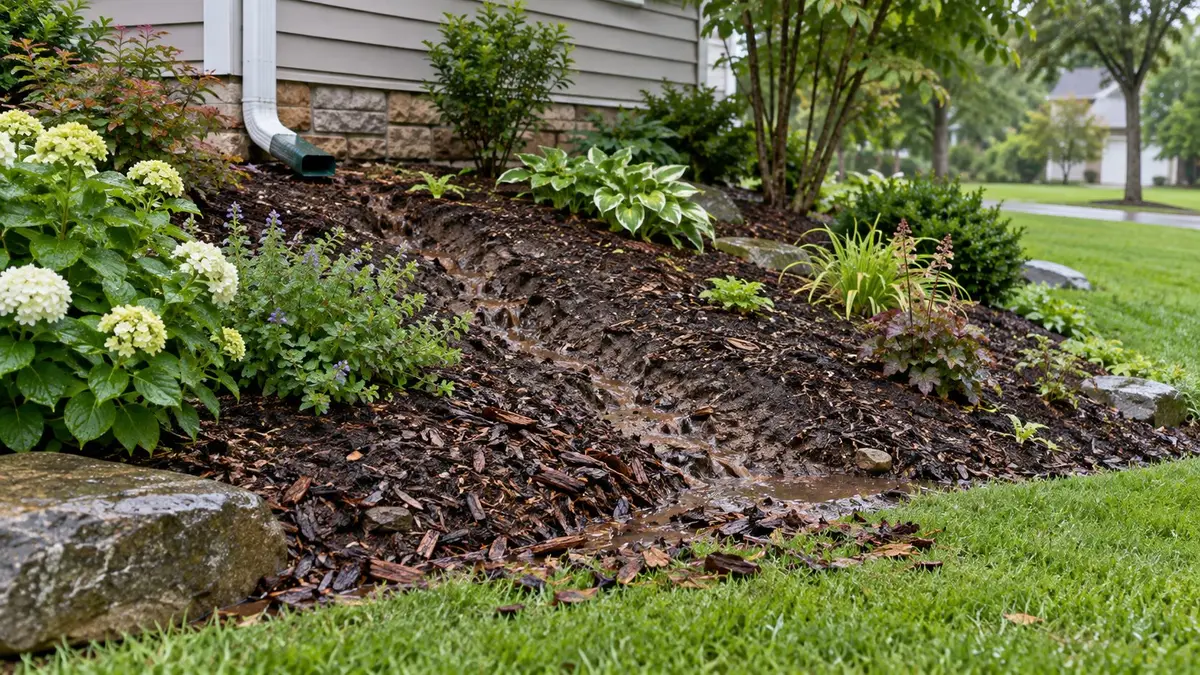
Mulch in the driveway after every storm is a water-path problem first. The same flow may be coming from one downspout, a roof edge, a patio or the lawn uphill. Replacing the material without changing that path means buying it again.
Observe one rain from a safe place. Where does water enter the bed, does it spread or cut a channel, and where does it leave? Date photos taken during and after the storm. University of Maryland Extension recommends documenting runoff paths, especially when nearby work or a neighbor’s drainage may be involved.
No reliable national cost range was found for bed erosion work. A splash block, planted slope, buried drain and engineered wall have different scopes; access, outlets, permits and regional labor can dominate a quote. First determine which problem needs fixing.
How do you find the cause when mulch and soil wash away?
Stay indoors during lightning. When weather is safe, observe from stable level ground; do not walk a shifting slope. From a safe spot, note the entry point, whether water arrives as a sheet or stream, and the exit or deposit area. Afterward, look for splash marks, exposed soil, fan-shaped mulch piles and repeated small grooves. If every washout begins under the same downspout, the outlet is more important than the mulch label.
| Damage pattern | Likely water path | First decision |
|---|---|---|
| Crater under a downspout | Concentrated roof discharge | Find a stable, permitted outlet. |
| Bare line below roof edge, soil on siding | Roof drip or overflowing gutter | Ask a gutter contractor about capture and discharge. |
| Nuggets scattered downhill | Sheet flow plus floating material | Reduce flow, then select mulch and cover. |
| Same little channel after each storm | Water concentrating on slope | Slow and spread it; protect bare soil. |
| Mulch onto walk or driveway | Bed edge too low or hardscape flow crossing bed | Check edge level and flow direction. |
| New washout at lot line | Upstream grade or drainage change | Document and check easements and local rules. |
This table points to a first check, not a diagnosis of slope stability. If rainwater is exposing a buried line or undermining a surface, stop using the area and call the relevant utility or engineer.
When is washout more than a mulch problem?
Soil loss beside a foundation can contribute to water problems near the house. A void, persistent ponding or water entering a basement calls for a drainage or foundation professional. Photograph the flow path for that assessment; Do not dig at the foundation to “see how deep it goes.”
A retaining wall that leans, bulges or loses soil from behind it needs assessment by a civil or geotechnical engineer. Keep people and pets away from the wall and its base. New York State emergency management also lists new ground cracks or bulges, unexpected springs or seeps, tilting decks, displaced fences or trees, and sticking doors or windows as signs of possible ground movement. A geotechnical engineer or local officials must assess a slope with those signs; follow emergency guidance if movement is active. Do not climb it or excavate the base.
If the washout affects a septic drain field, ask a septic professional or local health department before redirecting water. All digging for a trench, swale, planting or wall should begin with your state 811 center and its required notice. Private lines may need additional locating.
How much water can a roof send to one bed?
University of Nebraska–Lincoln Extension estimates about 0.6 gallons for each square foot of roof for every inch of rain. Multiply the roof area draining toward your bed by that rate to see why a small patch can be overwhelmed. The exact share carried by one downspout depends on roof layout; do not assume a whole-roof total arrives at every outlet.
A splash block or extension can move the discharge to a stable planted or gravel area, but it does not make the water disappear. Check its next destination: a wall, steep slope, foundation, septic area, hardscape or neighbor’s lot. Nebraska advises against sending overflow onto impermeable surfaces and notes that gravel below an overflow can reduce erosion. For a roof edge without gutters, a stable splash strip may help; a gutter contractor should assess gutter installation or overflow.
Rules are local. As an example, Portland, Oregon’s downspout-disconnection guidance requires discharge at least six feet from a basement, two feet from a crawl-space or slab foundation, five feet from a neighbor’s property line, and ten feet from a retaining wall; it disallows disconnection on slopes over 10%. Those are Portland’s rules, not a national setback. Check your municipality before changing a storm-pipe connection or burying a discharge line.
How can you slow water and cover exposed soil?
After the water source is addressed, keep the bed surface below its edging rather than mounding mulch above it. Dense, suitable plant cover is the longer-term stabilizer; exposed soil between new plants remains vulnerable, especially on slopes. University of Maryland Extension suggests temporary biodegradable barriers such as untreated burlap while groundcovers establish. It describes loose organic mulch as more suitable for fairly level sites.
On a stable slope, Iowa State Extension discusses jute, coir, burlap and straw erosion blankets, pinned right after planting. Some straw products use polypropylene mesh that degrades under UV over a product-dependent three to 24 months. Ask whether a natural-fiber option fits your plants and maintenance. Keep existing vegetation where practical; stripping the whole slope removes roots that already hold soil.
If a shaded tree bed is eroding because turf never held there, the under-tree landscape guide helps choose a tree-safe cover. Avoid piling soil on roots during slope repairs; tree decline after construction explains why grade changes deserve caution. For a thin sunny lawn above a bed, the overseed-or-renovate decision addresses the turf feeding runoff.
Which mulch is less likely to wash away?
Clemson Extension says pine straw interlocks and tends to stay on a slope better than many mulches, while large pine-bark nuggets can float in heavy rain. Iowa State favors shredded bark over chips or river rock on hillsides. University of Georgia Extension also suggests pine straw or finely shredded wood on steep slopes. None of them will reliably stop a concentrated stream from a downspout.
| Material | Likely behavior in moving water |
|---|---|
| Pine straw | Interlocks and tends to stay on moderate slopes. |
| Finely shredded wood or bark | Holds together better than large chips. |
| Large bark nuggets | May float during heavy rain. |
| Loose chips or river rock | Can migrate downhill; rock is not an automatic cure. |
For ordinary beds, Clemson gives about two to three inches for fine mulch and up to four for coarser material. More depth does not stop concentrated flow. Keep mulch away from stems and roughly six to twelve inches from building walls per Clemson’s termite-related guidance. Washington State University Extension cautions against landscape fabric beneath organic mulch in permanent beds: organic matter accumulates above it, roots grow into it and the fabric degrades. It is not a proven washout cure.
Is the slope steep enough to need a landscape contractor?
On a stable, walkable area, slope percentage can be estimated by measuring vertical drop over a level horizontal distance. A 100-inch horizontal run makes each inch of drop equal one percent, as Nebraska’s rain-garden guide explains. Do not climb an unstable bank to take this measurement.
Iowa State treats slopes under about 5% as needing little special planning, 8–16% as needing slope-aware planting and 20% or more as needing specialized plantings. These are landscape guidance bands, not permit thresholds. The steeper the slope or the more concentrated the flow, the more valuable a landscape contractor’s plan becomes. Small terraces may slow flow, but Georgia Extension advises keeping DIY retaining walls to about a foot or two and hiring professionals for larger work.
The model 2021 International Residential Code provision reproduced by Grant County, Washington exempts walls not over four feet measured from the bottom of the footing to the top, unless they support a surcharge. A driveway, building or slope above can be a surcharge. Local jurisdictions amend and adopt codes differently and may require permits for lower walls. Ask the building department and a civil or geotechnical engineer before using that model text to plan a wall.
Would a rain garden, swale or buried drain solve it?
Only if it has a safe location and outlet. Nebraska’s rain-garden guidance places a rain garden at least ten feet from a house and 25 feet from a septic system, off slopes over 12%, and calls for a six-inch infiltration test hole that drains within 24 hours. Nebraska says to do that test in spring or the typical rainy season; dry, cracked summer or fall soil can give a false result. Use 811 and locate private lines before digging the test hole. A steep bed beside a foundation will fail several of those siting checks.
A swale or dry creek bed still sends water somewhere; a buried drain needs an outlet and digging. Maryland Extension warns that homeowner trenches, blocked pipes and downspout extensions can worsen runoff for adjacent land. The muddy-yard guide covers drainage assessment in more depth. Ask a drainage-focused landscape contractor where the water will end up in an intense storm, and have the location of buried utilities marked first.
What if runoff comes from or goes toward a neighbor?
Document the flow in photos and video, note recent construction or regrading, and check plats or HOA papers for drainage easements. Talk with the neighbor and ask municipal stormwater or code staff about local rules before creating a berm or rerouting a downspout. Maryland Extension describes a Maryland rule about upstream and downstream flow, but drainage law varies by state; do not assume the same rule applies at your property.
For a quote, supply the storm photos and ask the contractor to itemize area, materials, plants, excavation, soil disposal, outlet, restoration, and any engineering or permit work. Compare the main cost drivers:
| Cost driver | Why it moves the quote | What to ask |
|---|---|---|
| Water source and outlet | A surface discharge correction differs from a buried route. | Where will the water end up? |
| Slope, access and area | Hard-to-reach ground needs more labor and cover. | What area and materials are included? |
| Drain or wall work | Excavation, engineering, permits and restoration add scope. | Why is this needed after the roof and hardscape flow is addressed? |
Start by testing a safe downspout or bed-edge correction, then cover exposed soil and compare mulch. A wall or drain should follow a traced flow path, not be the first guess. Get another opinion if a large one is proposed without that evidence. After the repair, watch the next rain for erosion shifted elsewhere.
Frequently asked questions
Why does my mulch float away when a nearby bed stays put?
Material and water path can differ. Large bark nuggets may float, while pine straw or shredded mulch tends to interlock. A downspout or hardscape stream can move nearly any loose mulch, so compare flow before changing products.
Will landscape fabric stop organic mulch from washing out?
There is no good extension basis here for treating it as a washout fix. Washington State University Extension cautions that permanent fabric beds collect organic matter and weeds above the fabric while roots grow into it. Control flow and cover soil instead.
Is river rock better than mulch for a washing-out bed?
Not automatically. Iowa State notes river rock can migrate on slopes. It may be useful in a designed stable discharge area, but the flow path and outlet need to be addressed first.
How far should a downspout extension carry water?
Far enough to reach a safe discharge area under your local rules, without sending water to a wall, foundation, septic field, steep slope or neighbor. Portland’s distances are one city’s example, not a national rule. Ask municipal stormwater staff when the outlet is constrained.
Do I need a permit for a small retaining wall?
Possibly. The model IRC has a four-foot exemption measured from the footing bottom with a surcharge exception, but your jurisdiction may use different rules. Ask your building department before construction.
Can I fix a washed-out slope myself?
A stable, mild slope may respond to water-source correction, planting and a temporary biodegradable cover. A moving slope or leaning wall needs a civil or geotechnical engineer and local officials; a foundation-adjacent void needs a drainage or foundation contractor. Call the utility about exposed lines and keep clear of them.
Sources
- Clemson Cooperative Extension — Mulch
- University of Maryland Extension — Groundcovers
- Iowa State University Extension — Gardening on Slopes and Hillsides
- University of Georgia Extension — Tackle Erosion with Grasses, Landscape Plants and Terraces
- University of Nebraska–Lincoln Extension — Rainwater Harvesting with Rain Barrels
- University of Nebraska–Lincoln Extension — Rain Garden Design for Homeowners
- City of Portland — Downspout Disconnect
- University of Maryland Extension — Stormwater Runoff: What to Do When It Impacts You
- New York State Division of Homeland Security and Emergency Services — Landslide Warning Signs
- International Code Council — 2021 IRC Section R105 Permit Exemptions
- Washington State University Extension — The Myth of Landscape Fabric
- 811 — 811 Before You Dig