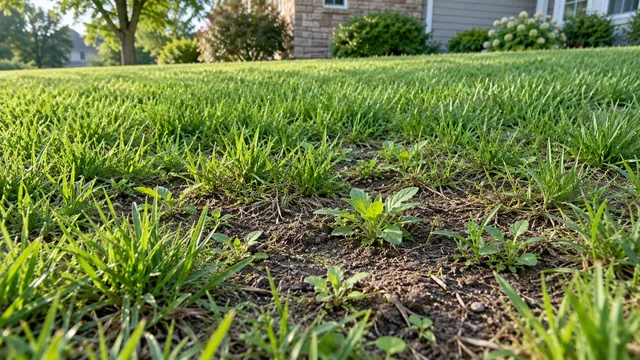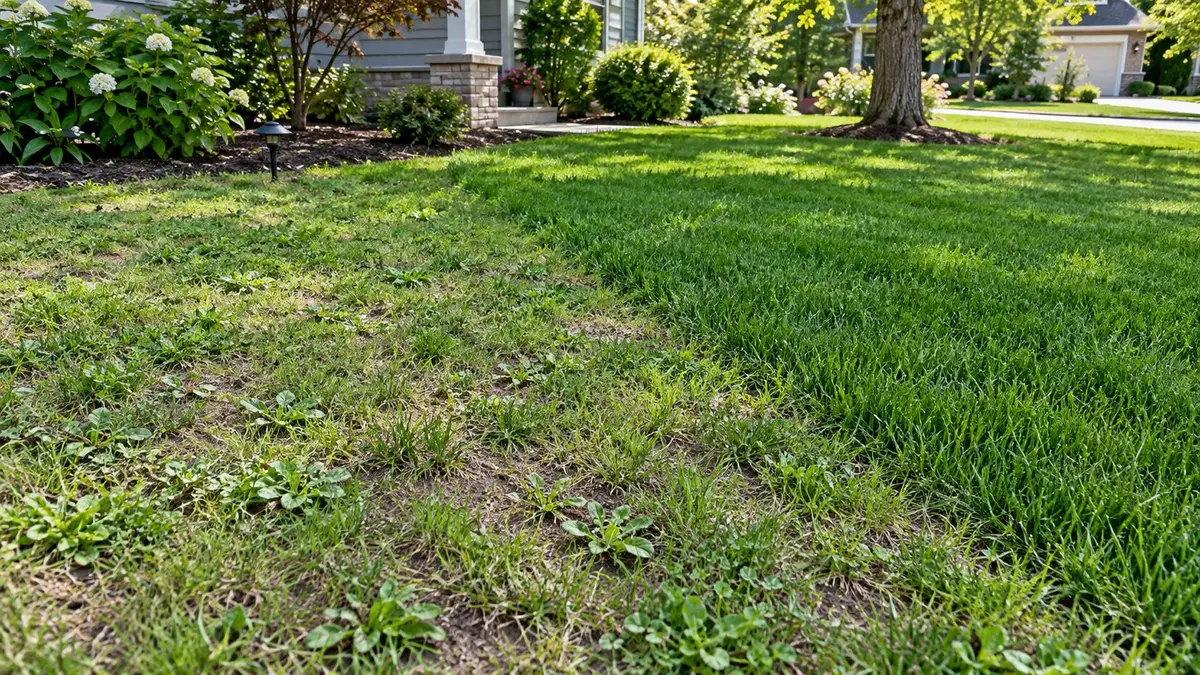
A lawn can look “half weeds” while enough useful grass remains to save. It can also look mostly green because perennial grassy weeds have taken over. The bag of seed is the last decision; first find why the desirable turf thinned.
Clemson Extension’s renovation guide starts with diagnosis. Seed under the same shade or on the same poorly draining soil can fail again. Map the yard in sections, identify what is growing, and select a method for each section instead of treating every square foot alike.
There is no dependable national price for overseeding versus full renovation. Area, soil prep, seed versus sod or plugs, drainage work, access and regional labor move the quote. The cheapest attempt can still waste a planting season if it ignores the cause.
Why did the lawn thin before weeds filled it?
Weeds commonly take open space in weak turf. University of Georgia Extension says they appear primarily in thin or bare areas caused by lawn-care or site problems. Spray alone does not put grass back there. Check mowing height, water coverage, shade, traffic, soil pH and fertility, insects, disease and thatch before deciding to seed.
| Pattern | Question before planting | Direction |
|---|---|---|
| Thin beneath trees | How many hours of direct summer sun? | Change species or make a bed if light is too low. |
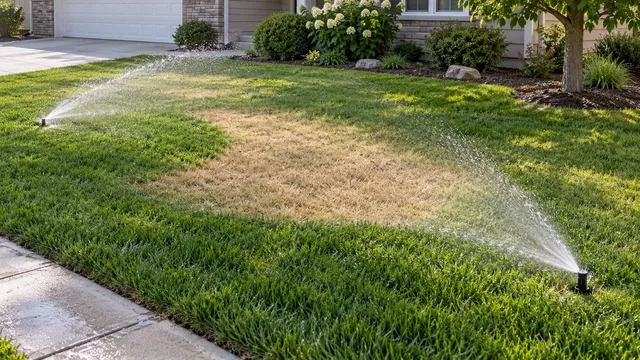
| Dry arcs in irrigated grass | Does that area receive less water? | Fix coverage before seed. |
| Thin path where people walk | Is moist soil compacted? | Address traffic and soil first. |
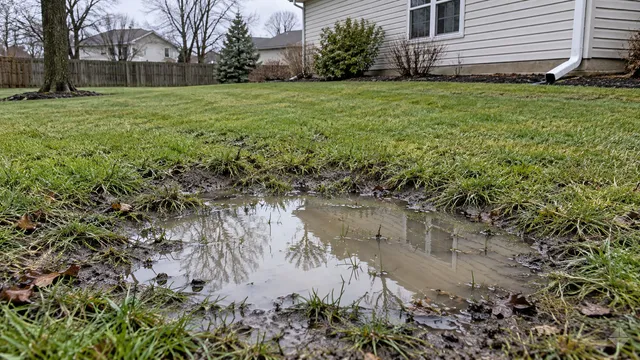
| Soggy low area | Does water linger after rain? | Have grade or drainage assessed. |
| Scattered bare spots | Did pests, disease or mowing cause loss? | Treat the confirmed cause, then repair. |
Penn State Extension recommends a soil test several weeks before renovation. A test tells you whether lime or nutrients are needed; a weed name alone cannot. A 1993 Rutgers renovation guide says renovation itself will not correct bad drainage, deep compaction, major grade defects or contaminated soil. Those need site work first. See sprinkler coverage checks, brown-patch diagnosis or a muddy-yard assessment when those patterns fit.
How much desirable grass is left?
Walk each yard zone in a zigzag during that grass’s active season. Stop about 50 times and mark what is under your toe: desirable grass, broadleaf weed, grassy weed or bare soil. With exactly 50 stops, multiply the desirable-grass count by two for a rough percent in that zone. This is a rough homeowner adaptation of University of Maryland Extension’s step-point cover method, which was developed for pasture rather than lawns. It helps you avoid judging only the worst patch. Photograph and sketch each zone.
Distinguish a dandelion or clover from off-type grass. Annual crabgrass returns from seed, while perennial quackgrass, nimblewill or creeping bentgrass survives from year to year. Iowa State Extension calls quackgrass and nimblewill particularly hard to control selectively. Have your county extension office identify them before you plan to spray or seed over a green-looking infestation.
The often-quoted 50% rule is a guideline, not a law of lawns. Penn State and Clemson favor overseeding when about half or more is desirable grass, with other conditions met. That 1993 Rutgers guide permits overseeding above about 30% desirable turf. The range reflects different renovation programs. Use the composition, cause and grass species to decide within it.
| Inventory and cause | More sensible path |
|---|---|
| Mostly desirable grass, scattered bare or broadleaf-weed areas | Improve care and overseed where needed. |
| Sound lawn with one failed strip or patch | Correct local cause and spot renovate. |
| Very little desired grass, or perennial grassy weeds throughout | Consider full renovation after identification. |
| Shade, wetness or grade makes turf unsuitable | Change the site or use less lawn before replanting. |
Virginia Cooperative Extension emphasizes that complete renovation is often unnecessary; problem spots of roughly 50–150 square feet can be repaired separately. A sunny front yard may need overseeding while the dark strip beneath a tree becomes a bed. The under-tree grass decision helps define that boundary.
What makes overseeding a poor bet even above 50% grass?
Perennial grassy weeds are a major override. Seed scattered over quackgrass or nimblewill does not remove them. Penn State and Purdue Extension put such lawns toward more complete renovation even when some desirable grass survives. Spot treatment may still be enough if the perennial patches are contained.
Heavy thatch is another barrier to seed-soil contact. Penn State and Purdue use more than roughly one-half inch as a threshold favoring renovation, while Rutgers uses about one inch to distinguish different removal approaches. Measure the fibrous layer, not the mixed soil mat; aeration versus dethatching explains the check. Do not treat one threshold as universal.
A grass suited to full sun will still struggle under a mature canopy, and a species needing frequent water may be a poor fit for a dry landscape. High traffic, grade and drainage can likewise undo a new lawn. For weeds that return despite treatment, the bare-space cause must change alongside the weed plan.
Can your grass type actually be overseeded?
Cool-season grasses—tall fescue, Kentucky bluegrass, ryegrass and fine fescue—are commonly repaired with seed in late summer to early fall. Spring is a second choice, but summer annual weeds compete with spring seedlings. Warm-season grasses establish during active spring or early-summer growth; a fall redo can meet winter before it roots. Local calendars shift with climate.
UF/IFAS establishment guidance separates species and propagation methods:
| Existing grass | Can you buy seed to match it? | Common repair route |
|---|---|---|
| St. Augustinegrass | No established seed method | Sod or plugs. |
| Zoysiagrass | Seed for only some cultivars | Usually sod, plugs or sprigs; confirm cultivar. |
| Common bermudagrass | Yes | Seed or vegetative material. |
| Hybrid bermudagrass | No viable hybrid seed | Sod, sprigs or plugs matching the lawn. |
| Centipedegrass or bahiagrass | Yes | Seed or locally appropriate sod or plugs. |
Clemson’s zoysia guide says seeded types exist but establishment can be slow and difficult. Its bermudagrass guide distinguishes seedable common bermuda from sterile-seeded hybrids. Identify the cultivar before buying a bag. In the South, Texas A&M AgriLife Extension notes that “overseeding” can mean ryegrass added to dormant bermuda for winter color; that is different from repairing a thin warm-season lawn.
How do you repair just the failed areas?
First fix the local cause. Clear a patch of persistent weeds by a method allowed locally, then prepare the surface so seed contacts soil. If good grass remains within it, Virginia Tech recommends a lower seeding rate than a bare renovation; use the seed label and local extension rate rather than scattering a full-bare-ground amount. Sod or plugs may fit a warm-season grass better than seed.
The patch needs establishment moisture and low traffic just like a whole lawn. A thin compost topdressing can help where local extension guidance supports it, but avoid piling soil over tree roots. If the failed area is a muddy depression, get drainage assessed before paying for new turf. An itemized spot-repair quote should name area, preparation, species, material quantity, watering plan and return visit.
What does successful overseeding require?
Seed must touch soil. Virginia Tech warns that broadcasting onto unprepared turf mostly feeds birds. Core aeration, slit seeding or suitable surface preparation can create contact. Read the seed tag for named cultivars, germination and weed-seed content. Match the mixture to your climate and sun rather than buying only by price.
Check all weed products already applied. Iowa State’s crabgrass guide says most pre-emergent herbicides also stop turfgrass seed germination; a spring application usually wears down by the late-summer seeding window, but check the actual product label. Rutgers turf specialists describe mesotrione and siduron products labeled for use at seeding as exceptions for some grasses. Do not choose one without checking species tolerance, local rules and the label.
Broadleaf sprays also impose waiting periods. Penn State gives roughly four weeks for some common mixtures; Rutgers gives at least two weeks in its program. Those are different recommendations, so the product label governs. The EPA’s pesticide-label guidance states that use inconsistent with labeling violates federal law. Keep children and pets out as directed on that label. Newly sown seed needs a consistently moist surface, then watering tapers as roots develop; ask local extension for timing suited to your weather and water rules.
What does starting over involve?
A full renovation removes or kills unwanted vegetation, waits for the chosen method to work, prepares a seedbed, applies soil-test amendments, then seeds or lays sod in the right season. Non-selective herbicides are one approach where allowed; physical removal or smothering may fit other sites. Waits differ by product and target weed: Purdue says at least three days for one glyphosate program, Iowa State says seven days after spot treatment, while Penn State advises confirming complete die-off, often 14–21 days. Follow the product label and local restrictions, not a universal countdown. Montgomery County, Maryland is one example of local private-lawn pesticide limits.
Kill-in-place can preserve soil structure; removing sod or tilling can address a heavy organic layer or grade but creates more disturbance and labor. Before excavation, locate buried lines under your state 811 process. Seed generally costs less material than sod but takes careful establishment; St. Augustine and hybrid bermuda require vegetative material. Once sod is chosen, new-sod browning and rooting checks help protect that installation.
A quote should separate soil test, weed control by product and visits, removal and disposal, aeration or seedbed preparation, seed or sod cultivar and quantity, irrigation work and follow-up. Ask what caused the decline and how the work fixes it. Seek another opinion for a full tear-out where only one zone failed, or for seeding scheduled immediately after a weed-preventer application.
When is changing the landscape better than another lawn?
Deep shade beneath a tree, a continually wet depression or a steep eroding bank may never support the turf you want. Keep grass where conditions allow and use a tree-safe mulch bed, path, suitable groundcover or drainage work elsewhere. A redo in unchanged conditions is a repeat of the first failure. For slope washout, see why mulch and soil keep washing away.
Frequently asked questions
Can I overseed without killing the weeds first?
Yes, if enough desirable grass remains and the weeds are mainly manageable broadleaf plants. Identify persistent grassy weeds first; seeding over them leaves the same competition. Prepare seed-to-soil contact and follow any herbicide label’s seeding interval.
I applied crabgrass preventer in spring. Can I still seed this year?
Often a spring pre-emergent has worn down by a late-summer cool-season seeding, Iowa State says, but products differ. Read the exact label and application date before buying seed. Most pre-emergents also prevent turfgrass germination.
What St. Augustine seed should I buy to thicken it?
None for an established St. Augustine lawn. UF/IFAS lists sod and plugs as its establishment methods. Fix why it thinned, then use matching vegetative material in the local warm-season window.
Can I seed zoysia or bermuda into thin spots?
Some zoysia cultivars have seed, but most repairs use sod, plugs or sprigs. Common bermuda can be seeded; hybrid bermuda cannot produce viable seed. Confirm the existing cultivar with your extension office before buying a different type.
Is seed or sod better when starting over?
It depends on species, timing, watering capacity and site preparation. Seed suits many cool-season lawns; sod supplies faster cover but still needs soil contact and establishment care. Compare quotes for the same prepared area and named grass cultivar.
How long after weed killer can I seed?
The product label sets the interval. Extension examples range from a few days after some non-selective treatments to several weeks while vegetation dies or after broadleaf treatment. Do not plant on a generic waiting rule.
Should I test soil before overseeding?
Yes. A state extension soil test can guide lime and nutrient decisions before either overseeding or renovation. Order it a few weeks before your planting window so there is time to act on the result.
Sources
- Penn State Extension — Renovation of Lawns
- Rutgers NJAES Cooperative Extension — Renovating Your Lawn
- Virginia Cooperative Extension — Cool Season Lawn Renovation
- Purdue University Extension — Lawn Improvement Programs
- Clemson Cooperative Extension — Lawn Renovation
- UF/IFAS Extension — Establishing Your Florida Lawn
- Iowa State University Extension — Control Perennial Grassy Weeds in the Lawn
- Iowa State University Extension — How to Control Crabgrass
- Rutgers Center for Turfgrass Science — Weed Control in Spring Seedings
- University of Georgia Cooperative Extension — Weed Control in Home Lawns
- U.S. EPA — Introduction to Pesticide Labels
- Clemson Cooperative Extension — Zoysiagrass
- Clemson Cooperative Extension — Bermudagrass
- University of Maryland Extension — How to Estimate Vegetative Cover
- Montgomery County, Maryland — Pesticide Law
- Texas A&M AgriLife Extension — Bermudagrass Home Lawn Management Calendar