Fresh sod can look like an instant lawn while its roots are still sitting in a thin harvested layer. When the blades turn blue-gray or brown and the slab lifts easily, the first question is whether moisture is reaching the soil underneath it. Penn State Extension calls lack of water the most common cause of sod deterioration, but adding water blindly can leave a low spot saturated.
Look at the pattern, then lift one corner at the edge of a troubled area. The underside, the ground beneath it and the grass’s season tell a fuller story than its color alone.
For context, a December 2025 LawnStarter cost estimate puts sod alone around $0.60 per square foot and installed sod around $1.65 per square foot as national commercial averages. Region, grass, prep and access change local quotes. There is no dependable national figure for replacing a failed patch or for warranty coverage; read your own terms.
Is brown new sod normal, or has rooting failed?
In favorable growing conditions, sod may tack down in about a week and develop stronger roots in roughly 10–14 days. Purdue Extension’s 2013 sod guide, Mississippi State University Extension, and University of Florida IFAS show a broader one- to four-week establishment window. Heat, cool soil and dormancy can stretch it. A loose corner soon after installation is not automatically a loss.
Blue-gray blades, crunchy edges and dry soil under a slab deserve prompt attention. So do a sour, squishy low spot or spreading circles in humid weather. Warm-season grasses may turn uniformly tan in fall or winter without being dead. NC State Extension says warm-season sod does not form roots until soil stays above about 55°F for several weeks. Purdue notes root growth can pause during summer heat above 90°F. Judge the color alongside soil, season and new white roots.
What does the browning pattern tell you?
Walk the lawn and mark the boundaries on a photo before changing the timer. Brown at an edge is a different clue from a pallet-sized block failing all at once.
| Brown pattern | First suspect | First check |
|---|---|---|
| Seams, edges, tiny trimmed pieces | Fast drying or open gaps | Lift a corner and feel both soil layers. |
| Strip beside paving | Dry edge or grade mismatch | Compare moisture and slab height at the edge. |
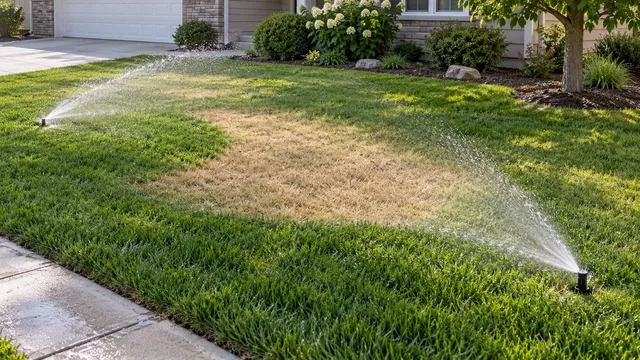
| Arc or one sprinkler zone | Uneven coverage | Compare water reaching brown and green spots. |
| Whole pallet-sized group | Delivery or storage problem | Match pieces to delivery and laying records. |
| Low, squishy area | Saturation or poor drainage | Check whether soil remains wet between cycles. |
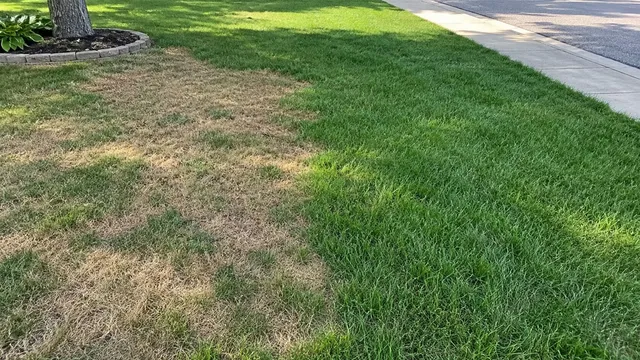
| Shade only | Grass and site mismatch | Count direct summer sun hours. |
| Uniform tan warm-season lawn in winter | Possible dormancy | Check season and crowns before replacing. |
Purdue says edges dry particularly fast and small, narrow pieces are vulnerable. A sprinkler-shaped pattern warrants the dry-zone irrigation check. Persistent wet ground after rain belongs in a drainage assessment. If only the area beneath trees fails, measure summer light and root competition before installing the same sod again.
Is water reaching the soil beneath the sod?
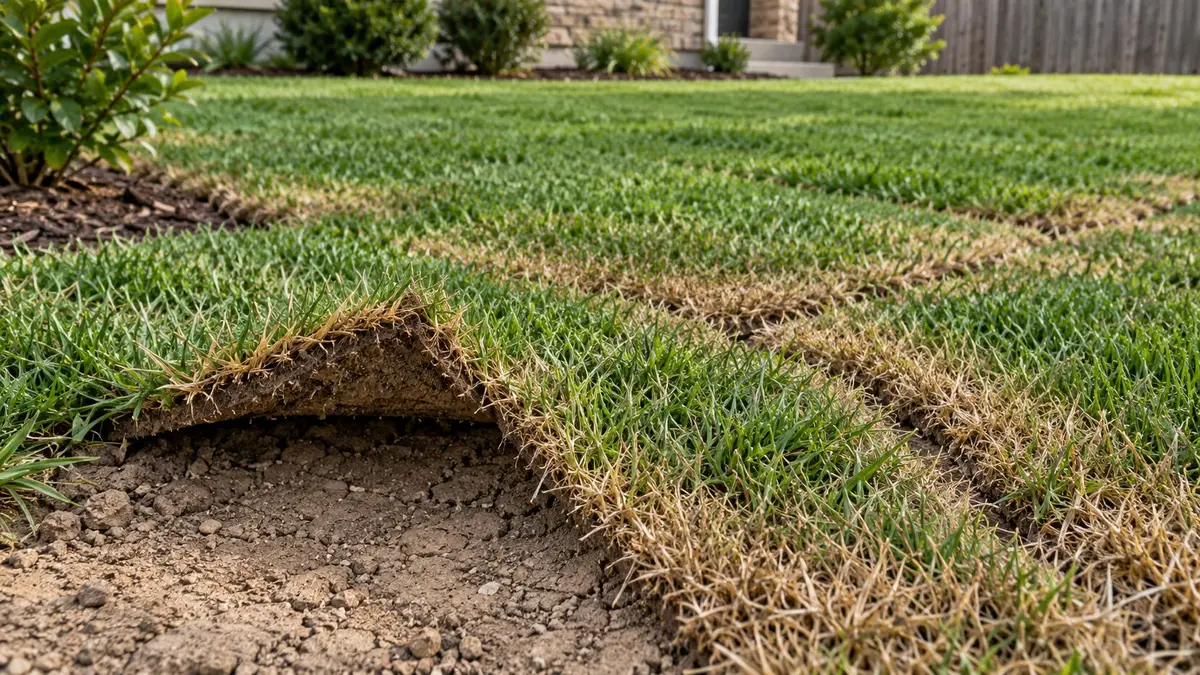
Lift a corner gently; do not pull up an entire strip. Feel the sod soil and the site soil below. Both should be moist, not oozing. If the top slab is wet and the ground beneath is dry, water has not reached the rooting zone. Press a screwdriver into the ground beside the slab. Mississippi State says dry soil resists it; adequately watered soil feels cool or moist on the tool. A blue-gray cast is another drought-stress clue.
The goal is a moist sod-to-soil interface, followed by less frequent watering as roots anchor. Extension schedules vary by climate and soil, so minutes on your controller are not the measure:
| Extension guidance | Early example | How it tapers |
|---|---|---|
| UF/IFAS, Florida | Several short 5–10 minute irrigations daily for 7–10 days | Once daily at ¼–½ inch for another 7–10 days, then 2–3 times weekly. |
| NC State | Keep the top 1½ inches moist; this may mean 2–3 light cycles daily for 7–21 days | Adjust as rooting develops. |
| Purdue, Indiana | Morning watering daily until rooted, around 10 days in favorable conditions | More often during warm, dry weather; taper as roots hold. |
| Mississippi State | Soft underfoot but not oozing in week one | Daily, then every other day after 2–3 weeks. |
| Penn State | Daily when needed, possibly up to four weeks | Adjust to the soil and establishment. |
These are regional examples, not interchangeable prescriptions. Sand drains quickly; a slope or sunny edge may dry sooner than a shaded center. Use your state’s extension schedule and the soil check to adapt. Local watering rules vary. Denver Water stopped issuing general watering-establishment permits on October 1, 2026; its remaining exceptions are for its Lead Replacement Program, mainline pipe replacement and Certificate of Occupancy projects. Ask your provider what applies before setting extra cycles.
Can too much water make new sod brown?
Yes. If your footprint squeezes water from the ground, the soil stays muddy, or the area smells sour, cutting back repeated short cycles may be necessary. Keep the interface moist while letting the site drain. Where a low spot stays wet even without irrigation, an installer or drainage-focused landscape contractor should assess the grade. Long leaf-wetness periods in hot, humid weather can also favor disease; Clemson Extension links patch diseases with wet leaves, excess nitrogen and poor drainage. A circle is a clue for diagnosis, not a reason to spray.
Could the sod have been damaged before installation?
Purdue advises delivery and installation within 24 hours of harvest; NC State says install within 24 hours of delivery. Fresh sod has a short shelf life, and heat in a stacked pallet can damage it. A yellow tinge on the pallet alone does not prove failure, Mississippi State cautions. Look for groups of pieces from the same pallet or pieces laid last failing together while adjacent rolls remain healthy.
Record the harvest date if available, delivery time, pallet condition, when each area was laid, weather and your watering log. Photograph the pallet, the pattern on the ground, seams and soil under a lifted corner. Save the invoice and any warranty terms. Those facts help the supplier distinguish delivered quality from site and care issues. Ask the installer what soil prep and products were used before laying sod, and when it was rolled for contact.
Avoid moving a heavy pallet alone. Mississippi State says a sod pallet can approach a ton; Purdue gives roughly 35–40 pounds per square yard. Have the sod installer arrange suitable handling equipment or a crew, and schedule hand-watering to avoid prolonged work in extreme heat.
Why won’t watered sod root into the ground?
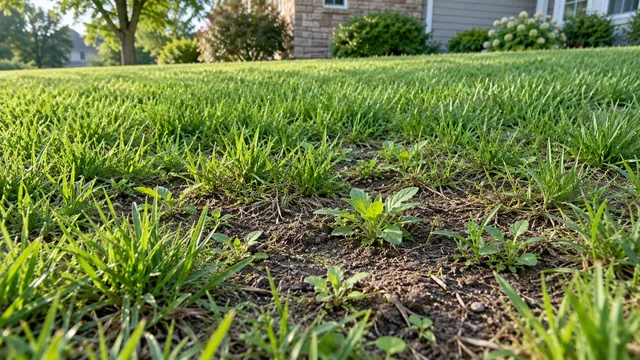
Roots need contact with prepared soil. An air gap under a loose slab, construction debris, an overly hard subgrade or sod placed on saturated ground can prevent that contact. UF advises tight seams without stretching and rolling to press sod to soil. Penn State warns against laying sod on wet soil; Purdue also cautions against an excessively dry or hot bed. If watering is reaching the ground but sections still float or lift, ask the installer to inspect the base instead of simply increasing watering.
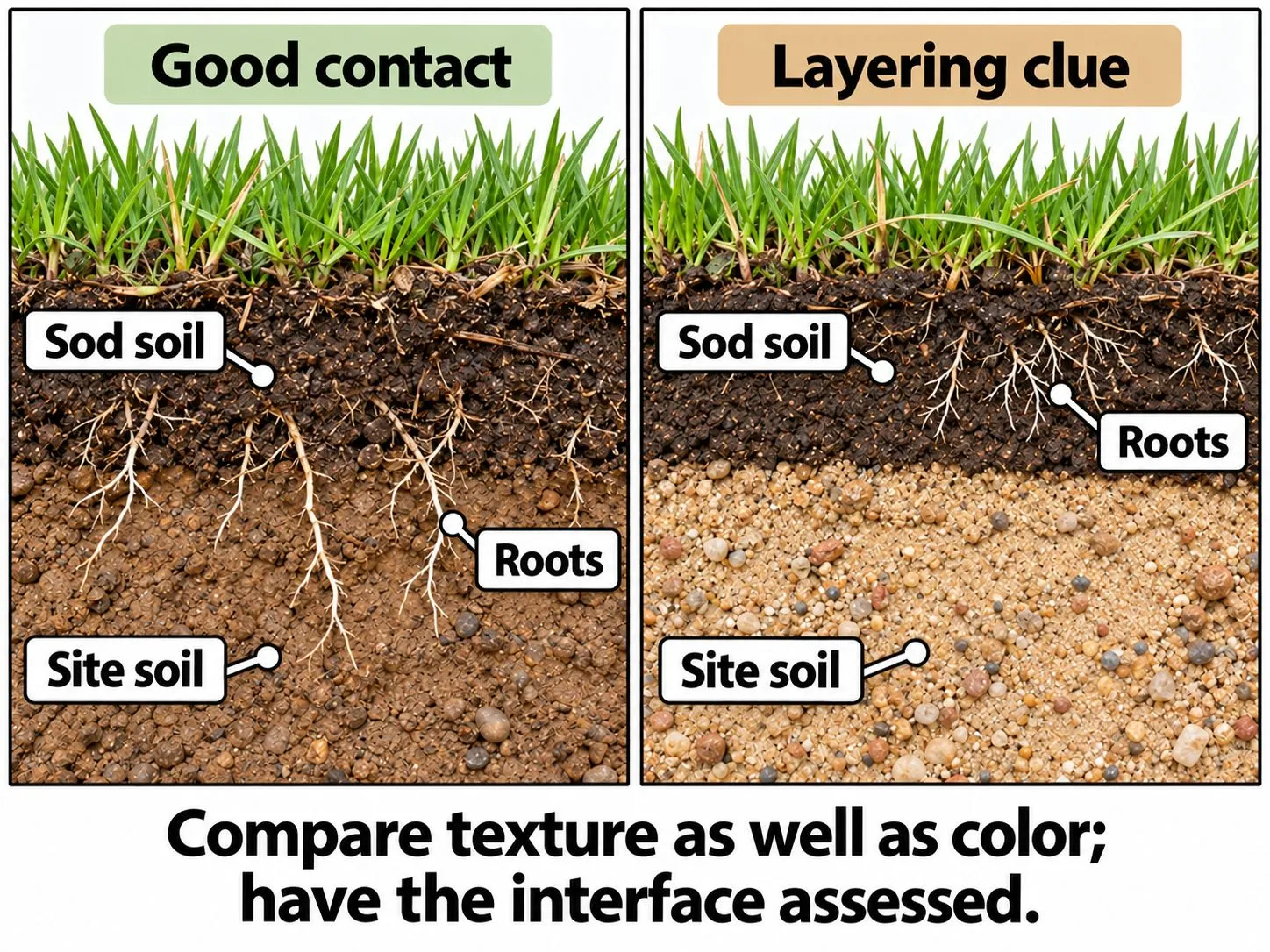
Soil color alone does not prove layering; compare texture and have a persistent rooting problem assessed.
Another cause is soil layering. Purdue calls it a serious problem: a clay-heavy soil layer on harvested sod can sit over a sandy site soil, impeding water and air movement across the boundary and slowing roots. Lift a corner and compare the color and feel of each layer. A clear difference is a clue, though color alone does not prove a texture mismatch. Ask the installer or extension office to assess it.
Purdue recommends core aeration for layering only after the sod has securely rooted, typically at least two months after installation. Aerating loose pieces can tear them up. Core aeration versus dethatching explains what the machine actually changes. If the site was treated with a pre-emergent herbicide before installation, tell the installer; Purdue says some products reduce rooting and advises avoiding most herbicides within two months before laying sod.
Is the grass dormant, poorly matched, or diseased?
Cool-season sod, such as tall fescue or Kentucky bluegrass, struggles when installed into late-spring or summer heat; Purdue favors fall establishment. Warm-season sod, such as bermudagrass or zoysia, can remain tan and unrooted in cold soil. Dormant sod still needs appropriate moisture. Purdue’s check for doubtful warm-season dormancy is to keep a small moist piece indoors above 70°F and watch for growth for up to two weeks. That is a test of that piece, not a guarantee that a whole lawn will recover.
Grass species and light must match. Mississippi State gives approximately four hours of direct light for St. Augustinegrass, six for zoysia, and almost eight for bermudagrass and centipedegrass. A shade-only failure calls for changing the plant or landscape, not watering ever harder.
Disease can occur in hot, humid, wet conditions, but new-sod browning is not automatically fungal. Brown patch affects cool-season grass in warm humidity; large patch often shows on warm-season grass around green-up and fall. Ask a county extension office or diagnostic lab to identify a spreading lesion pattern before buying fungicide. For already established turf, brown-patch diagnosis covers more causes.
Should you fertilize, spray, wait or replace the brown pieces?
Do not try to green stressed new sod with weed-and-feed. UF says to wait at least 30 days before fertilizer; Purdue places the first nitrogen about a month after installation. Purdue says many selective broadleaf herbicides are delayed about 30 days, or 60 for dormant sod, subject to the product label. Mississippi State cautions that pre-emergents can injure young sod. The label controls timing and use.
Gently tug a slab corner after correcting moisture. Resistance and small white roots entering the site soil mean it is taking hold. If blades are brown but pieces are anchored and the soil is moist, give it a suitable growth period before replacing it. If slabs lift freely and roots remain dead-looking after a reasonable establishment window in the right season, contact the installer about replacing sections. Keep traffic off new sod for roughly three to four weeks per Purdue; UF advises waiting to mow until pieces no longer lift. For partly failed cool-season sod, the overseed-or-start-over guide helps plan the right seasonal repair.
Ask the installer for an itemized repair quote showing area, sod species and cultivar, removal, soil preparation, delivery, labor and any irrigation changes. The supplier handles harvest and batch concerns; an irrigation contractor handles uneven zones; the county extension office can help with soil or disease ID. Read your written warranty before assuming a replacement is covered.
Frequently asked questions
How long should I keep watering new sod several times a day?
Florida UF/IFAS gives several short cycles daily for about 7–10 days; NC State says two or three light cycles may be needed for 7–21 days to keep the upper soil moist. Taper when the soil check and new rooting support it, following your local extension schedule rather than a universal number of minutes.
Can completely brown sod come back?
Sometimes, especially when warm-season turf is dormant. Check the crown, soil moisture, grass type and season; an anchored piece is more promising than a dry slab that still lifts freely. Ask the installer or extension office to assess a doubtful area before replacing the whole lawn.
Should I walk on or mow sod that has not rooted?
Keep traffic off while it anchors; Purdue recommends about three to four weeks. Wait to mow until the sod resists lifting, as UF advises, so a mower does not shift pieces.
Is it normal for seams to brown while middles stay green?
It is common for edges and narrow pieces to dry first, but it calls for a moisture check. Feel below a seam and close gaps according to the installer’s guidance; don’t assume longer whole-zone watering reaches the dry edge.
Does my city’s watering schedule apply to new sod?
Rules depend on the water provider. Denver Water ended general establishment permits on October 1, 2026, with only specified infrastructure and occupancy exceptions. Check your provider’s current rules before watering outside assigned days.
When is fertilizer or weed killer safe on new sod?
UF says wait at least 30 days for fertilizer. Purdue gives about 30 days for many selective broadleaf products, or 60 days on dormant sod. Always follow the specific product label and ask your state extension office about the grass and season.
Sources
- Purdue University Extension — Establishing a Lawn from Sod
- Mississippi State University Extension — Sod Installation and Maintenance
- UF/IFAS Extension — Establishing Your Florida Lawn
- NC State Extension — Extension Gardener Handbook: Lawns
- Penn State Extension — Lawn Establishment
- Clemson Cooperative Extension — Brown Patch and Large Patch Diseases of Lawns
- Denver Water — Watering Establishment Permits
- LawnStarter — How Much Does Sod Cost in 2026?