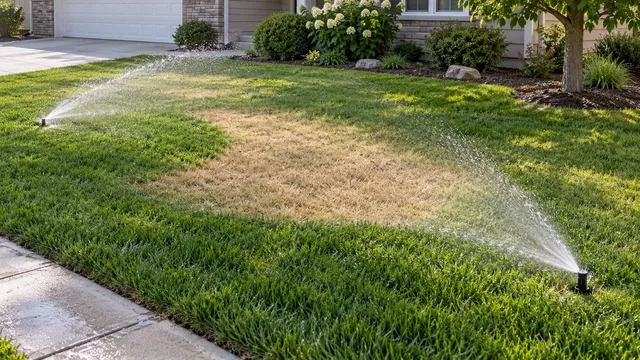
Uneven sprinkler coverage is a useful first suspect when one part of an irrigated lawn turns brown. Place identical containers in the brown and green areas during a normal cycle: the difference may explain what you’re seeing. Colorado State University Extension identifies uneven coverage as the most common brown-spot issue in its irrigation-audit tutorial, as a field observation.
Without sprinklers, start with the tug test at the patch edge. Water problems cut both ways. Dry roots can cause browning, while prolonged wet leaves favor patch diseases. Before changing the timer, work through the pattern, grass type, roots and water reaching that spot.
What causes brown patches in the lawn?
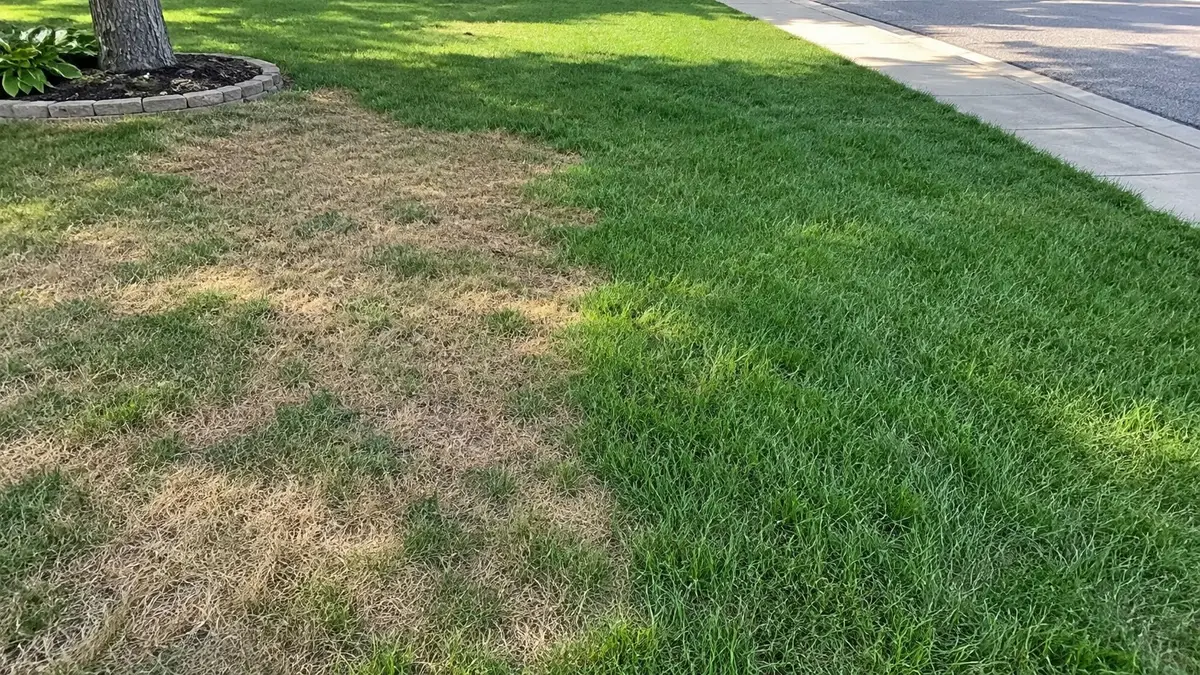
Look before digging. Is the whole lawn tan, or are there separate spots? Note whether the pattern follows a sprinkler zone, driveway, low spot or area your dog uses.
The University of Minnesota Extension diagnostic key separates several look-alikes. Use these clues to choose a check, not to declare a diagnosis from a photograph.
| Pattern and feel | Root or leaf clue | Timing or setting | First suspect |
|---|---|---|---|
| Broad, fairly even tan color | Turf remains rooted | Hot, dry weather in cool-season lawns | Drought or dormancy |
| Brown strips or zone edges | Compare water depths with green areas | Sprinkler coverage boundaries or slopes | Uneven irrigation |
| Irregular, spongy patches; animal digging | Sod lifts with roots mostly missing | Often late summer or fall; regional spring damage occurs | Grubs |
| Circles, arcs or smoky borders | Leaf lesions; turf usually stays anchored | Hot, humid weather in cool-season grass | Brown patch disease |
| Large patches near seasonal green-up | Blades release at rotted bases while roots remain | Warm-season lawns in spring or fall | Large patch disease |
| Tan rings without leaf spots | Roots and crowns black, rotted and short | Hot, dry spell after cool, wet weather | Root-infecting patch disease; send a lab sample |
| Small round spots with taller, dark-green rims | Usually under 12 inches across | Areas dogs use | Dog urine injury |
| Sharp boundaries; weeds also dead | Shape follows spraying or a spill | After chemical use | Chemical injury |
| Damaged low areas | Mushy, dark or smelly turf | Flooding; northern ice damage after winter | Saturated soil or winter injury |
Know your grass and season before suspecting disease
Tall fescue, Kentucky bluegrass and ryegrass are cool-season grasses. Bermudagrass, zoysia, St. Augustinegrass and centipedegrass are warm-season grasses. If you don’t know yours, ask your county extension office, especially in the transition zone where lawns may contain mixtures.
Clemson Extension distinguishes brown patch from large patch. Brown patch is a cool-season disease favored by hot, humid summers. Large patch affects warm-season lawns, particularly centipede, zoysia and St. Augustinegrass, around spring and fall dormancy transitions.
| Lawn type | Spring | Summer | Fall |
|---|---|---|---|
| Cool-season | Northern snow mold after snowmelt; regional grub damage | Drought, uneven water, brown patch; emerging grub injury | Grub injury in affected regions |
| Warm-season | Large patch around green-up | Drought or coverage problems; chinch bugs in Southern St. Augustinegrass; grubs where locally active | Large patch around dormancy; check local grub timing |
Is it grubs? Check roots and count before treating
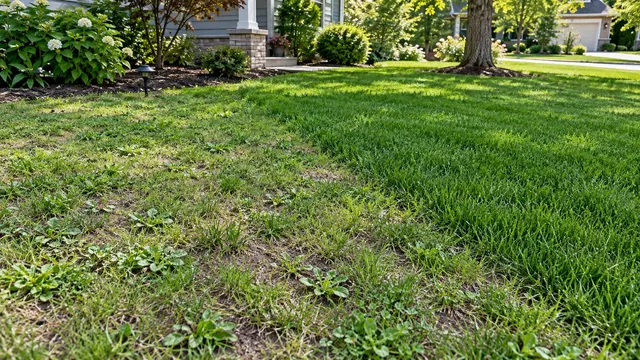
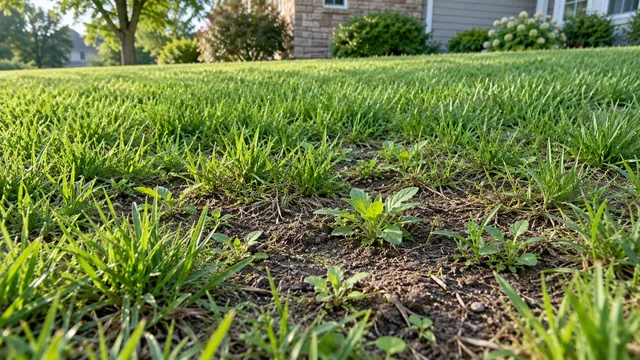
Gently tug turf along the boundary between brown and healthy grass. Grub-damaged sod may lift like carpet because roots have been eaten. Drought and brown patch usually leave turf anchored. Root-infecting diseases can weaken it too, but leave roots black and rotted rather than chewed off; send that finding to a diagnostic lab. A loose leaf alone is different from lifting the whole rooted sod.
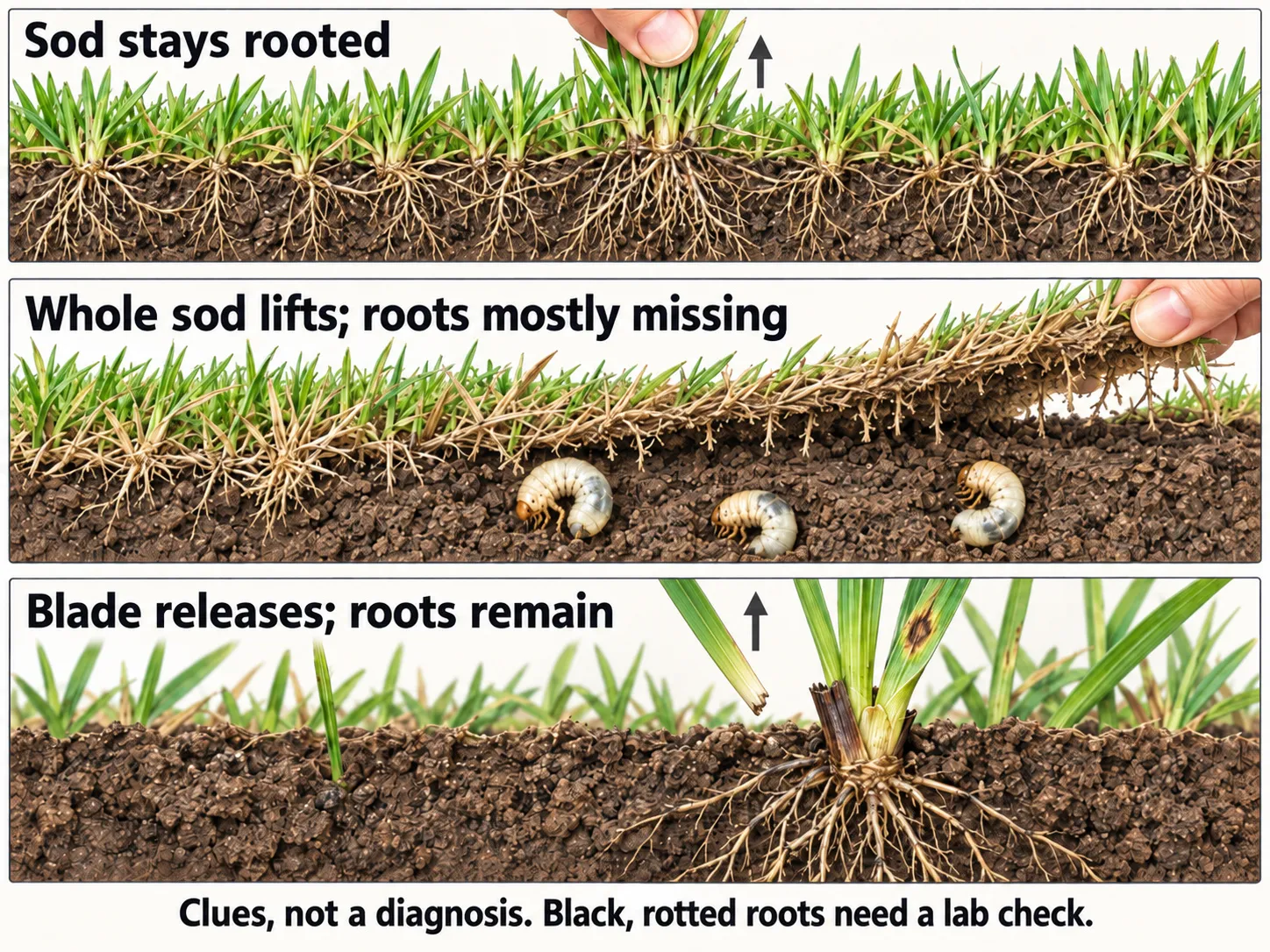
Conceptual comparison: check whether the whole sod lifts or only a blade releases. These clues alone do not establish a diagnosis.
If roots are missing, make a square-foot check following Penn State Extension’s sampling guidance:
- Choose a spot straddling the damaged edge, rather than only the dead center.
- Lift a 12-by-12-inch section of sod and inspect the soil beneath it, about 2–4 inches deep. Stay away from sprinkler lines and marked utilities; don’t deepen the hole to chase insects.
- Count white, C-shaped grubs, typically about half an inch to an inch long. Record the count and location.
- Repeat at several patch edges. Replace and water each lifted piece of sod.
Treatment thresholds vary by species, lawn health and region:
| Extension source | Guidance per square foot |
|---|---|
| Purdue | Fewer than 5 rarely require treatment |
| Penn State | 5–10 is often used for curative decisions, depending on species |
| Illinois | About 12 can cause damage requiring control |
Illinois notes that animals may dig even at low counts.
If roots are missing but no grubs appear, sample other edges. Grubs may have moved deeper or pupated, or another root problem may be involved. Keep further digging shallow and use a diagnostic sample if the cause remains unclear.
Is it a watering problem? Test coverage, moisture and dormancy
A running sprinkler isn’t proof that water reaches the brown patch. CSU’s catch-can audit makes that difference measurable:
- Set 5–10 identical containers across one sprinkler zone. Include brown and green areas, edges and the middle. Keep containers level and a few feet from sprinkler heads.
- Run the zone for its normal cycle.
- Measure the water depth in each container with a ruler. Record which containers were in brown grass.
In CSU’s example, a green area receives 0.2 inches while a brown area receives 0.1 inches. That’s twice the water each cycle; extra runtime won’t fix uneven coverage.
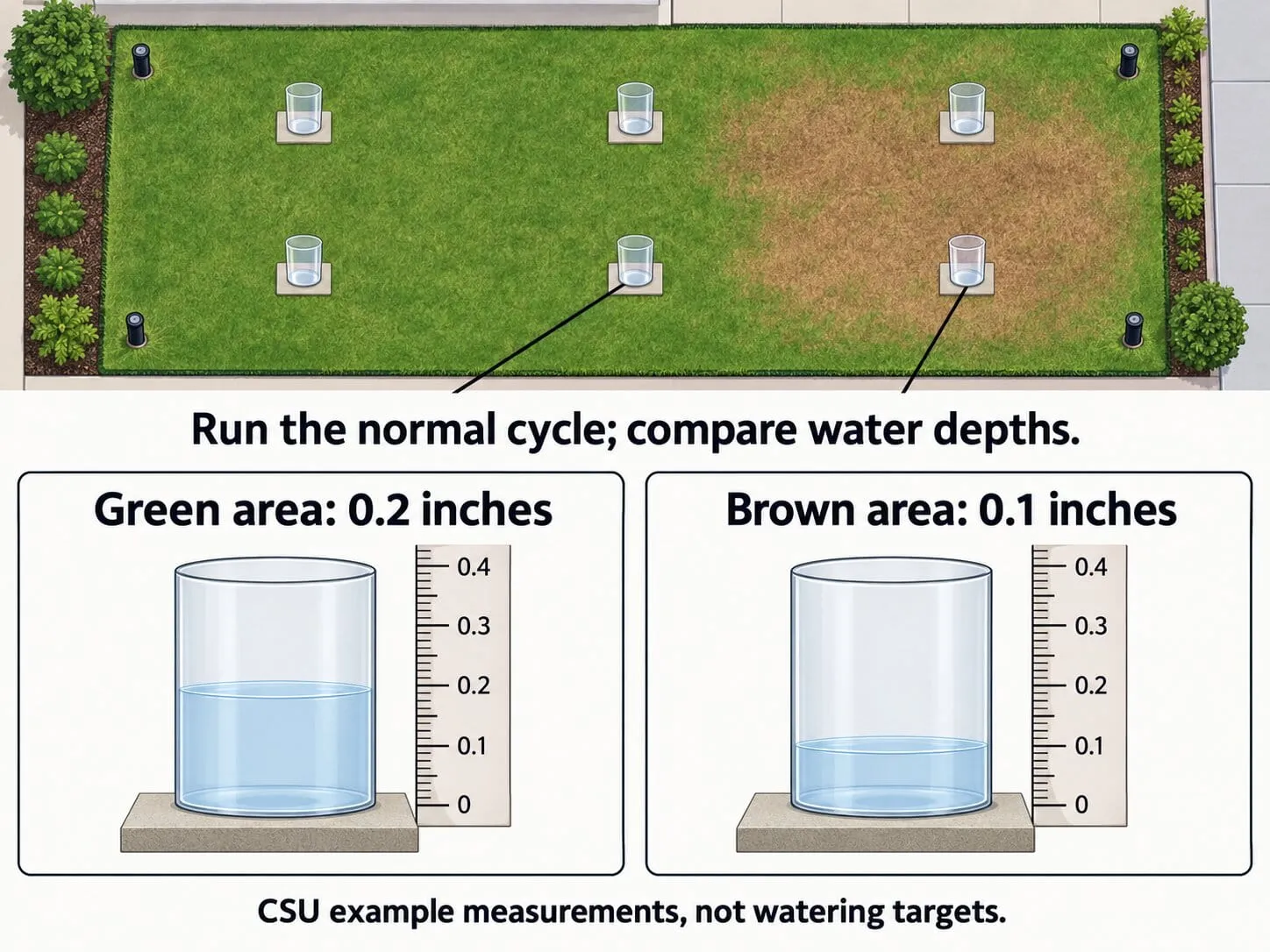
CSU example measurements, not watering targets. Use your own catch measurements to compare coverage.
If catch depths differ, watch for heads sunk too low, tilted or stuck, spray blocked by plants, clogged or worn nozzles, and low pressure. Clear visible vegetation blocking spray; have damaged heads, nozzle problems and pressure assessed by an irrigation contractor before extending runtime.
Next, compare soil moisture in both areas. Illinois Extension recommends a screwdriver probe to judge how far moisture reaches. Compare how easily it enters brown and green areas: greater resistance in the brown area suggests drier soil. Stay away from sprinkler lines and marked utilities, and don’t force the tool against resistance; compaction can also resist the probe. Persistent footprints and an off-color, darker cast can be early drought clues.
Illinois suggests about 1–1.5 inches weekly for actively growing lawns. Needs depend on climate, soil and grass type. Include rain in your assessment, and check local watering restrictions before changing the schedule.
Decide whether to keep it green or allow dormancy
A cool-season lawn turning broadly tan during heat and drought may be dormant. Minnesota says it usually recovers with cool, wet weather, but prolonged severe drought can kill grass. Purdue cautions that dead and dormant turf are hard to distinguish until rehydrated.
For its drought conditions, Purdue suggests about half an inch every few weeks to help keep crowns—the living bases of grass plants—alive. Seek local advice before using that approach for another climate or species. Avoid fertilizer during drought and minimize traffic.
Is it disease? Look at leaves before adding water
Inspect the patch early in the morning while dew is present. NC State Extension describes grayish, cottony fungal growth and occasional dark “smoke ring” borders with brown patch. On tall fescue, Clemson describes tan leaf spots with dark-brown borders.
NC State reports severe brown patch under conditions including nights above roughly 70°F and days above 90°F. Long periods of leaf wetness matter too. Clemson and NC State describe disease-favoring wetness lasting roughly 10 hours or longer; evening irrigation can extend that window.
Look closely at individual blades. Minnesota’s key distinguishes dollar spot’s tan bands with rusty borders from rust, whose orange spores rub onto a white tissue. Orange spores point toward rust; bands point toward dollar spot. Photograph either finding for diagnosis before selecting a fungicide.
In warm-season large patch, blades may pull free from rotted leaf sheaths at soil level. Roots remain, unlike the missing-root pattern expected with substantial grub injury.
NC State warns that curative fungicide may not help cool-season grass recover in hot weather, so a spray isn’t a promise of green turf. For reseeding tall fescue, NC State recommends brown-patch-resistant varieties. Clemson describes preventive fungicide timing for lawns with recurring, confirmed disease: timing depends on the disease and local conditions, and every application must follow its label.
Something else? Check dogs, chemicals, insects and soil
Compare the damage with recent yard activity and the Minnesota diagnostic key.
Dog spots often have a dark-green rim around a small brown center. Thorough watering and reseeding can help fill them, but don’t generalize that extra-water response to every circular patch.
Nonselective herbicide injury may follow a sharp spray pattern and kill weeds along with grass. Fertilizer overapplication or spills can also burn turf, especially in heat. Record the product and application date rather than applying another product to counter it.
Other insects need their own diagnosis. Sod webworms can leave quarter-sized ragged spots. Billbug damage may appear near pavement in July or August in Minnesota’s guidance; cutworms are another possibility.
Clemson’s chinch bug guidance covers chinch bugs in hot, sunny St. Augustinegrass near pavement. For the float test, press a one-gallon can with both ends removed into the turf at a patch edge, maintain 1–2 inches of water above the grass, and count bugs floating up within five minutes; repeat nearby, avoiding sharp can edges. Measure the can’s inside diameter in inches. Total sampled area in square feet = 3.14 × (diameter ÷ 2)² × number of placements ÷ 144. Divide the combined bug count by that area before comparing it with Clemson’s general threshold of 20–25 chinch bugs per square foot.
Thin, pale turf near trees or north-facing walls points toward shade. Mushy, smelly turf in low spots suggests flooding; straw-colored strips along northern curbs may follow ice damage. Buried debris, shallow soil or compaction can contribute, but a patch’s shape alone doesn’t confirm them. Keep any soil inspection shallow and away from utilities.
Match the next action to the likely cause
| Likely cause | First action | Avoid |
|---|---|---|
| Uneven coverage | Identify dry areas and have coverage, heads or pressure corrected | Extending every zone without measuring |
| Drought | Choose consistent watering or locally appropriate dormancy care | Fertilizing stressed turf |
| Disease | Correct irrigation timing, excess nitrogen and drainage; confirm the disease | Fungicide chosen from patch shape alone |
| Grubs | Match counts and species to local thresholds and timing | Treating because animals dug holes |
| Confirmed dead turf | Plan reseeding or sod for the grass type’s suitable season | Expecting a pesticide to restore dead grass |
Grub timing varies by region and species. Penn State targets small, actively feeding grubs in late summer, with August to mid-September guidance for Pennsylvania. Spring treatment is less effective against large grubs; Minnesota cautions against fall treatment when grubs move deeper. Use local guidance to choose the treatment window.
The EPA explains that pesticide labels are legally enforceable. Follow the label for the approved site, application conditions and re-entry instructions for children and pets. Don’t use homemade mixtures or combine products “just in case.”
Use a lab or professional when the evidence doesn’t fit
A county extension office or university diagnostic lab can help when symptoms conflict or patches keep spreading. Contact the receiving lab first for its requirements and current fees. Fees and turf services vary by state; there is no reliable national price range for lawn diagnosis or treatment programs.
Ohio State’s turf-sample guidance provides a useful preparation checklist:
- Include both healthy and affected turf from the patch edge.
- Take at least a 6-by-6-inch sample, 2–3 inches deep, away from lines and utilities.
- Wrap it in foil or newspaper, not plastic.
- Ship overnight early in the week, following the receiving lab’s instructions.
- Include photos, grass type, symptom dates, watering schedule and recent product use.
For coverage problems, use an irrigation contractor. For warranted pesticide treatment, check your state’s applicator licensing or certification requirements. A useful inspection examines roots, soil, thatch, leaf lesions, insect counts and irrigation coverage.
The estimate should separate diagnosis, applications, number of visits, turf repair and irrigation repairs.
Keep the same problem from returning
Audit sprinkler coverage seasonally and water deeply, less often, early in the day when irrigation is needed. Match fertilizer timing and mowing height to your grass species. Address excess thatch and recurring drainage problems rather than repeatedly treating the resulting patches.
Avoid repeatedly waking a dormant lawn and letting it go dormant again. In grub-prone areas, monitor animal digging and root damage. Illinois notes that summer-dormant lawns are less attractive to egg-laying beetles, but dormancy still needs a locally suitable plan. Record what changed and whether the patches returned during the same season.
Frequently asked questions
I watered for a week and the patch is still brown. Does that rule out drought?
No. Water may still be missing the patch, or severe drought may have killed some turf. Purdue also describes early grub injury as wilting that does not respond to irrigation: tug the edge and check a square foot for grubs before adding runtime.
Will the patches fill back in, or do I need to reseed?
Dormant grass may recover after rehydration, but recovery isn’t guaranteed. Dead areas generally need reseeding or sod after the cause is corrected. If new sod turns brown or won’t root, check it before replacing it. Purdue puts Indiana’s cool-season reseeding start around mid-August; follow local timing.
Is annual grub control necessary?
No blanket annual treatment follows from finding a few grubs. Purdue recommends monitoring to guide treatment decisions; a damage history identifies areas to watch closely. Before buying a yearly program, ask for the diagnosis and the reason its timing fits your region.
What should I do first if the cause is still unclear?
Keep your photos, catch-can measurements and square-foot counts together. Send them with a patch-edge sample to a diagnostic lab. That gives you a firmer next step than trying successive insecticides and fungicides.
Correction
October 11, 2026: Clarified how to convert chinch-bug can samples to a count per square foot.
September 28, 2026: Added root-disease and irrigation-resistant grub clues, corrected preventive-treatment attribution, and removed an unsupported sod-webworm symptom.
Sources
- University of Minnesota Extension — Turf diagnostic key
- Penn State Extension — White Grubs in Home Lawns
- Purdue Extension — Managing White Grubs in Turfgrass
- University of Illinois Extension — Dealing with Grubs in Lawns
- Clemson Extension — Brown Patch & Large Patch Diseases of Lawns
- NC State Extension — Brown Patch in Turf
- Clemson Extension — Chinch Bugs
- Colorado State University Extension — Lawn Irrigation Audit Tutorial
- University of Illinois Extension — Watering Your Lawn
- Purdue Turfgrass Science — My Lawn is Brown and Crunchy… Is it Dead?
- Ohio State Extension — Collecting and Submitting a Turfgrass Sample
- EPA — Introduction to Pesticide Labels