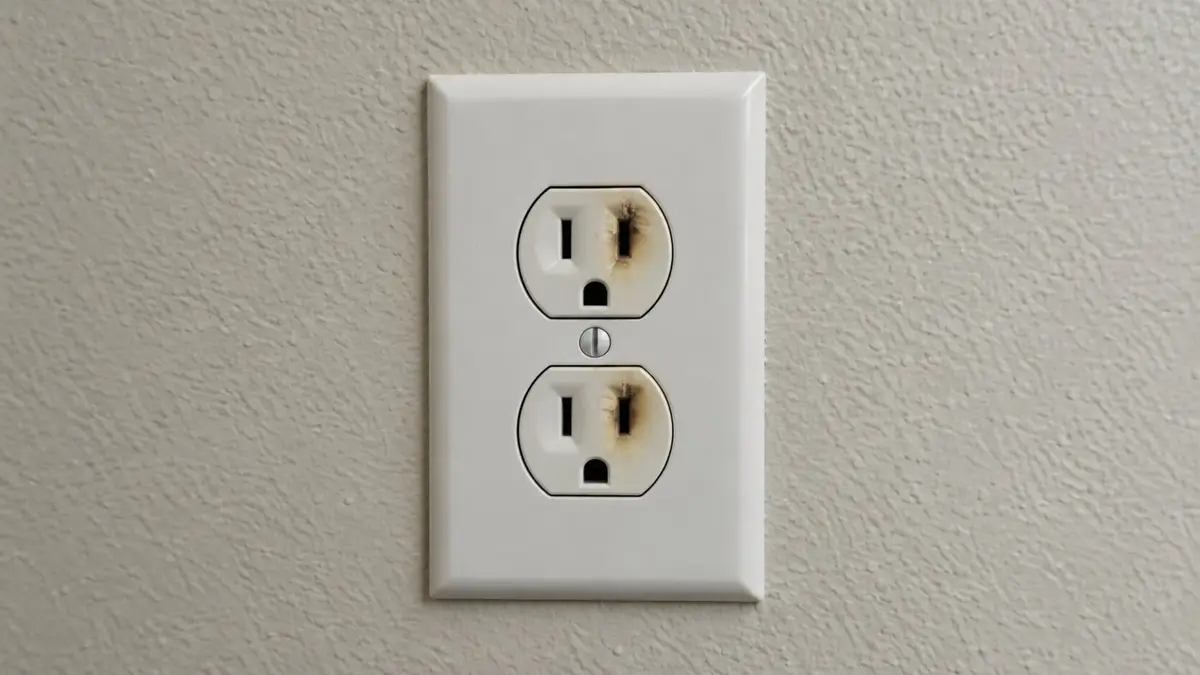
A charger can feel warm while its wall plate stays cool. A receptacle—the device gripping the plug—can overheat even when empty.
A cool browned plate still needs an electrician. Smoke means an active emergency.
What to do in the next five minutes
Separate where the heat is from how hot it is: location suggests the source; temperature sets urgency.
| What you observe | What to do now |
|---|---|
| Smoke, flame, burning smell, plastic melting now, or showers of sparks | Leave and call 911. Stay out; water is unsafe on electrical equipment. |
| Hot or uncomfortable plug or faceplate; cooled heat discoloration or scorch marks; receptacle buzz, crackle or sizzle; shock or tingle | Stop use. Switch the circuit off if safely identifiable and call an electrician promptly. Leave the outlet closed. |
| Warm adapter with cool plate; comfortably warm, undiscolored plate; hum clearly from a device or light | Identify the source without recreating a warning symptom. A warm-plate reading needs follow-up, not permanent clearance. |
Before touching a breaker, check the panel from outside. A hot or buzzing panel is a stop point: leave it alone and call an electrician urgently. A burning smell means leave and call 911. Otherwise, operate only outer breaker handles; both covers stay on. If you cannot identify the circuit, keep the outlet unused and tell the electrician.
The CPSC’s long-standing Home Wiring Hazards guide says to stop using a hot receptacle or switch immediately and get an electrician as soon as possible. Only an electrician should remove the service-panel cover.
CPSC distinguishes a spark while unplugging a running appliance: switch it off first when possible. That does not clear heat, damage, smoke, or repeated arcing.
Confirm a working smoke alarm on that level. USFA notes that wall fires can smolder before visible smoke; its guidance calls for monthly tests and replacement ten years from manufacture. An alarm doesn’t replace an electrician.
Is a warm outlet normal?
CPSC says electrical covers, cords, and plugs “may be warm,” but never “hot—painful to touch—or discolored from heat.”
Smoke, flame, burning smell, melting plastic, or showers of sparks mean leave and call 911; do not touch the plate. For known overheating, buzzing, sizzling, shock or tingling, discoloration, damage, moisture, or any earlier warning sign, leave it alone and call an electrician. Only for an intact plastic plate without that history, a brief check with the back of dry fingers can distinguish warmth from discomfort. Do not touch metal plates or mounting screws.
Look for browning around the slots, yellowing, or a smoke shadow above the plate. Don’t yank a hot plug out by its cord; switch the circuit off first if you safely can.
Where is the heat coming from?
| Location and condition | What it tells you | Next decision |
|---|---|---|
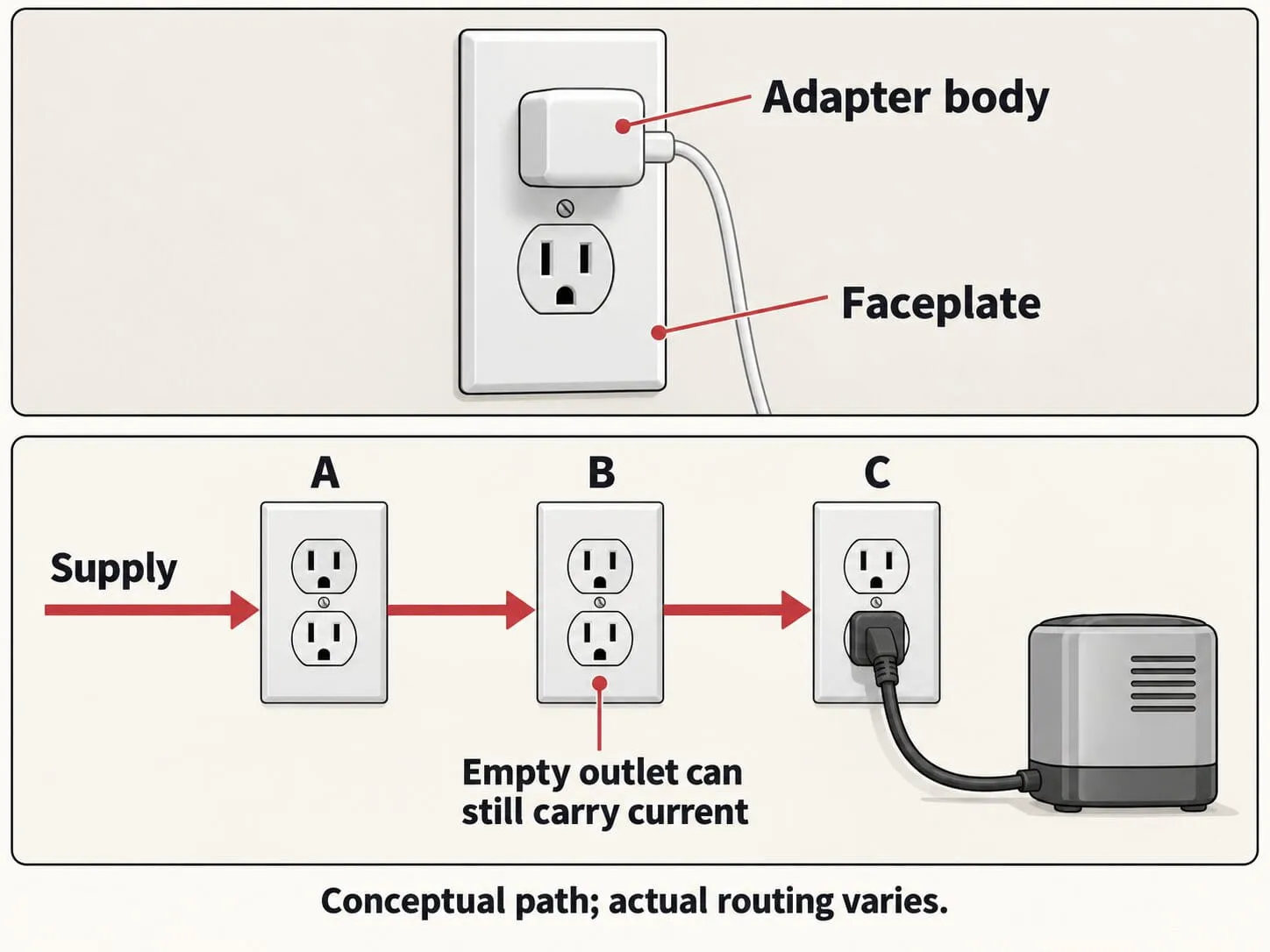
| Warm adapter body, cool faceplate | Heat belongs to the plug-in power supply. | Check for deformation, discoloration, and a fully seated plug. Ordinary warmth alone is not a building-wiring symptom. |
| Comfortably warm plate under load, no discoloration | Heat is on the receptacle side, but below the hot threshold. | Record the appliance and run time already observed. Report recurring warmth to an electrician; do not rerun a heater. |
| A cool plate doesn’t clear a hot plug; cooled discoloration still means stop use. CPSC says an unusually warm appliance plug requires stopping the appliance and having an electrician check its plug and cord. Ordinary faceplate warmth is different. |
Recurring faceplate warmth under a heater needs a prompt electrician assessment. Keep the heater off; another high-load run adds no useful evidence. A merely warm plate is distinct from a hot one. Report several warm plates, or known or suspected aluminum wiring, to the electrician.
Why an empty outlet can be hot
CPSC explains that “electric power delivered to one receptacle outlet often passes through the connections” of others. An empty receptacle can carry current for an appliance elsewhere and heat at its connections.
Switching the circuit off removes current from its connections. If essential equipment prevents that, call an electrician urgently and ask where it can be powered. An outlet in another room or a panel label does not establish a safe alternate supply. USFA says heaters must plug directly into wall outlets, without extension cords or power strips. Its appliance guidance also rules out extension cords for major appliances.
A hot switch plate also means stop use and call an electrician.
Why is my outlet buzzing?
CPSC lists unusual electrical sizzles and buzzes as warning signs. First work out whether the sound comes from the outlet or a nearby device.
Smoke, flame, burning smell, melting plastic, or showers of sparks mean leave and call 911; skip this test. Check only an unidentified faint hum with no outlet or plug warning history. Known sound at the receptacle or plug, crackling, sizzling, heat, damage, moisture, or shock means stop use and call an electrician.
- Turn the connected devices off, then unplug them. Turn off nearby lights, dimmers, and fans.
- Listen in a quiet room. Keep the plate on and leave the outlet untouched.
- If the noise stops, restore only a light or intact low-draw device never associated with the sound, one at a time. Stop if noise returns at the wall or plug. Leave heaters, air conditioners, and other high-draw appliances off.
An empty receptacle that still buzzes needs an electrician. Silence after unplugging does not clear the outlet: a loose connection may buzz only under load. A hum clearly located in an adapter or bulb points toward that device; a sound at the plug or wall remains the stop-and-call case. Report any high-load buzz you already heard without recreating it.
If the noise follows a dimmer
Lutron’s Maestro LED+ troubleshooting guide gives a useful second split. Noise only at the low end calls for the model’s low-end range adjustment. Noise across the entire range points toward bulb/dimmer compatibility; consult the compatibility tool or bulb manufacturer.
Check the packaging: many LEDs, including smart bulbs, aren’t dimmable. A hot dimmer plate means stop use and call an electrician.
Why a loose connection heats itself up
Less metal-to-metal contact means current passes through a smaller area. Heat forms copper oxide, which raises resistance. More resistance produces more heat and more oxide. The connection can eventually glow inside the box.
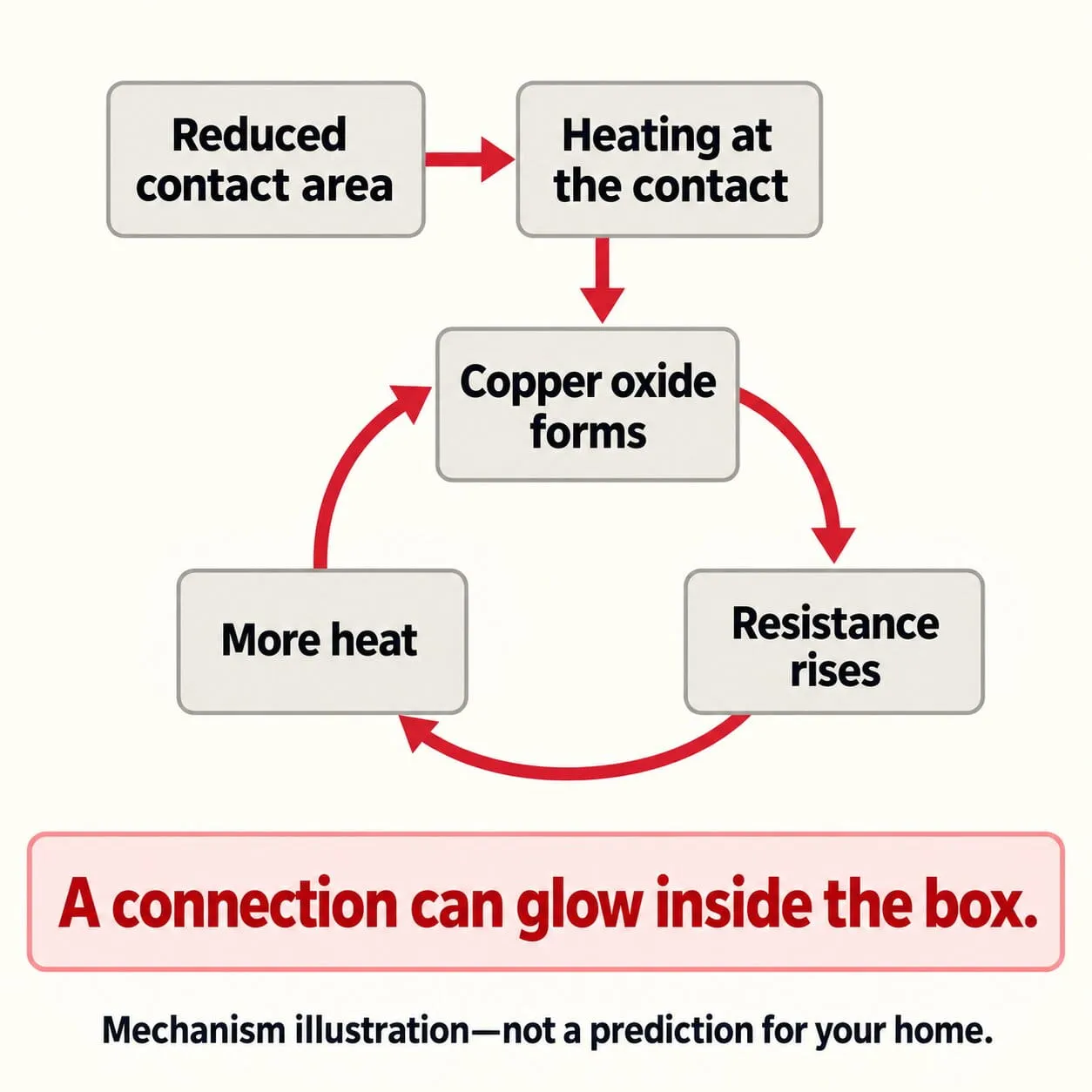
Conceptual mechanism, not a prediction of what will happen in a particular home.
The 2014 IAFSS receptacle study tested deliberately loosened connections under controlled conditions, powered up to 23 hours daily. Its results explain a mechanism, not the likelihood of your outlet catching fire.
In the loosened connections, overheating indicators were almost absent at 6 amps; roughly half developed indicators after current rose to 9 amps. A heater or air conditioner can reveal a defect that a charger doesn’t. Removing that load can quiet the symptom without fixing the connection.
In the tests, glowing stopped without power, often returned when power resumed, and could recur days later. Failures took 5 to 365 days, averaging 161. That is no household countdown; a stable symptom grants no safe interval.
Why didn’t the breaker trip?
A conventional breaker responds to excessive current. A bad connection can overheat below the breaker’s rating.
CPSC’s AFCI technical paper discussing the 1999 code cycle explains that a series arc—a fault along the current’s existing path—has current limited by the load. It names loose receptacle connections as one cause. That current can stay below the level that trips a conventional breaker.
The historical paper says the AFCIs it discusses detect some secondary effects but not a glowing connection without an arc or ground fault. This is not a claim about every current AFCI. Only one of twelve flaming events in the IAFSS laboratory tests tripped the breaker. That is not a household failure rate or an argument against breakers and AFCIs; their silence does not clear the connection.
What could be wrong behind the faceplate?
Loose terminals and push-in connections
In the controlled IAFSS tests, a fraction of a turn separated tested screw connections that overheated from those that did not. Tightening belongs to the electrician, not a homeowner working by feel.
CPSC names push-in connections as a possible overheating mechanism and advises watching for faceplate heat. In the IAFSS study, three of 42 push-in receptacles tested at 15 amps showed overheating indicators after daily vibration and prior wire removal and reinsertion. The researchers found those tested connections robust and not prone to overheating: looseness, high current, and vibration were required, versus looseness and high current for screw connections.
A device swap alone may miss a fault elsewhere; aluminum wiring also changes the repair question.
Worn contacts, damaged cords, and sustained load
Sagging plugs can mean a loose connection likely to overheat. Skip plug-fit checks on any symptomatic outlet or one with a history of heat, buzzing, shock, or damage. Only on a cool, quiet, undamaged outlet without that history, CPSC suggests comparing two or three other plugs gently. Most fitting loosely points to electrician replacement; most fitting firmly points to a worn or defective first cord. Never bend plug blades.
Report damaged cords, deformed plugs, heat-damaged adapters, dampness, or corrosion. Leave internal inspection to the electrician. If a GFCI outlet also will not reset, see what that button behavior can mean; heat, buzzing, damage, moisture, or shock still means leave it alone and call an electrician, without a reset attempt.
Could a house wired between 1965 and the mid-1970s have aluminum wiring?
CPSC’s Repairing Aluminum Wiring guide identifies that installation window for possible aluminum branch wiring, including additions and new circuits. Homes built before 1965 are unlikely to have it, but later electrical work matters.
This branch changes the assessment: CPSC says failing aluminum connections seldom give easily detected warnings and can overheat without prior problems. Cool outlets elsewhere don’t clear the system.
Read cable-jacket markings only where already visible and safely accessible in unfinished spaces. “Al” or “Aluminum” indicates aluminum. “CU-clad” or “Copper-clad” means copper-coated aluminum, excluded from this guide’s repair recommendations. Don’t open anything to identify it; ask an electrician if the markings aren’t clear.
CPSC does not accept twist-on connector pigtails or CO/ALR devices as permanent solutions. It treats them as emergency temporary measures pending a recommended permanent repair. Ask for an assessment beyond the one symptomatic device; choosing among permanent repair methods is a separate decision.
What can you safely record before the electrician arrives?
Photograph the outlet and plug from outside. Note the room, heat location, appliance, run time, empty-outlet behavior, flickering, and recent electrical work or added loads. Leave hot or buzzing symptoms unreproduced.
At a panel without heat, buzzing, or odor, consult the directory and operate only outer breaker handles. Leave the covers on. Mark an identified switched-off breaker so nobody restores it. Never keep resetting a tripping breaker.
Report essential-equipment conflicts, including a freezer, pump, medical device, or heating control. Keep an unidentified circuit task with the electrician.
What will the repair involve, and what moves the price?
Nobody can price this before the diagnosis. There is no reliable national figure for this symptom; the number of affected connections and heat damage change the job.
| Scope | What changes the job |
|---|---|
| Diagnosis | Number of connected devices inspected and time to locate the fault |
| One-device repair | Condition of the terminals, wire ends, and box |
| Wider circuit repair | Heat-damaged conductors or multiple affected devices |
| Circuit or panel work | Evidence that the existing circuit cannot serve the intended load |
| Aluminum assessment | Wiring type changes the repair scope |
Replacement requirements vary with locally adopted code and amendments. Ask the electrician or building department what applies.
What to tell the electrician, and what to expect
Call an electrician licensed and insured where you live. Give them your observations, house age, suspected aluminum wiring, and shutoff status.
Expect the circuit to be de-energized and verified dead before devices are opened. Ask, “How did you establish which connection is at fault?”
Ask the estimate to separate diagnostic fees and any repair credit, after-hours charges, device locations, conductor or panel work, permits, restoration, and warranty terms. An undocumented rewire recommendation or returning symptom deserves another opinion. Keep the circuit off. An unexplained “tighten it up” proposal must account for heat damage.
Can this wait until morning?
Call an electrician now and explain whether the circuit is off. In the IAFSS tests, removing power stopped glowing at the connection. If the affected circuit can remain off, there are no active emergency signs, and the electrician agrees on the timing, the repair may wait until the next day. That is not permission to turn it back on.
An unidentified circuit, essential equipment preventing shutoff, continuing heat, or a hot or buzzing panel needs an electrician urgently tonight. A burning smell, smoke, flame, melting plastic, or showers of sparks means leave and call 911.
Frequently asked questions
Only the top half is hot. Can I use the bottom half?
Keep the whole receptacle out of use and call an electrician. A cool socket on that device doesn’t establish sound internal connections.
A new outlet is getting hot too. What does that mean?
The replacement hasn’t resolved the cause. Stop use and have an electrician assess the circuit rather than swapping it again.
I rent. What should I put in writing?
Report the location, observed heat or noise, any damage, and when it occurs to the party responsible for the wiring today. Record whether the circuit is off and keep the message and photos. Emergency signs still require leaving and calling 911; don’t wait for a written reply.
It buzzes briefly when the AC starts. Is that normal?
A brief sound is not enough to clear the outlet. If the buzz comes from the wall or plug, leave the AC off and have an electrician assess the connection and load. Tell them when it happened; don’t restart the AC to demonstrate it.
Can a power strip solve the problem?
No. It adds sockets without bypassing the outlet’s connections. USFA says heaters and major appliances belong directly in wall outlets, and heaters must not use power strips or extension cords. CPSC’s long-standing guide illustrates roughly 1,500 watts on a 15-amp circuit as a power-budget rule of thumb, not a modern circuit specification or proof that an outlet is safe below that load.
Correction (October 12, 2026): Earlier touch and hum checks did not exclude outlets with prior warning signs.
Sources
- CPSC — Guide to Home Wiring Hazards
- CPSC — Repairing Aluminum Wiring
- CPSC — New Technology for Preventing Residential Electrical Fires: AFCIs
- IAFSS — Electrical Receptacles: Overheating, Arcing, and Melting
- USFA — Residential Building Electrical Fires (2014–2016)
- USFA — Portable Heater Fire Safety
- USFA — Electrical and Appliance Fire Safety
- USFA — Smoke Alarms
- Lutron — Maestro LED+ Flickering, Buzzing, or Dropping Out Troubleshooting