

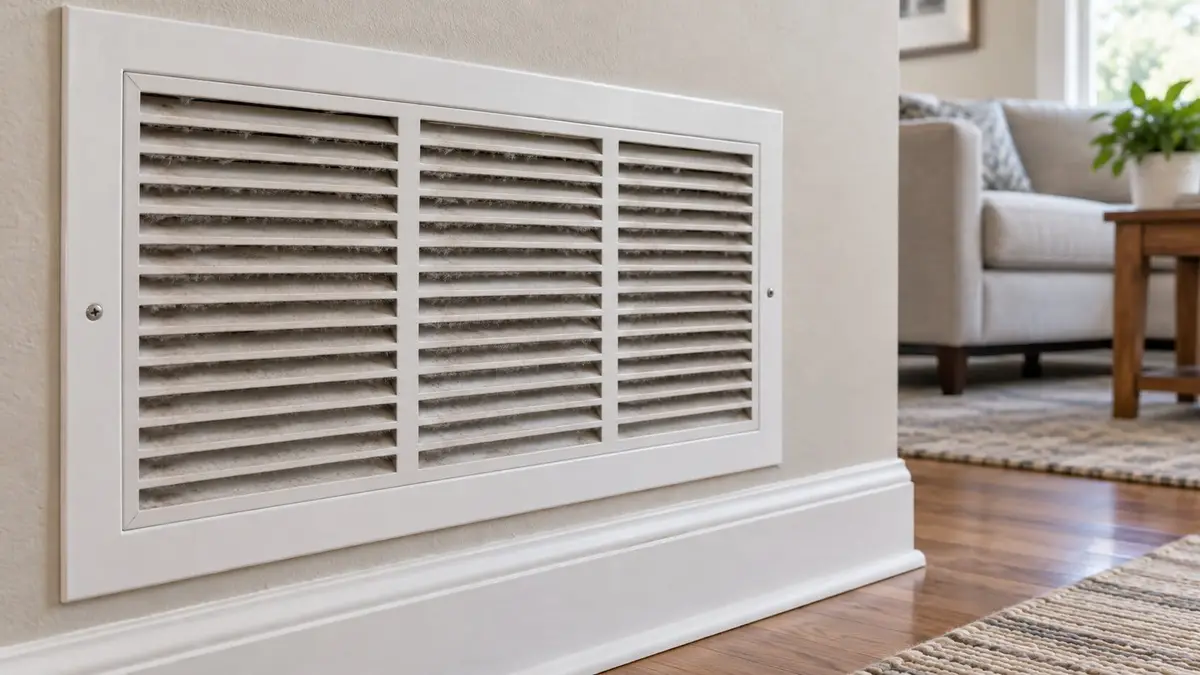
The gray fuzz on your return grille can look like the explanation for every sneeze. But that grille catches dust as room air passes through it. EPA says this is normal, so ordinary surface dust alone is no reason to book a whole-system cleaning. Have someone without allergies vacuum the grille, ideally with a HEPA vacuum, while anyone with allergies or asthma stays out of the room, following EPA’s exposure precautions.
Separate two questions: what are you reacting to, and does the HVAC system have a documented problem? An allergist handles the first; an HVAC contractor investigates the second.
Mark Zarzeczny owns a Pennsylvania duct-cleaning company and is a former NADCA president. The evidence, rather than the service being sold, guides the recommendations here.
What are you actually reacting to?
Indoor allergens have sources. Dust mites are associated with bedding, upholstered furniture, and carpet. Pet allergens come from material such as skin flakes, saliva, and urine. Moisture supports mold growth; pests introduce allergens where they live and feed. EPA’s trigger guidance directs attention to those sources, rather than routine duct cleaning.
| When symptoms seem worse | What to discuss or investigate | First useful observation |
|---|---|---|
| During a particular season | Outdoor pollen and other possible triggers | Note whether the timing tracks the season. |
| At night or on waking | Bedroom exposures, including bedding | Record where you sleep and what bedding or pets are present. |
| Only when the system runs | A possible system-related source | Note odors and whether supply vents actually release debris. |
| In one room | A local source or moisture problem | Look for visible water staining without opening walls or equipment. |
Bring these notes to a board-certified allergist for testing, as AAFA recommends.
What did the research actually find?
EPA says duct cleaning has not been shown to prevent health problems. Studies also haven’t conclusively established that dirty ducts increase household particle levels or that cleaning reduces them.
A 2010 review of 48 studies is summarized by the NIH duct-cleaning fact sheet and University of Georgia Extension. It found insufficient evidence for firm conclusions about indoor air quality, occupant health, HVAC performance, or energy savings. University of Georgia Extension reaches the same practical conclusion from that review.
Ductwork can accumulate dust and serve as a reservoir for microbial growth. Yet removing contamination from duct interiors did not reliably reduce pollutants in occupied rooms. NIH reports that post-cleaning contaminant levels were higher in many cases. This is a finding across the reviewed research, not a prediction for every home.
| Supported | Not established | Still uncertain |
|---|---|---|
| Ducts can hold contamination. | Routine cleaning reliably relieves allergies. | Whether cleaning will improve a particular home’s occupied-room air. |
| Specific contamination warrants investigation. | A dirty-looking vent identifies the cause of symptoms. | How much any individual will benefit after a system problem is corrected. |
EPA says cleaning is probably unnecessary when nobody has allergies or unexplained symptoms and inspection finds no substantial dust deposits, mold or musty odor. That does not prove cleaning helps allergy sufferers; EPA directs unexplained symptoms to a doctor.
Watch for pages quoting EPA, then claiming “however, for allergy sufferers” without supporting evidence. Reject percentage reductions attributed to an unnamed, unlinked “2018 study”; you cannot evaluate an unidentified paper.
Why duct dust isn’t the same as dust in your air
Much of the dirt inside ducts sticks to the surfaces. Its presence doesn’t establish how much reaches your living space. Cooking, cleaning, outdoor air, and movement around the house are other particle sources, which can produce greater exposure.
A return grille pulls air from the room toward the equipment. A supply register delivers conditioned air back into the room. Dust collecting on the return grille therefore tells you something different from particles blowing out of a supply register.
Return grille → return ducts and plenum → filter slot → blower and coil → supply plenum and branches → supply registers. A plenum is the chamber connecting the equipment to the ducts. The drain pan beneath the cooling coil collects condensation.
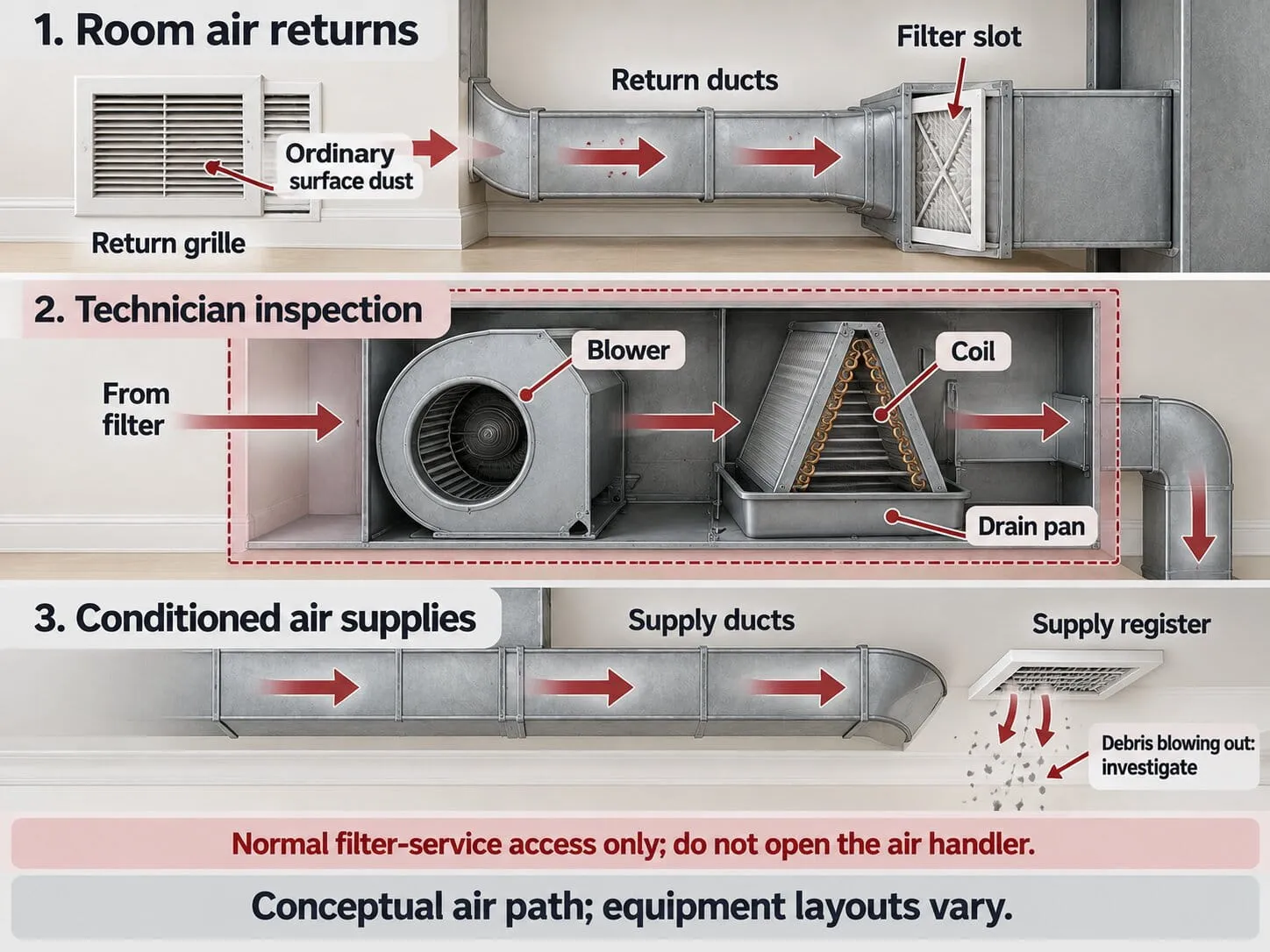
You can observe an accessible grille and normal filter-access area. The blower, coil, drain pan, and equipment cabinet belong to a technician’s inspection. Don’t open the air handler to follow the diagram.
When do air ducts actually need cleaning?
EPA identifies three reasons to consider cleaning: substantial visible mold growth inside hard-surface ducts or other system components; vermin infestation; and excessive dust or debris clogging ducts or releasing particles through supply registers.
NIH also identifies water damage, microbial growth, airflow-restricting debris, dust discharge, and odors originating in ductwork. NADCA’s 2021 standard includes construction contamination and deteriorated fiberglass liner. NADCA’s industry standard describes cleaning practice, not independent proof of allergy relief.
Choose whom to call:
- Ordinary dusty return grille only: arrange surface cleaning with the exposure precautions above.
- Debris visibly blowing into the room: photograph it and request an HVAC inspection for its source and extent.
- Water stains or a system-linked odor: request a moisture and equipment inspection before considering cleaning.
- Possible mold or pest material: leave it undisturbed and arrange the appropriate professional assessment.
For a closer look, remove only an easily accessible register cover and photograph the visible interior. Don’t reach into the duct. Check the usual filter slot only through its normal service access, and look for exterior water staining near the air handler. Stop if access requires opening the equipment cabinet, entering an attic or crawl space, or disturbing suspect insulation or register boots. Suspected asbestos requires a specially trained contractor.
Possible mold changes the job
A substance may look like mold without being mold. Confirmation requires an expert and sometimes laboratory analysis.
Do not run an HVAC system suspected of mold contamination. It can spread mold through the building. Have a qualified professional investigate the moisture source and arrange appropriate remediation.
Wet or moldy fiberglass insulation or duct board cannot be effectively cleaned and should be removed and replaced. Cleaning without correcting the moisture source allows growth to recur.
Pest contamination needs pest control first
An active infestation belongs with a pest control professional. Entry points and the infestation must be addressed before duct work, or the contamination can return. Leave droppings and nesting material alone; this is not a homeowner shop-vac task.
Can duct cleaning make allergies worse?
Cleaning deliberately dislodges settled material. The collection equipment must capture it. EPA identifies inadequate vacuum collection as a way cleaning can release more contaminants than leaving the ducts alone. Careless work can also damage the system and increase repair or operating costs.
Ask how the crew will contain dust, where the vacuum exhausts, and how occupied rooms will be protected. Plan for sensitive occupants to be elsewhere during cleaning. Ask about a fresh filter afterward and NIH’s recommendation for filter material over grilles when the system restarts; the contractor should arrange that protection. NIH describes containment barriers and high-efficiency filtered collection equipment as occupant-protection measures.
If symptoms worsen after cleaning, leave the affected area and seek medical advice. Ask the contractor to investigate dust escape, chemical use and the system’s condition before running it again; don’t deliberately restart it to reproduce symptoms.
Reject methods that introduce moisture into ductwork.
Which allergy-focused upsells should you reject?
Reject equipment that intentionally produces ozone. EPA also warns that ionizers, electrostatic precipitators, inadequately coated UV lamps and plasma units may emit ozone. EPA describes ozone as a highly reactive gas regulated outdoors as a lung irritant, and advises avoiding devices designed to produce it.
| Sales claim | Your question | A credible answer must address |
|---|---|---|
| “You need sanitizer.” | What product, duct material, and label-authorized use? | Registration for that surface, the need, risks, and alternatives. |
| “Ozone will treat the air.” | Does the device intentionally produce ozone? | If yes, decline it under EPA’s guidance. |
| “We’ll seal over the contamination.” | Is there wet liner, active growth, or remaining debris? | None should be covered with sealant. |
| “This petri dish proves mold.” | How does that establish a source in my system? | Settling-plate growth doesn’t establish duct contamination. |
EPA says research has not demonstrated duct biocides’ effectiveness or resolved potential adverse health effects. A small number are registered for use inside bare sheet-metal ducts. None are registered for internally insulated systems, fiberglass duct board, or fiberglass-lined ducts.
A biocide sprayed into an operating system can travel into other rooms, and some people may react to it. Sealants also have unresolved safety and effectiveness questions. They can affect fire-retarding or acoustic properties and warranties; they must never cover wet liner, active mold, or debris.
Some microorganisms in indoor air and growth on a settling plate are normal. EPA calls that demonstration inappropriate as proof. It also does not certify, endorse, or approve duct-cleaning companies. Sweeping health promises, claimed EPA certification, and routine annual cleaning pitches are reasons to seek another provider.
What can you do instead to control indoor allergens?
Start with the identified source. Filtration supplements source control and ventilation with clean outdoor air; it doesn’t replace them. EPA’s air-cleaner guide recommends at least MERV 13, or as high as your system will accommodate. MERV is a filter efficiency rating.
EPA says most furnaces and HVAC systems can accommodate MERV 13 if the filter is replaced frequently. An overly restrictive filter can reduce airflow in some systems. Ask your HVAC contractor what the equipment supports and whether air bypasses the filter holder.
| Intervention | What it addresses | Practical limit |
|---|---|---|
| Compatible higher-efficiency HVAC filter | Airborne particles passing through the system | Doesn’t remove the source; airflow compatibility matters. |
| Portable HEPA air cleaner | Airborne particles in the room | Studies don’t always show major symptom improvements. |
| Humidity control | Conditions favoring mold and dust mites | Doesn’t repair a leak or remove existing contamination. |
| Allergen-barrier bedding encasements | Contact with dust mites in bedding | Doesn’t address pets, pests, or other triggers. |
| Source removal and moisture repair | The place contamination originates | Requires finding the actual source first. |
| Duct cleaning | Documented contamination inside the system | Allergy relief remains unproven. |
EPA reports that multiple portable HEPA studies found improvement in one or more allergy or asthma symptoms, although improvements weren’t always major.
For mold control, EPA recommends indoor relative humidity ideally between 30% and 50%. AAFA also recommends reducing humidity to control dust mites, without specifying that numerical range. Fix leaks and dry wet materials promptly. AAFA recommends allergen-barrier covers for pillows, mattresses, and box springs, and weekly bedding washing at 130°F or hotter.
Keep pets out of sleeping areas, consider reducing wall-to-wall carpet, and have someone without allergies vacuum regularly, ideally with a HEPA vacuum. Anyone with allergies or asthma should stay out of the room because vacuuming can raise airborne dust. Choose these measures around the trigger identified with your physician; none is a cure.
How do you prevent duct contamination?
EPA recommends cleaning only as needed, rather than automatically every three to five years. Use the highest-efficiency filter the manufacturer recommends, change it on schedule or sooner if clogged, and check its fit.
At routine HVAC service, ask about moisture, coil and pan condition, drainage and insulation. Cleaning coils, fans and heat exchangers may improve efficiency; evidence for ducts alone is limited. Don’t accept promised utility savings.
Before renovation, arrange to seal registers and keep the system off until construction dust is removed. Follow humidifier maintenance directions. NADCA’s one-year air-handler and two-year duct intervals are inspection schedules, not mandatory cleaning schedules.
What does duct cleaning cost?
There is no reliable current federal or academic dataset establishing a national residential price. EPA’s $450–$1,000 per heating and cooling system comes from its October 1997 publication. It is not current.
Compare written scopes for your system instead. Access, contamination, services included, system size, and climatic region affect the job. A cheap advertised visit that expands sharply after arrival deserves scrutiny. A Washington attorney general enforcement action documented that pattern; it wasn’t a national pricing survey. Seek a second opinion when the price or treatment changes.
If cleaning is justified, what should the quote include?
Tell the inspector about symptoms and their timing, filter changes, water damage, recent renovation, and system-linked odors. Bring your photographs. Ask them to identify the specific condition, its cause, and the components affected.
Talk to at least three providers and obtain written estimates, as EPA recommends. Get a written scope covering supply and return ducts, registers, coils, drain pan, blower and housing, and air handler housing. Ask how the crew will dislodge and collect debris, whether the vacuum exhausts outdoors or uses HEPA filtration indoors, and how fiberglass surfaces will be protected. EPA calls for soft-bristled brushes on fiberglass.
The pre-work inspection should consider asbestos-containing materials without disturbing them. Ask what happens if the crew discovers wet insulation, suspected mold, or a need for replacement; don’t make that decision under same-day pressure.
Require before-and-after documentation and visual checks at multiple supply and return locations. Ask the technician to show that a flashlight shines through the clean coil, with undamaged fins, a clean draining pan, and clean blower blades. Access doors should be properly fastened, not held with duct tape alone.
Without a qualifying system condition, skip cleaning and put your effort into the allergen controls that fit your identified trigger.
Frequently asked questions
Can dirty ducts cause allergies?
EPA reports no evidence that a light amount of household dust in ducts poses a health risk. Moisture, possible mold or pests require investigation, but a dusty duct does not identify what you are allergic to.
Why do some people say they felt better after cleaning?
A personal report doesn’t establish what caused the change or predict another household’s result. The research doesn’t support treating that report as proof that routine duct cleaning relieves allergies. Other changes around the same time can make the cause hard to separate. Discuss persistent symptoms with your allergist rather than assuming another cleaning is the answer.
Are black specks around a supply register mold?
Color alone doesn’t identify the substance. It may look like mold, but an expert must confirm that, sometimes with laboratory analysis. Photograph it without disturbing it and arrange an assessment.
Correction
September 28, 2026: Corrected vacuuming precautions, the study-count and humidity attributions, and EPA’s visible-mold criterion. Added the author’s duct-cleaning business disclosure.
Sources
- EPA — Should You Have the Air Ducts in Your Home Cleaned?
- NIH DOHS — Fact Sheet on HVAC Duct Cleaning
- University of Georgia Extension — HVAC filters, duct cleaning, and indoor air quality
- EPA — Asthma Triggers: Gain Control
- EPA — A Brief Guide to Mold, Moisture and Your Home
- NADCA — ACR, The NADCA Standard, 2021 Edition
- EPA — Guide to Air Cleaners in the Home
- AAFA — Control Indoor Allergens to Improve Indoor Air Quality
- Washington State Attorney General — Lawsuit over unlawful robocalls and deceptive marketing